Español
 Português (Brasil)
 Français
 Deutsch
 Italiano
 Nederlands
 Polski
 Svenska
 Türkçe
 Русский
 日本語
日本語 한국어
한국어 简体中文
简体中文 Tiếng Việt
 Bahasa Indonesia
 繁體中文
繁體中文 Čeština
 Dansk
Dansk Suomi
Suomi Ελληνικά
 Română
 Magyar
 Українська
 ไทย
ไทย हिन्दी
 العربية
 עברית
עבריתTeads Review 2026: The Merged Outbrain+Teads Platform for Advertisers
The Outbrain–Teads merger produced one omnichannel platform under the Teads name. What advertisers actually get, how it compares with the feed networks, and who should buy it.

Teads in 2026 is not the Teads you may remember. The February 2025 completion of the Outbrain–Teads merger produced a single company, operating under the Teads name, that combines Teads' premium in-article video and display with Outbrain's recommendation-feed supply. The result is an omnichannel open-web platform strongest for brand and consideration advertisers who want viewable, premium-context placements at scale. Performance buyers used to squeezing CPA on Taboola or MGID will find it less forgiving — higher effective costs and more managed-service gravity — but the merged feed side keeps a genuine performance path open inside the same platform.
What Teads is now#
Two companies became one: Outbrain, the recommendation-feed network, acquired Teads, the premium outstream-video specialist, and the combined business adopted the Teads brand. The full history and what happened to each product line is in Did Outbrain become Teads? — the short version is that both supply types survived and now sit under one roof.
That roof covers four format families:
- In-article video — the original Teads product: an outstream player that appears inside editorial content, plays in view, and collapses when done. No pre-roll inventory dependency, no user-generated context.
- Recommendation feeds — the placements Outbrain built its business on: image-plus-headline cards in and around article content, priced per click.
- Premium display — high-impact banner and rich-media formats on the same publisher relationships.
- CTV — connected-TV extensions of the video business.
The pitch is one platform, one publisher footprint, brand budgets and performance budgets in the same account. For the fuller platform overview, see what Teads is.
What advertisers actually get#
Three things distinguish the platform in practice. First, direct premium publisher relationships: Teads built its business on exclusive or semi-exclusive access to large news brands, which is why its in-article placements feel editorial rather than widget-like. Second, a measurement culture built around viewability and attention — Teads sells the idea that a viewable, in-context impression is worth more than a cheap one, and its buying options (viewable CPM, completion-based pricing) are structured accordingly. Third, buying flexibility: managed insertion orders with an account team, self-serve dashboards, or programmatic deals through your own DSP.
What you give up relative to the widget networks is granular self-serve control. The platform's center of gravity is managed and premium; if your workflow is placement-level bid surgery across ten thousand widgets, the feed side supports some of it, but that is not what the company optimizes for.
Who advertises on Teads: what our index shows#
OpenAdLibrary's feed-first capture holds a small, honest Teads sample — 113 live feed-format creatives (July 2026); the core in-article video product under-represents in a recommendation-feed index, so read this as a window rather than a census. The window is still informative: travel is the top vertical, with Flight Centre running motorhome tours and holiday packages; Georgetown University promotes graduate programs; Moon Valley Nursery sells same-day landscaping; Sisal's FunClub gaming creatives ran for 26 days. These are consideration campaigns from real brands — a different species from the payout-math creatives that dominate mid-tier feed networks.
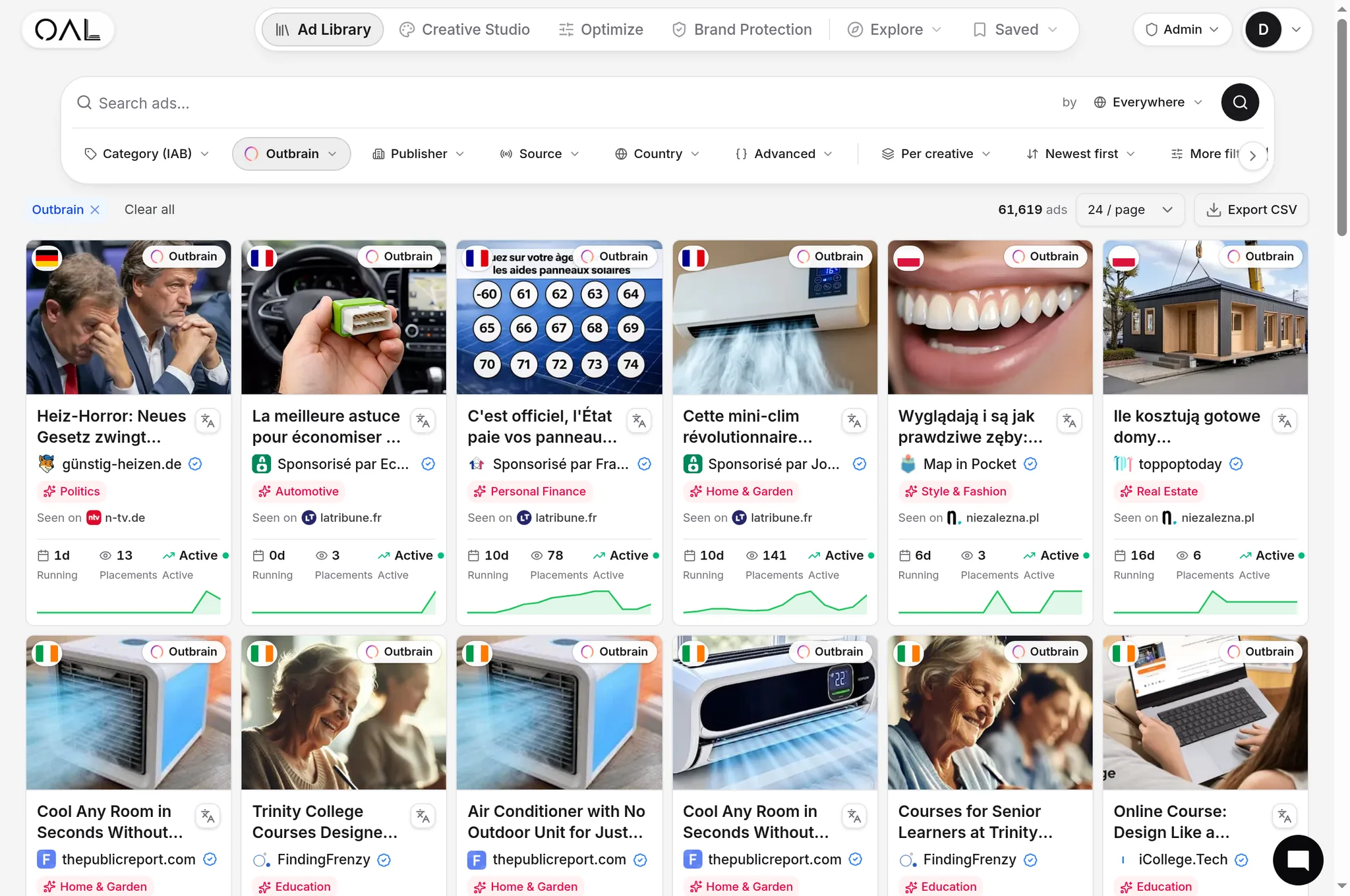
The merged company's Outbrain side is the volume story. Our Outbrain ad library tracks 108,573 live creatives (July 2026), with classified demand led by:
| Vertical | Live Outbrain creatives |
|---|---|
| Insurance | 4,345 |
| Finance | 3,990 |
| Health | 3,102 |
| Ecommerce | 2,277 |
| Software | 1,932 |
| Home & garden | 1,545 |
Put the two samples together and you see the merged platform's real shape: a brand-video business and a direct-response feed business sharing infrastructure. Both are genuinely active; which one you experience depends on which door you walk through.
Strengths#
- Premium context at scale. In-article placements on major news publishers are the closest the open web gets to walled-garden-quality context, and Teads owns more of that supply than anyone.
- True omnichannel consolidation. Video, feed, display and CTV in one buy, one publisher footprint, one reporting view — genuinely useful for teams tired of stitching channels.
- Attention-first measurement. Viewability and completion guarantees mean you can pay for delivered attention rather than raw impressions.
- Two demand engines. Brand teams and performance teams can share an account without sharing a strategy — the feed side runs CPC payout math while video runs CPM lift studies.
Weaknesses#
- Cost of entry. Unit costs and practical minimums sit well above mid-tier feed networks; native cost budgeting looks different here. Small performance budgets will feel the ceiling immediately.
- Managed-service gravity. The best inventory and packaging skew toward insertion orders and account teams. Self-serve exists but is not where the platform shines.
- Post-merger churn. Two product stacks are still converging — dashboards, product names and packaging keep evolving. Verify the current lineup at teads.com before planning around a feature.
- Harder pure-CPA math. On the feed side you compete head-on with Taboola's auction density; on the video side, last-click math will always look worse than a click network's. Buyers who judge everything by immediate ROAS should read Taboola vs Outbrain first and think hard about which product they actually need.
Teads vs the alternatives#
| Platform | Core product | Pricing | Best for |
|---|---|---|---|
| Teads | Premium in-article video + feed | CPM (video), CPC (feed) | Brand and consideration campaigns with creative assets |
| Taboola | Largest recommendation feed | CPC | Performance buyers who need maximum feed reach |
| MGID | Mid-tier feed network | CPC | Direct-response testing with lower entry costs |
The honest comparison: nobody buys Teads and MGID for the same reason. If your decision is between feed networks, MGID vs Taboola covers that trade-off. Teads enters the conversation when premium context, video creative and brand outcomes are on the brief.
Verdict: who should buy Teads#
Buy Teads if you are a brand or consideration advertiser with real video or high-impact creative, budgets that can fund readable flights, and success metrics beyond last-click — or a performance team that wants Outbrain's feed supply with the option to layer premium formats later. It is the strongest premium open-web platform a native advertiser can currently buy.
Look elsewhere if you are running lean CPA arbitrage: the platform's economics are built around attention, not cheap clicks, and mid-tier feed networks will teach you more per dollar. Before either decision, spend fifteen minutes with the live evidence — browse what runs today in the Teads spy tool and the Outbrain spy tool, and check which advertisers have persisted for weeks; ad longevity remains the most honest public signal of what is actually working on any network.