Español
 Português (Brasil)
 Français
 Deutsch
 Italiano
 Nederlands
 Polski
 Svenska
 Türkçe
 Русский
 日本語
日本語 한국어
한국어 简体中文
简体中文 Tiếng Việt
 Bahasa Indonesia
 繁體中文
繁體中文 Čeština
 Dansk
Dansk Norsk (bokmål)
 Suomi
Suomi Ελληνικά
 Română
 Magyar
 Українська
 ไทย
ไทย हिन्दी
 العربية
 עברית
עבריתTaboola for Publishers: Requirements, RPM Reality & Is It Worth It
What it really takes to run Taboola as a publisher: the acceptance bar, the RPM drivers nobody quotes, the exclusivity trade-offs, and how to inspect the actual ads before you sign.


Taboola pays publishers a revenue share for running its content-recommendation feed — the grid of sponsored stories below and inside your articles. Advertisers bid per click; you earn a negotiated share of that click revenue, usually discussed as RPM (revenue per thousand pageviews). Getting a direct deal takes scale: Taboola publishes no official threshold, but publishers commonly report needing several hundred thousand monthly pageviews — figures around half a million come up most often — before direct conversations go anywhere, and the standard contract is multi-year and exclusive. Whether it's worth it comes down to three things: how much Tier-1 traffic you have, how the feed's look sits with your audience and brand, and the terms you can negotiate before signing.
How the Taboola publisher model works#
Taboola's core product is a feed unit rendered at the end of (and sometimes within) your article pages. The feed mixes two kinds of items: sponsored ads from advertisers bidding in Taboola's real-time auction, and organic recirculation — links back to your own content, which is part of the engagement pitch. When a reader clicks a sponsored item, the advertiser pays their bid and you receive a contracted share.
That mechanic drives everything about the economics:
- You're paid on clicks, not impressions. A million pageviews of readers who never touch the feed earn little. Native feeds monetize engaged, scroll-to-the-end audiences.
- Demand is auction-based. What advertisers will pay for your readers depends on who those readers are — geo, device, age profile — and which advertisers want them that month.
- Large publishers negotiate guarantees. For sizable, exclusive deals, publishers commonly report negotiated minimums or guaranteed rates. If you have real scale, everything is negotiable; if you don't, you take the standard terms.
The organic-recirculation half of the feed deserves more attention than it gets in negotiations. Those self-referral slots drive real pageviews back into your own content — which you then monetize again with display and the feed itself — and the split between sponsored and organic items is a configurable part of many deals. A feed tilted heavily toward sponsored items maximizes short-term RPM and reader fatigue simultaneously; publishers who treat the mix as a tunable dial rather than a fixed setting tend to keep both numbers healthier.
The advertiser-side view of this machine is covered in how Taboola ads work — worth reading even as a publisher, because understanding what buyers optimize for tells you why some audiences earn multiples of others.
Requirements: what it takes to get accepted#
Taboola's stated requirements are deliberately vague, but the pattern from publishers who've been through the process is consistent:
- Traffic scale. The commonly reported bar for a direct deal sits around 500,000 monthly pageviews, sometimes higher for competitive geos. This is not an official number — treat it as what the market reports, not a published policy.
- Editorial, article-style content. The feed lives at the bottom of articles. News, lifestyle, sports, finance and entertainment sites fit; tools, forums, and thin utility pages don't.
- Content quality and provenance. Scraped, spun, pirated or low-effort content gets declined — the demand side pays for engaged readers, and Taboola protects that.
- Brand-safe environment. Adult content, piracy, and adjacent gray areas are out.
- Audience quality. Traffic from Tier-1 geos, arriving through search and direct rather than bought clicks, is what the auction pays for. A site built on purchased traffic will either be declined or earn very little — the traffic-arbitrage publishers who make native feeds work do it with carefully bought traffic that genuinely engages.
If you're under the bar, you have two honest options: smaller networks with lower entry requirements — MGID and Revcontent are the usual first stops, compared in our native ad network rankings — or resellers and sub-network arrangements, which carry worse terms and deserve extra diligence.
On exclusivity: the standard Taboola contract locks the recommendation-widget category to Taboola for a multi-year term, commonly with auto-renewal clauses. Publishers switching between Taboola and Outbrain at contract end is a well-worn industry ritual — which tells you the leverage moment is before signing. Solicit a competing bid even if you're happy; the delta between a first offer and a contested offer is real money.
Negotiating the deal: what's actually on the table#
Publishers who treat the first offer as the deal leave money on the table for years, because the term is long and everything compounds. The negotiable list, roughly in order of leverage required:
- Revenue floor or guarantee. The single most valuable clause for a publisher with scale — it converts a projection into a commitment. If the recruiter's RPM pitch is real, they can put a floor under part of it.
- Term length and renewal. Push the initial term down and strike or soften auto-renewal; a shorter first term keeps the re-bid leverage alive. Diarize the renewal notice window the day you sign — missing it is how publishers get rolled into another term by default.
- Category-block rights in writing. You will want to block sensitive categories; make sure the contract acknowledges the right rather than leaving it to dashboard goodwill.
- Placement scope. Which templates, positions and page types carry the feed should be your call. A contract that lets the network dictate density trades your page experience for their revenue.
- Reporting granularity. Per-page, per-geo, per-device revenue reporting is the difference between managing the partnership and merely hosting it.
- A competing bid. The cheapest negotiating chip available: get Outbrain/Teads (or another network) to price the same inventory before you sign anything. The delta between contested and uncontested offers is consistently reported as material.
What RPM actually depends on#
Nobody can quote you "the Taboola RPM" because there isn't one — the honest answer is a list of multipliers:
| Driver | Why it moves RPM |
|---|---|
| Audience geo | Tier-1 clicks clear at multiples of Tier-2/3; a US-heavy site out-earns a mixed-geo site at identical traffic |
| Audience age & habits | Older, desktop-heavy news audiences click recommendation feeds far more than young mobile audiences — a pattern visible across the whole industry |
| Placement position | Below-article feeds seen by scroll-completers earn on engagement; poorly placed units just add clutter |
| Device mix | Desktop and mobile monetize differently by vertical and season |
| Demand alignment | If insurance and finance advertisers want your audience, rates rise; niche audiences without matching demand earn less |
| Seasonality | Q4 demand pushes rates up; Q1 sags — budget accordingly |
Publishers commonly report native-feed RPMs anywhere from well under a dollar to a few dollars on engaged Tier-1 traffic — a deliberately wide range, because the drivers above genuinely spread results that far. Treat any recruiter promising a specific RPM sight-unseen with suspicion, and if you have the traffic to negotiate, push for a guaranteed floor in the contract rather than a verbal projection.
What ads will actually run on your site#
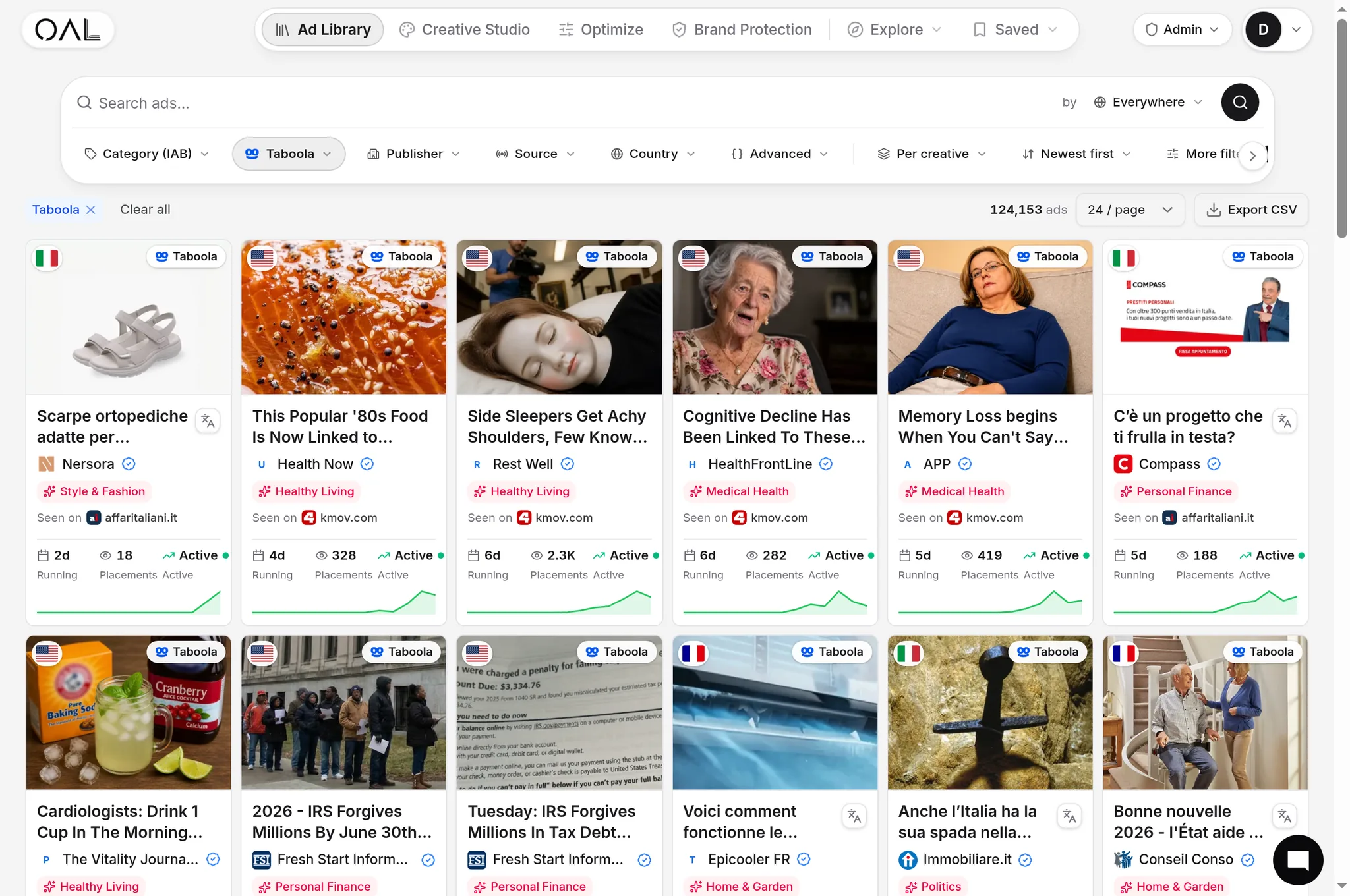
This is the question publishers skip and then regret. The feed is not an abstraction — it's specific ads from specific advertisers, and you can inspect the inventory before signing anything.
OpenAdLibrary's index holds 206,000+ live Taboola creatives as of June 2026. The classified vertical mix tells you what the demand side looks like: health leads with 11,982 live classified creatives, followed by finance (8,200), insurance (7,422), ecommerce (5,185), home & garden (4,414) and software (3,665). In practice that means hearing aids, retirement planning, insurance quote funnels, gadget offers and home-improvement leads — alongside genuine brand campaigns from real-estate portals, banks and consumer brands.
Quality within that mix varies from polished brand work to aggressive advertorials, which is exactly why you should look at the actual creatives running in your geo before you sign: browse the Taboola ad library or the /spy/taboola tool page and filter to your audience's country. Ten minutes of scrolling tells you more about what your readers will see than any sales deck. For the advertiser-level view — who the biggest spenders are and what verticals they cluster in — see who advertises on Taboola. And if you're evaluating a site that already runs native units, this walkthrough shows how to identify the buyers behind any page's ads.
You do get controls: category-level blocks (most publishers immediately block a handful of sensitive categories), advertiser-level blocks, and brand-safety review escalation for specific creatives. What you don't get is per-ad pre-approval — the feed is programmatic, and moderation is reactive. Budget editorial attention for the first weeks: your readers will tell you quickly which ads cross their line.
The trade-offs nobody puts in the pitch deck#
- Reader trust. The recommendation feed has a reputation problem — the "chumbox" label exists for a reason. The bottom slots of a feed can carry aggressive advertorials, and some slice of readers will judge your site by them. This cost is real, hard to measure, and permanent while the widget is live.
- Page experience. The widget itself carries no search-ranking penalty, but implementation can: late-loading feeds cause layout shift, and stacking the feed on top of heavy display ads hurts Core Web Vitals. Reserve the container space in your layout and measure before/after.
- Support burden. Reader complaints about specific ads become your inbox's problem. Have a process: capture the creative, block the advertiser or category, escalate to your account manager.
- Exclusivity opportunity cost. A multi-year exclusive means you can't test the competition. Whatever you sign, you live with through the term — hence the pre-signing bake-off.
- Transparency hygiene. Verify your ads.txt entries are exactly what your contract specifies, and check how your inventory is represented in sellers.json. Misdeclared inventory is a recurring source of publisher-side revenue leakage across the industry.
- The arbitrage temptation. Once the feed is live, buying traffic to feed it looks like free margin. It rarely is: bought traffic engages worse, drags your effective rates down, and misrepresenting traffic sources violates audience-quality clauses in standard contracts — a termination offense, not a slap on the wrist. The publishers who make paid-traffic-plus-native-feed math work are running a specialized business, not a side experiment.
Getting paid and reading the reports#
Payment runs on the net terms in your contract — confirm the cycle and any minimum-payout threshold before signing rather than discovering them in month two. Once live, three reporting habits separate publishers who grow feed revenue from those who watch it decay:
- Track RPM by page type, geo and device, not just the account-level number. A sagging aggregate usually decomposes into one template or traffic source diluting the mix.
- Watch widget viewability, not just pageviews. A feed that loads below where readers actually stop scrolling monetizes nothing; placement moves the needle more than most contract terms.
- Reconcile monthly. Compare your analytics pageviews against the network's reported widget loads; persistent discrepancies are worth a conversation with your account manager, and they're much easier to raise early.
Budget seasonally: Q4 flatters everything, Q1 humbles it, and a contract negotiated on Q4 numbers alone will disappoint by February.
Taboola vs the alternatives for publishers#
Live creative volume in an independent index is a useful proxy for advertiser demand — more live ads means more bidders competing for your impressions. Here's how the main feed providers compare in the OpenAdLibrary index (June 2026):
| Network | Live creatives in index | Publisher-side reality |
|---|---|---|
| Taboola | 206,145 | Largest demand pool; highest entry bar; standard deals exclusive |
| Outbrain (Teads) | 108,573 | Premium-skewing demand; comparable entry bar; the natural competing bid |
| MGID | 62,765 | Accepts much smaller publishers; more aggressive creative mix |
| Revcontent | 15,789 | Mid-tier option; flexible terms; smaller demand pool |
| MediaGo | 6,571 | Smaller but growing demand; worth watching, rarely a primary |
Two notes on reading that table. First, demand pool matters most for Tier-1 audiences — the big networks' advantage compresses for Tier-2/3 traffic, where the smaller networks compete harder. Second, Outbrain's merger into Teads changed its demand profile; the advertiser-side comparison in Taboola vs Outbrain covers what that means in practice.
Is it worth it? A decision checklist#
Run your site against this list before starting the conversation:
- Audience: majority Tier-1 traffic, article-page format, readers who scroll to the end. If your traffic is young, mobile-only and bounce-heavy, native feeds will disappoint.
- Scale: at or above the commonly reported direct-deal bar. Below it, price the reseller discount honestly or start with a smaller network.
- Brand tolerance: you've looked at the live creatives for your geo and can accept your readers seeing them, with the sensitive categories you'd block already listed.
- Negotiating position: you've solicited at least one competing bid (Outbrain/Teads is the obvious one) and pushed for a revenue floor and a shorter initial term.
- Implementation plan: reserved layout space, Core Web Vitals measured before and after, a complaint-handling process.
If all five boxes tick, the feed is usually meaningful incremental revenue for the traffic profile it suits — engaged, Tier-1, editorial. If the first two don't tick, spend your energy growing traffic first; the native-feed conversation improves dramatically with scale.