Español
 Português (Brasil)
 Français
 Deutsch
 Italiano
 Nederlands
 Polski
 Svenska
 Türkçe
 Русский
 日本語
日本語 한국어
한국어 简体中文
简体中文 Tiếng Việt
 Bahasa Indonesia
 繁體中文
繁體中文 Čeština
 Dansk
Dansk Norsk (bokmål)
 Suomi
Suomi Ελληνικά
 Română
 Magyar
 Українська
 ไทย
ไทย हिन्दी
 العربية
 עברית
עבריתMediaGo Review 2026: Baidu's Deep-Learning Native DSP, Tested
Baidu's MediaGo hands your budget to a deep-learning bidder on premium portal feeds. We reviewed it against 6,571 live MediaGo creatives: who runs there, what it costs, and who should skip it.


MediaGo is the native-advertising DSP built by Baidu's international arm, and its pitch is simple: hand a deep-learning bidding engine your budget, creatives and conversion signal, and let it find converting users across premium portal feeds — most visibly Microsoft's MSN — instead of managing placements by hand. Judged against the 6,571 live MediaGo creatives in OpenAdLibrary's index (July 2026), that pitch attracts a specific crowd: insurance and home-services lead generation, ecommerce, browser gaming and comparison-content arbitrage. It is a good fit for performance advertisers with solid conversion tracking who are comfortable ceding placement control to an algorithm, and a poor fit for buyers whose edge lives inside publisher whitelists.
What MediaGo is and how it works#
MediaGo launched in 2020 as Baidu's international demand platform for native advertising, and machine-learned prediction is the whole product. Instead of you bidding placement by placement, the platform predicts click and conversion probability per impression and prices your CPC bid into each auction accordingly — the same philosophy as smart bidding on the large ad platforms, applied to native feeds. You buy on cost-per-click, feed conversions back via pixel or postback, and the model optimizes toward the event you care about. The company's own materials at mediago.io describe the current campaign options; access routes (self-serve versus managed onboarding) have shifted over time, so verify before you plan a launch.
On the supply side, MediaGo's footprint concentrates on premium portal feeds. It has been one of the demand paths into Microsoft's MSN ecosystem — the feed environment we map in the MSN native ads guide — alongside other portal and app inventory. That context matters: your MediaGo ads render as standard news-feed cards next to mainstream editorial content, in front of portal audiences that skew older and mainstream rather than niche. Because that inventory is resold through multiple demand partners, working out who sold which impression from the outside is genuinely confusing; our glossary entry on resold inventory and demand partners explains the plumbing.
Scale check: MediaGo next to the rest of the field#
Inside OpenAdLibrary's index of 725,000+ live native creatives across 49 networks (July 2026):
| Network | Live creatives in the index |
|---|---|
| Taboola | 206,000+ |
| Outbrain | 108,000+ |
| MGID | 62,700+ |
| Revcontent | 15,700+ |
| MediaGo | 6,571 |
Read that number carefully. MediaGo's own creative count is small next to the feed giants, but the environments it buys into are enormous — our Microsoft Audience Network corpus alone holds 281,000+ live creatives, supplied by multiple demand sources of which MediaGo is one. The practical takeaway: MediaGo is not a reach play in itself; it is an optimization layer over premium feed supply, with far fewer direct competitors per niche than you will meet on Taboola.
Who advertises on MediaGo#
The classified vertical mix of live MediaGo creatives in our index (July 2026):
| Vertical | Live creatives |
|---|---|
| Insurance | 378 |
| Home & garden | 301 |
| Ecommerce | 265 |
| Auto | 257 |
| Gaming | 218 |
| Health | 155 |
Unlike Revcontent's health monoculture, MediaGo's demand is spread across lead-gen and commerce categories — consistent with a platform whose model rewards clean, machine-readable conversion events. The live examples back this up. Browser-game advertisers run persistently: Rise of Kingdoms' "Play for free in your browser – no download needed!" had been live 29 days at last observation, and Play4Free's "A Real MMO for Grown-Up Gamers" had run 17. Comparison-content advertisers like Loop of Now push large batches of near-identical cost-comparison headlines ("House Cleaning Rates in New Zealand", "Term Deposit Rates for Seniors") — a search-feed arbitrage pattern that only survives when the algorithm keeps unit economics positive. Health direct response appears too, with SmoothSpine's sciatica creative at 21 days. The common thread: advertisers with unambiguous conversion events, letting the model do the placement work.
Strengths: what MediaGo does well#
- The algorithm does real work. With a clean conversion signal and enough volume, buyers commonly report the model surfacing pockets of converting inventory they would never have whitelisted manually. This is the entire value proposition, and with good signal it compounds.
- Premium-feeling feed context. Portal feeds put your card beside news content in front of mainstream audiences — a different neighborhood from bottom-of-article widget clutter.
- Less crowded auctions. Far fewer direct competitors per niche than the major feed networks, which shows up as cheaper learning and slower creative fatigue.
- CPC pricing with conversion optimization. You pay for clicks while the model optimizes toward your postback events, which keeps spend accountable while it learns.
Weaknesses: what to watch#
- Black-box placements. Publisher-level transparency and manual control are limited compared with self-serve widget networks. If placement surgery is your edge, this platform removes your scalpel.
- Signal-hungry. Thin conversion volume starves the model. Accounts with low budgets or long, murky funnels commonly stall in learning and never reach efficient delivery.
- A smaller ecosystem. Fewer third-party guides, community benchmarks and agency specialists exist than for Taboola or Outbrain, so you will debug more alone.
- You inherit feed-quality debates. Some portal feeds carry heavy arbitrage neighborhoods. Look at the actual environment before committing anything brand-sensitive.
What MediaGo costs#
MediaGo is CPC-priced with no public rate card. Media buyers commonly report Tier-1 desktop native-feed CPCs in the same broad band as other mid-tier native platforms — roughly $0.10 to $0.60, with mobile and smaller geos cheaper and competitive insurance or finance targets higher. Those are practitioner-reported, non-official figures; your vertical, geo and creative quality will move them a lot. Budget for the model, not just the clicks: plan enough spend to generate a meaningful stream of conversions per week, or the optimizer has nothing to learn from. Our guides to native advertising costs and cross-network CPC benchmarks give the wider budgeting picture.
Scout the platform before you spend#
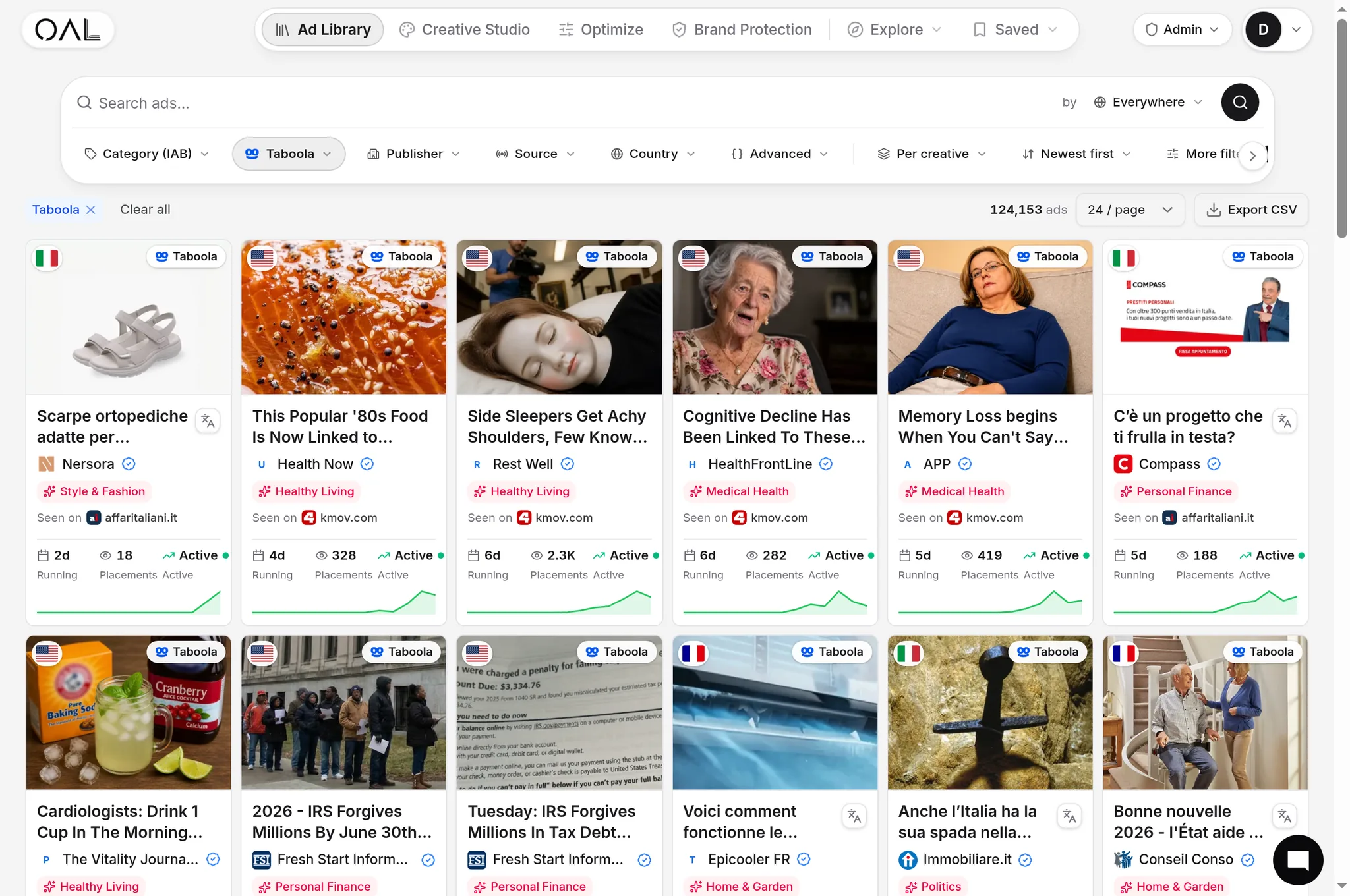
Because MediaGo publishes no ad library, the practical way to research it is an independent index. OpenAdLibrary tracks 6,571 live MediaGo creatives (July 2026): browse them in the MediaGo spy tool, sort by observed longevity to find advertisers who have paid for the same creative for weeks, and trace their landing pages to see the funnels behind the cards. The MediaGo ad library guide walks through that workflow, and how to find winning ads covers reading longevity and iteration signals across any network. Free tier available; full landing traces and watchlists are on the $29.99/month plan.
Verdict: who should run MediaGo#
Run MediaGo if you have a conversion-tracked funnel in a category that overlaps its proven demand — insurance, home services, ecommerce, gaming, health — and you are comfortable trading placement control for algorithmic optimization on premium portal feeds. It rewards advertisers who feed it clean signal and stable budgets.
Skip it if you need placement-level control, run thin test budgets that cannot generate conversion volume, or require guaranteed brand context. And whichever side you fall on, look at the live corpus first: fifteen minutes reading what has survived 20+ days on the platform tells you more than any pitch deck.