Español
 Português (Brasil)
 Français
 Deutsch
 Italiano
 Nederlands
 Polski
 Svenska
 Türkçe
 Русский
 日本語
日本語 한국어
한국어 简体中文
简体中文 Bahasa Indonesia
 繁體中文
繁體中文 Čeština
 Dansk
Dansk Norsk (bokmål)
 Suomi
Suomi Ελληνικά
 Română
 Magyar
 Українська
 ไทย
ไทย हिन्दी
 العربية
 עברית
עבריתRSOC & Search Arbitrage Explained (With Live Native Examples)
Search arbitrage is a spread trade on click prices: buy cheap native clicks, monetize them with search-feed ads. Here is how RSOC funnels actually work, with live examples captured from Yahoo and MediaGo.


RSOC — Related Search on Content — is a Google AdSense format that lets publishers place blocks of related search terms inside content pages; when a visitor clicks a term, they land on a search results page filled with paid ads, and the publisher earns a share of each ad click. Search arbitrage is the media-buying model built on top of it: buy a cheap click from native or social, route it through an RSOC-monetized page, and profit when the search-ad payout exceeds what you paid for the visitor. It is one of the largest and least-discussed demand sources on native networks, and its footprint is easy to spot once you know the creative shapes.
The search-arbitrage funnel, step by step#
The whole model is a spread trade on click prices. In sequence:
- A native ad with a keyword-shaped headline runs on Taboola, MGID, MediaGo or the Microsoft Audience Network — something like "House Cleaning Rates in New Zealand," which reads more like a search query than an ad.
- The click lands on a content page built around that keyword, carrying an RSOC block of related search terms ("house cleaning prices," "cleaning services near me," and so on).
- The visitor clicks a search term and arrives on a search results page dominated by paid listings.
- An advertiser's search ad gets clicked, and the feed pays the arbitrageur a share of that click's value.
The economics are simple algebra: revenue per visitor equals the share of visitors who complete both downstream clicks multiplied by the payout per search-ad click; the campaign profits when that number beats the native CPC. Because two clicks sit between spend and revenue, small changes in term relevance or page layout move margins a lot — which is why arbitrage advertisers test creative variants at volumes most brands never approach. The model is a specialized case of traffic arbitrage, and its older cousins are covered under ad arbitrage.
RSOC vs the older arbitrage formats#
Search arbitrage predates RSOC. The earlier vehicles were AFD (AdSense for Domains — monetized parked domains, now effectively dead) and bare AFS (AdSense for Search) keyword landers with no content at all. Google progressively tightened both, and RSOC is the current, stricter iteration: the related-search unit must live on an actual content page, and traffic sourcing has to comply with AdSense policy on arbitrage and misleading pre-click experiences. Access generally comes through Google-approved feed partners — companies like System1, Sedo and Tonic operate in this space — rather than a plain AdSense account, and partner requirements shift often enough that the current AdSense program policies are the only reliable reference. Microsoft and Yahoo operate equivalent search-feed monetization on the Bing/Yahoo side, which is why arbitrage inventory is so visible around the Microsoft and Yahoo ecosystems.
What search arbitrage looks like in the wild#
OpenAdLibrary captures native placements across 49 networks daily, and search-arbitrage creatives are among the easiest patterns to recognize in the corpus. Two live clusters from the index (June 2026):
The keyword-lander shape on MediaGo. A single advertiser, "Loop of Now," runs dozens of near-identical, geo-targeted, query-shaped headlines:
| Captured headline | Network | Observed running |
|---|---|---|
| "House Cleaning Rates in New Zealand: What You Should Know in 2026" | MediaGo | 22 days |
| "Term Deposit Rates for Seniors in New Zealand: What to Know" | MediaGo | 16 days |
| "Licence-Free Small Cars In New Zealand: Updated Overview" | MediaGo | recently captured |
Rates, costs, "what to know" — headlines engineered to attract a searcher's mindset, each feeding a keyword page. The index holds 6,571 MediaGo creatives; browsing them, this shape repeats constantly. (Background on the network: the MediaGo ad library.)
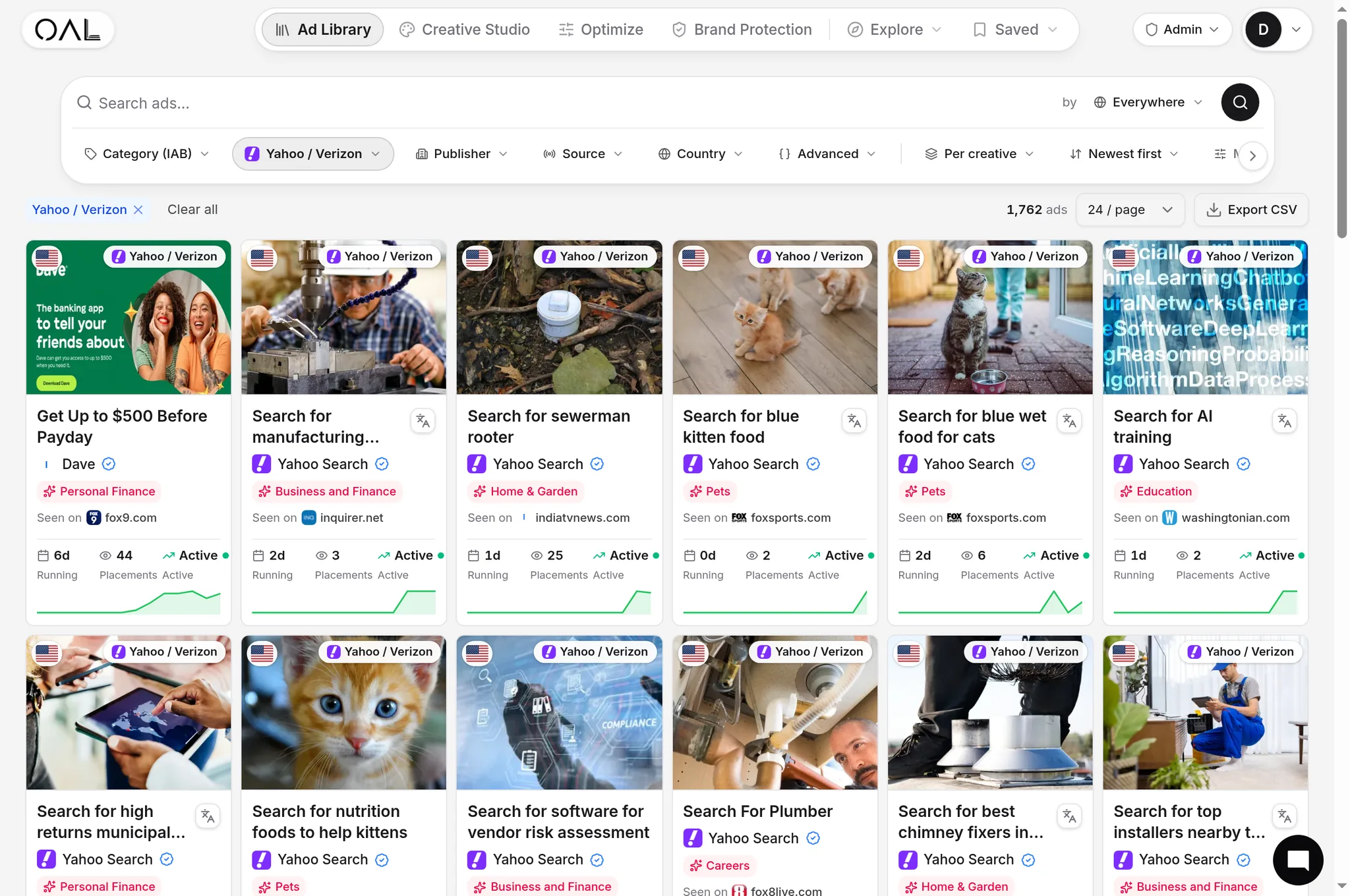
The literal search funnel on Yahoo. Among the 5,926 Yahoo-native creatives in the index are ads titled "Search For Superannuation," "Search for business insurance," and "Search for digital trading platforms" — branded as Yahoo Search, each routing the click to a monetized results page for that keyword. It is the native-to-search funnel run in its most undisguised form, and it shows how deeply search-feed demand is woven into how Yahoo's native stack works after the Gemini era ended (what happened to Yahoo Gemini covers that history).
The tells, condensed: headlines that read like queries; "rates," "cost," "options" and a geo in the title; one advertiser running dozens of thin variants; and traced landing pages that are keyword pages wrapped around a related-search block.
The pattern extends well beyond these two networks. The Microsoft Audience Network corpus — at 281,839 creatives the largest in our index — carries substantial volumes of the same query-shaped inventory around finance, insurance and home-services keywords, which makes sense given how directly MSN placements sit next to Bing's search monetization; the MSN native ads guide covers that ecosystem. Once you have the shape in your head, you will notice arbitrage demand on effectively every native network we track.
Why the economics work — and when they don't#
Arbitrage concentrates in categories where search clicks are expensive and native clicks are not: insurance, legal claims, home services, finance, senior products. Native CPCs are typically a fraction of search CPCs in these categories — that spread is the entire business. Our native CPC benchmarks give the native side of the equation.
Margins die three ways: policy enforcement (a feed partner or Google cutting a non-compliant source overnight), quality clawbacks (advertisers on the search side bidding down or excluding arbitrage traffic), and auction compression (too many arbitrageurs bidding up the same native keywords). The players who survive treat it as a portfolio: hundreds of keyword-geo pairs, each small, killed or scaled daily on observed spread. That portfolio structure is also why the geo distribution looks the way it does — the New Zealand cluster above is typical, because smaller English-speaking markets combine cheap native inventory with search feeds that still pay Tier-1-adjacent rates, and fewer competitors have bothered to test them.
How to research live RSOC funnels#
Ten minutes in an ad library beats a week of forum threads:
- Search query-shaped headlines — "rates," "cost," "prices," a geo name — in the Yahoo ad index and the MediaGo ad index, where the pattern is densest.
- Open the advertiser profile on any hit. Arbitrage advertisers are unmistakable: huge variant counts, thin brand identity, keyword-everything creative.
- Read the traced landing page. OpenAdLibrary follows the redirect chain to the destination, so you can see the keyword page and its related-search block without clicking a live ad.
- Check longevity and geo. A keyword-geo pair that has run for weeks is a profitable spread; longevity is the profitability proxy. The New Zealand cluster above is a reminder that the best spreads often hide in smaller geos.
- Reverse the funnel end to end — creative, lander, term block, destination — the same way you would reverse-engineer any competitor's native funnel.
Should you run search arbitrage?#
Honest answer: not as a first native business. Feed access runs through partners with real vetting, policy risk can zero an account in a day, and the margin per visitor is thin enough that operational tooling — automated pausing, spread tracking, variant generation at scale — is the actual moat. The buyers doing this well are running engineering operations, not campaigns; if you are choosing between learning search arbitrage and learning a conversion vertical, the vertical teaches transferable skills and the arbitrage mostly teaches you its own plumbing.
What every native buyer should take from RSOC is the research discipline: arbitrageurs are the most ruthlessly data-driven buyers on these networks, and the keywords, geos and page formats they keep funding for weeks are a free map of where click-price inefficiencies live. If an arbitrageur can profitably buy "house cleaning rates" clicks in New Zealand and resell them to search advertisers, a home-services brand can certainly buy those same clicks and keep the customer. Watch them in the index even if you never touch a feed.