Español
 Português (Brasil)
 Français
 Deutsch
 Italiano
 Nederlands
 Polski
 Svenska
 Türkçe
 Русский
 日本語
日本語 한국어
한국어 简体中文
简体中文 Tiếng Việt
 Bahasa Indonesia
 繁體中文
繁體中文 Čeština
 Dansk
Dansk Suomi
Suomi Ελληνικά
 Română
 Magyar
 Українська
 ไทย
ไทย हिन्दी
 العربية
 עברית
עבריתIs Microsoft Audience Network Worth It? An Honest 2026 Review
The Microsoft Audience Network holds the largest live native footprint we track — bigger than Taboola's. Who its older, wealthier audience actually converts for, and who should pass.


The Microsoft Audience Network is worth it for two kinds of advertisers: those already running Microsoft Advertising search campaigns who want cheaper incremental volume from the same account, and native/direct-response buyers targeting older, higher-income demographics — finance, insurance, health, home services — where the network's MSN, Outlook and Edge audience over-delivers. It is a weaker fit for youth-skewing DTC brands and for anyone unwilling to manage it as a separate channel from search. The evidence for both halves of that answer is in live capture data, so let's look at it properly.
What the Microsoft Audience Network actually is#
The Microsoft Audience Network (MAN) serves native, display and video ads across Microsoft's owned surfaces — the MSN feed, Outlook.com, Microsoft Edge new-tab pages, Bing surfaces — plus syndication partners. You buy it inside Microsoft Advertising, either as dedicated audience campaigns or as an extension of existing campaigns, with targeting drawn from Microsoft's search intent data and user profiles (including LinkedIn profile dimensions in supported markets — a targeting axis no other native channel offers). The feed placements are classic native ads: headline, image and brand label rendered to match editorial content. Our MSN native ads guide covers formats and buying mechanics in depth; the glossary entry on MSN native ads is the short version.
The scale nobody prices in#
Here is the fact most reviews miss: the Microsoft Audience Network is the single largest source of live native creatives in OpenAdLibrary's index — 281,839 live creatives as of June 2026, out of 725,000+ across 49 networks. That is more than Taboola (206,145) and roughly two and a half times Outbrain (108,573). The MSN feed alone is one of the highest-traffic content surfaces on the open web, default-installed in front of every Windows user who opens Edge or a new tab.
The classified vertical mix says as much about the audience as the volume does:
| Vertical | Live MAN creatives (June 2026) |
|---|---|
| Ecommerce | 9,978 |
| Finance | 9,029 |
| Travel | 8,830 |
| Insurance | 8,406 |
| Software | 7,909 |
| Education | 5,025 |
Compare that with the health-and-nutra-heavy mix on mid-tier native networks: MAN's demand is broader and noticeably brandier — travel, software and education barely register on most native networks and are top-six categories here. Global brands run it at scale too; the index captures McAfee, Amazon's international storefronts and major European retailers running localized MAN creatives across a dozen languages. This is not a niche arbitrage channel. For where MAN sits against the rest of the field, see our ranking of native ad networks by real ad volume.
Who wins on it — the longevity evidence#
Longevity is the most honest public performance signal in native: an ad that keeps running for weeks is almost certainly paying for itself. In the index's list of longest-running native ads, Microsoft Audience Network creatives dominate, and the pattern is unmistakable. Among the creatives at 38 days and counting as of June 2026:
- Fisher Investments — "When Should You Retire?" (retirement planning lead gen)
- Silver Penny — "Retirees Are Dropping These 12 Costs" (finance content funnel)
- Boots Hearingcare — hearing aid consultations (health lead gen)
- Fetchapro — senior homeowner bathroom-upgrade offers (home services lead gen)
- Expert Market — smartphone vehicle-tracking for fleets (B2B lead gen)
Retirement, hearing care, home improvement, B2B services: that is a portrait of the audience. The MSN/Outlook/Edge user base skews older, financially established and desktop-heavy — exactly the demographic that is expensive and elusive on Meta and TikTok. Advertisers whose economics work on 45+ homeowners, investors and decision-makers keep these campaigns running for weeks because the math holds.
The case for the Microsoft Audience Network#
- Cheap clicks relative to search. Audience clicks typically cost a fraction of what the same advertiser pays for Bing search clicks — the standard trade of intent for reach. For lead-gen offers with strong landing pages, the arithmetic frequently works.
- A demographic you cannot cheaply buy elsewhere. Older, higher-income, desktop-heavy users, reached at default-browser scale. The longevity list above is what product-market fit with that audience looks like.
- Low setup friction. If you already run Microsoft Advertising, audience campaigns reuse the account, billing, conversion tracking and much of the campaign structure. It is the lowest-effort native test available to a search advertiser.
- Unique targeting data. Search-intent remarketing plus LinkedIn profile targeting (industry, function, company) in supported markets gives B2B buyers a native channel with actual firmographic control.
- Less creative competition. Meta-grade creative sophistication is rare in the MSN feed. A competent hook-and-image program that would be table stakes on Facebook can be genuinely differentiated here — the same dynamic we describe in diversifying beyond Meta.
The case against#
- Mixed placement quality. Your ad can render next to celebrity chum and aggressive advertorials in the same feed. Direct-response buyers shrug; brand teams often cannot.
- Lead quality varies by vertical. The audience reads and clicks, but intent is browse-grade, not search-grade. Verticals that need in-market urgency see softer conversion rates, and volume without back-end quality checks can flatter itself.
- It must be managed as its own channel. The classic MAN mistake is letting audience inventory blend into search campaigns and judging both on blended metrics. Keep audience campaigns separate, with their own budgets, bids and conversion goals, and audit your settings so expansion features do not quietly re-blend them.
- Placement transparency is thinner than the click price. Site-level reporting and exclusions exist but are coarser than what native-specialist networks give you; you optimize with a blunter knife.
- Younger audiences are simply not here. If your buyer is under 35, MAN is a rounding error next to what Meta still delivers for DTC.
Verdict by advertiser type#
| Advertiser | Worth it? | Why |
|---|---|---|
| Microsoft Ads search advertiser | Yes — test now | Lowest-friction incremental volume; reuse account and tracking |
| Finance / insurance / health lead gen | Strong yes | The longevity data shows this is the network's core winning demand |
| B2B lead gen | Yes, selectively | LinkedIn profile targeting is unique; watch lead quality closely |
| Ecommerce / DTC (older demo) | Worth testing | Largest classified vertical on the network; creative bar is low |
| Youth-skewing DTC | Probably not | Audience mismatch; spend the test budget on social instead |
| Brand awareness | Limited | Feed adjacency and coarse placement control undercut premium goals |
Research it before you spend#
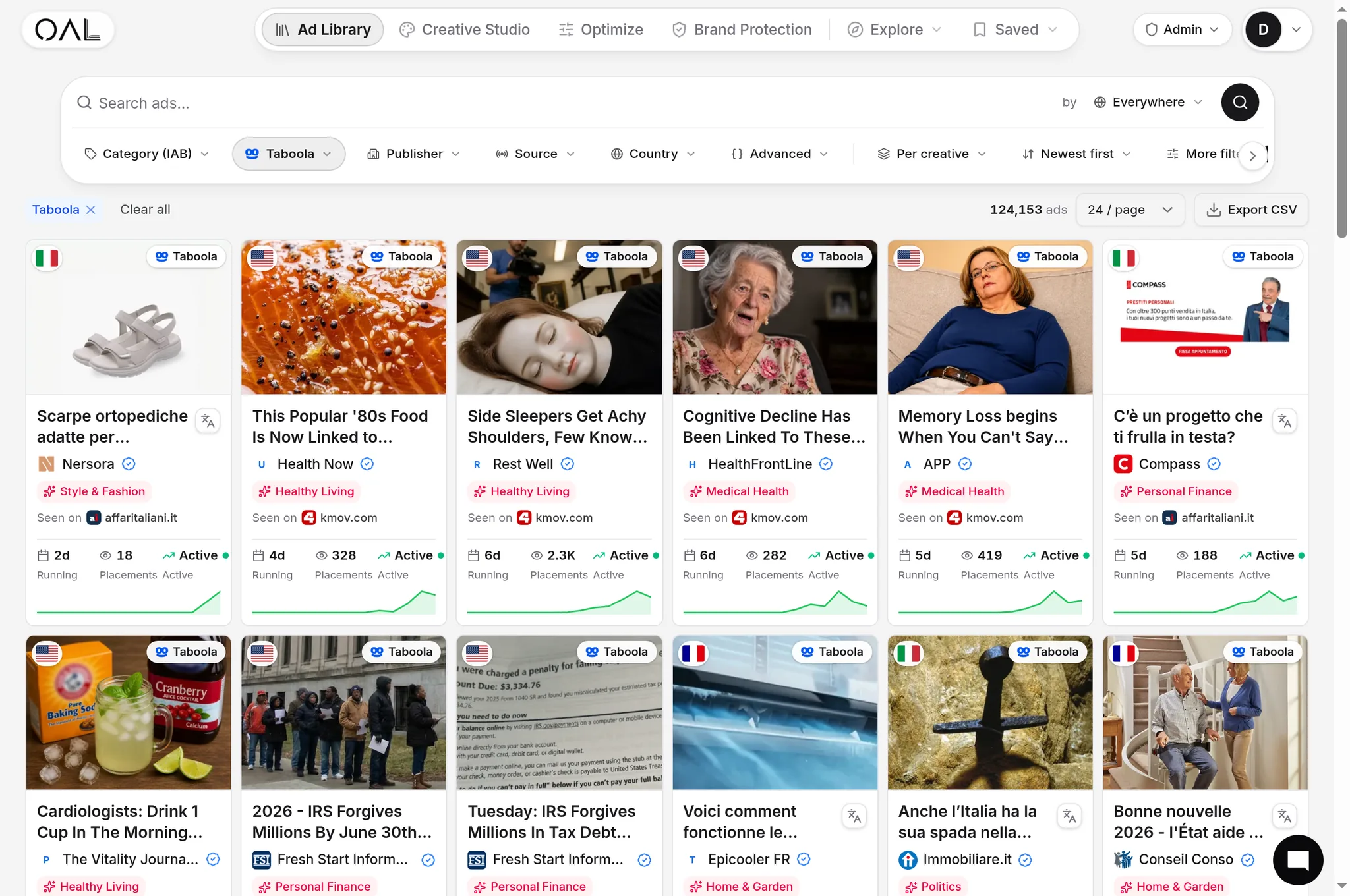
Because MAN creatives, advertisers and landing pages are captured continuously in the open index, you can audit the network like a buyer instead of trusting reviews — including this one. Search the live corpus with the native ad spy tool: filter to the Microsoft Audience Network, pull your vertical, and check who is running, with what hooks, for how long. Thirty-plus-day campaigns from recognizable advertisers in your category are the strongest yes signal available; a category ghost town is a warning worth more than any think-piece. Fold the check into a weekly competitive research routine and you will see network shifts before they show up in anyone's benchmark report. For budgeting the test itself, our native advertising cost guide covers realistic click costs and testing overhead.
The bottom line#
The Microsoft Audience Network is underrated for the same reason it is mispriced: buyers judge it by its feed aesthetics instead of its audience. The live data shows the largest native creative footprint of any network we track and a longevity leaderboard full of finance, health and home-services advertisers quietly compounding on a 45+ desktop audience. If that audience buys what you sell, MAN is one of the best risk-adjusted tests in native advertising — provided you run it as its own channel, watch lead quality from day one, and let the winners' 38-day campaigns tell you what the network already knows.