Español
 Français
 Deutsch
 Italiano
 Nederlands
 Polski
 Svenska
 Türkçe
 Русский
 日本語
日本語 한국어
한국어 简体中文
简体中文 Tiếng Việt
 Bahasa Indonesia
 繁體中文
繁體中文 Čeština
 Dansk
Dansk Suomi
Suomi Ελληνικά
 Română
 Magyar
 Українська
 ไทย
ไทย हिन्दी
 العربية
 עברית
עבריתWhat Is Search Arbitrage? The Native-to-Search Model Explained
The business model hiding behind every cost-question headline in your news feed: how search arbitrage buys native clicks low and resells them to search advertisers high.


Search arbitrage is the practice of buying visitors cheaply on one channel — usually native, display, or social ads — and sending them to a page monetized with paid search results, earning more per click from the search ads than the visitor cost to acquire. The arbitrageur profits on the spread: pay a low CPC to a native network, collect a higher payout when the visitor clicks a sponsored search result served by a monetized feed. It is a real, legal, widespread business model — and one of the least understood corners of the native ecosystem, because the whole machine hides in plain sight behind headlines that read like search queries.
How search arbitrage works, step by step#
The loop has four moving parts:
- Buy the click. The arbitrageur runs native ads with headlines shaped like a search query or a cost question — deliberately picking topics where search advertisers pay premium CPCs.
- Land the visitor on a monetized page. The destination is either a search-results-style page or an article wrapped around blocks of sponsored "related searches." Those units come from a search feed — programs like Google's AdSense for Search and its related-search-on-content (RSOC) format, or syndicated Bing and Yahoo demand, typically accessed through authorized partners. Terms, formats and availability change often; check the feed provider's current documentation rather than any third-party summary.
- The visitor clicks a sponsored result. Curious visitors click a related search term, land on a results page, and click one of the paid listings.
- The feed pays a revenue share. The search advertiser paid market rate for that click; the feed provider passes a share back to the page owner.
If revenue per acquired visitor exceeds cost per acquired visitor plus overhead, the loop is profitable — and repeatable until the economics or the policies change.
The model is a specific case of traffic arbitrage — buy traffic low, monetize it higher — with search demand as the monetization layer. The broader family, including display and content variants, sits under ad arbitrage.
The economics: buy the click low, sell it high#
Everything rides on two numbers: the CPC you pay the traffic source and the revenue per visitor the monetized page produces. The spread is thin, and small moves in either number flip the sign. Three structural facts shape the business:
- Keyword value drives everything. Search advertisers bid most aggressively on insurance, legal, finance, home-services and health terms — so arbitrage pages concentrate there. That is why native feeds carry so many cost-question headlines about walk-in tubs, dental implants and business insurance, and so few about board games.
- Breakage is the hidden tax. Not every purchased visitor clicks a sponsored result. The fraction who do — and the value of what they click — sets your revenue per visitor, which functions like the EPC of a conventional affiliate funnel.
- Volume hides the margin. Because per-visitor profit is small, operators scale wide: many geos, many topics, hundreds of creatives, relentless testing. Search arbitrage is an operations discipline, not a trick.
What search arbitrage looks like in the wild#
You have already seen these ads. Across OpenAdLibrary's index of 725,000+ live native creatives (June 2026), the pattern shows up wherever search demand can be resold:
- Query-shaped headlines on content networks. MediaGo captures from June 2026 include "House Cleaning Rates in New Zealand: What You Should Know in 2026" and "Term Deposit Rates for Seniors in New Zealand" (advertiser: Loop of Now) — headlines that read like the search you would have typed yourself.
- Cost-curiosity angles on Taboola. Creatives like "Granny Pods in 2026: Options That May Surprise You" (Visionary Echo) sit squarely on home-and-money topics where search CPCs run hot.
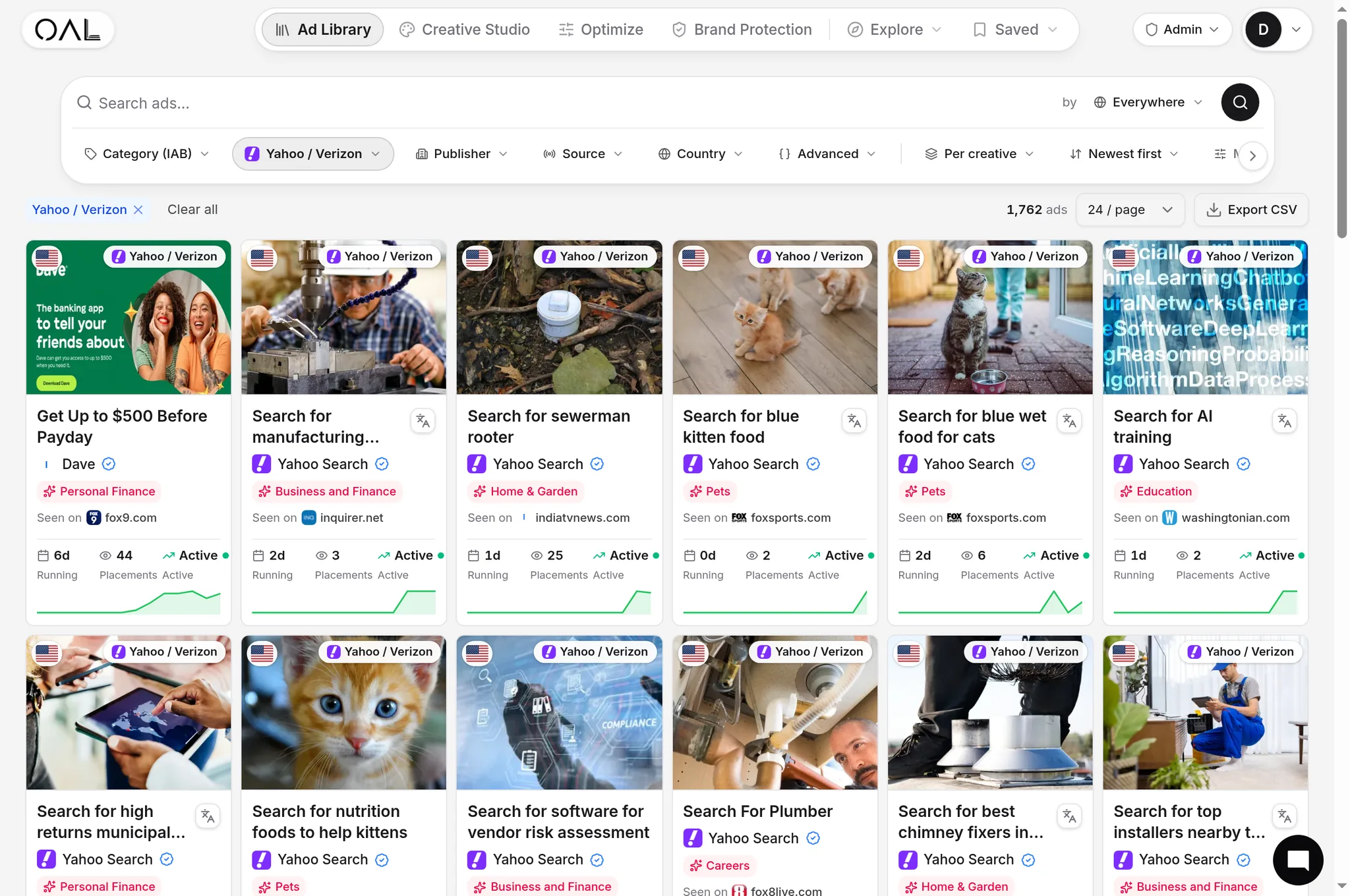
- First-party search promotion on Yahoo. Among the 5,900+ Yahoo-network creatives in the index, a recurring pattern is the literal query headline — "Search for business insurance," "Search For Superannuation" — branded as Yahoo Search itself, driving users into monetized search results. The same loop, run by a company that owns the feed.
The tell is always the same: the headline is a query, and the landing page exists to earn one more click rather than to sell a product. The headline is only the visible fingerprint, though — to confirm what a specific advertiser is doing, trace the funnel. You can browse these placements, with the traced landing page attached to each creative, on the Yahoo ads page and the MediaGo ads page.
Who sits in the chain#
- Search advertisers — the ultimate payers, bidding on keywords through normal search channels, often unaware their budget buys arbitraged eyeballs.
- Feed providers — Google, Microsoft and Yahoo, who syndicate search demand beyond their own properties.
- Authorized feed partners — intermediaries who grant qualified operators feed access and police traffic quality on the provider's behalf.
- Arbitrageurs — media buyers who own the pages and buy the traffic.
- Traffic sources — native networks such as Taboola, Outbrain, MGID, Revcontent and MediaGo, plus the MSN / Microsoft Audience Network feed, where low CPCs and enormous scale make the math workable.
If you want the full picture of how money and clicks route through these layers — and how an outside observer can reconstruct it — see the native ad supply chain, explained.
The risks nobody puts in the pitch deck#
- Policy dependence. The entire business exists at the pleasure of feed providers. Programs have tightened repeatedly; formats get deprecated, quality bars rise, and capacity changes with little notice. Feed policy risk sits above media-buying risk.
- Single point of failure. Most operators run through one feed partner. A quality flag or contract change at that partner is an extinction event, not a setback.
- Quality feedback loops. Feeds score the traffic they receive. If purchased visitors don't convert for the search advertisers downstream, revenue per click drops — the arbitrageur's margin can be repriced away without any warning email.
- Margin compression. Native CPCs on proven arbitrage topics get bid up by other arbitrageurs; the spread narrows exactly where the model is best known.
- Creative adjacency. Query-bait headlines live one step from clickbait, and traffic sources reject or ban accounts that cross their misleading-creative lines.
Is search arbitrage still viable?#
Yes — for a specific kind of operator. The buyers who sustain it have direct or well-established feed access, keyword-level revenue tracking, a high-tempo creative testing habit, and enough geo spread that no single market or partner decision kills the business. What it is not is passive income: the margins are thin, the policy ground shifts, and the operators who treat it as a spreadsheet-and-systems business are the ones still running when a format gets deprecated. Anyone entering today should size the opportunity by their tolerance for platform risk, not by revenue screenshots.
What you need before you start#
If the model still appeals after the risk section, the entry checklist is short but unforgiving:
- Feed access. Without a feed partnership there is no business. Approach authorized partners with a real traffic history and a clean compliance story; expect vetting, and expect the terms to be the single most important document you sign.
- Keyword-level revenue reporting. You will be making kill decisions on individual keyword-geo-creative combinations. If your reporting can't attribute revenue at that grain, you are flying blind on the only decisions that matter.
- A content and page pipeline. RSOC-style monetization needs real pages, produced fast, in multiple languages. Thin doorway pages are exactly what feed compliance teams hunt for.
- A creative testing engine. The traffic side is ordinary native media buying — hooks, images, headline iterations — at higher tempo than most affiliate campaigns, because the margins forgive nothing.
- Stop-loss discipline. Thin spreads punish slow reactions in both directions: keywords that worked last month get bid up, and feeds reprice quietly.
Research the model before you run it#
Search arbitrage rewards reconnaissance more than most models, because everything about it is observable:
- Find the query-shaped ads. Search a live ad index for cost-question and "search for" headlines in a vertical you understand.
- Check longevity. Ads that keep running keep paying — arbitrage creatives that persist for weeks mark keyword-geo combinations where the spread is real.
- Trace the funnels. OpenAdLibrary has captured 1.3 million+ landing pages behind live native ads (June 2026), so you can see whether a creative leads to a results-style page, an RSOC article, or a conventional offer.
- Map the networks. Note which traffic sources carry the volume for your topic — the distribution is uneven and it changes.
An afternoon of tracing live funnels will teach you more about the current state of search arbitrage than any course — and it costs nothing but the time.