 Español
 Português (Brasil)
 Français
 Deutsch
 Italiano
 Nederlands
 Polski
 Svenska
 Türkçe
 Русский
 日本語
日本語 한국어
한국어 简体中文
简体中文 Tiếng Việt
 Bahasa Indonesia
 繁體中文
繁體中文 Čeština
 Dansk
Dansk Suomi
Suomi Ελληνικά
 Română
 Magyar
 Українська
 ไทย
ไทย हिन्दी
 العربية
 עברית
עבריתTaboola vs MediaGo: Scale vs Algorithmic Efficiency
Taboola is the scale play; MediaGo is Baidu's algorithm-first native platform riding premium Microsoft-weighted supply. Live index data on both networks, and a sequencing playbook for using each where it wins.


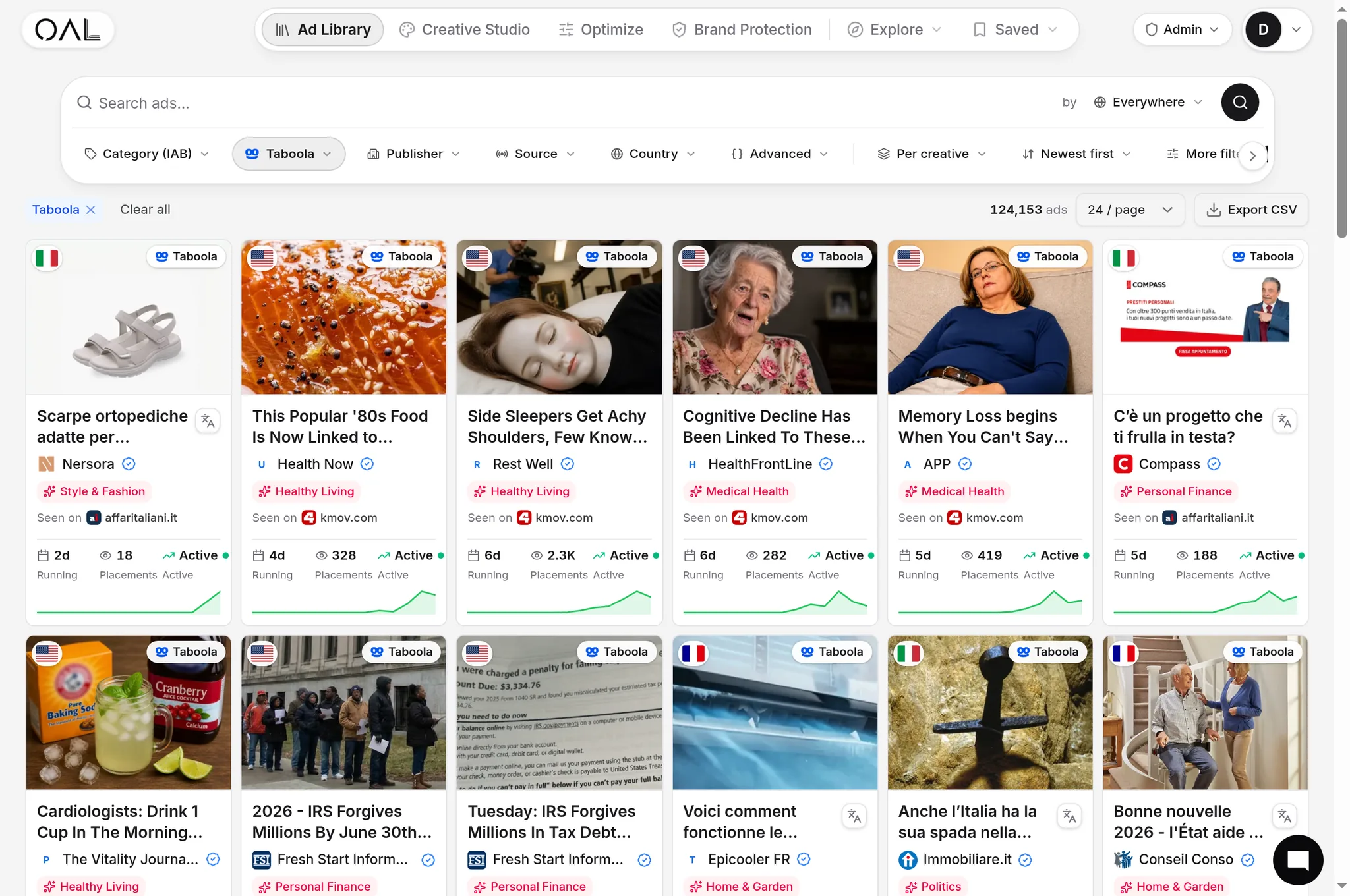
Taboola and MediaGo both place image-and-headline native ads in publisher content feeds, but they are different bets. Taboola is the scale play: the largest of the classic content-recommendation networks, with 206,000+ live Taboola creatives in OpenAdLibrary's index as of June 2026. MediaGo — Baidu's international native advertising platform — is roughly a thirtieth of that size in the same index (6,500+ live creatives), but it concentrates premium supply, much of it on Microsoft's MSN feed, behind a deep-learning bidding engine and far thinner advertiser competition. The short version: buy Taboola for reach, volume, and mature tooling; add MediaGo as a second network where a proven creative can meet less contested inventory.
Taboola vs MediaGo at a glance#
| Taboola | MediaGo | |
|---|---|---|
| What it is | The largest self-serve content-recommendation network | Baidu's international native ad platform |
| Live creatives in OpenAdLibrary's index (June 2026) | 206,145 | 6,571 |
| Primary supply | Its own publisher network of news and content sites, secured through long-term deals | Premium publishers, with a heavy weighting toward Microsoft properties (the MSN feed) |
| Buying model | CPC bidding, self-serve platform | CPC bidding with algorithmic CPA-style optimization goals |
| Optimization pitch | SmartBid automated bidding on top of manual CPC control | Deep-learning conversion prediction as the core product |
| Competition level | High in every money vertical | Thin — whole verticals are lightly contested |
| Best fit | Primary native channel; scale campaigns | Incremental reach for offers already proven elsewhere |
Both networks sell the same fundamental unit: a thumbnail image plus a headline rendered inside a publisher's content recommendation widget or feed. The differences are in how much inventory sits behind that unit, who you compete against for it, and how much of the optimization work the platform does for you.
The scale gap, in real numbers#
OpenAdLibrary's index holds 725,000+ live native ad creatives across 49 networks (June 2026). Within that, the classic native networks rank like this: Taboola 206,145 live creatives, Outbrain 108,573, MGID 62,765, Revcontent 15,789 — and MediaGo 6,571. Taboola's slice alone is larger than the next three combined, and about 31 times the size of MediaGo's.
That gap is not a data artifact; it reflects how much distinct advertiser activity each network carries. What it means in practice:
- On Taboola, you can scale. More publishers, more geo depth, more device inventory. Campaigns that work can be scaled horizontally across new publishers and geos for a long time before saturating.
- On Taboola, you will fight for it. The health, finance, and insurance feeds are crowded with sophisticated buyers running dozens of creative variants. Your headline competes against teams who iterate daily.
- On MediaGo, volume caps out sooner. A winning campaign on MediaGo will exhaust its best inventory faster, simply because there is less of it.
- On MediaGo, clicks are less contested. Fewer advertisers bidding on the same feed slots is the structural reason media buyers commonly report cheaper clicks there for comparable geos — more on cost below.
Neither profile is "better." They answer different questions. Taboola answers "where can I spend five figures a day profitably?" MediaGo answers "where can I get incremental conversions at a lower CPC once my funnel already works?"
Where the ads actually run#
Taboola's supply is its own publisher network. The company signs long-term, often exclusive, deals with news and content publishers, and its widgets appear below and within articles across thousands of sites. As an advertiser you control placement quality at the site level with whitelists and blacklists — and building those site lists from performance data is a core part of running Taboola well. The full mechanics are covered in our guide to how Taboola ads work.
MediaGo's supply skews hard toward Microsoft properties. The MSN feed — the content stream on MSN.com, Microsoft Start, and the Edge new-tab page — is a multi-demand environment where Microsoft's own Audience Network demand runs alongside resold demand partners, and MediaGo buys a meaningful share of its impressions there, alongside other premium publishers. In OpenAdLibrary's supply-chain traces, MediaGo-attributed creatives surface in the same feed environments where other MSN demand runs. If you want to understand that feed environment before buying it, our MSN native ads guide breaks down who monetizes it and how.
The practical consequence: MediaGo's audience skews toward the MSN reader — desktop-heavy, older, Tier-1 — while Taboola's audience is whatever its publisher mix is in your target geo, which is broader and more variable. If your offer historically converts on MSN-style inventory (finance, insurance, home services, senior-targeted products), MediaGo is buying you a fairly specific audience, not just "cheaper native."
Optimization: SmartBid vs deep learning#
Taboola's optimization stack is mature and well documented: you set a baseline CPC, and SmartBid adjusts bids per impression toward your conversion goal. You retain a lot of manual control — per-site bid adjustments, day-parting, device splits — and experienced buyers use that control heavily. The learning phase needs real conversion volume to work with, and buyers commonly report that campaigns need a meaningful number of conversions per week before automated bidding beats careful manual management.
MediaGo's entire product pitch is the algorithm. Its deep-learning models predict post-click conversion probability per impression and bid accordingly, with CPA-style optimization goals. The platform exposes less manual machinery than Taboola, and that is deliberate — you are trusting the model. Two honest caveats. First, any conversion-optimizing model needs conversion data; on a smaller network your campaign may accumulate it slowly, which makes the learning phase feel long at low budgets. Second, bid strategies and optimization goals change; check MediaGo's current documentation for exactly what is available rather than relying on any third-party summary, including this one.
A useful mental model: Taboola rewards operator skill — site-list curation, bid laddering, creative iteration. MediaGo rewards feeding the machine — clean conversion tracking, patience through learning, and enough budget for the model to explore.
What actually runs on each network (June 2026 data)#
Vertical mix is where the two networks look most different. Top classified verticals by live creatives in OpenAdLibrary's index, June 2026:
| Rank | Taboola | Creatives | MediaGo | Creatives |
|---|---|---|---|---|
| 1 | Health | 11,982 | Insurance | 378 |
| 2 | Finance | 8,200 | Home & garden | 301 |
| 3 | Insurance | 7,422 | Ecommerce | 265 |
| 4 | Ecommerce | 5,185 | Auto | 257 |
| 5 | Home & garden | 4,414 | Gaming | 218 |
| 6 | Software | 3,665 | Health | 155 |
Taboola's profile is the classic native money-vertical stack: health, finance, and insurance dominate, which tells you where the proven-profitable demand — and the toughest competition — sits. MediaGo's mix is flatter and slightly different in character: insurance and home services lead, but gaming makes the top five (browser-game advertisers like free-to-play MMO titles run consistently there), and a noticeable share of MediaGo creatives are cost-comparison content pieces — "house cleaning rates," "term deposit rates for seniors" — the search-arbitrage-adjacent style that thrives on MSN-type audiences.
The cross-network behavior of individual advertisers is instructive too. In the June 2026 index, the same direct-response advertisers show up on both: a sciatica-relief advertiser's creative had been running 21 days on MediaGo while the same brand ran parallel creatives on Outbrain; a skincare advertiser ran near-identical "Koreans do this instead" headlines on Taboola and MGID simultaneously. Sophisticated buyers treat these networks as a portfolio and port winners across them — which is exactly the argument for treating MediaGo as your second or third native network rather than your first.
Creative and funnel implications#
The creative unit is identical — image plus headline — so your asset library transfers between the two networks with almost no rework. What changes is the audience reading it, and that should shift your angle selection.
Taboola's feed rewards the full range of native creative craft: curiosity-gap headlines, "one weird trick" mechanisms, listicle framings, and local-intent hooks. Because competition is dense, the marginal winner is usually the sharper angle, not the prettier image — a dynamic we unpack in how to analyze winning native ad creatives. Fresh angles matter more than fresh images; buyers rotating headline variants weekly consistently outlast buyers who set and forget.
On MediaGo's Microsoft-weighted inventory, the reader profile skews older and desktop-heavy, and the creative styles that persist in the index reflect it: plainer, more informational headlines — cost breakdowns, benefit-eligibility framings, "what to know in 2026" listings — outnumber the aggressive curiosity bait that dominates parts of Taboola's feed. If you port a Taboola winner to MediaGo, port the advertorial funnel behind it too, but consider testing a toned-down headline variant alongside the original; the same offer often needs a calmer front door for this audience.
Funnel-wise, both networks run best with a pre-lander or advertorial between click and offer for cold direct-response traffic. Nothing about MediaGo changes that playbook — the click still arrives cold from editorial context and needs warming before a checkout or lead form.
Cost: what buyers commonly report#
Neither network publishes rate cards, and any precise number you read is someone's campaign average, not a market price. With that said, the qualitative picture practitioners consistently describe:
- Taboola: media buyers commonly report Tier-1 desktop CPCs from roughly $0.20 to $0.90, with mobile lower and competitive verticals (finance, insurance) at the top of the range or above it. Your niche and geo move this a lot.
- MediaGo: buyers commonly report CPCs below Taboola's for comparable Tier-1 inventory — the thin-competition effect — but with less volume available at those prices, and CPCs that rise as you push for scale.
The deeper cost question is never the CPC; it is cost per conversion after the click, which depends on how well each network's audience matches your offer. A cheaper MSN-feed click that never converts is more expensive than a costly Taboola click that does. Our native ads CPC benchmarks piece covers how to think about click pricing across networks without anchoring on fake precision.
Which network should you pick?#
Decision criteria, in the order that actually matters:
- Is this your first native network? Pick Taboola. The tooling, documentation, inventory depth, and sheer amount of public knowledge about running it make it the sane starting point. MediaGo as a first network means learning native advertising and a black-box optimizer at the same time.
- Is your funnel already proven? If you have a creative-plus-lander combination converting on Taboola, Outbrain, or Meta, MediaGo is a low-friction place to port it for incremental volume at commonly-reported lower CPCs.
- Who is your buyer? Offers that historically perform on MSN-style inventory — insurance, senior-focused health and home products, finance comparison — are the strongest MediaGo candidates, because that is disproportionately the audience you are buying.
- How much conversion volume can you feed the algorithm? MediaGo's model-driven buying needs conversions to learn from. Very low-budget tests with rare conversion events play against the platform's strengths.
- How fast do you need to scale? If the plan is aggressive daily-budget growth, Taboola's inventory depth matters. MediaGo winners plateau earlier.
For most advertisers the answer is sequencing, not either/or: prove the funnel on Taboola, then add MediaGo for margin. Running both also diversifies platform risk — account reviews, policy changes, and publisher-mix shifts hit a single-network advertiser much harder.
Common mistakes when adding MediaGo#
Buyers who bolt MediaGo onto a working native program tend to hit the same avoidable problems:
- Judging it on Taboola timelines. With less inventory and a model-driven buying loop, MediaGo campaigns often need longer to stabilize at low budgets. Killing a campaign three days in, before the algorithm has meaningful conversion data, tells you nothing.
- Optimizing CPC instead of CPA. The cheap clicks are the headline attraction, but the only number that matters is what a conversion costs after the MSN-skewed audience hits your funnel. Track it separately from day one rather than blending it into a cross-network average.
- Skipping tracking hygiene. A conversion-predicting model is only as good as the conversion signal you send it. Fire your postback or pixel on the event you actually care about — not on a soft pre-lander click — or the algorithm optimizes toward the wrong thing with perfect efficiency.
- Treating it as a scaling channel. MediaGo is an efficiency channel. When a winner plateaus there, the move is usually back to Taboola or Outbrain for volume, not doubling MediaGo budgets into rising CPCs.
Research both networks before you spend#
The fastest way to de-risk either network is to look at what is already running on it — sustained spend is the closest public signal that something converts. OpenAdLibrary indexes both networks continuously: browse 206,000+ live Taboola creatives at /spy/taboola and the MediaGo feed at /spy/mediago, filtered by vertical, geo, and how long each ad has been running. An ad that has run for weeks is paying for itself — the logic behind that is covered in why ad longevity is the strongest winning signal. Before committing budget, spend an hour looking at which advertisers persist on each network in your vertical, what angles they run, and where their clicks land; the full workflow is in our guide to spying on competitor native ads.
The honest summary: Taboola is the market. MediaGo is an edge — a real one, built on premium Microsoft-weighted supply and thin competition — but an edge you exploit after you have something worth scaling, not a place to figure out native advertising from scratch.