Español
 Português (Brasil)
 Français
 Deutsch
 Italiano
 Nederlands
 Polski
 Svenska
 Türkçe
 Русский
 日本語
日本語 한국어
한국어 简体中文
简体中文 Tiếng Việt
 Bahasa Indonesia
 Čeština
 Dansk
Dansk Norsk (bokmål)
 Suomi
Suomi Ελληνικά
 Română
 Magyar
 Українська
 ไทย
ไทย हिन्दी
 العربية
 עברית
עבריתDid Outbrain Become Teads? The Merger Explained
Outbrain bought Teads, then took its name and Nasdaq ticker, and our live capture data shows the Outbrain engine still serves nearly all the volume.

If you searched "Outbrain" recently and got bounced to a Teads page, your browser isn't broken. Outbrain and Teads are one company now, and that company answers to Teads. The deal merged two of the biggest names in native and outstream video on the open web, and it left behind a mess of half-updated logos, stale help docs, and ad-server identifiers that still say "Outbrain." Here is what actually happened, in order, and what live captured inventory tells you about the network as it stands in 2026.
Did Outbrain become Teads?#
Yes, with one twist worth understanding. Outbrain acquired Teads in a deal that closed on February 3, 2025, and the combined company kept the Teads name. In June 2025 the parent renamed itself from Outbrain Inc. to Teads Holding Co. and swapped its Nasdaq ticker from OB to TEAD. Outbrain was the buyer. Teads is the brand that survived.
That is the single fact most people get backwards. The acquirer took the target's name. The Outbrain shell wrote the check; the Teads logo is the one still on the door.
The timeline, in plain terms#
This was not one announcement. It played out over roughly ten months, and each stage moved something different for advertisers and publishers.
| Date | Event | What it meant |
|---|---|---|
| August 2024 | Merger announced | Outbrain agreed to buy Teads for roughly $900M ($625M cash plus ~43.75M shares) |
| February 3, 2025 | Deal closed | Combined company started operating under the Teads brand |
| Early 2025 | Integration | ~200 roles cut globally; products and sales teams consolidated |
| June 10, 2025 | Corporate rebrand | Outbrain Inc. became Teads Holding Co.; ticker moved from OB to TEAD |
The strategic read is simple. Outbrain owned performance and the recommendation feed that sits under articles. Teads owned outstream video and upper-funnel brand budgets on premium publishers. Stitch them together and you get the "end-to-end" platform the company now pitches, awareness through conversion, across web, mobile, and connected TV.
The brand choice tells you who they want as customers. Teads carried more weight with premium publishers and brand-side media buyers. The recommendation widget, fairly or not, had an image problem. Outstream video did not. So the name that stuck was the one that opens doors with brand money.
How big is the combined company#
The merged entity is one of the largest independent players on the open internet, and that scale is the whole pitch. The "open internet" framing is a deliberate counterweight to Google, Meta, and Amazon. At close, the company reported:
- Roughly $1.7 billion in combined ad spend for FY24
- Reach of about 2.2 billion consumers
- More than 10,000 publishers and around 20,000 advertisers
- Roughly 2,000 employees after the ~200-role cut
For where this sits in the wider field, our native advertising guide maps the full set of supply-side and demand-side players.
What the live inventory actually shows#
Here is the part the press releases skip. On the open web, the Outbrain pipes are still doing the heavy lifting, and the numbers are not close.
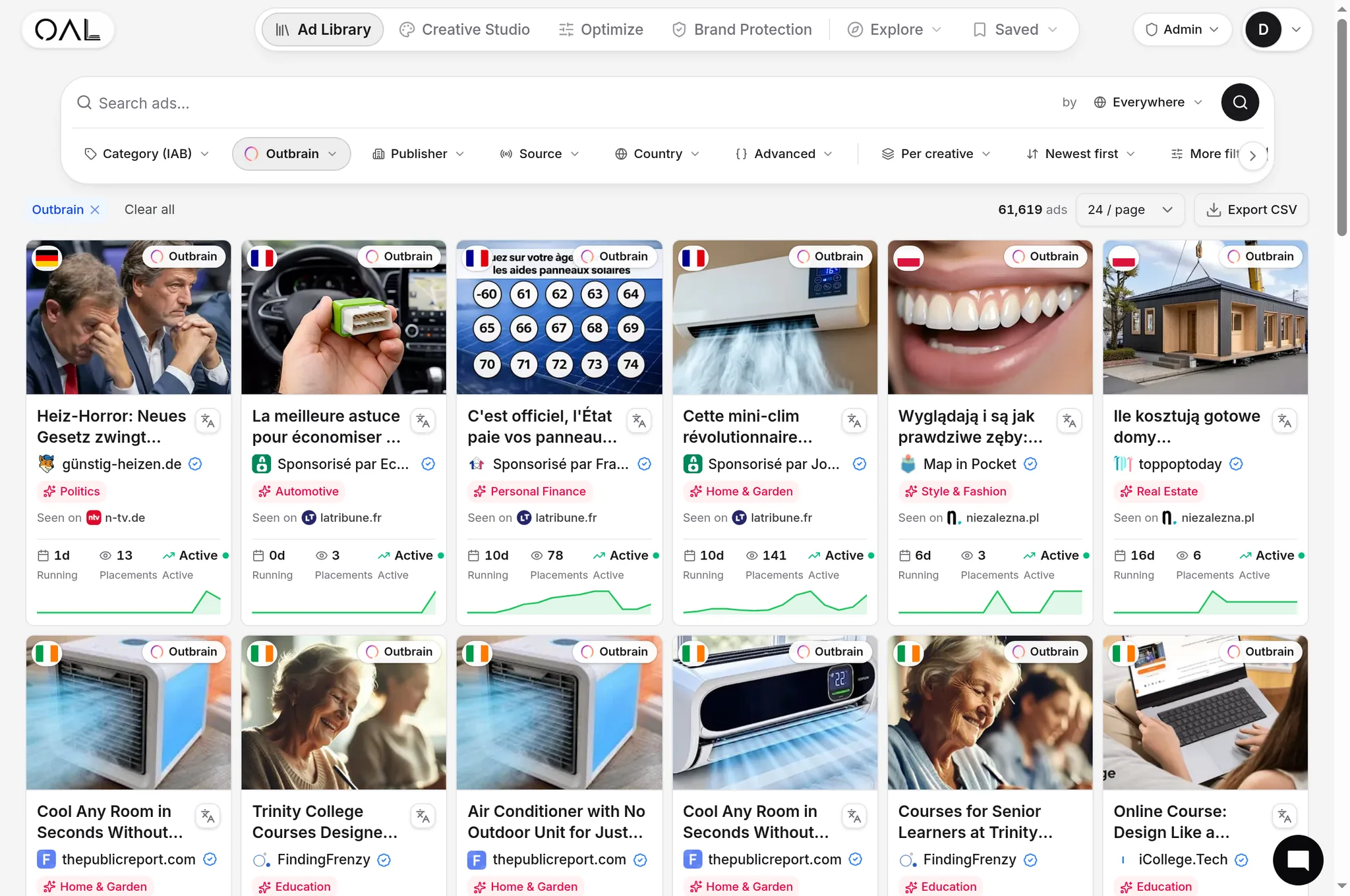
We capture live public native ads continuously. As of June 2026, OpenAdLibrary holds 84,252 creatives tagged to Outbrain, against just 55 tagged to Teads. That gap is not a measurement quirk. It reflects what the network is: a recommendation-feed business at its core, with outstream video layered on top. The "Outbrain" supply identity is still everywhere because that is where the volume lives.
What is running on it skews exactly where you would expect for a feed network. Outbrain's top verticals in our index are Finance (2,640 creatives), Insurance (2,615), Health (2,016), Ecommerce (1,479), and Software (1,197). That is the classic native demand stack: lead-gen offers, supplement angles, and clickbait curiosity gaps.

That olive-oil unit is the native genre in one frame: a vague authority figure, a personal-revelation hook, and a payoff withheld until the click. It had been running 16 days when we captured it. The Teads-branded slice of the same network looks completely different. Its handful of creatives lean Travel (9), Ecommerce (6), and Food & Beverage (1), the upper-funnel brand verticals the merger was supposed to bring in. Different inventory, different buyer, same parent company.
What actually changed for advertisers#
If you ran Outbrain campaigns, the day-to-day impact was a lot smaller than the corporate headlines made it sound. This was a consolidation, not a shutdown.
- Your campaigns kept running. Outbrain's Amplify recommendation feed and publisher network carried straight through the transition. Spend migrated into the combined platform instead of getting cut off.
- The product surface unified. Two sales motions became one. Advertisers now buy a single platform that pairs Outbrain's predictive performance tech with Teads' video and branding inventory.
- The branding flipped. Dashboards, contracts, and rep email signatures moved to Teads. Under the hood, much of Outbrain's optimization engine is still doing the work.
- The pitch moved up-funnel. Where Outbrain sold clicks and conversions, the combined company pushes harder on full-funnel outcomes, CTV, and brand metrics. That is Teads' heritage talking.
For a current operating walkthrough, our guide to how Outbrain works in 2026 (now part of Teads) covers the live formats and buying flow, and our explainer on what Teads is covers the combined platform end to end.
What it means for publishers and brand safety#
Consolidation cuts both ways. Publishers get one larger demand partner, which can simplify monetization and lift fill rates. But fewer independent networks also means fewer places to spread your revenue, and a bigger combined entity makes brand safety governance more consequential. When one platform serves recommendation widgets, outstream video, and CTV across thousands of premium sites, a single policy call propagates fast and wide.
For advertisers, the flip side is brand protection running the other direction: watching for competitors and affiliates pushing copycat creatives or misleading pre-landers under the network's banner. A merged supply chain does not remove that risk. It concentrates it. And the aggressive end of native demand has not gone anywhere, as this captured finance angle shows.

How to tell who you are really dealing with today#
Because the rebrand is recent and uneven, the identifiers lag the branding. This is where most stale guides fall apart, and where live data beats memory.
- Ad-server and tracker domains still reference Outbrain even when the buying UI says Teads. The supply chain does not rename itself overnight, and our capture counts prove it.
- Creatives in the wild still mix legacy Outbrain widget styling with newer Teads outstream units.
- Landing-page redirects routed through the network reveal which advertiser actually sits behind a placement, no matter what brand is printed on the dashboard.
This is exactly the gap an ad-transparency tool closes. At OpenAdLibrary we capture live public native ads across Outbrain, Teads, Taboola, MGID, Revcontent, and more, store the real creative image at full quality, classify the ad-tech supply chain behind each placement, and follow the click through to the advertiser's landing page, all without clicking live ads. The result is current ground truth: who is advertising, under which network identity, and how long each creative has run. Across the platform that adds up to 589,036 creatives, 25,933 advertisers, and over 5.4 million ad observations as of June 2026.

That Peugeot unit is the rarer breed on this network: a named brand, clean creative, clearly sponsored, 16 days into its run. It is the kind of upper-funnel demand the Teads side of the house is built to attract, sitting in the same supply as the belly-fat ad above.
How long do these ads actually run#
Longevity is the cleanest proxy for a winner, because nobody keeps paying to serve a creative that loses money. Our index currently spans up to about 28 days of continuous observation per creative, and the ads that hit that ceiling tell you what the network rewards.
On Outbrain specifically, the 28-day survivors in our data include SmartAsset's "Ask a Pro: How Can I Avoid Paying Taxes on IRA Withdrawals?" (Finance), Combat Siege's "The most realistic game 2025. If you own a mouse, play it for 1 minute" (Gaming), and a Cleverst pets angle about what your dog's licks really mean. Curiosity-gap finance, mobile gaming, and pet trivia, all proven enough to keep buying for weeks.

One caveat worth stating plainly: 28 days is the current span of our continuous observation window, not the lifetime of the campaign. Industry lore about "90-day winners" is real, but it is not our measurement. What we can verify is that these specific creatives kept running for at least four weeks straight, which is a strong signal in a market where most native creatives burn out in days.
How the merged network compares to its peers#
Teads (the merged company) is not the only game in native. If you are reassessing your media mix after the consolidation, it helps to see the network against the field:
- Taboola is the largest standalone recommendation network and Outbrain's longtime archrival. The merger arguably leaves Taboola as the last pure-play giant of the feed model.
- MGID competes on performance and international reach, often at lower entry costs.
- Revcontent plays up publisher quality and direct-deal flexibility for performance buyers.
The honest takeaway: the merger pulled one of two interchangeable recommendation giants off the buyer's shortlist and replaced it with a broader, video-heavy, brand-friendly platform. Whether that is an upgrade depends entirely on your spend. If it skews performance, you are buying the old Outbrain engine. If it skews branding and CTV, you are buying what Teads brought to the table.
The bottom line#
Outbrain did become Teads, with an asterisk. Outbrain bought Teads, then took its name, its ticker, and increasingly its market positioning. The advertising machinery you knew as Outbrain still runs, now inside a larger company aimed squarely at brand and video budgets on the open internet. And our capture counts (84,252 Outbrain creatives versus 55 Teads) make the practical reality clear: on the open web, the Outbrain engine is still where the volume is.
The cleanest way to verify any of this is not a press release or a year-old blog post. It is looking at what the network serves right now. You can browse the network's live inventory on our Outbrain ad spy page, and the same data feeds Creative Studio, Optimize, Copy DNA, and our API and MCP for teams that want it programmatically.
Start free and watch live Outbrain and Teads inventory, trace each ad to its real advertiser and landing page, and see which creatives are actually winning. No credit card needed for your first 200 ads.