Español
 Português (Brasil)
 Français
 Deutsch
 Italiano
 Nederlands
 Polski
 Svenska
 Türkçe
 Русский
 日本語
日本語 한국어
한국어 简体中文
简体中文 Tiếng Việt
 Bahasa Indonesia
 繁體中文
繁體中文 Čeština
 Dansk
Dansk Norsk (bokmål)
 Suomi
Suomi Ελληνικά
 Română
 Magyar
 Українська
 ไทย
ไทย हिन्दी
 العربية
 עברית
עבריתShould You Run Native Ads for Dropshipping? (Data-Backed)
Native advertising wins for a narrow slice of dropshipping products, and here's the data-backed case for when it beats social, drawn from live native ad captures.


Most "native vs Facebook" advice for dropshippers comes from someone selling a course on one or the other. So let me give you the honest version, backed by what we actually see in the wild. Native advertising wins for a specific slice of products, margins, and offer structures. Outside that slice, it loses, and it loses fast. This piece draws the line using real patterns from live native ad captures, so you can decide before you torch a test budget learning it the hard way.
The short version: if your product is a cheap impulse buy that lives or dies on a thumb-stopping video, stay on social. If your product needs explaining, carries a real markup, and can be sold through a story, native is often cheaper and more durable, especially as Meta costs climb and signal loss keeps chewing through social targeting.
One thing worth grounding up front. Native is bigger and more commercial than most dropshippers assume. Across the OpenAdLibrary index we've captured 589,000+ creatives from 25,933 advertisers across 42 networks (OpenAdLibrary index, June 2026). Ecommerce is the fourth-largest vertical in that whole set with 13,872 creatives, sitting right behind finance, insurance, and health. People are selling physical products on these placements at scale. The question is just whether your product is one that should.
When does native actually beat social for dropshipping?#
Native beats social when your product has a strong markup (3x or more), benefits from explanation or storytelling, and reaches an older, desktop-leaning audience that still reads articles. Native advertising drops your ad inside the content stream of a publisher site rather than a social feed, which is why it favors problem-solution products sold through an advertorial pre-lander. Social wins for cheap impulse buys that scale on viral video.
That answer hides a lot of nuance, so here are the decision factors that actually matter.
The margin test comes first#
Native traffic is colder than social traffic. Someone reading a news article did not come looking for your product. You have to interrupt them, educate them, and persuade them in a single click-through. That friction means you generally need a higher average order value and a fatter margin to make the math work.
Here's the rule of thumb buyers running both channels tend to land on:
| Factor | Native is a strong fit | Social is a stronger fit |
|---|---|---|
| Product price | $40+ AOV, 3x+ markup | $15-$30 impulse buys |
| Selling mechanism | Story, explanation, "as seen on" | Visual wow, demo video |
| Audience | 35-65, desktop + mobile, article readers | 18-34, mobile-first, feed scrollers |
| Creative format | Article headline + image, advertorial | Short-form video, UGC |
| Conversion path | Ad to pre-lander to product | Ad straight to product page |
Fail the margin test and native will bleed you out before you find a winning angle. Each click costs less, but each conversion often costs more once you account for the warm-up page in the middle.
Cheap CPCs are a trap#
This is where most first-time native buyers get burned. In 2026, Taboola CPCs commonly land in the $0.25-$0.90 range depending on device and vertical, while Meta's average ecommerce CPM sits around $14.40 and Facebook CPCs have pushed past $1.70 with year-over-year cost increases in the low-to-mid 20s. On paper, native looks dramatically cheaper.
Cheap clicks are not cheap customers. Native traffic is colder, so you pay for it twice: once at the click, and again in the conversion-rate gap you close with a pre-lander. Judge native on CPA and ROAS, never on click price.
Run the numbers. A $0.40 click that converts at 0.5% costs you $80 per sale. A $1.70 social click that converts at 3% costs you about $57. The arbitrage only works when your pre-lander and offer lift native's conversion rate enough to overcome that colder intent. The buyers who survive native treat the traffic source as a cost-per-acquisition channel, not a cheap-click channel. The ones who treat it like a coupon for cheap clicks are the ones funding everyone else's data.
The structural case for native in 2026#
Two slow shifts have quietly tilted the field toward native for the right products.
Signal loss gutted social targeting. Lean on the browser pixel alone and you now miss roughly 30-40% of conversion data thanks to iOS privacy prompts, consent banners, and ad blockers. Meta's optimization gets worse with less data, which inflates your measured CPA. Native networks were never as dependent on granular interest targeting, so they degraded less.
Social cost inflation has been relentless. With Meta ecommerce CPMs near $14.40 and double-digit annual cost growth, the channel that was "too cheap to ignore" five years ago is now a premium auction. That makes the cheaper, less-saturated native inventory worth a serious look, especially the native ad widget placements at the bottom of premium publisher articles that social-only buyers never touch.
None of this makes native a Facebook replacement. It makes native a complement that wins outright for explanation-heavy, higher-margin products.
What actually scales on native: patterns from live captures#
The best input for this decision isn't theory, it's watching which ads survive. Unprofitable native ads get paused within days, so longevity and spread are the closest thing to a public profitability signal the channel offers.
A quick honesty note on what "longevity" means in our data. Our index currently spans up to about 28 days of continuous observation per creative, so when you see us call something "long-running," we mean it has stayed live across the full window we've been watching it, not the 90-day winners you'll hear about in forums. That 90-day lore is industry folklore, useful context, but it is not our measurement. What we can say is that the ads still live at day 27 and 28 are a very different population from the ones that vanished in 72 hours.
Look at our current crop of longest-running creatives and the pattern is loud. SmartAsset is still running "Ask a Pro: How Can I Avoid Paying Taxes on IRA Withdrawals?" on Outbrain at 28 days. It reads like an editorial advice column, not an ad. That is the template.

Health is the other vertical that refuses to die. Hidden Hearing's "Try next-gen hearing aids" has held at 28 days on the Microsoft Audience Network, and the same problem-solution shape shows up over and over in our ecommerce captures. Filtering the offer and creative patterns that recur among long-running native ecommerce campaigns:
- Problem-solution products dominate. Posture correctors, joint-pain devices, hearing tech, kitchen gadgets that fix one specific annoyance, car accessories, pet problem-solvers. The headline names a problem the reader already has.
- The advertorial pre-lander is non-negotiable. Winners almost never send native clicks straight to a product page. They route through a "5 reasons" article, a founder story, or an "I tried it for 30 days" review that warms the visitor before the buy button appears.
- Curiosity and specificity in headlines. "Why orthopedists recommend this $39 device" beats "Buy our posture corrector." It reads like editorial, not like an ad. Notice the captured headlines lean on exact dollar figures and numbers: "$138 AC," "10 Medications," "$39 device."
- Slightly raw images beat polished studio shots. Contextual, almost-amateur images outperform glossy product renders because they match the surrounding editorial content.
- Geo and device targeting matter early. Many winners start narrow (one country, one OS, desktop only) before expanding.
Here's a live ecommerce-style example from the index. "Tested: Does This $138 AC Run On Almost No Power? The Results Are Baffling!" The headline is a test, a price, and a cliffhanger. That is the whole native playbook in one line.

And here is the health angle that physical-product sellers borrow constantly. "Americans Are Ditching Hearing Aids for This New Device" from Nebroo had been running 26 days when we caught it. New-category framing, social-proof opener, a device you have to read about to understand.

Taboola is where the bulk of this lives. We've captured 157,727 Taboola creatives, and its top verticals tell you exactly who thrives there: health (6,048 creatives), finance (5,558), insurance (4,303), and ecommerce (3,330) (OpenAdLibrary index, June 2026). If your dropshipping product has a health or "fixes a problem" angle, you are launching into the busiest, most competitive corner of the network. Treat that as confirmation the demand exists, and as a warning that your pre-lander has to be good.
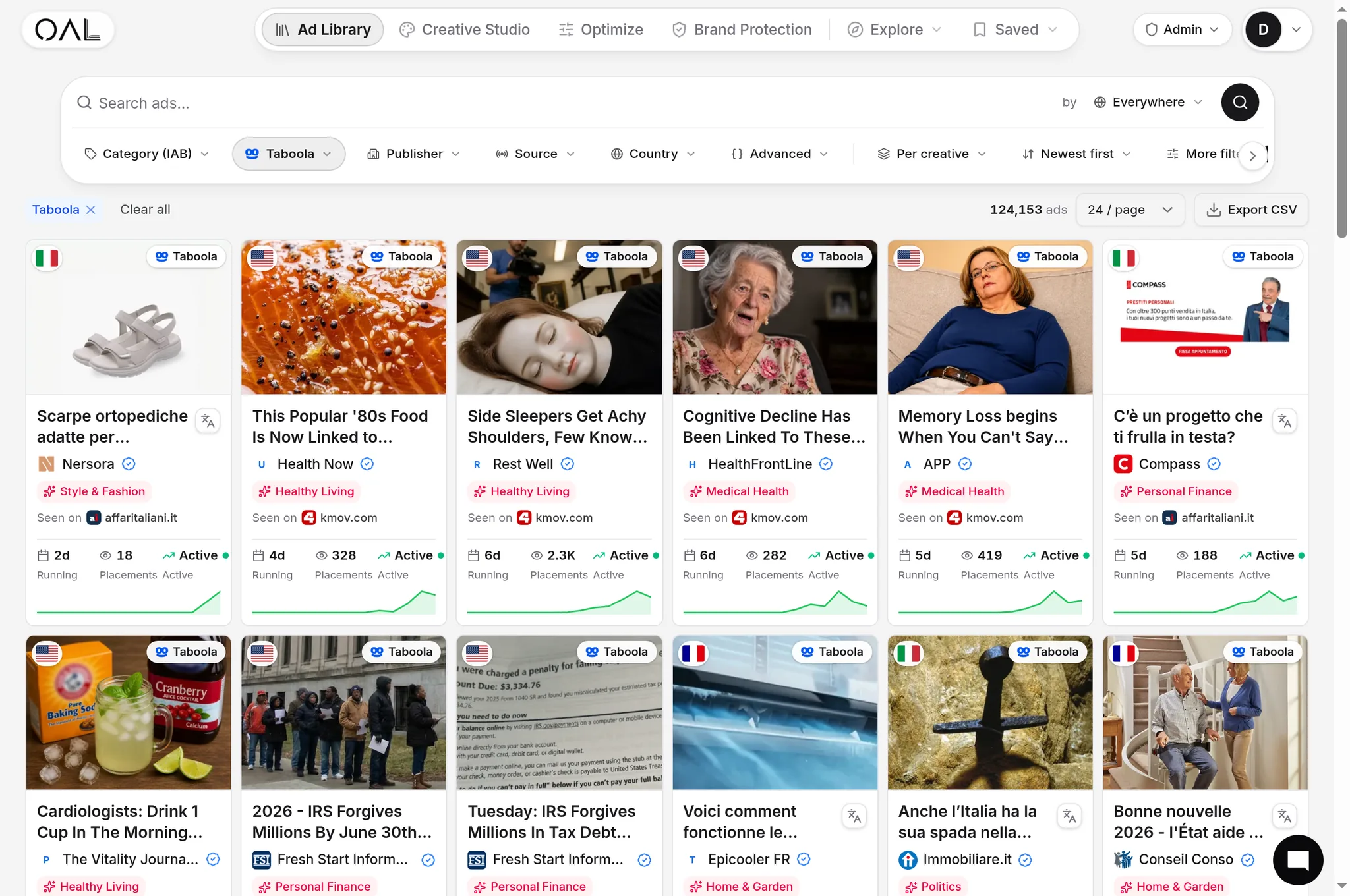
You don't have to guess at any of this. A native ad spy tool that captures live public ads shows you the exact creative, how long it has run, where it appeared, the real advertiser behind it, and the landing page or pre-lander each click resolves to. That last piece is the whole game for dropshippers. Seeing the full funnel a competitor uses to convert cold native traffic is worth more than any creative swipe file.
Which network to start with#
The native landscape consolidated in 2025 when Outbrain acquired Teads (a roughly $900 million deal) and renamed the combined company Teads, though the Outbrain performance platform most buyers know still runs under that umbrella. For dropshippers, the practical lineup looks like this:
- Taboola is the usual starting point for direct-response ecommerce, thanks to a large long-tail publisher network and granular site-level bid control. Our walkthrough on how to advertise on Taboola covers setup specifics.
- Outbrain (now under Teads) leans premium-publisher and content-led. We've captured 84,252 Outbrain creatives, and its top verticals skew toward finance and insurance over pure ecommerce, which tells you it favors brand-safe, story-led placements.
- MGID and Revcontent are smaller and cheaper, useful for low-budget testing and certain geos.
Most serious buyers run two or three in parallel and let the data settle the argument. If the buying mechanics across these networks are new to you, start with our beginner's guide to media buying for native ads before you commit real budget.
A realistic testing plan and budget#
Native is not a $20-test channel. The networks need volume to optimize, and the learning phase punishes anyone who pulls the plug early.
- Budget for a real test. Taboola recommends at least $50/day per campaign, and cleanly exiting the learning phase can run around $300/day. A practical floor to validate one product across enough placements is $1,500-$3,000.
- Build the pre-lander first, the ad second. Your advertorial does most of the conversion work. Model it on long-running competitor funnels you find via captures, then write your own angle. Model, do not copy.
- Launch wide on placements, then prune. Start with broad site targeting, let it run, then block the publishers that spend without converting. Site-level bid control is where Taboola earns its keep.
- Read CPA at the campaign level, not the click level. Give it enough conversions to mean something before you judge it.
- Scale deliberately. Once a product is profitable, raise budgets on winners and duplicate into new placements and geos. Don't chase every shiny tactic.
When a winner emerges, scaling native is its own discipline. The right path depends on whether you push spend into proven winners or widen your footprint, a tradeoff we cover in horizontal vs vertical scaling. And because native's cheaper inventory is unevenly distributed, expanding into Tier-2 and Tier-3 geos is often where dropshippers find the fattest margins before competition catches up.
The verdict#
Run native ads for dropshipping if your product clears three bars: a markup around 3x or more, a selling mechanism that benefits from explanation, and a willingness to build a proper advertorial pre-lander. Under those conditions, native's lower click costs and lighter dependence on the privacy signals that broke social targeting make it a genuinely cheaper and more durable channel in 2026.
Skip native if you're selling a $19 impulse gadget that only works as a viral video. That product belongs on social, full stop.
Whichever way you lean, the smartest first move is reconnaissance, not a test budget. Study the native campaigns that have stayed live for weeks, trace where their clicks land, and reverse-engineer the offer behind the winners. That's the exact workflow our native advertising for affiliate marketing playbook is built around, and the same competitive-intelligence approach maps cleanly onto ecommerce.
Start free on OpenAdLibrary to browse 200 live native ads with no card, see the real advertiser and landing page behind each one, and find the dropshipping offers actually scaling right now.