Español
 Português (Brasil)
 Français
 Deutsch
 Italiano
 Nederlands
 Polski
 Svenska
 Türkçe
 Русский
 日本語
日本語 한국어
한국어 简体中文
简体中文 Tiếng Việt
 Bahasa Indonesia
 繁體中文
繁體中文 Čeština
 Dansk
Dansk Norsk (bokmål)
 Suomi
Suomi Ελληνικά
 Română
 Magyar
 Українська
 ไทย
ไทย हिन्दी
 العربية
 עברית
עבריתOutbrain Ad Spy: Find & Analyze Outbrain (Teads) Competitor Ads
The Teads merger killed off Outbrain's per-creative competitive data, so here is how to capture live Outbrain/Teads ads from publisher pages instead: find rivals' creatives, trace each click to its landing page, and read longevity instead of fake spend numbers.

Outbrain ad spy used to be easy. You opened a competitive tool, typed in an advertiser, and got a wall of their headlines, thumbnails, and rough run dates. That world is gone. Outbrain bought Teads and closed the deal in February 2025. Outbrain was the buyer, but the merged company kept the stronger Teads brand and moved its stock ticker from OB to TEAD. Somewhere in that transition, the dashboards and surfaces that used to leak per-creative competitive signal quietly stopped exposing it. The native widgets you still see on news and finance sites are now one slice of a much bigger Teads supply path that also carries outstream video and CTV.
So spying on Outbrain is harder than it was two years ago. It is not impossible. The ads are still public. They render on real publisher pages, in front of real readers, every minute of the day. The trick is that you stop asking Outbrain for the data. You capture the ads where they actually live and rebuild the intelligence yourself. This is the practical playbook for doing that in 2026.
For context on the scale we are working with: OpenAdLibrary's index holds 84,252 Outbrain creatives, part of 589,036 total creatives across 42 networks, tied to 25,933 advertisers and 926,259 captured landing pages (OpenAdLibrary index, June 2026). None of that came from a network feed. All of it was captured from publisher pages.
What "Outbrain ad spy" actually means in 2026#
An Outbrain ad spy tool finds the native ads competitors are running across the Outbrain/Teads network, captures the real creative and headline, and traces where each ad sends the user. Outbrain publishes no public ad library, and the merged Teads platform no longer surfaces per-creative competitive metrics. The only reliable method left is third-party capture of live placements directly from publisher pages.
Three distinctions change what you can and cannot learn:
- The ads are public; the metrics are private. Anyone can see an Outbrain creative by loading the page it runs on. Nobody outside the advertiser's account can see its true spend, CPC, or conversion rate. Any tool claiming exact competitor spend is estimating. Treat those numbers as fiction.
- The label is rarely the advertiser. Native ads run on misdirection. The brand shown on a creative is often a content arbitrage publisher or a vague "sponsored by" tag, while the click routes through redirect domains before it lands on the real offer.
- Outbrain is now Teads inventory. When you research Outbrain ads, you are looking at native placements inside the Teads ecosystem. The capture technique is identical. Just do not be surprised when supply-chain classification shows Teads infrastructure underneath.
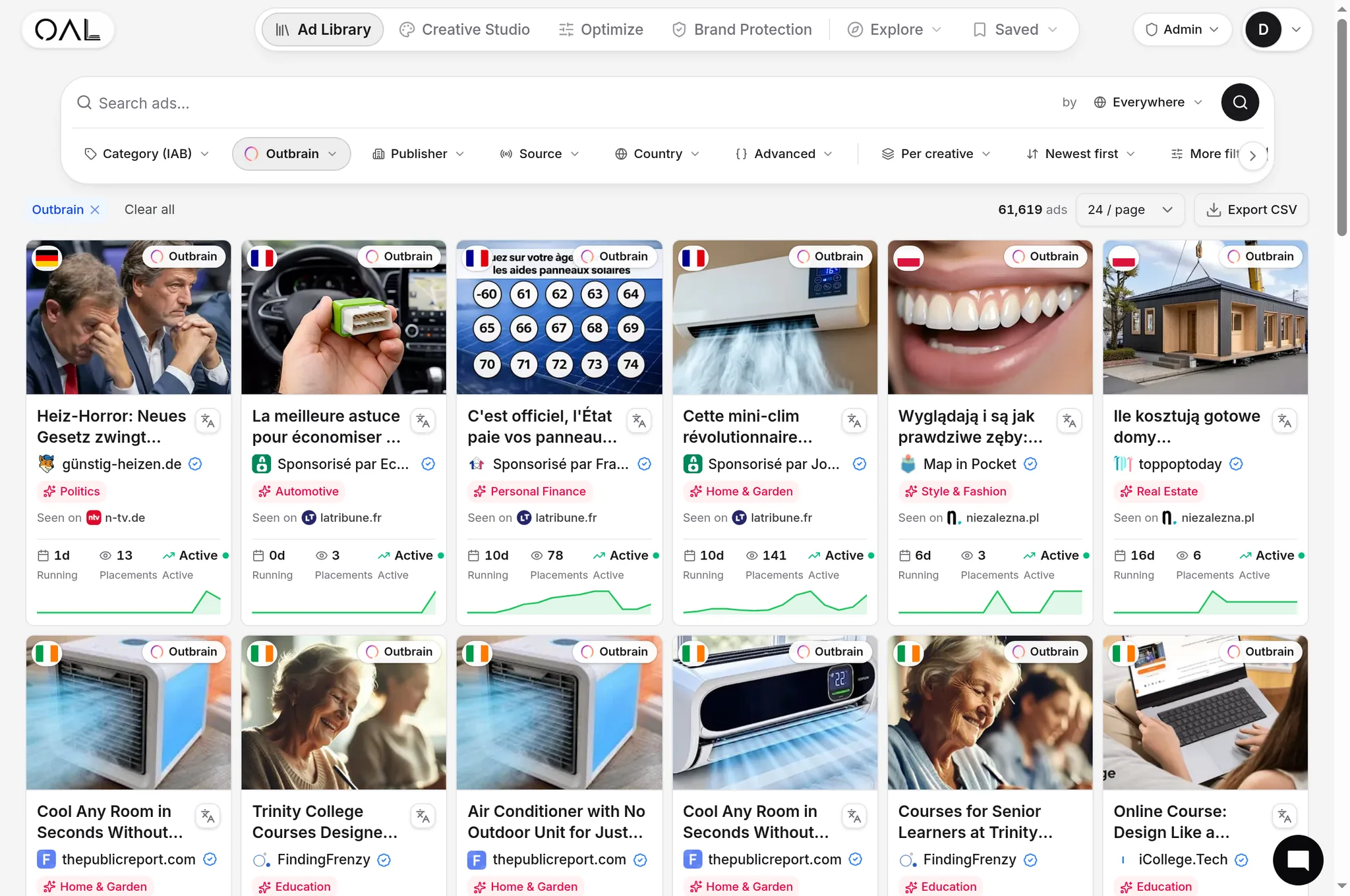
Here is what a real Outbrain placement looks like once you capture it. The brand on the card is a publisher name, not the company funding the campaign:

Why the old approach broke#
For years the standard competitive workflow leaned on whatever the networks chose to reveal. Outbrain's older interfaces, plus a few legacy spy tools that scraped them, gave buyers a workable view of rival creatives. The Teads merger collapsed that. Consolidation almost always cuts public transparency: fewer separate dashboards, tighter API access, and a clear incentive to keep the combined inventory's performance signals in-house.
The ad that has been live for weeks across dozens of publishers is not lucky. It is the one paying its own way. Longevity is the closest thing to a public profit signal native advertising has.
The practical takeaway: if your competitive process still depends on a network handing you creative data, it has a shelf life. The durable move is to treat the open web as your dataset and capture ads from the supply side, the publisher pages, where no merger can switch them off.
A capture-side workflow that survives platform changes#
Here is the workflow we use, reframed so you can run it with any serious native intelligence tool. The principle: observe the same ads a real user in a given geo would see, then enrich them.
- Capture live placements, do not ask the network. The ads you want are rendering right now on premium sites. A capture-side tool loads those pages from real geographies and records the native creative at full quality, the actual image, the headline, the placement context, rather than relying on an Outbrain feed that may be throttled or sanitized.
- Resolve the real advertiser. Take the surface brand with a grain of salt. The valuable step is classifying the ad-tech supply chain behind the creative and following the click through its redirects to the final landing page. That is how you learn that "HealthLiving Daily" is really a supplement advertiser running a quiz pre-lander.
- Read longevity and spread. A single sighting tells you almost nothing. The signal lives in the time series: how many days a creative has stayed live, and how many distinct publishers carry it. Ads that persist and spread are being funded because they convert.
- Pull the landing page and pre-lander. The creative is the hook. The money is made on the page after the click. Capturing the landing page, including any advertorial or quiz-style pre-lander, shows you the full funnel, not just the thumbnail.
- Decompose the winners. Once you have isolated ads that survive, break them into reusable parts: angle, headline formula, thumbnail style, offer, and funnel structure. That is what you actually port into your own tests.
This is exactly the model OpenAdLibrary is built around. It captures live public native ads across Outbrain/Teads and the other major networks, stores the real creative image at full quality, classifies the supply chain, and follows each click to the advertiser's landing page, without ever clicking live ads. Its per-creative Outbrain reporting was specifically cracked to restore the granularity advertiser dashboards stopped exposing after the Teads transition.
Where the Outbrain volume actually concentrates#
If you want to know where to point your research, follow the creative counts. On Outbrain specifically, finance leads with 2,640 captured creatives, insurance is right behind at 2,615, then health at 2,016, ecommerce at 1,479, software at 1,197, and home and garden at 1,091 (OpenAdLibrary index, June 2026). That order is not random. Those are the verticals where the math on premium native traffic works, so that is where the competition is thickest and the creative iteration is fastest.
Health is the loudest category on the card itself. The headlines get blunt because curiosity and a little alarm are what earn the click:


Zoom out to the whole index and the ranking holds across networks: finance (17,232 creatives), insurance (15,629), health (14,895), and ecommerce (13,872) are the four heaviest verticals overall, with entertainment, software, and travel close behind (OpenAdLibrary index, June 2026). If you sell in any of those, you are competing in the most crowded rooms in native, which is precisely why you need to see what already survives there.
What you can and can't learn#
Setting expectations honestly is part of doing this well. Here is the line between real, capturable signal and the numbers you should never trust from any spy tool.
| Signal | Can you get it? | How to read it |
|---|---|---|
| Competitor's exact spend | No | Private to their account; "estimates" are guesses |
| Exact CPC / CPM paid | No | Auction-specific and private |
| Live creatives & headlines | Yes | Captured directly from publisher pages |
| Real advertiser behind the ad | Yes | Via supply-chain classification + click trace |
| Landing page & pre-lander | Yes | Captured by following the click |
| Creative longevity (days live) | Yes (proxy) | Strongest public winner signal |
| Publisher spread | Yes (proxy) | Wide spread = scaled, working campaign |
| Geo & device targeting hints | Partial | Inferred from where/how an ad renders |
The takeaway: stop hunting for a fake spend number and start reading longevity and spread. Those two proxies, captured accurately, will steer your budget better than any dashboard estimate.
One honesty note on longevity, because plenty of tools fudge this. Industry lore loves to talk about "90-day winners." That is general folklore, not something our index claims. Our continuous observation window currently spans up to about 28 days per creative, so when we say a creative is a probable winner we mean we have actually watched it stay live across that window. The longest-running ads we are tracking right now, finance pieces like SmartAsset's "Ask a Pro: How Can I Avoid Paying Taxes on IRA Withdrawals?" on Outbrain, sit at 28 observed days (OpenAdLibrary index, June 2026). Read "days observed live," not invented multi-month claims.
How Outbrain spying differs from the other native networks#
Outbrain/Teads inventory skews toward premium, brand-safe publishers: major news, finance, and lifestyle properties. That shapes what wins. The creatives lean editorial and curiosity-driven rather than the harder-edged, high-volume style that thrives on more aggressive networks. You still see clickbait, but it is dressed up. A car promotion runs as a sponsored brand placement, not a screaming offer:

If you allocate budget across multiple sources, study them side by side rather than assuming a winner ports cleanly between them. Our pillar on the best native ad networks in 2026, ranked by real ad volume maps where the inventory and advertisers actually concentrate. If your decision is specifically Outbrain versus its largest rival, the data-backed Taboola vs Outbrain comparison, updated for the Teads era, breaks down reach, advertiser mix, and where each platform's creatives genuinely differ. And if your budget is more mid-tier, the MGID vs Revcontent comparison covers the networks where lower CPCs and looser inventory often produce faster creative iteration worth mirroring.
A concrete example#
Say you sell a finance newsletter and want to know what is working in the space on Outbrain. A capture-side search surfaces a creative, plain chart thumbnail, headline like "The boring stock quietly up 240%," that has been live for several weeks across a dozen finance publishers. Finance is the single biggest Outbrain vertical in our index, so you will not be short of comparables. That persistence alone flags it as a probable winner.
Now trace it. The visible brand is a generic content site, but the click routes through two redirect domains to an advertorial pre-lander that frames a single stock pick, then funnels to a subscription page. You now know the angle (contrarian and curiosity-led), the funnel (advertorial then subscription), the offer structure, and roughly the geos where it is served. None of that came from Outbrain. All of it came from capturing the ad where it lives and following the click. And it is directly actionable for your next test.
Where this fits in your stack#
Ad spying is not the whole job. It is the input. Once you have isolated durable Outbrain/Teads creatives and decomposed them, the value is in execution speed: turning a captured winner into a tested variant of your own, then watching whether your version starts showing the same longevity. Pairing capture-side intelligence with creative production and optimization (the Creative Studio, Optimize, and Copy DNA workflows) closes that loop, and an API and MCP layer lets you wire the same data into your own dashboards.
It also helps to ground your reads in cost reality. Knowing a creative survived several weeks means more once you understand what native traffic actually costs to buy. Our 2026 native ad budgeting guide covers the CPC ranges and minimums you will face on Outbrain/Teads, so you can judge whether a competitor's persistence implies a budget you can match.
The bottom line#
The Teads merger did not kill Outbrain ad spying. It killed the lazy version that depended on the network volunteering data. The ads are still public. You just capture them from the supply side, resolve the real advertiser, and read longevity and spread instead of imaginary spend figures. Do that and you arguably get a better view than the old dashboards gave you, because you are seeing the full funnel a competitor built, not a sanitized creative list.
That is the whole premise behind OpenAdLibrary as an Outbrain ad spy tool: open, affordable native intelligence, the real advertiser, the traced landing page, and the longevity signals, without the $80 to $400 per month price tags of the legacy incumbents. Start free and browse 200 live native ads, no card required.