
 Español
 Português (Brasil)
 Français
 Deutsch
 Italiano
 Nederlands
 Polski
 Svenska
 Türkçe
 Русский
 Tiếng Việt
 Bahasa Indonesia
 Dansk
Dansk Norsk (bokmål)
 Suomi
Suomi Ελληνικά
 Română
 Українська
 ไทย
ไทย8 MGID Alternatives for Advertisers & Publishers, Compared
Taboola, Outbrain (Teads), Revcontent, MediaGo, Microsoft Audience Network, Yahoo, Dianomi and TripleLift — eight MGID alternatives compared with live ad counts, entry bars and honest fit guidance.


Eight MGID alternatives are worth shortlisting: Taboola and Outbrain (now Teads) for premium scale, Revcontent as the closest like-for-like mid-tier network, MediaGo and the Microsoft Audience Network for Microsoft-ecosystem inventory, Yahoo's native supply via its DSP, and Dianomi and TripleLift for specialist and programmatic-native buying. Which one fits depends on which side of the market you sit — advertiser or publisher — and on what pushed you off MGID in the first place: creative-quality standards, Tier-1 reach, RPM ceilings, or moderation friction. Below, each option with live ad-volume data from OpenAdLibrary's index of 725,000+ native creatives across 49 networks (July 2026), and an honest read on who should pick what.
Why advertisers and publishers outgrow MGID#
MGID's accessibility is real, and nothing below argues otherwise. But three complaints recur:
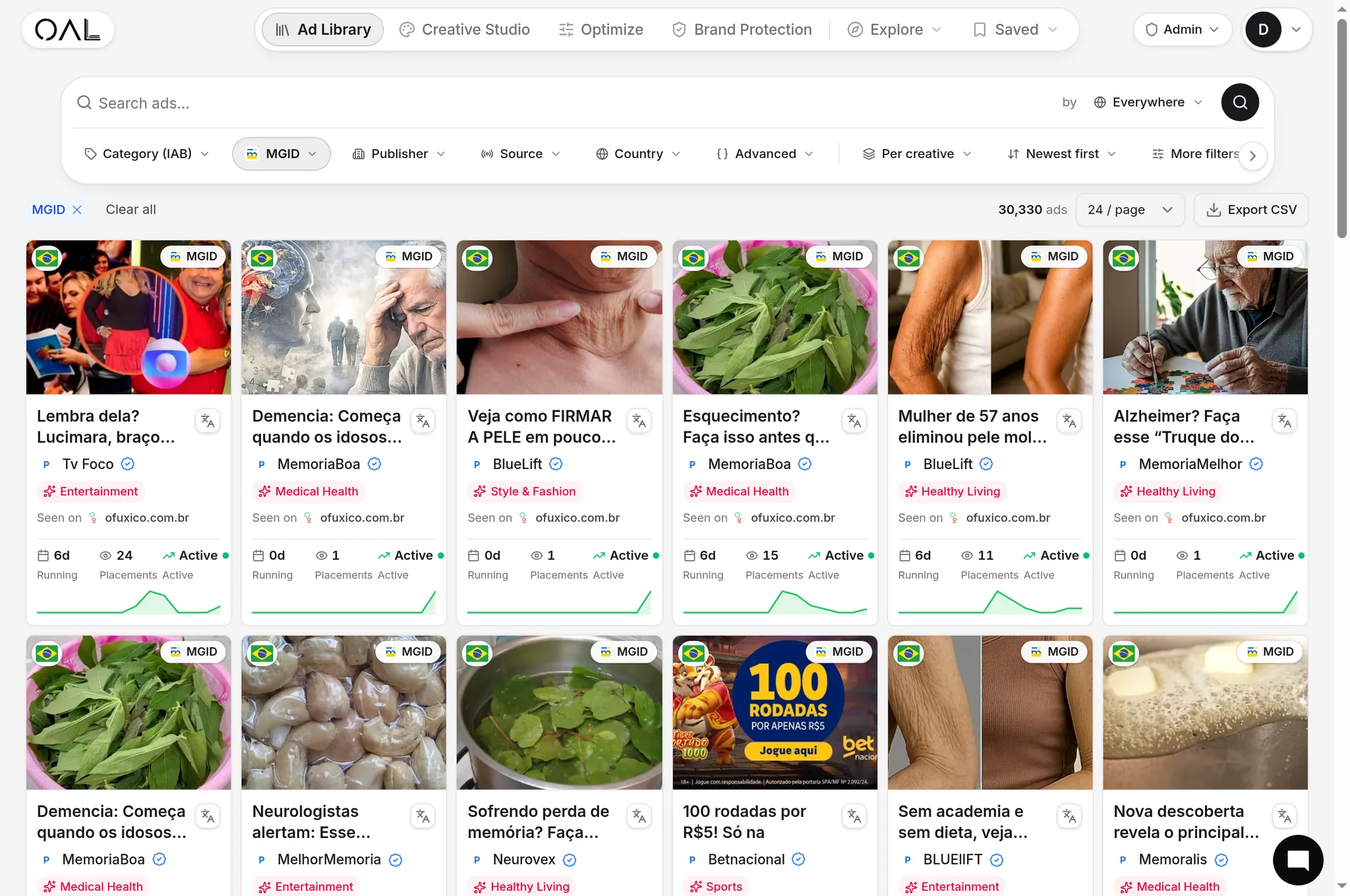
- The creative neighborhood. Entertainment-teaser demand dominates the network — 13,987 of its 62,765 live indexed creatives classify as entertainment, the largest vertical by more than eleven times — and both brand advertisers and premium publishers eventually want cleaner company.
- Tier-1 depth. MGID's inventory strength is the global mid-tier. Buyers chasing scale in premium US, UK and DACH editorial supply hit its ceiling and start looking up-market.
- Standards friction, in both directions. Some advertisers want stricter moderation around their placements; some publishers want demand that earns more per thousand on affluent audiences.
Every alternative below trades away some of MGID's accessibility to fix one of these. There is no free upgrade — only better fits.
The eight alternatives at a glance#
| Network | Best for | Publisher entry bar | Live creatives in OpenAdLibrary's index (July 2026) |
|---|---|---|---|
| Taboola | Scale on both sides of the market | High — premium pageview thresholds commonly reported | 206,145 |
| Outbrain (Teads) | Premium editorial supply, brand-heavier demand | High | 108,573 |
| Revcontent | Closest like-for-like mid-tier swap | Moderate — selective | 15,789 |
| MediaGo | Microsoft-ecosystem reach, ecommerce offers | Advertiser-first platform | 6,571 |
| Microsoft Audience Network | Search-adjacent native buying via Microsoft Advertising | n/a — demand platform | 281,839 (MSN capture) |
| Yahoo (DSP) | Programmatic native plus Yahoo owned-and-operated | n/a — DSP route | 5,926 |
| Dianomi | Finance and business audiences on premium publishers | Selective, finance-focused | — |
| TripleLift | Programmatic native through your existing DSP | Via SSP integration | — |
Counts are live creatives observed per network; Dianomi and TripleLift inventory is not broken out as a separate slice in the index. Volume is not a quality score — but it is the honest measure of how much demand actually flows through each pipe, and it exposes marketing claims quickly. A network pitching "premium scale" with a few thousand live creatives is selling context, not reach; that can still be the right buy, as long as you price it as what it is. The sections below follow the table in order, advertiser lens first, publisher lens at the end.
Taboola: the scale benchmark#
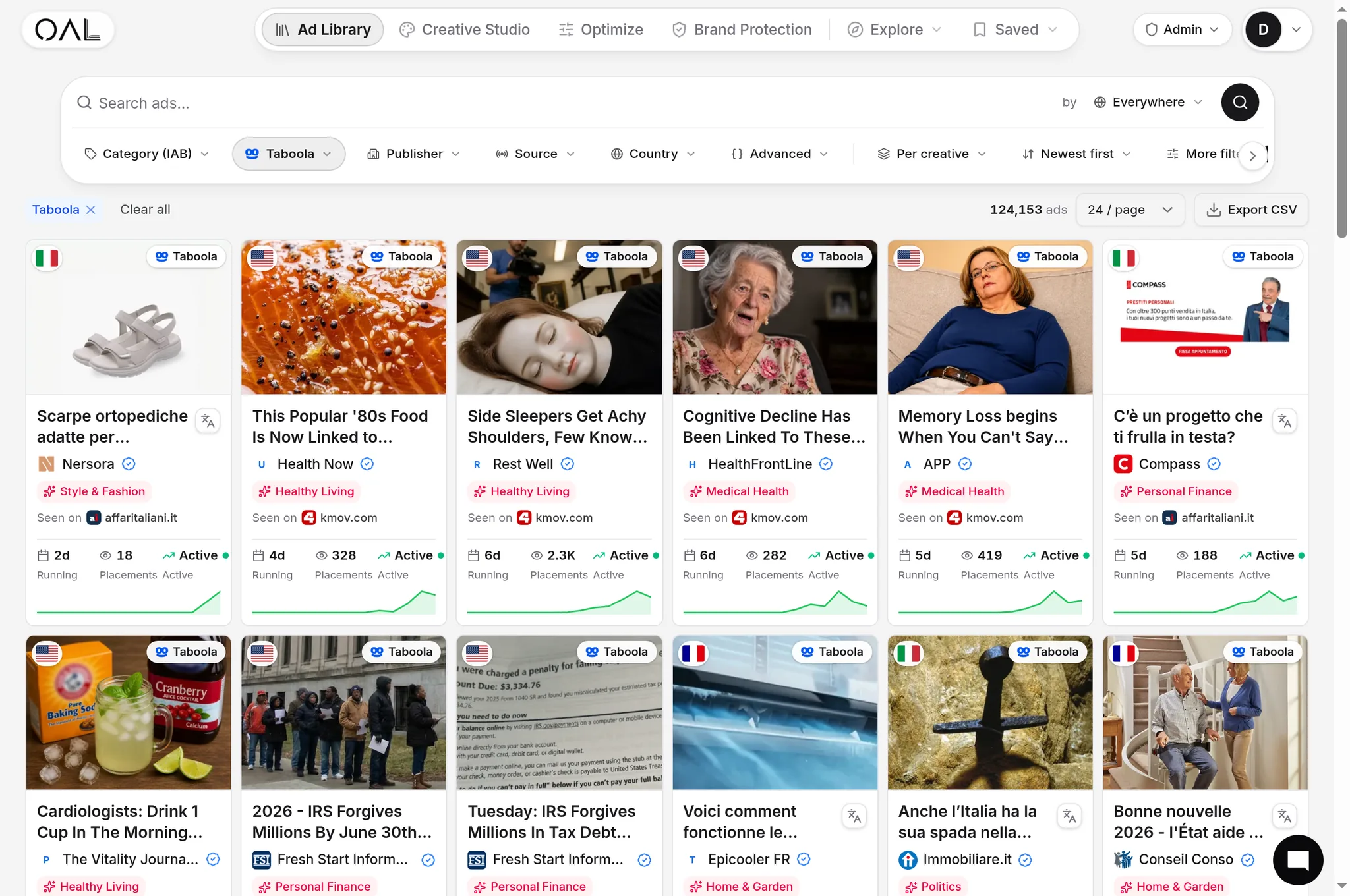
Taboola is the largest dedicated content-recommendation network we index, with 206,145 live creatives — more than three times MGID's slice. For advertisers that buys reach into premium publisher feeds, deeper Tier-1 auction liquidity, and better brand-side tooling; it also costs more per click and enforces stricter creative moderation, so angles that cruise through MGID's review will need cleaning up before they clear Taboola's.
The demand profile tells you who thrives there: Taboola's largest classified verticals in our index are health (11,982), finance (8,200) and insurance (7,422) — offer categories with deep funnels and deep pockets, competing hard for the same Tier-1 readers. That competition is the real cost of the upgrade. Media buyers commonly report Tier-1 desktop CPCs from roughly $0.20 to $0.90 on premium native inventory, against materially cheaper clicks on the mid-tier — non-official figures that your vertical and geo will move a lot, but the direction is reliable: you pay for the context and the liquidity.
For publishers, Taboola is the aspirational direct deal — entry bars commonly reported in the several-hundred-thousand monthly pageview range, negotiated revenue shares or guarantees, and multi-year exclusive contracts whose auto-renewal clauses deserve a lawyer's read. Whether the premium is worth it for buyers is examined against live data in is Taboola worth it, and the direct comparison is in MGID vs Taboola.
Outbrain (now Teads): premium supply, brand-heavier demand#
Outbrain merged with Teads and operates under the Teads name — the mechanics of that consolidation are unpacked in did Outbrain become Teads. The combined platform holds 108,573 live creatives in our index and skews toward premium editorial publishers and brand-adjacent demand: in the same index its largest classified verticals are insurance (4,345), finance (3,990) and health (3,102), a very different neighborhood from MGID's entertainment wall.
For advertisers the pitch is context and format range: feed placements on serious editorial supply plus the video-forward brand formats the Teads side built its business on. Performance buyers still run advertorial funnels here, but the moderation line sits noticeably higher than MGID's, and the audience skews toward readers of established news brands — which changes what converts. For publishers, Teads is the other premium direct conversation besides Taboola, with similar scale expectations and a demand mix that reads better next to journalism. The trade in both directions: higher entry bars, slower experimentation, and less tolerance for aggressive funnels. Choose it over MGID when your offer needs credibility rubbing off from its surroundings — financial products, considered purchases, anything where the reader checks who else is on the page.
Revcontent: the closest like-for-like swap#
Revcontent occupies MGID's tier of the market while positioning itself as the selective one: it reviews publishers for engagement and originality rather than accepting on scale alone, and its 15,789 live indexed creatives skew to health (2,566 classified) rather than entertainment — followed by finance, home & garden and insurance, an offer-led mix that looks more like a small Taboola than a small MGID.
For advertisers, that means advertorial-tolerant traffic with somewhat tighter review and an audience that skews more Tier-1 and engaged than MGID's international mid-tier — health and lead-gen funnels that already work on curiosity traffic usually port over with minimal creative surgery, which is why this is the default first alternative to test. For publishers, it is a network that says yes at mid scale but asks for genuinely engaged audiences, and offers unusually granular widget styling in return. Mechanics in how Revcontent works, and the direct matchup in MGID vs Revcontent.
MediaGo and the Microsoft Audience Network: the Microsoft-ecosystem route#
These two are different animals that hunt the same terrain. MediaGo, operated by Baidu, is an advertiser-first native platform whose visible footprint concentrates on Microsoft surfaces — MSN placements feature heavily in its 6,571 indexed live creatives — with a machine-learning-forward targeting pitch and a demand mix led by insurance, home & garden and ecommerce. It has built a reputation among ecommerce and lead-gen buyers as the quieter auction: less incumbent creative volume than the big recommendation networks, on inventory whose audiences skew older and desktop-heavier than the social-native crowd. Browse its live inventory in the MediaGo ad library.
The Microsoft Audience Network is Microsoft's own native demand channel, bought through Microsoft Advertising alongside search, serving MSN, Outlook and Edge inventory with Microsoft's audience signals attached. Our MSN capture — 281,839 live creatives — is the single largest network slice in the index, which says something underappreciated: the quietest native ecosystem is also one of the biggest. Setup, formats and buying mechanics are covered in the MSN native ads guide.
Choose MediaGo if you want a managed native platform with Microsoft reach and hands-on support; choose MAN directly if you already run Microsoft search and want native as an extension with shared conversion tracking and audience data. Either way, the creative register differs from MGID: cleaner, more product-forward units clear review and convert on these surfaces, so budget a creative pass.
Yahoo, Dianomi and TripleLift: DSP and specialist routes#
Yahoo retired its Gemini self-serve native platform and folded native buying into the Yahoo DSP — the history and current state are in what happened to Yahoo Gemini. Its 5,926 indexed live creatives make it a modest slice, but the DSP route bundles Yahoo's owned-and-operated properties — still enormous consumer surfaces — with programmatic reach, which suits teams already buying through a seat. The practical barrier is exactly that: this is a platform-and-minimums conversation, not a credit-card signup, so it filters out the solo buyer by design.
Dianomi is the specialist: native placements on premium financial and business publishers, serving finance, fintech and B2B advertisers who need affluent, compliance-sensitive contexts that MGID structurally cannot offer. If your offer is a regulated financial product, the question is rarely Dianomi versus MGID — it is Dianomi versus Teads, and the deciding factor is how narrow your audience is.
TripleLift is programmatic native infrastructure — template-based native units bought through your existing DSP rather than a self-serve network UI, with creative assembled to match each publisher's look. It suits teams that want native reach folded into existing programmatic buying, reporting and frequency control rather than another standalone dashboard.
The common thread: all three trade MGID's cheap, fast experimentation for context quality or pipe integration. None is a first channel for a solo affiliate; all three make sense as incremental supply for teams with an existing stack and proven creative.
Which alternative should publishers pick?#
Ranked by accessibility rather than prestige:
- Revcontent — the natural next application at mid scale, if your audience is engaged and Tier-1-weighted. Expect selectivity, not a rubber stamp.
- Taboola / Teads direct — the premium deals, realistic only at several hundred thousand monthly pageviews and up. Guarantees and negotiated shares are the upside; multi-year exclusivity is the thing to read twice. Both networks' publisher realities differ enough from MGID's that the full comparison in best native ad networks is worth the time.
- Specialist and programmatic supply — Dianomi for finance-heavy editorial, TripleLift-style native via your SSP stack — usually additive to a recommendation widget rather than a replacement for it.
The honest publisher take: if MGID's RPM disappoints on a premium audience, the fix is moving up-market. If it disappoints on a mid-tier or international audience, the fix is more likely layout, engagement and density work than a network swap — the alternatives at your tier will pay within the same band.
Migration playbook: moving budget without losing signal#
Advertisers switching networks lose money in the gap between the old learnings and the new auction. The sequence that minimizes it:
- Export the learnings, not just the creatives. Before touching the new platform, write down what MGID taught you: winning angles ranked by longevity, the geos that paid, the publisher placements that converted versus burned. That document is the asset; the ad images are replaceable.
- Parallel-run for two to four weeks. Keep MGID live at maintenance budget while the new network exits its learning phase. Cutting the profitable channel before the replacement is proven converts a migration into a gamble.
- Port tracking first. Postbacks, click IDs and UTM conventions differ per network. Verify conversion data flows end-to-end on a small test campaign before scaling spend — attribution gaps discovered at scale are the expensive kind.
- Rebuild allow-lists from zero. Publisher and placement IDs do not transfer between networks. Expect the first weeks to re-run the placement-quality filtering you did years ago on MGID, and budget for it.
- Re-clear moderation deliberately. Submit softened variants of your proven angles rather than testing the new network's review line with your most aggressive creative. An account flagged in week one starts every later review from behind.
Hold the new network to a simple bar: beat MGID's cost per outcome for a full month at meaningful volume. Until it does, it is a test, not a migration.
How to choose: a buyer's checklist#
- Match the network to the offer's natural context. Finance lead-gen belongs where finance demand concentrates (Teads, Dianomi); impulse ecommerce and story-driven offers thrive where curiosity traffic is cheap (MGID, Revcontent); mass-reach advertorial scales on Taboola.
- Price the moderation pass. Every step up-market means stricter creative review. Budget the rework before the migration, not after the rejections.
- Check geo depth against your payout map. MGID's edge is international mid-tier inventory; Taboola's and MAN's is Tier-1 depth. A network that cannot serve your paying geos cheaply is no alternative at all.
- Verify the demand or supply with live data, not sales decks. Before moving budget, look at what actually runs on each candidate: the Taboola spy page, Revcontent spy page and MGID spy page show live creatives, resolved advertisers and how long each ad has survived — and an ad that keeps running for weeks is an ad that keeps paying.
- Move sequentially. Prove the funnel on one network, port the winners, and let performance set the split. Cross-network expansion multiplies tracking and moderation overhead before it multiplies profit.
None of the eight is a universal upgrade — each fixes a specific MGID complaint at a specific price. Name your complaint precisely, and the shortlist above usually collapses to one obvious candidate and one control test.