Español
 Português (Brasil)
 Français
 Deutsch
 Italiano
 Nederlands
 Polski
 Svenska
 Türkçe
 Русский
 日本語
日本語 한국어
한국어 简体中文
简体中文 Tiếng Việt
 Bahasa Indonesia
 繁體中文
繁體中文 Čeština
 Dansk
Dansk Norsk (bokmål)
 Suomi
Suomi Ελληνικά
 Română
 Magyar
 Українська
 ไทย
ไทย हिन्दी
 العربية
 עברית
עבריתTaboola Ad Spy: How to See Competitors' Taboola Ads (Free)
Taboola has no public ad library, so here's how to reconstruct one: filter live captures by network, vertical and geo, rank advertisers by volume and days live, then pull the full creative and the click-to-landing trace.

Taboola serves native recommendation ads across tens of thousands of publisher sites: the "From around the web" and "You may like" widgets stapled under articles. Billions of impressions a day flow through it, and somewhere in that stream are the exact creatives, headlines, and landing pages your competitors are paying to keep alive. Here's the catch. Taboola has no public ad library. You can't type a competitor's name into Taboola and pull their ads the way you can on Meta or Google.
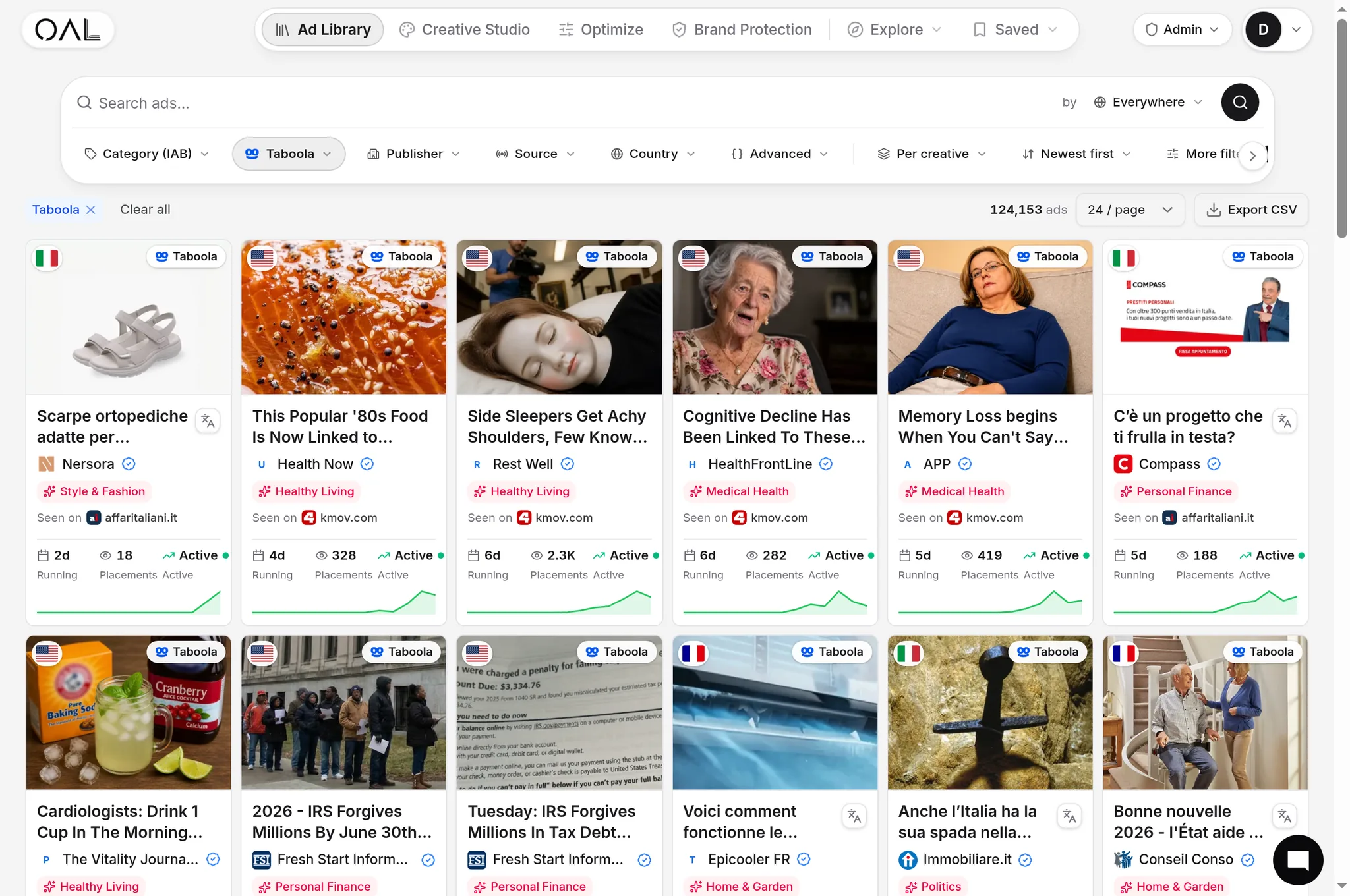
So you reconstruct it. This is a network-specific playbook for spying on Taboola ads: filter live captures down to Taboola plus a vertical plus a geo, rank advertisers by how much they're running and for how long, then open the full-resolution creative and the click-traced landing page. The goal isn't to admire ads. It's to reverse-engineer what already works before you burn a dollar testing it yourself.
For context on the haystack you're searching: OpenAdLibrary's index holds 157,727 Taboola creatives as of June 2026, part of 589,036 creatives across 42 networks and 5.4 million individual ad observations. That's the raw material. The workflow below is how you turn it into a competitor map.
What "Taboola ad spy" actually means#
A Taboola ad spy tool captures the native ads running live on Taboola's network (the creative image, the headline, the publisher site it ran on, the advertiser behind it, and the page the click lands on) and makes all of it searchable. Because Taboola ships no official library, third-party capture is the only dependable way to see competitors' active Taboola creatives at scale.
The distinction matters because people conflate two different things. "Seeing an ad" is trivial. Scroll any news site and you'll trip over a Taboola widget. "Spying" means systematic competitive intelligence: knowing who runs what, where, for how long, and to which offer. That's the gap between noticing one ad and mapping a competitor's whole native strategy. If you're new to the category mechanics, our Ad Spy Tool glossary entry covers the basics.
Taboola is the largest open-web native network by reach, which makes it the highest-value place to run this research and also the noisiest. A disciplined filter is what separates signal from the endless scroll.
Here's what a real Taboola finance card looks like in the wild:

That deadline framing isn't an accident. Finance is the second-biggest vertical on Taboola in our index (5,558 creatives) behind health (6,048), and tax-relief offers lean hard on urgency because the click is the whole game.
The single most useful number in native ad spying isn't impressions or some spend estimate. It's days live. On Taboola, advertisers cut losing creatives within hours. An ad that's been running for three weeks is a confession that it's profitable.
Why Taboola has no public ad library (and why that's the opening)#
Regulators have pushed for ad transparency. The EU's Digital Services Act now forces very large platforms to keep searchable ad repositories. But those obligations land hardest on the walled gardens. Open-web native networks like Taboola sit in a grayer zone. Taboola's own policies require advertisers to label sponsored content and disclose the source of promoted offers, which is good for users, but disclosure on the ad is not the same as a public, queryable database of every advertiser's creatives. There is no "Taboola Ad Library" you can search.
That's exactly the gap a capture-based tool fills. Where the platform won't hand you transparency, you rebuild it by watching the live network. OpenAdLibrary does this for Taboola and the rest of the native ecosystem: Outbrain (which merged with Teads in February 2025 and now operates under the Teads brand), MGID, Revcontent, MediaGo, Yahoo, and MSN. For the wider landscape and how the networks rank by real ad volume, start with Best Native Ad Networks in 2026 (Ranked by Real Ad Volume), the pillar this guide sits under.
The 5-step Taboola spy workflow#
Here's the exact sequence. Ten minutes the first time, two minutes once you've saved your filters.
1. Filter to the Taboola network#
Start broad, then narrow. In OpenAdLibrary, set the network filter to Taboola so you're only looking at Taboola placements, not Outbrain or MGID inventory, which behaves differently on cost and audience. This one filter cuts the noise by an order of magnitude and everything else builds on it.
2. Add your vertical#
Native ads cluster hard by vertical: supplements, finance, insurance, survival, "weird trick" health, e-commerce gadgets, mobile games. Layer a vertical or keyword filter on top of Taboola so you're studying your actual competitive set. The concentration is real. In our index the top six Taboola verticals are health (6,048 creatives), finance (5,558), insurance (4,303), e-commerce (3,330), home and garden (2,630), and software (2,206). If you run skincare offers, you don't care what a crypto advertiser is doing. You care about the other health and beauty advertisers fighting for the same placements you're bidding on.
Health is the heaviest category, and the angles get aggressive. This one had been live 26 days when we captured it:

3. Pin the geo#
Taboola creatives, claims, and landing pages vary enormously by country. A US health angle won't be the one running in Australia or the UK, and compliance differs too. Filter to the geo you actually buy in. A common rookie mistake is studying US creatives and then wondering why they flop on AU or CA traffic. Here's a geo-specific insurance card aimed straight at one market:

Note the country named in the headline. That's not generic copy. The advertiser is buying AU inventory and writing for it, which is exactly the kind of localized angle you'll miss if your filter is stuck on US.
4. Rank advertisers by ad volume and run days#
This is where spying becomes intelligence. Sort the advertisers in your filtered view by two signals:
- Ad volume. How many distinct creatives an advertiser has live. High volume means active, well-funded testing.
- Run days (longevity). How long individual creatives have stayed up. A long run is a proven winner.
The advertisers scoring high on both are your real competition. They're testing aggressively and finding winners. Their surviving creatives are a free education in what converts on Taboola right now.
One honest caveat about longevity numbers. Our index currently spans up to about 28 days of continuous observation per creative, because that's how long we've been tracking these particular ads. So when you see "28 days running" in the data, read it as "live for at least the entire window we've watched," not as a hard ceiling. The classic native lore about "90-day winners" is industry folklore, not something we've measured. What we have measured is which ads survive the full window, and the survivors cluster in predictable places: hearing aids, IQ quizzes, tax and finance offers, and pet content. The longest-running creatives in the index right now sit at that 28-day mark across health, finance, gaming, and entertainment.
5. Open the full creative and the landing trace#
For each winning ad, open the full-resolution creative image (not a thumbnail, you want to read the exact headline, see the image treatment, and clock the visual hook) and then follow the click to the landing page. OpenAdLibrary traces each ad to its destination, the advertiser's landing page or pre-lander, without clicking live ads and inflating the advertiser's real click stats. The landing page is usually where the money logic lives: the offer, the price point, the funnel, the upsell path.
What to record for each competitor#
Don't just look. Log it. A simple capture table turns scattered browsing into a strategy document you can act on:
| Field | Why it matters |
|---|---|
| Advertiser / brand | The real entity behind the ad, not just the on-card label |
| Creative count (live) | Testing velocity, how aggressively they iterate |
| Longest run (days) | Their proven winner; copy the angle, not the asset |
| Top publishers seen | Where their inventory concentrates on Taboola |
| Geos active | Markets they've validated |
| Landing page / offer | The funnel and price point you're actually competing against |
| Headline pattern | The hook that's surviving (curiosity, fear, number, before/after) |
One nuance worth internalizing: the visible sponsor name on a Taboola card is not always the real advertiser. Native is full of arbitrage players, media-buying agencies, and white-label brands. Look at the brand names in our capture set, "Consumer World," "Vital Guardian," "The Vitality Report," "Fresh Start Information." These are content fronts, not the underlying offer owner. The landing-page domain is the more honest identifier, which is exactly why following the click matters more than reading the label. Two cards with different brand names can resolve to the same offer page. That's one advertiser running a split test, and it's invisible if you only read the front of the card.
Reading the signals: winner versus noise#
Once you've got a filtered, ranked view, here's how to read it like someone who's bought native at scale:
- Longevity beats everything. A creative live for three weeks on Taboola is worth more study than ten ads launched yesterday. Native auctions are brutal. Survival is the signal. This is the core idea behind spy tools generally, but it's especially true on native.
- Spread confirms longevity. A winner shows up across many publisher sites, not just one. Breadth of placement plus run days together is a near-certain profitability tell.
- Angle clusters reveal market truth. When five unrelated advertisers in your vertical all run the same hook, that hook is converting on cold Taboola traffic. The "doctors identify X medications" and "this common snack is tied to cognitive decline" structures repeat across different brands in our health captures for exactly this reason. Don't reinvent. Adapt.
- Watch the price point on the landing page. If every surviving competitor lands on a $39 offer with a 3-bottle upsell, that's the economics Taboola CPCs currently support in your vertical. Pricing your own offer blind to that is how budgets evaporate. For the cost side, see How Much Do Native Ads Cost? A 2026 Budgeting Guide.
Here's a "tested it for you" e-commerce angle that ran 5 days, the format that dominates the gadget and home verticals:

Notice the price is baked into the headline. That's the advertiser pre-qualifying clicks so they only pay for traffic that's already comfortable with a $138 price point. Small detail, real money.
Taboola versus the other native networks for spying#
Taboola is the obvious starting point because of reach, but good researchers don't spy on one network in isolation. The same advertiser often runs the same offer across several, and comparing where a winning creative also appears tells you how much budget is behind it.
- Taboola vs Outbrain/Teads: the two largest premium-publisher native networks, heavy overlap in advertisers and inventory. If you're choosing a network or want to see where competitors split spend, Taboola vs Outbrain in 2026 breaks down the data.
- Taboola vs Revcontent: Revcontent skews toward higher-volume, lower-CPC inventory, often the same offers at a different stage of the funnel. Revcontent vs Taboola covers reach and advertiser mix.
- Taboola vs MGID: MGID is the mid-tier challenger where many advertisers test before scaling onto Taboola. MGID vs Taboola maps which fits which budget.
Spying across all of them in one tool means you see a competitor's full native footprint, not a single slice.
Turn intelligence into action, without copying#
The point of all this isn't to clone a competitor's banner. That's how you end up with a worse version of a winner already saturating the same placements. The point is to extract the pattern: the angle, the funnel logic, the price economics, the audience the geo implies. Then build something better.
OpenAdLibrary is built to close that loop. Once you've found a winning Taboola pattern, Creative Studio helps you spin fresh creatives off the insight (learn, don't copy), Optimize ties what you've learned back to live campaign decisions, and Copy DNA, the API, and an MCP endpoint let you pull competitive data straight into your own stack. Research and execution live in the same place.
If native spy tools have priced you out at $80 to $400 a month, the math here is different. You can browse around 200 live native ads (Taboola included, full creatives and landing traces) with no card at all, and full access runs $29.99/mo.
Start free and run your first Taboola spy in the next ten minutes: filter to Taboola, pin your vertical and geo, rank the advertisers, and open the winners.