
 Español
 Português (Brasil)
 Français
 Deutsch
 Italiano
 Nederlands
 Polski
 Svenska
 Türkçe
 Русский
 日本語
日本語 한국어
한국어 简体中文
简体中文 Tiếng Việt
 Bahasa Indonesia
 繁體中文
繁體中文 Čeština
 Dansk
Dansk Norsk (bokmål)
 Suomi
Suomi Ελληνικά
 Română
 Magyar
 Українська
 ไทย
ไทย हिन्दी
 العربية
 עברית
עבריתWho Advertises on Outbrain? The Live Advertiser Mix, Layer by Layer
Brands, performance advertisers and arbitrage players: the three layers of Outbrain's advertiser base, mapped with live index data and real running creatives.


Outbrain's advertiser base is a three-layer mix: brand and corporate-content advertisers buying premium-publisher reach, performance and affiliate marketers running advertorial funnels in health, finance and insurance, and media-arbitrage players buying clicks into ad-monetized content. As of July 2026, OpenAdLibrary's index holds 108,000+ live Outbrain creatives — insurance, finance and health lead the classified verticals — and every advertiser behind them is resolvable and searchable. This article maps who is actually on the network, layer by layer, with live examples.
The advertiser mix, by the numbers#
Outbrain — which merged with Teads in 2025 and now operates under the Teads name (the merger, explained) — publishes no advertiser directory and no ad library. What follows comes from independent observation: continuous capture of live Outbrain placements into an index of 725,000+ native creatives across 49 networks. The Outbrain slice, classified by vertical:
| Vertical | Live creatives (July 2026) |
|---|---|
| Insurance | 4,345 |
| Finance | 3,990 |
| Health | 3,102 |
| Ecommerce | 2,277 |
| Software | 1,932 |
| Home & garden | 1,545 |
Two notes on reading the table honestly. The counts cover creatives our classifier has assigned to a vertical — a portion of the corpus always sits unclassified or mid-classification, so treat these as a floor and a ranking, not a census total. And creative count is not spend: one brand campaign may run three creatives on budgets that dwarf an affiliate's thirty-variant test grid.
Ranking aside, insurance and finance at the top is the signature Outbrain pattern — regulated, high-LTV categories whose advertisers value the premium editorial context the network built its publisher relationships on (how Outbrain works covers that inventory in detail). Health sits close behind, carried mostly by the performance layer described below.
Layer 1: brands and corporate content#
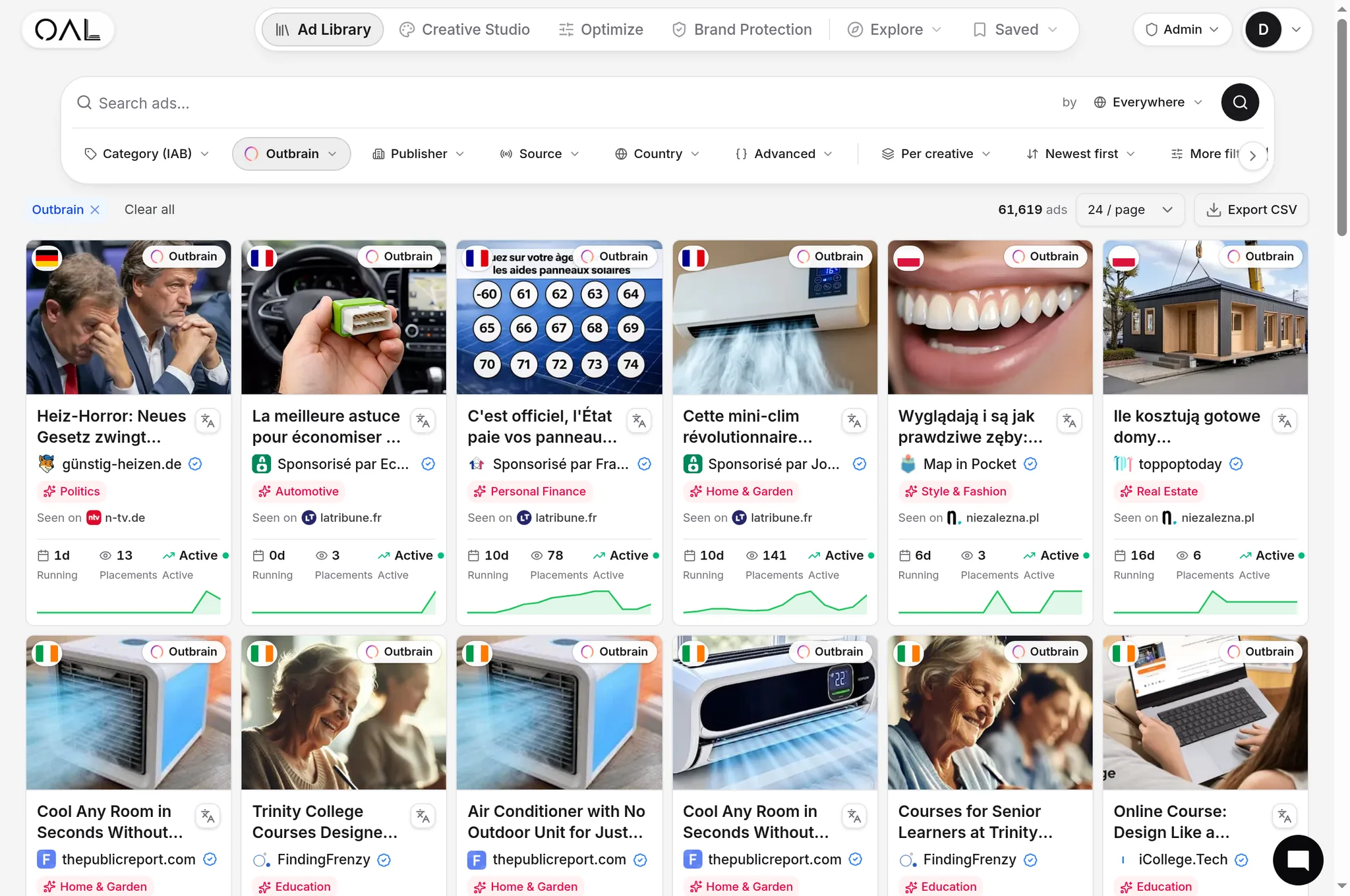
The most distinctive slice of Outbrain demand barely resembles direct-response advertising. Corporate-content programs use the network to distribute editorial-grade material onto premium news placements. A live example from the index: SPECTRA by MHI — Mitsubishi Heavy Industries' branded content hub — running story pieces like "Methane: Tackling a rising climate priority" (34 days) and "From trash to treasure: Waste to energy explained" (9 days). No offer, no urgency; the KPI is qualified attention, and the month-long run signals the program is getting it.
For buyers, this layer matters as context: on Outbrain you are sharing feeds with brand content, and creative that matches the calmer editorial register tends to travel further than shouty direct-response framing transplanted from other channels.
Layer 2: performance and affiliate advertisers#
The volume engine of the network. Advertorial funnels in beauty, health and finance dominate the creative count, and the live index shows the craft:
- The Skin Mag — "Moisturizer Won't Tighten Skin! Use This Household Item Instead" — a beauty advertorial hook at 30 days running.
- Health Weekly — "Cardiologist: 2 Veggies Will Kill Your Belly Fat Overnight!" — the authority-figure health angle, 22 days.
- SmoothSpine — "Why Your Sciatic Nerve Won't Heal (What Most Doctors Miss)" — problem-agitation into a device funnel.
- Tech-tips lead gen — "One Setting, Turn Off Ads (Android Users)" — utility hooks feeding software and security offers, 26 days.
These advertisers are the ones worth studying if you buy performance traffic: their survivors are proven combinations of hook, pre-lander and offer. The research method — filtering by vertical and run duration, then tracing landing pages — is written up in the Outbrain ad spy guide, and the same longevity logic applies here as everywhere: an ad still running after 30 days is almost certainly profitable.
Layer 3: content arbitrage#
The third layer buys clicks into content monetized by more ads — traffic arbitrage. The index shows it plainly: Novelodge's story-format creative "[Story] Man Helps Hitchhiking Girl To Get Home…" has run for 35 days, buying curiosity clicks into serialized content pages whose economics depend on the reader seeing more ads than the click cost to acquire.
Arbitrage demand is a permanent feature of native networks, and its 35-day survivor above is a reminder that the model works when run with discipline. For buyers, the layer's main relevance is auction context: arbitrageurs are ruthless, price-sensitive bidders whose margins force them out of any placement the moment it stops paying, which makes their sustained presence on a placement a weak but real quality signal. For publishers, this layer shapes what "fill" looks like on lower-tier placements.
What the mix means if you are buying#
- Expect real competition in insurance, finance and health. The vertical table above is your competitive census. Entering those categories means outbidding — or out-crafting — advertisers who have already survived the auction for weeks.
- Register matters. The three layers share feed space. Creative calibrated to editorial context (curiosity, authority, specificity) recurs among the long-runners across all three layers; imported hard-sell rarely does.
- The advertiser mix differs from Taboola's. The two networks overlap but skew differently — the comparison is mapped in Taboola vs Outbrain, and the Taboola-side census in who advertises on Taboola. Cross-network advertisers — brands running the same angle on both — are usually the strongest signal of a working offer, a pattern visible across top native advertisers by network.
- If you sell inventory, the mix is your revenue forecast. Publishers evaluating the network can read the same table: heavy insurance and finance demand means the feed on a business or news site will monetize with relevant, tolerable ads, while a lighter entertainment skew than mid-tier networks means fewer of the chum-style creatives that erode reader trust.
Reading a single advertiser's strategy from the outside#
Once you can pull any advertiser's full live portfolio, the metadata tells a story the creatives alone do not:
- Creative count signals phase. Two or three creatives that have run for weeks is a matured program in maintenance mode; thirty variants a few days old is an advertiser mid-test, burning budget to find an angle. Both are informative — the first tells you what won, the second what someone believes is worth testing.
- Longevity distribution separates winners from wishes. A portfolio where a handful of creatives carry 30+ day runs while the rest churn weekly shows you exactly which angles pay. Sort by run duration and read the top; ignore the churn.
- Angle spread reveals conviction. Ten executions of one claim means the advertiser has found something and is scaling it. Five unrelated angles means they have not — or are defending several offers at once.
- Landing page diversity maps the funnel test. Multiple creatives resolving to different pre-landers is a funnel experiment in progress; everything funneling to one page is a settled pipeline.
Ten minutes of this per competitor, monthly, is more strategic information than most paid intelligence subscriptions delivered a few years ago — and the underlying observation data is public behavior.
How to look up any Outbrain advertiser#
Since no official directory exists, the lookup runs through independent observation:
- Search the brand or domain in OpenAdLibrary's Outbrain spy tool — every captured creative resolves to an advertiser, with run dates, geo and device data attached.
- Read their live portfolio. All current creatives for that advertiser, sorted by longevity, show which angles they trust with budget.
- Trace the funnels. Each creative links to its captured landing page or pre-lander, so the full click path is inspectable without generating a billable click.
- Browse the corpus sideways. The Outbrain ad library supports vertical, geo and keyword filters when you want the census view instead of a single advertiser.
The advertiser column of a native network is public information rendered searchable — the network shows these ads to millions of readers daily. The only thing that was missing until recently was the index.