
 Español
 Português (Brasil)
 Français
 Deutsch
 Italiano
 Nederlands
 Polski
 Svenska
 Türkçe
 Русский
 日本語
日本語 한국어
한국어 简体中文
简体中文 Tiếng Việt
 Bahasa Indonesia
 繁體中文
繁體中文 Čeština
 Dansk
Dansk Norsk (bokmål)
 Suomi
Suomi Ελληνικά
 Română
 Magyar
 Українська
 ไทย
ไทย हिन्दी
 العربية
 עברית
עבריתTaboola vs Google Display Network: Where Should the Budget Go?
GDN is the broadest cheap-reach machine in advertising; Taboola is a native feed that supports advertorial funnels banners cannot. A practitioner framework — backed by live ad data — for deciding which job to give each channel.


Taboola and the Google Display Network solve different problems, and the budget split follows from that. GDN is the broadest cheap-reach machine in advertising — banner and responsive display ads across millions of AdSense sites and apps, automated by Google's bidding and plugged into the Google Ads stack you already run. Taboola is a native network: image-and-headline ads inside editorial feeds, clicked by readers who chose your headline, feeding advertorial-style funnels that banners cannot support. Direct response with a story to tell — health, finance, insurance, considered ecommerce — generally converts cold traffic better on Taboola; retargeting, broad awareness, and campaigns that live or die on Google's automation belong on GDN. Most advertisers who test both properly end up funding both, for different jobs.
What each channel actually is#
The Google Display Network is display advertising at maximum breadth: your ads render as banners, responsive display units, and native-styled placements across the millions of websites and apps that monetize with Google, plus Google surfaces like Gmail and YouTube. You buy it inside Google Ads, target it with Google's audience and contextual machinery, and increasingly let Google's automated bidding — or Performance Max, which bundles display alongside every other Google surface — decide where impressions go. Reach is the product; no other network touches GDN's footprint. (For the fundamentals of the format family, see our glossary entry on display advertising.)
Taboola is the largest of the content-recommendation networks. Its unit is a thumbnail image plus headline placed in "recommended for you" feeds below and inside articles on its contracted publisher network. The click is a content click: the reader finished an article and chose your headline as the next thing to read. That single behavioral difference — choosing to read versus being interrupted by a banner — drives everything else about how the channel performs. The complete mechanics are in our guide to how Taboola ads work.
Head-to-head comparison#
| Taboola | Google Display Network | |
|---|---|---|
| Ad format | Image + headline in editorial feeds | Banners, responsive display, native-styled units |
| Reach | Thousands of contracted publishers | Millions of AdSense sites and apps + Google surfaces |
| Click psychology | Reader chooses your headline as content | Ad interrupts the page; banner blindness is the enemy |
| Targeting | Geo/device/OS, publisher context, retargeting, platform audiences | In-market, affinity, custom audiences, keywords/topics/placements, remarketing |
| Bidding | CPC with SmartBid optimization | Smart bidding (tCPA, tROAS, max conversions), CPC/CPM |
| Funnel fit | Advertorials, pre-landers, story-driven DR | Retargeting, awareness, direct offers with existing intent |
| Automation depth | Moderate — hands-on buying rewarded | Extreme — Performance Max is a black box by design |
| Transparency | No official ad library | Google Ads Transparency Center (creatives, not placements) |
Attention and intent: the feed click vs the banner impression#
Banner display has carried the same burden for two decades: users have trained themselves not to look at it. Advertisers compensate with volume — GDN impressions are extraordinarily cheap — and with retargeting, where the ad is relevant because the user already knows the brand. Where GDN shines is exactly there: staying in front of people who visited your site, and buying enormous cheap reach when awareness itself is the goal.
The native feed click is a different object. A reader who taps a Taboola headline has chosen to read that story, which is why native traffic tolerates — in fact rewards — a long-form advertorial between the ad and the offer. The classic native funnel (feed ad → pre-lander → offer page) converts cold audiences that would bounce off the same offer behind a banner click. This funnel structurally does not work on GDN: a banner click carries no reading intent, so interposing an article between click and offer usually just adds a drop-off step.
That is the cleanest budget heuristic in this comparison. If your offer needs explaining — a mechanism, a story, an eligibility pitch — the native feed is the natural habitat, and our library of live native advertising examples shows how advertisers actually structure those pitches. If your offer needs remembering — you want to be present when an already-warm user is ready — GDN retargeting is the cheapest way to do it at scale.
Targeting and automation#
GDN's targeting is Google's data. In-market and affinity audiences built from search and browsing behavior, custom audiences seeded with keywords and URLs, demographic layers, contextual targeting by keyword, topic, or hand-picked placement, and remarketing lists — all of it steerable by smart bidding toward a target CPA or ROAS. The direction of travel is automation: Performance Max takes budget and creative assets and distributes them across display, search, YouTube, Gmail and Maps with limited per-channel control. When it works, it works with no operator effort; when it does not, diagnosis is hard because placement-level visibility is deliberately coarse.
Taboola's targeting is context and platform data. Geo, device, OS, publisher-level context, Taboola's own audience segments, and your retargeting lists. SmartBid automates bid adjustments toward conversions, but the platform still rewards manual craft: per-site bid laddering, publisher whitelists and blacklists, day-parting, aggressive creative rotation. There is no Taboola equivalent of Performance Max — you are the automation.
The practical read: GDN's ceiling with a skilled operator and GDN's floor with a lazy one are closer together, because Google's machine does most of the work either way. Taboola's spread is wider — skilled buyers extract results that casual buyers never see, which is why the network has a reputation for burning tourists and rewarding professionals.
Creative requirements#
GDN creative is asset-based: you supply headlines, descriptions, images, and logos, and responsive display units assemble themselves per placement. Testing means swapping assets and letting Google mix them; the craft ceiling is real but low. Fatigue is managed largely by the system's rotation.
Taboola creative is the whole game. One image, one headline, competing in a feed against professional direct-response copy — the difference between a losing and winning campaign is usually the angle, not the targeting. Winning buyers maintain a headline pipeline, test angles weekly, and study what sustains spend across the network. Two resources if you are new to that discipline: our analysis of native ad headline formulas and real Taboola ad examples with teardowns of why each works.
This asymmetry also affects team cost. A GDN retargeting program can idle profitably for months with occasional asset refreshes. A Taboola program without ongoing creative investment decays — budget for iteration, not just media.
Cost: how the two channels price#
No precise cross-network numbers survive contact with reality — costs move by geo, vertical, seasonality, and your own funnel — so calibrate with the qualitative picture practitioners consistently report:
- GDN clicks are typically the cheapest in mainstream advertising. Display CPCs commonly run a fraction of search CPCs for the same advertiser; broad-awareness display buys are often priced per-mille at very low CPMs. Click quality is the trade: much of the volume is low-attention.
- Taboola clicks price above display, below search. Media buyers commonly report Tier-1 desktop CPCs from roughly $0.20 to $0.90, with regulated verticals above that and mobile below. The click carries reading intent, which is what you are paying the premium for.
- The comparison that matters is CPA after the funnel. Cheap GDN clicks that bounce cost more than pricier feed clicks that read a pre-lander and convert. Run the arithmetic on cost per qualified action, never per click.
Our native ads CPC benchmarks piece covers native click pricing in more depth, and how much native ads cost walks through full campaign budgeting including testing reserves.
Transparency and competitive research#
The two channels differ sharply in how researchable they are. Google operates the Google Ads Transparency Center, which lets you look up a verified advertiser's creatives — useful, but it shows you ads, not placements, funnels, or duration, so you cannot see where a competitor's display budget actually lands or what happens after the click.
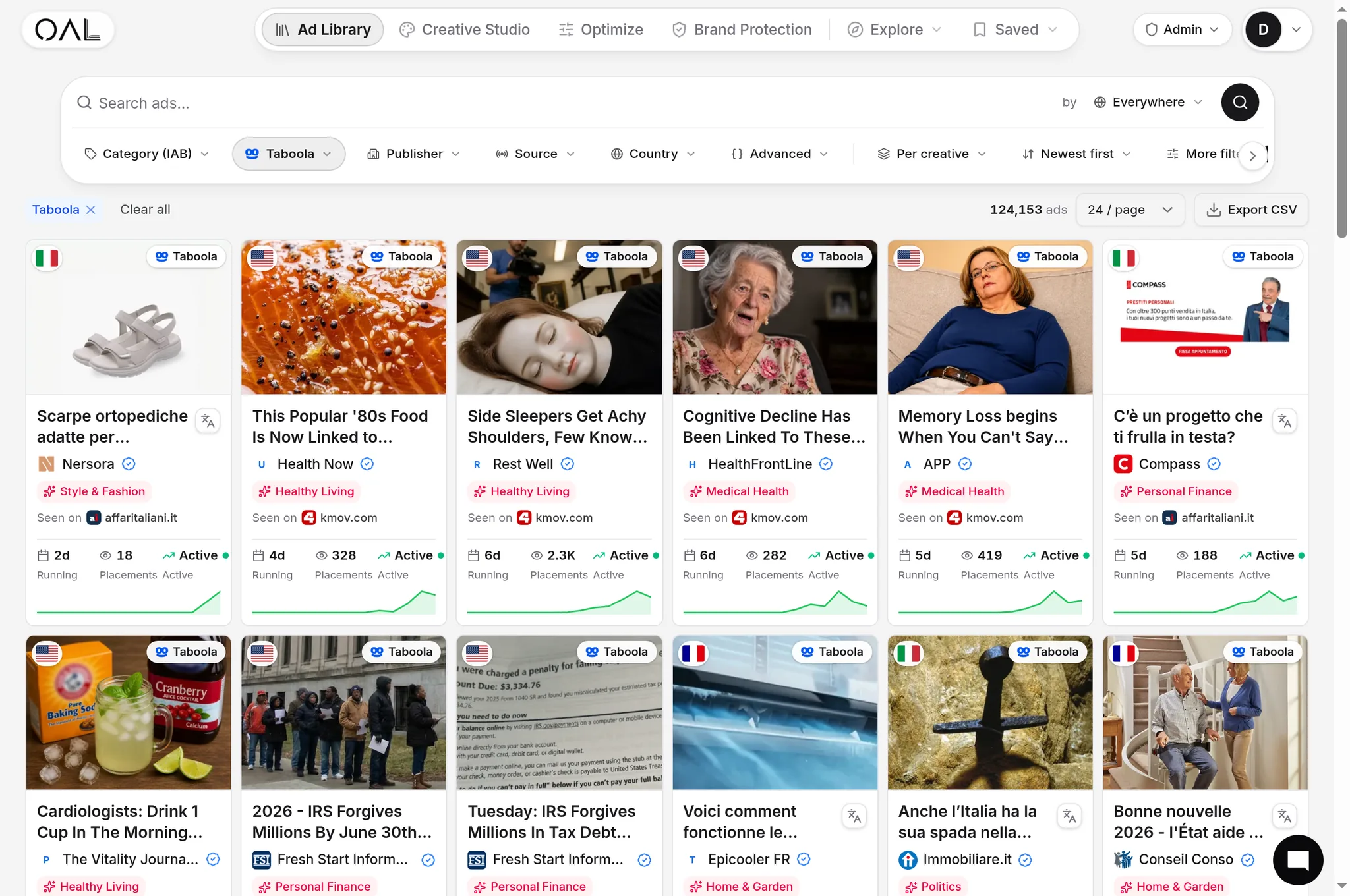
Taboola publishes no official library at all. Independent capture fills the gap: OpenAdLibrary's index tracks 206,000+ live Taboola creatives (June 2026) with the advertiser behind each ad, how long it has been running, the geos and devices it was captured on, and the traced landing page behind the click. Browse it at /spy/taboola. For budget-split decisions this is disproportionately useful in one specific way: before committing to the native side, you can verify that advertisers with your exact offer type are running sustained Taboola spend — and sustained spend is the strongest public signal a channel is paying. Nothing equivalent exists for verifying a competitor's GDN performance.
Measurement: automation's black box vs the hands-on ledger#
How you will know which channel is working differs enough to affect the budget decision itself.
GDN measurement inherits the Google Ads stack: conversion tracking or GA4 imports, view-through conversions counted by default in display reporting, and smart bidding that optimizes against whatever conversion definition you feed it. Two habits protect you. First, separate click-through from view-through conversions before judging performance — display's reported numbers flatter it when view-through is blended in, since many "converters" would have bought anyway after seeing nothing more than an impression they never noticed. Second, in Performance Max, insist on the placement and channel breakdowns that are available rather than the topline — display inventory inside PMax can absorb budget at low incremental value while search inside the same campaign does the real work.
Taboola measurement is more manual and more honest by default: CPC pricing means every dollar maps to a click you can trace, and the platform's per-publisher reporting shows exactly which sites produce conversions. The work is on you — pipe conversions back via pixel or server-side postback, then prune. Expect a long tail: a large share of publishers will spend without converting, and the discipline of cutting them weekly is where Taboola accounts are won. The upside of that labor is diagnosability; when performance moves, you can usually see which publisher, geo, or creative moved it, with no modeled attribution in the way.
Attribution windows deserve a final word: native clicks convert on longer delays than retargeting clicks, because the audience is colder and often meets your brand for the first time mid-article. Judge a Taboola test on at least a couple of weeks of matured conversions, not a same-day dashboard — and hold GDN retargeting to the opposite standard, since it harvests intent that already existed.
Common budget-split mistakes#
- Testing Taboola with GDN creative. Responsive display assets recycled as native thumbnails almost always lose to purpose-written headline-image pairs. Budget creative work for the native test or skip the test.
- Sending native clicks to a display landing page. A page built for warm retargeting traffic will bleed cold feed clicks. The advertorial step is not optional decoration; it is the mechanism.
- Letting Performance Max cannibalize the comparison. If PMax runs alongside a display test, budget flows opaquely between surfaces and you cannot isolate what display reach contributed. Structure clean experiments before drawing channel conclusions.
- Comparing CPCs instead of CPAs. GDN will win every CPC comparison and lose many CPA ones on cold traffic. The click prices measure different products.
- Scaling the winner and starving the infrastructure. Retargeting reach on GDN and cold-traffic acquisition on Taboola are complements. Buyers who move the entire budget to whichever performed better last month usually rediscover, expensively, why both existed.
Where should the budget go?#
A decision framework that holds up in practice:
- Cold-traffic direct response with a story (health, finance, insurance, home services, considered ecommerce): lead with Taboola. The advertorial funnel is the channel's native strength, and the vertical data backs it — health (11,982 live creatives), finance (8,200), and insurance (7,422) are Taboola's three largest classified verticals in our June 2026 index. That is where the proven, renewing spend sits.
- Retargeting warm audiences: lead with GDN. Cheapest reliable frequency against people who already know you; native retargeting exists but rarely beats it on cost.
- Broad awareness on a budget: GDN (or its video cousins). Feed clicks are wasted on impressions-first goals.
- Search-constrained scaling: if search captures all existing demand and you need to create demand, that is a native job — banners rarely manufacture new intent, headlines can.
- Team capacity: no one to write and rotate creative weekly? GDN's automation degrades more gracefully than an unmanaged Taboola account. Conversely, a strong creative team is underutilized on responsive display assets.
For a typical DTC or lead-gen advertiser already saturating search and social, a common pattern is GDN retargeting as permanent infrastructure (modest, stable budget) plus Taboola as the growth experiment (test budget with a real creative pipeline behind it, scaled only on proven CPA). Advertisers in Taboola's dominant verticals often invert that over time — the advertorial funnel becomes the primary cold-traffic engine and display shrinks to a retargeting utility — while visual-impulse ecommerce brands frequently conclude the opposite and keep native as a small satellite. Both endpoints are rational; they reflect the offer, not the channels' abstract quality.
They stop being rivals the moment you assign them different jobs — the mistake is asking either channel to do the other's.