Español
 Português (Brasil)
 Français
 Deutsch
 Italiano
 Nederlands
 Polski
 Svenska
 Türkçe
 Русский
 日本語
日本語 한국어
한국어 简体中文
简体中文 Tiếng Việt
 Bahasa Indonesia
 繁體中文
繁體中文 Čeština
 Dansk
Dansk Norsk (bokmål)
 Suomi
Suomi Ελληνικά
 Română
 Magyar
 Українська
 ไทย
ไทย हिन्दी
 العربية
 עברית
עבריתHow Much Do Native Ads Cost? A 2026 Budgeting Guide
A practitioner's breakdown of what native advertising really costs in 2026: minimum deposits, CPC ranges and the test budgets that actually decide whether you win, grounded in live ad data from Taboola, Teads, MGID and Revcontent.

Native advertising has a pricing reputation problem. The networks dangle a $0.03 minimum bid and a $10/day starting budget, then quietly let new advertisers burn $1,500 learning that neither number is real. The honest answer to "how much do native ads cost" comes in three layers: the minimum deposit to open an account, the CPC you actually pay to win quality traffic, and the total budget you need before the data means anything.
This guide breaks down all three across the major networks in 2026. It also shows you how to sanity-check every number against what advertisers are doing right now, using live ad data instead of vibes.
For context on scale: across the OpenAdLibrary index (June 2026) we're tracking 25,933 advertisers, 589,036 captured creatives, and over 5.4 million ad observations across 42 networks. That's the pool the numbers below are read against.
If you're still deciding which platforms to test, start with the pillar: Best Native Ad Networks in 2026 (Ranked by Real Ad Volume). This page assumes you've narrowed it down and now need to budget.
How much do native ads cost in 2026?#
CPCs run roughly $0.20 to $0.90 depending on network, device and vertical, with minimum account deposits between $50 and $100 on most self-serve platforms. The number that actually decides your fate is total test budget: plan $2,000 to $5,000 per offer, per network before the results are trustworthy. That works out to about $50/day for early signal and around $300/day to exit the learning phase.
The gap between the advertised minimum and the functional minimum is where most beginners lose money. So the rest of this guide is built around the functional numbers, not the marketing ones.
The three costs that actually matter#
When people ask what native ads cost, they're usually mashing three separate things together. Pull them apart and budgeting gets a lot clearer.
- Minimum deposit. The one-time amount to fund and activate an account. Low, mostly symbolic.
- CPC (cost per click). What you pay per click in the native ad auction. This is the price of traffic.
- Total test budget. The spend required to gather enough conversions for the network's algorithm to optimize, and for you to make a confident keep/kill call. This is the real cost.
Treat the deposit as a turnstile, the CPC as the meter, and the test budget as the actual bill. The deposit gets you in. The test budget is what you should be planning around.
Minimum deposits by network#
Here's where each major self-serve native advertising platform sets its entry bar in 2026. These are activation floors, not budgets.
| Network | Minimum deposit | Pricing models | Notes |
|---|---|---|---|
| Taboola | ~$100 | CPC, CPM, vCPM | Self-serve; some accounts see a ~$50 to $75 ad-spend floor |
| Outbrain / Teads | Higher (managed onboarding) | CPC, CPM | Outbrain acquired Teads in 2025; combined entity runs under the Teads name |
| MGID | ~$100 | CPC, CPM | Often the cheapest path to first data |
| Revcontent | ~$50 threshold | CPC, vCPM | Advertiser approval gates new accounts; historically higher manual minimums |
The minimum deposit tells you almost nothing about what a network costs to run. A $50 Revcontent deposit and a $100 MGID deposit will both evaporate in a day or two of real testing. Budget for the test, not the turnstile.
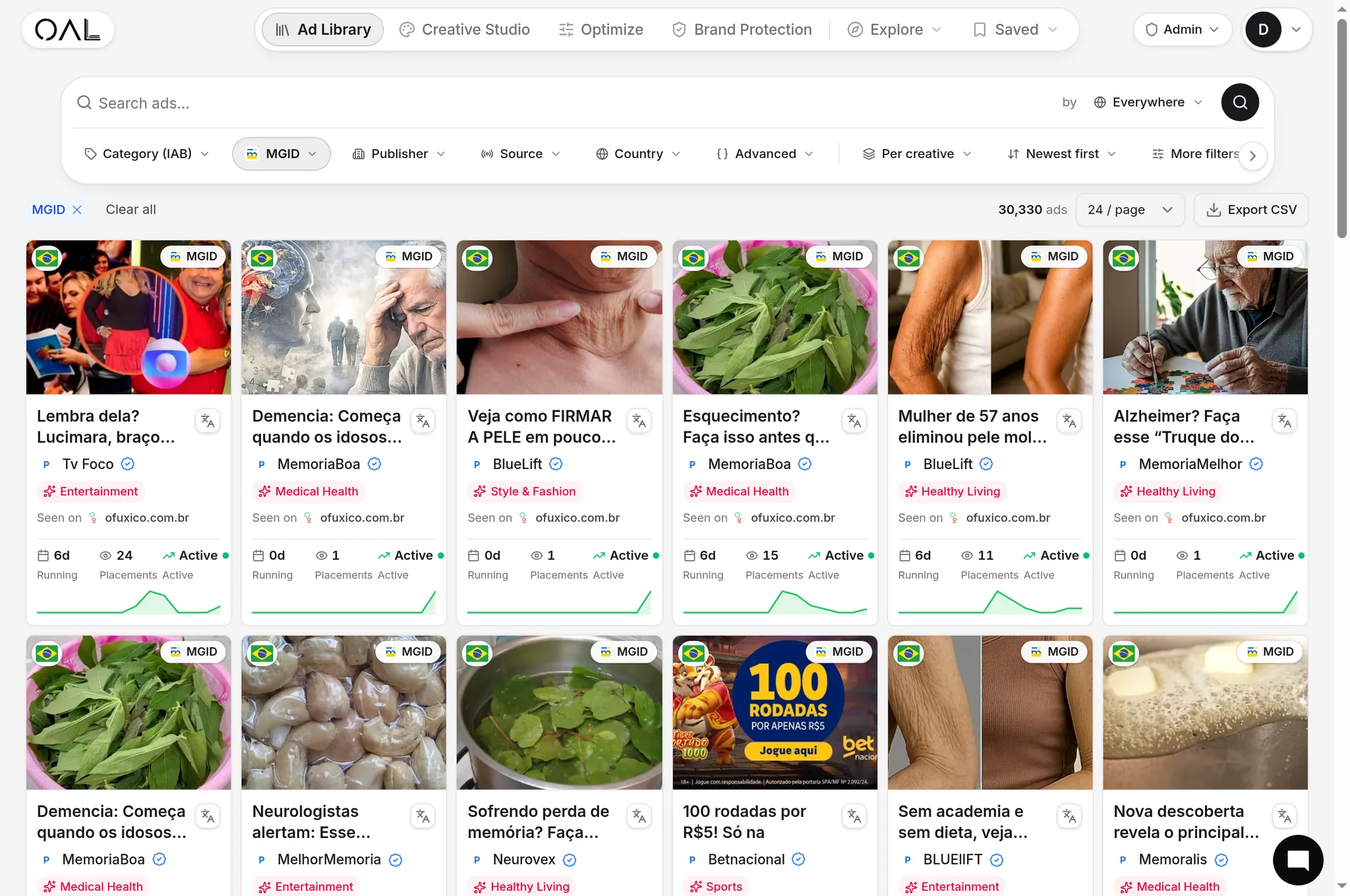
One thing the deposit table hides: scale is wildly uneven between these networks. In our index, Taboola accounts for 157,727 captured creatives. MGID has 49,689. Revcontent has 11,478. Teads, since the rebrand, shows up with just 55 (OpenAdLibrary, June 2026). If you want a deep, liquid auction with plenty of competitors to learn from, Taboola is in a different weight class. The cheaper networks are real, but you're fishing in a smaller pond.
A note on the Outbrain/Teads line. Outbrain completed its acquisition of Teads in February 2025 and rebranded the combined company under the Teads name by mid-2025. If you're reading older "Outbrain pricing" guides, the entry experience now runs through Teads' onboarding, which leans more managed than the fully self-serve flow on MGID or Revcontent. We cover the merged platform's positioning in Taboola vs Outbrain in 2026: Data-Backed Comparison (Now Teads).
CPC ranges by network#
CPC is the meter, and it varies more by vertical and device than by network. Mobile is consistently cheaper than desktop. Finance, insurance and other high-ticket verticals cost multiples of what content arbitrage or simple lead-gen does. With that caveat, here are realistic 2026 averages.
| Network | Typical CPC range | Relative cost | Best fit |
|---|---|---|---|
| Taboola | ~$0.30 mobile / ~$0.60 desktop | Premium | High-intent traffic, brand-safe inventory |
| Outbrain / Teads | ~$0.20 to $0.50 (US) | Premium | Quality publishers, direct response |
| MGID | ~30 to 50% below Taboola/Outbrain | Mid-tier | Affordable testing, broad reach |
| Revcontent | Low CPC, very high volume | Budget | Volume plays, aggressive creative testing |
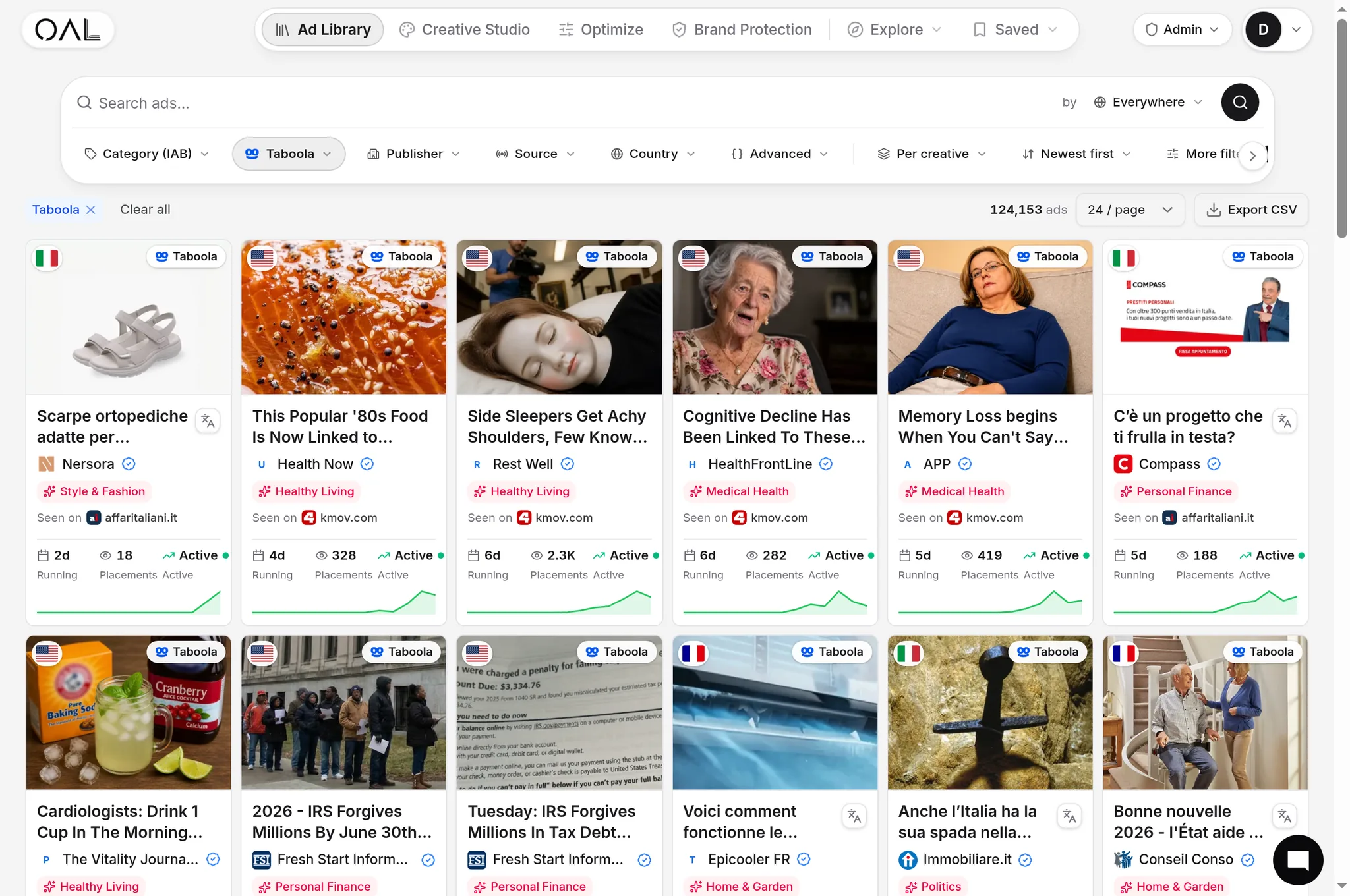
The reason finance and insurance clicks cost so much is simple: that's where everyone is. Across the whole index, finance is the single biggest vertical at 17,232 creatives, with insurance close behind at 15,629 and health at 14,895 (OpenAdLibrary, June 2026). More advertisers chasing the same placements means a hotter auction and a higher CPC. If you're entering one of those verticals, price in the competition before you set a bid.
Here's a live finance ad we captured running on Taboola, the kind of debt/tax angle that floods this vertical:

Two things to internalize from the CPC table:
- A cheaper click is not a cheaper customer. MGID and Revcontent win on CPC, but the traffic quality is more variable, so you spend more on creative iteration and on blocklisting junk publisher sites. The cost just moves from the auction to your testing budget. We go deep on this trade-off in MGID vs Revcontent: Mid-Tier Native Networks Compared and Revcontent vs Taboola: Reach, Cost and Advertiser Mix Compared.
- Your displayed CPC is rarely your effective CPC. Bid adjustments, premium placements and the algorithm's optimization mean what you actually pay per click, your eCPC (effective cost per click), drifts from your set bid. Budget against the effective number once you have a few days of data.
The networks also specialize, and it shows in their creative mix. Health and finance dominate Taboola (6,048 and 5,558 creatives respectively). MGID skews hard toward entertainment, with 8,904 entertainment creatives versus 615 in health. Revcontent leans health and nutra. If your offer matches a network's strength, you'll find more comparable advertisers to learn from and, often, a more efficient auction.
For a fuller vertical-by-vertical breakdown, see Native Ads CPC Benchmarks 2026: Taboola, Teads, MGID, Revcontent.
The real number: total test budget#
This is the figure the networks downplay. Their algorithms, like every programmatic advertising system, need a minimum volume of conversion events to optimize. Starve them and they never leave the learning phase, which means your early CPAs are not representative of what the campaign can do at maturity.
The working rules of thumb for 2026:
- $50/day is the bare minimum to generate enough signal for the algorithm to do anything at all.
- ~$300/day is what it typically takes to reliably exit the learning phase on Taboola or Teads and stabilize optimization.
- $2,000 to $5,000 total, per offer, per network, is a realistic test budget before you have enough conversions to trust a keep/kill decision.
Here's how that translates into a sane onboarding budget depending on what you're testing.
| Scenario | Daily budget | Total test budget | Timeline |
|---|---|---|---|
| Single offer, signal check | $50 to $100/day | $1,500 to $2,000 | 2 to 4 weeks |
| Single offer, proper validation | $200 to $300/day | $3,000 to $5,000 | 2 to 3 weeks |
| Multi-network test (one offer) | $50 to $100/day each | $5,000 to $8,000 | 3 to 4 weeks |
The single biggest budgeting mistake is spreading a small budget thin. $500 across four networks teaches you nothing. $500 on one network for ten days starts to teach you something. Pick one network, fund it properly, and only expand once an offer proves out. A change of more than about 20% to budget, bid, audience or creative can reset the learning phase, so batch your changes rather than tinkering daily.
How to right-size your budget before you deposit#
You don't have to walk into native blind and let the first $2,000 be pure tuition. The best way to set realistic cost expectations is to study advertisers who are already winning, because longevity is a profit signal you can read from the outside.
This is exactly what OpenAdLibrary is built for. It captures live public native ads across Taboola, Outbrain/Teads, MGID, Revcontent, Yahoo, MSN and more, stores the real creative at full quality, and, without ever clicking a live ad, traces each click through to the advertiser's landing page or pre-lander.
What does a proven winner look like? Here's a hearing-aid ad from Nebroo that we'd watched run for 26 straight days on Taboola at the time of capture. Nobody pays for the same placement for nearly a month unless the math works:

A quick honesty note on day-counts. Our index currently spans up to about 28 days of continuous observation per creative, so the longest-running ads we can confirm sit at the 28-day mark. The classic affiliate lore about "90-day winners" is general industry wisdom, not something we've measured. Treat the two separately: our 28-day observation is data; the 90-day rule is folklore that happens to point the same direction.
Even inside that 28-day window, the pattern is loud. The longest-running ads we're tracking are dominated by quiz funnels and lead-gen. "My IQ" alone has multiple IQ-test creatives sitting at the full 28 days on the Microsoft Audience Network. Hidden Hearing's "Try next-gen hearing aids" hit 28 days. SmartAsset's "Ask a Pro: How Can I Avoid Paying Taxes on IRA Withdrawals?" hit 28 days on Outbrain. When the same angles keep surviving the longest, that's the market telling you which funnels print money.

Three things in the data directly inform your budget:
- Longevity and spread. A creative that's been running for weeks across many publishers is almost certainly profitable. That tells you the CPC and funnel economics in that vertical work, which de-risks your own bid planning. Short-lived ads are tests that probably failed. Don't model your budget on them.
- The real advertiser behind each ad. Native ads route through layers of programmatic native advertising intermediaries and native ad widget placements. OpenAdLibrary classifies the supply chain and surfaces the actual advertiser, so you know who you're competing against for inventory.
- The full funnel. Click tracing reveals the landing page and pre-lander structure top advertisers use, the part that decides whether your CPC turns into a conversion or a bounced visit.
Used this way, a native ad spy tool turns "how much should I budget?" from a guess into an evidence-backed estimate. You can confirm a vertical is active, see how long winners sustain spend, and reverse-engineer the creative-and-landing-page combination before risking a cent.
Home and solar is another live category worth watching. Here's a subsidy-angle ad we'd tracked for 27 days on Taboola:

Putting it together: a sample first-month budget#
Suppose you're testing a single lead-gen offer and want a defensible plan rather than a wild guess.
- Research first (free). Spend a few hours confirming your vertical is active and identifying 5 to 10 long-running competitor creatives and their landing pages. Cost: $0.
- Pick one network. If budget is tight, MGID or Revcontent get you cheaper data. If you want higher-intent traffic from day one, start on Taboola or Teads. See MGID vs Taboola: Which Native Network Wins for Your Budget? for that call.
- Fund it properly. Deposit your $100, but plan around a $3,000 test budget at roughly $150 to $200/day.
- Hold changes. Run 5 to 8 creatives, resist edits for the first few days, and let the algorithm gather signal before you judge anything.
- Read the verdict on CPA, not CPC. A $0.25 click that never converts is more expensive than a $0.70 click that does.
A realistic, honest first month on a single offer therefore costs $3,000 to $5,000 to get a clean answer. Not the $50 the deposit screen implies, and not the $50,000 some agencies quote. The networks make the floor look low. The algorithm makes the real floor much higher.
If you'd rather not learn that the hard way, Start free: browse live native ads with no card, confirm your vertical is active, and see how long the winners have been spending before you budget a single dollar.