Español
 Português (Brasil)
 Français
 Deutsch
 Italiano
 Nederlands
 Polski
 Svenska
 Türkçe
 Русский
 日本語
日本語 한국어
한국어 简体中文
简体中文 Tiếng Việt
 Bahasa Indonesia
 繁體中文
繁體中文 Čeština
 Dansk
Dansk Norsk (bokmål)
 Suomi
Suomi Ελληνικά
 Română
 Magyar
 Українська
 ไทย
ไทย हिन्दी
 العربية
 עברית
עבריתTaboola Review 2026: Is It Worth It?
An evidence-backed verdict on where Taboola genuinely delivers, where it will frustrate you, and which advertisers should skip it entirely.


Taboola is the largest dedicated native advertising network, and for the right advertiser it remains one of the cheapest sources of scaled Tier-1 traffic available. This review is grounded in OpenAdLibrary's index of 206,145 live Taboola creatives (June 2026) rather than a demo account: the short verdict is that Taboola is a genuinely scalable channel for advertorial-style performance funnels and content distribution, and a frustrating one for small budgets, narrow B2B targeting, or anyone expecting Meta-grade tooling out of the box.
What Taboola is — and what you're actually buying#
Taboola sells sponsored slots in content-recommendation widgets — the "you may like" feeds below and inside articles on publisher sites. Through a 30-year exclusive deal signed in 2022 it also powers native ads across Yahoo's properties, and it sells the native slots inside Apple News and Apple Stocks in several markets. In 2025 the company rebranded its advertiser platform as Realize, positioning itself as a general performance channel rather than a "content discovery" vendor — but what you buy has not changed: clicks, priced by auction, delivered from feeds on other people's websites. The mechanics are covered in how Taboola ads work.
That placement context matters more than any feature list. Nobody on a news site is searching for your product. Taboola traffic is interruption traffic dressed as editorial, which is why the creatives that win look like stories and the funnels that win warm the click up before asking for money.
What 206,000+ live ads say about the network#
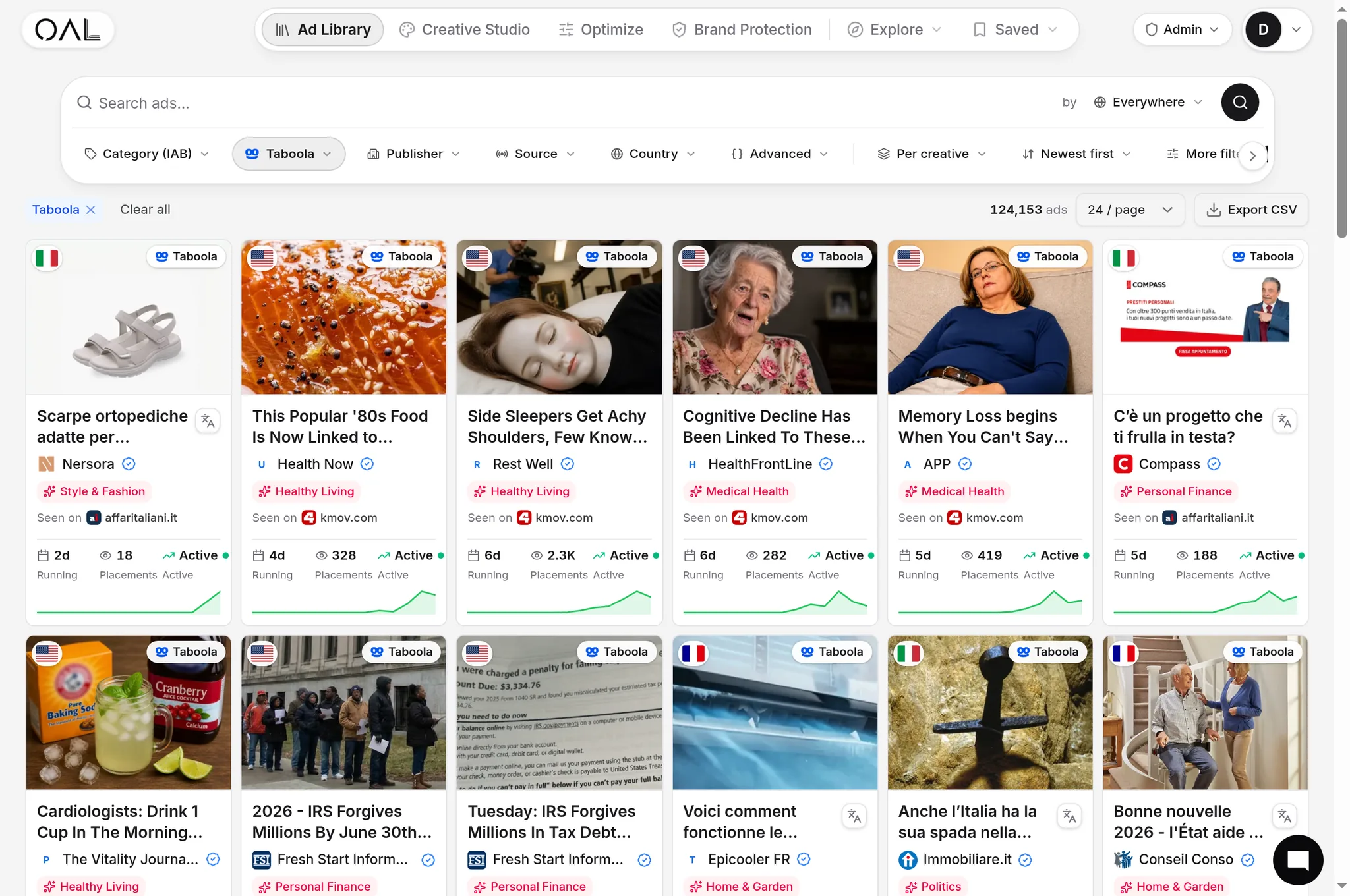
Because OpenAdLibrary captures live Taboola placements continuously, the index doubles as an X-ray of who actually spends there. Three things stand out as of June 2026:
The vertical mix is performance-heavy. Health leads with 11,982 classified live creatives, followed by finance (8,200), insurance (7,422), ecommerce (5,185), home & garden (4,414) and software (3,665). These are direct-response categories; Taboola is not primarily a brand-awareness shelf.
The advertiser mix is broader than its reputation. The same index snapshot holds household names — a major real-estate portal (Domain.com.au) distributing property stories, an international hearing-care brand (Audika) — alongside classic DTC advertorial players selling skin-care and hair-growth products. The chumbox cliché is real but incomplete; who advertises on Taboola breaks the mix down by vertical.
Winners run for weeks. In the current snapshot, Audika has held one creative live for 37 straight days, a home-and-garden gadget advertiser for 37, and a hair-care advertorial for 31. On a CPC network, month-long runs mean the economics work — ad longevity is the cleanest public profitability signal there is. For a tour of what these winning creatives actually look like, see the live Taboola ad examples teardown.
Where Taboola is genuinely strong#
- Reach. Thousands of publisher sites plus the Yahoo and Apple supply make Taboola one of the few places outside Google and Meta where a single campaign can reach Tier-1 audiences at real scale.
- Click economics. Native CPCs are typically a fraction of search CPCs and usually undercut social for comparable geos. Cold traffic, but cheap enough to warm up profitably if your funnel is built for it.
- Funnel freedom. Advertorials and pre-landers — the formats that make native profitable — are standard practice here, not policy violations waiting to happen. Review still applies, but the channel is built for story-first selling.
- Slow creative fatigue. Feed inventory across thousands of sites rotates audiences constantly, so a winning creative can run for weeks — the index's 30-plus-day runners are evidence — where a social ad might burn out in days.
- Self-serve access. You can open an account, load a card and launch without a sales call or an insertion order.
Where Taboola will frustrate you#
- Publisher quality variance. The network's long tail includes sites whose clicks are worth very little. Site blocking is not an optimization — it is mandatory hygiene, and it consumes real budget while you gather the data.
- Editorial review friction. Creative rejections can feel inconsistent, and appeals are slow. Buyers in health and finance report the most back-and-forth; build review time into launch plans.
- Tracking setup is on you. Conversion measurement means installing the pixel or wiring server-to-server postbacks properly. It is well documented but nowhere near as plug-and-play as Meta, and SmartBid is only as good as the conversion signal you feed it.
- Coarse targeting. Geo, device, OS, browser, some audience segments — but nothing like a social graph. Your creative does the targeting on Taboola; if the hook doesn't self-select the audience, no setting will.
- Small budgets get thin answers. As covered above, a decision-grade test commonly runs $1,000–$3,000. The network technically accepts far less; it just won't tell you anything reliable at that spend.
What it costs, briefly#
Taboola is a CPC auction with no rate card. Media buyers commonly report Tier-1 desktop CPCs of roughly $0.30–$0.90 and mobile at $0.10–$0.45, sliding well below that in Tier-2/3 geos — practitioner-reported ranges, not official rates, and crowded verticals like insurance clear higher. The native ads CPC benchmarks piece compares these ranges across networks and covers budgeting the channel as a whole.
The playbook if you go in#
Reviews that end at "it depends" waste your time, so here is the sequence that separates the advertisers who last from the ones who churn out in a month:
- Wire tracking before creative. Install the pixel or server-to-server postbacks and verify test conversions fire before you spend a dollar. Every downstream decision — bidding mode, placement cuts, creative verdicts — runs on this signal, and retrofitting it mid-test contaminates everything you learned.
- Launch with creative volume, not a favorite. Six to ten creatives per campaign, each a genuinely different angle rather than headline variations. Most will fail; the point is to let the auction tell you which story earns its CTR, because on Taboola CTR is effectively a bid discount.
- Split geo and device from day one. Desktop and mobile clear at different prices and behave differently on landing pages. Blended campaigns produce averages that describe neither half.
- Run blocking on a cadence, not on impulse. Review site-level performance on a schedule, block only after a placement has accumulated a fair click sample, and keep notes — the same site IDs reappear when you clone campaigns.
- Judge the channel at the funnel level. Taboola clicks are cold. Score the test on cost per acquisition through your warm-up funnel, not on bounce rate against traffic from channels with entirely different intent.
Buyers who follow that sequence tend to know within a month whether the network can work for their offer; buyers who skip steps tend to spend the same money and leave with anecdotes.
Who should use Taboola — and who shouldn't#
| Good fit | Poor fit |
|---|---|
| Advertorial / content-first funnels (health, finance, home, DTC) | Cold-outreach B2B with narrow ICPs |
| Offers with broad demographic appeal | Products that only convert on high purchase intent |
| Publishers and brands distributing content at scale | Anyone unwilling to manage site blocking |
| Buyers with $1,000+ to run a real test | Sub-$500 total budgets expecting conclusions |
| Teams that iterate creatives weekly | Set-and-forget account management |
Verdict#
Taboola earns its position: unmatched native reach, workable economics, and a creative culture that lets performance marketers actually perform. It extracts a management tax in return — publisher hygiene, review friction, tracking setup — and it punishes tourists who fund it like a boosted post. If your funnel monetizes cold story-driven traffic, it belongs on your shortlist next to a Taboola vs Outbrain comparison; if you need high-intent clicks this quarter, spend elsewhere.
Do the research before the deposit: browse the live corpus at /spy/taboola (free), check whether advertisers with your business model persist for weeks in the Taboola ad library, and revisit how Taboola ads work before you launch. The network rewards buyers who arrive already knowing what winning looks like.