Español
 Português (Brasil)
 Français
 Deutsch
 Italiano
 Nederlands
 Polski
 Svenska
 Türkçe
 Русский
 日本語
日本語 한국어
한국어 简体中文
简体中文 Bahasa Indonesia
 繁體中文
繁體中文 Čeština
 Dansk
Dansk Norsk (bokmål)
 Suomi
Suomi Ελληνικά
 Română
 Magyar
 Українська
 ไทย
ไทย हिन्दी
 العربية
 עברית
עבריתWho Advertises on MGID? Advertiser Data for MGID, Revcontent & MediaGo
Live capture data on the advertiser mix across MGID, Revcontent and MediaGo: the verticals, the named advertisers, and the five archetypes that dominate mid-tier native networks.


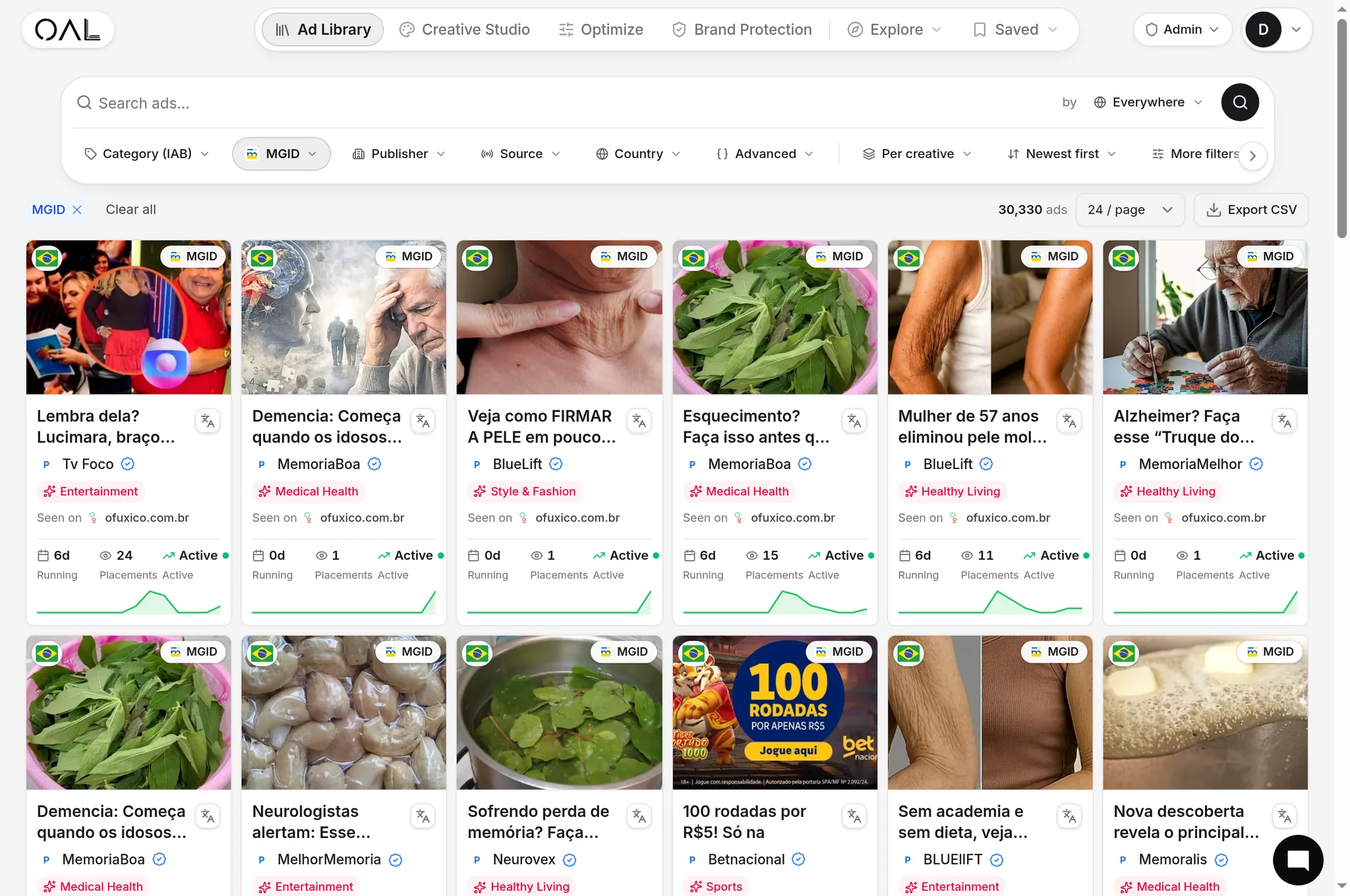
Ask who advertises on MGID and the honest answer is: direct-response marketers, at overwhelming scale. In OpenAdLibrary's live index of 62,765 MGID creatives (July 2026), the advertiser mix is dominated by content-arbitrage publishers, health and beauty offers, impulse ecommerce and lead-generation funnels — entertainment-classified creatives alone account for 13,987, more than five times the next five classified verticals combined. Revcontent and MediaGo, the two networks buyers most often evaluate alongside MGID, share the same DNA with different accents: Revcontent skews harder into doctor-framed health advertorials, MediaGo into insurance, gaming and search-style arbitrage. This breakdown covers all three, with named advertisers pulled from live captures.
What the live MGID data shows#
MGID is the largest of the three mid-tier networks by observed volume — 62,765 live creatives in OpenAdLibrary's MGID index, versus 15,789 for Revcontent and 6,571 for MediaGo. Here is how MGID's classified creative volume splits by vertical:
| Vertical (classified) | Live MGID creatives |
|---|---|
| Entertainment | 13,987 |
| Health | 1,220 |
| Insurance | 663 |
| Real estate | 309 |
| Ecommerce | 265 |
| Food & beverage | 219 |
The entertainment number needs decoding, because almost none of it comes from entertainment brands. It is overwhelmingly traffic arbitrage: publishers buying cheap MGID clicks into slideshow and listicle content that is itself monetized with ads, plus celebrity-angle advertorials that resolve to unrelated offers. When a classifier reads "entertainment" on a mid-tier native network, think "content plays," not streaming services.
The named advertisers behind the rest of the volume tell you exactly what works on the network:
- Health and beauty direct response. Tri Lift runs the crepe-skin angle ("Everyone Lotions Crepe Skin. Koreans Do This Instead") on MGID with near-identical copy to its Taboola creatives — a proven angle being scaled across networks. RejuvaCare pushes a red-light gum-regrowth mechanism ("Dentists Said Gums Can't Grow Back. Red Light Proves Them Wrong"), and Healthy66 runs "Nature's Morphine" pain-relief creatives. Authority-defiance framing — the expert was wrong, here's the workaround — is practically a house style.
- Impulse ecommerce. BESTSHOPLUXE was testing multiple near-duplicate creative variants for a U.S. veteran commemorative coin at capture time; several barely-different headlines running in parallel is a live split test, not sloppiness. Zanvishop runs urgency-anchored product ads ("Last Day 50% OFF" on a coconut-oil hair-removal cream).
- B2B experiments. Perpetual Ad Tech runs at least three distinct angles for a marketing-audit offer ("The $950 Audit That Shows Where Your Marketing Loses Money", "Paying An Agency $3k/Month? A Machine Does It For A Flat Fee"). B2B is rare on mid-tier native, which is exactly why it stands out — cheap clicks make offbeat tests affordable.
- International arbitrage. Greek-language cosmetic-procedure creatives from factripple.com sit in the same index. MGID's footprint is genuinely global, and a large share of its volume runs outside Tier-1 English-speaking geos.
Who advertises on Revcontent#
Revcontent's 15,789 live creatives have a clear center of gravity: health. The index holds 2,566 classified health creatives plus another 440 in nutra — the classic direct-response profile — followed by finance (816), home and garden (789), insurance (638) and fashion (247).
Three advertiser patterns dominate:
- Parallel-angle health advertorials. Health Weekly runs multiple doctor-framed creatives simultaneously — "Surgeons: This Simple Trick Will End Knee Pain & Arthritis Quickly" and "Endocrinologist: If You Have Diabetes, Read This Before It's Removed!" were live in the same capture window, the second in at least two variants. Running several authority-framed angles at once and letting the widget auction pick winners is the standard Revcontent playbook.
- Content arbitrage. dailysportx ("The 15 Most Useless Cars to Ever Be Produced"), learnitwise ("Costco Workers Reveal 14 Things They'd Never Buy From The Store") and novelodge (the WD-40 trick) are all listicle publishers buying clicks into ad-monetized galleries.
- Geo-targeted benefit lead-gen. Seniors Choice ("Ontario Residents Aged 50-80 Could Get This Benefit") is the qualification-funnel archetype: age- and geo-framed eligibility headlines feeding form-based lead capture.
If you're weighing these two networks against each other, MGID vs Revcontent covers reach and cost differences, and how Revcontent works covers campaign mechanics.
Who advertises on MediaGo#
MediaGo — Baidu's international native DSP — is the smallest of the three in the index at 6,571 live creatives, and its classified mix looks different: insurance (378), home and garden (301), ecommerce (265), auto (257) and gaming (218) lead, with health (155) noticeably further down the list than on MGID or Revcontent.
The advertiser roster reflects where its demand comes from:
- Gaming user acquisition. Play4Free ("A Real MMO for Grown-Up Gamers") and Rise of Kingdoms ("Play for free in your browser – no download needed!") are straight game UA — a category you rarely see at volume on Revcontent.
- Search-style content arbitrage. Loop of Now runs dozens of near-identical creatives against rate-and-cost queries — "House Cleaning Rates in New Zealand" in at least four phrasings, "Term Deposit Rates for Seniors in New Zealand", "Licence-Free Small Cars in New Zealand" — query-shaped content aimed at a single geo, refreshed continuously.
- Cross-network health scalers. SmoothSpine's sciatica mechanism story runs on MediaGo and Outbrain simultaneously. When an advertiser buys the same angle on a premium network and a mid-tier one at once, the funnel economics are almost certainly working.
The MediaGo ad library lets you page through the full set by vertical, geo and advertiser.
The five advertiser archetypes across all three networks#
Nearly every significant advertiser on MGID, Revcontent and MediaGo fits one of five archetypes:
- Health and beauty direct response — advertorial funnels, authority framing, mechanism stories. The biggest spender class on all three networks.
- Content and search arbitrage — listicle and rates-content publishers buying clicks below their ad revenue per session.
- Lead-gen qualifiers — insurance, home-improvement and benefits offers running eligibility-framed forms.
- Impulse ecommerce — discount-anchored product pages, often single-product stores testing many creatives at once.
- Opportunists — gaming UA, B2B lead-gen and other categories exploiting click prices that would make the same test unaffordable on a premium network.
If you sell to any of these categories — or compete with them — the archetype list doubles as a map of who you'll bid against.
Why the mid-tier attracts exactly this mix#
Three structural reasons. First, cost: media buyers commonly report materially lower CPCs on MGID and Revcontent than on Taboola or Outbrain for comparable geos — treat any specific figure as unofficial and verify against live rate behavior, but the gap is persistent. Second, creative review is more permissive, so aggressive direct-response angles that premium networks reject can run. Third, brand demand is largely absent, which means the auction is direct-response against direct-response — and the winners are whoever iterates creatives fastest.
That last point is why studying live creatives matters more here than anywhere else. Ad longevity is the closest public signal to "this offer is profitable," and on networks where nearly everything is DR, a creative that has run for 30 days is a validated funnel you can learn from before spending a dollar.
How to look up any advertiser yourself#
The workflow takes minutes: open the MGID spy tool, filter by vertical and geo, sort by longevity, and click through to an advertiser page to see every captured creative and landing page behind a brand label. The same flow works for Revcontent and MediaGo. Build a watchlist of the advertisers in your vertical and re-check weekly — new creatives from a proven advertiser are the cheapest market research available.
For the tier-1 counterpart of this analysis, see who advertises on Taboola and the cross-network top native advertisers breakdown.
What this means if you're planning a campaign#
Read the advertiser mix as a preview of your auction. If you're launching a health or beauty offer, you will bid against operators like Tri Lift and Health Weekly who iterate creatives weekly and have already found the angles that clear these networks' economics — enter with several distinct angles of your own, not one polished creative, because single-creative campaigns die quietly against iterators. If you're in lead-gen, note how the incumbents frame eligibility rather than product ("Ontario Residents Aged 50-80 Could Get This Benefit") and how tightly the creatives are geo-matched; a generic national pitch competes badly against that specificity.
Two practical cautions follow from the mix, too. First, because arbitrage content dominates so much volume — especially MGID's entertainment block — expect meaningful placement-quality variance and budget from day one for blacklisting publishers that send clicks and no conversions. Second, the near-absence of brand advertisers means widget context skews aggressive; check how your creative reads sitting beside "Doctors Call It Nature's Morphine" before assuming premium-network creative standards transfer. None of this argues against the mid-tier — it's where small budgets can still buy real signal — but it rewards buyers who scout the neighborhood before moving in. This page refreshes as the index grows, so the named examples above rotate; the archetypes don't.