Español
 Português (Brasil)
 Français
 Deutsch
 Italiano
 Nederlands
 Polski
 Svenska
 Türkçe
 Русский
 日本語
日本語 한국어
한국어 简体中文
简体中文 Tiếng Việt
 Bahasa Indonesia
 繁體中文
繁體中文 Čeština
 Dansk
Dansk Norsk (bokmål)
 Suomi
Suomi Ελληνικά
 Română
 Magyar
 Українська
 ไทย
ไทย हिन्दी
 العربية
 עברית
עבריתHow Outbrain Works in 2026 (Now Part of Teads): The Advertiser's Guide
Outbrain is now Teads on paper, but the native engine underneath is the same auction, and here is how its bidding, formats, pricing, and live creatives actually work for advertisers in 2026.

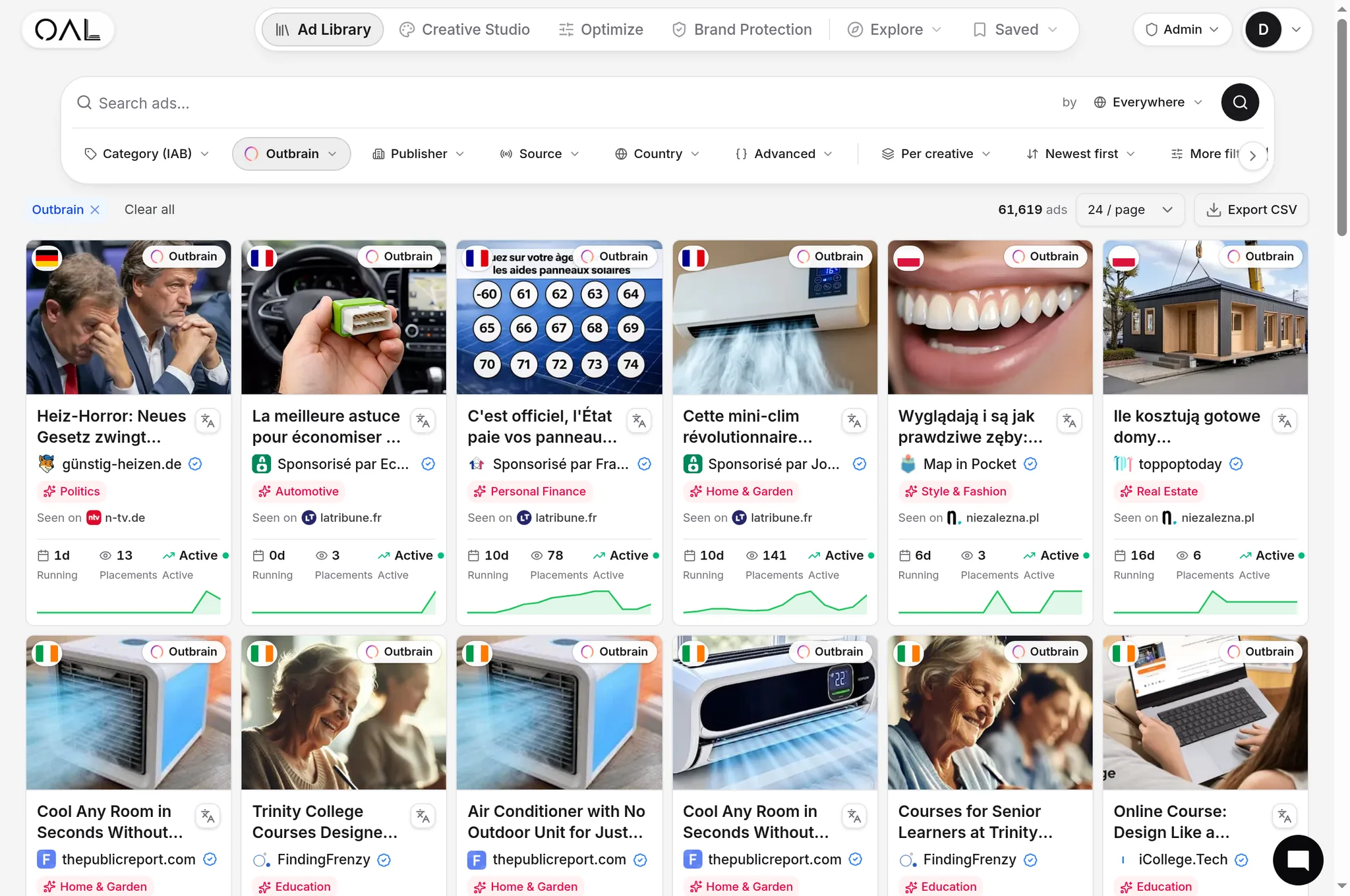
You have seen Outbrain a thousand times without knowing its name. It is the "around the web" or "you may also like" block of headline-and-thumbnail links stapled to the bottom of news articles. In 2026 the machinery behind that feed runs the same as it always has, but the nameplate on the building changed: Outbrain merged with Teads, and the combined company now legally operates as Teads. This guide walks through how the auction, bidding, formats, and pricing work for an advertiser today, what the merger actually changed, and how to read the live Outbrain creatives running on publisher pages right now.
We have a stake in that last part. OpenAdLibrary has captured 84,252 Outbrain creatives so far (OpenAdLibrary index, June 2026), so a lot of what follows comes from staring at what real advertisers actually run, not just the rate card.
How Outbrain works#
Outbrain is a native advertising network that drops paid recommendations inside the content feeds of premium publishers. You upload a headline, an image, and a landing page, then bid in a real-time auction for placement. Outbrain's algorithm matches each ad to the reader most likely to engage, charges you per click or impression, and sends that reader to your page. That is the whole loop: performance native at publisher scale.
The atomic unit is the native ad widget, a module of recommended links styled to look like the publisher's own editorial. Some links are organic (the publisher's own articles), some are paid placements. The blend is deliberate. Native ads earn attention by matching the form of the feed instead of interrupting it, which is exactly why the best-performing creatives look like the article you were already reading.
Here is one that proves the format works. SmartAsset has been running this finance recommendation on Outbrain for 28 straight days in our index, the longest continuous run we have observed for any creative:

The auction, step by step#
Every time a reader loads a page carrying an Outbrain widget, an auction fires for those slots. Here is what happens in the milliseconds before the feed paints:
- Page loads. The publisher's widget requests recommendations for that specific reader, context, and device.
- Eligible ads compete. Every active campaign targeting that geo, device, audience, and (optionally) publisher section enters the auction.
- Outbrain ranks by predicted value. The system scores each ad on bid multiplied by predicted engagement, historically click likelihood, now weighted more toward predicted conversion when you run automated bidding.
- Winners render. The highest-value ads fill the paid slots, interleaved with the publisher's organic links.
- You pay per outcome. Native bills primarily on cost-per-click. Video and CTV can run on CPM, CPV, or CPCV.
Your bid is not what decides placement. Outbrain ranks on expected value, so a lower bid behind a strong click-and-conversion rate routinely beats a higher bid on a weak creative. On native, the creative is the lever, not the bid box.
This is why experienced buyers treat Outbrain (and every native network) as a creative-testing machine first and a bidding exercise second. The fastest way to lower your costs is a better headline-and-image pair, not a higher number in the bid field. The gaming offer below has also held a paid slot in our index for 28 days, the same ceiling as SmartAsset, which tells you the creative is carrying the campaign, not the budget:

A note on that 28-day figure, because it matters. Industry folklore talks about native "90-day winners," and those almost certainly exist. But 28 days is the longest we have continuously observed any single creative, because that is roughly the span of our index right now, not a hard ceiling on the channel. When you see longevity numbers from us, read them as a floor on proven staying power, not the full lifetime of the ad.
What the Teads merger changed#
This is the part that confuses advertisers in 2026, so let me be precise about the timeline. Outbrain agreed to acquire Teads in August 2024 and closed the deal on February 3, 2025 for roughly $900 million. On June 9, 2025 the parent company renamed itself from Outbrain Inc. to Teads Holding Co., and it began trading on Nasdaq under the ticker TEAD the next day. The combined business reported about $1.7 billion in advertising spend (FY24) reaching roughly 2.2 billion consumers.
The Outbrain product did not disappear. The performance side is now sold as Outbrain Direct Response by Teads, and if you used to log into Outbrain Amplify, you log into the same self-serve platform, just under the Teads umbrella. Here is what shifted:
| Dimension | Before merger (Outbrain standalone) | After merger (Teads, 2026) |
|---|---|---|
| Company / branding | Outbrain Inc. | Teads Holding Co.; native product = "Outbrain Direct Response by Teads" |
| Core offering | Native recommendation feeds (web) | Native plus outstream video and CTV in one platform |
| Funnel position | Mostly lower-funnel performance | Pitched as full-funnel, branding through performance |
| Self-serve login | Outbrain Amplify | Same Amplify-derived platform under Teads |
| Inventory reach | Outbrain publisher network | Outbrain network + Teads video supply across screens |
The strategy is a full-funnel pitch: run awareness with Teads outstream video and CTV, then retarget and convert with Outbrain's native engine, all billed and optimized in one place. The company guided to roughly $65 to 75 million in annual cost synergies in FY26, with staff reductions of around 200 roles as part of the integration. For the video and CTV side, see our companion guide on what Teads is and how its platform works.
What does the merger look like in actual captured ads? Lopsided, so far. Our index holds 84,252 creatives tagged Outbrain against just 55 tagged Teads (OpenAdLibrary, June 2026). The native engine is still where the volume lives. So when a colleague says "we don't run Outbrain anymore, we run Teads," they are almost always running the same native auction under a new logo.
Bidding and optimization#
Outbrain's automation is the most important thing to understand for performance campaigns. Manual CPC still exists, but most accounts lean on the automated layers.
- Conversion Bid Strategy (CBS). The flagship automated bidder. It ingests your first-party conversion data and adjusts bids per publisher section and audience to hit a goal. Three modes:
- Target CPA, defend a cost-per-acquisition number.
- Fully-Automatic, maximize conversions within your budget.
- Semi-Automatic, push budget toward top-converting sections while you keep manual control.
- Engagement Bid Strategy (EBS). A cookieless option that optimizes on on-site behavior (time on page, scroll depth, pages per session) pulled from your analytics, rather than a hard conversion event. Useful when your conversion volume is too thin to train CBS.
- Smartlogic / AI bidding. Outbrain's predictive layer scores conversion probability in real time across placements, so the auction ranks toward likely converters, not just likely clickers.
The honest tradeoff: automated bidding is hungry. It needs conversion volume to work. New campaigns and thin-data accounts should expect a learning period, and if you starve the algorithm it will spend inefficiently. Feed it a clean conversion signal and a few strong creatives, and CBS does work most manual buyers cannot match by hand.
Targeting and formats#
Targeting on Outbrain is contextual and behavioral, not the dense interest graphs you get on social. The controls that matter:
- Geo, device, OS, and browser, the baseline.
- Publisher and section, include or exclude specific publishers and content sections. This is the single biggest manual lever on native performance.
- Audiences, first-party retargeting via pixel, lookalikes, and interest segments.
- Custom audiences and intent signals, layered where available.
On formats, the merger widened the menu well past the classic feed:
- Standard native, headline plus thumbnail in the recommendation widget.
- Clip, app-install, and lead formats, performance variants of native.
- Outstream video, the Teads specialty, auto-playing inside article body content.
- CTV, connected-TV inventory brought in through Teads.
If you run native at scale, learn the wider ecosystem these networks fight in. Our complete native advertising guide covers the category end to end, and the mechanics here rhyme closely with the other majors. See how Taboola ads work for the closest direct comparison.
Pricing, minimums, and what to expect#
Outbrain is self-serve with no subscription fee. You pay the auction.
- Native billing: primarily CPC. Reported CPCs commonly land in the ~$0.25 to $0.90 range depending on device, geo, and vertical, though competitive verticals and premium publishers push higher.
- Video / CTV billing: CPM, CPV, or CPCV depending on format.
- Minimum budget: roughly $600 per month, about $20 per day across the campaign.
- Managed service: larger advertisers can layer negotiated managed-service fees on top of the auction.
Budget is not your real constraint at the floor. Data is. A campaign spending $20 a day will struggle to give CBS enough conversions to optimize against. Plan to run several creatives per campaign and give each meaningful traffic before you call it.
It also helps to know which verticals dominate the channel before you write a single headline. Across our Outbrain captures, finance leads with 2,640 creatives, then insurance at 2,615, health at 2,016, ecommerce at 1,479, software at 1,197, and home and garden at 1,091 (OpenAdLibrary, June 2026). If you are in finance or insurance, you are entering the most crowded rooms on the network, which is exactly why the creative bar is so high there.
How to research what is actually running on Outbrain#
Here is the wall every Outbrain advertiser eventually hits: the network has no public ad library. You cannot log in and browse competitors' live native creatives, their headlines, or where their clicks land. That makes programmatic native one of the hardest channels to do honest competitive research on.
That blind spot is the problem OpenAdLibrary exists to close. We capture live, public native ads directly from publisher pages across 42 networks, recording the real creative image at full quality, classifying the ad-tech supply chain behind each placement, and tracing each click through to the advertiser's landing page or pre-lander (without clicking live ads). In total that is 589,036 creatives, 25,933 advertisers, and more than 5.4 million ad observations in the index as of June 2026. Because we track when and where each creative appears, longevity and spread surface the winners: an ad that has run across many publishers for weeks is a proven offer, not a guess.
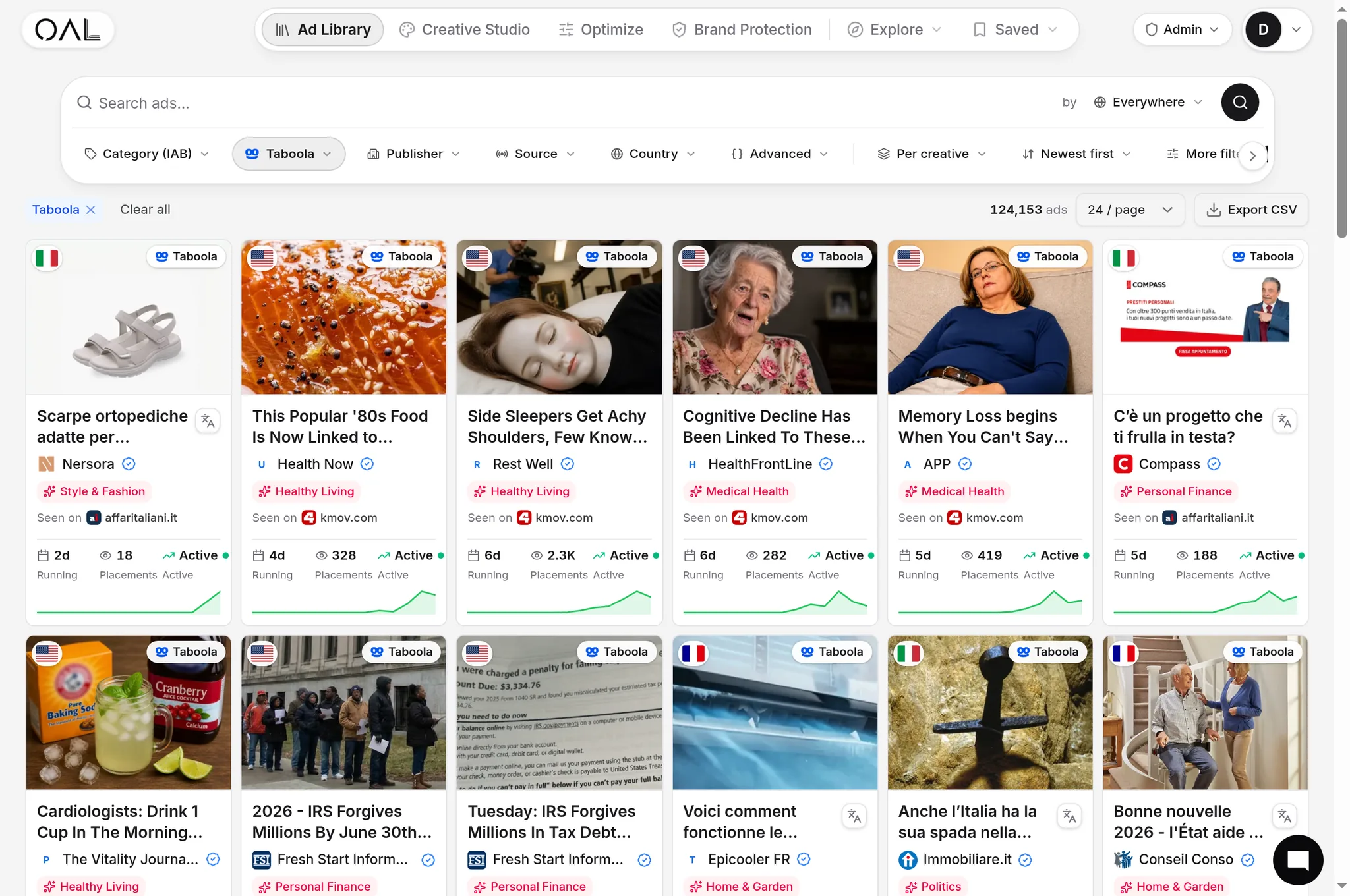
Outbrain and Taboola run on largely separate, exclusive inventory, so the same offer often shows up on both with different creative. Here is a Taboola finance ad in the same crowded tax-relief space SmartAsset competes in on Outbrain, which is the kind of side-by-side that only shows up once you watch both networks at once:

For practitioners, this turns Outbrain from a black box into a research surface. You can study which advertisers own a vertical, reverse-engineer the headline-and-image patterns that survive the auction, and read the landing pages converting that traffic, then build and test your own variants in Creative Studio, run Copy DNA on the angles that keep repeating, and pull it all through the API and MCP. Browse the live feed on our Outbrain ad spy page.
Native is a creative game, and the merger did not change that. It just put Outbrain's feed, Teads video, and CTV under one roof. The winners are the advertisers who can see what is working before they spend a dollar.
Start free and browse 200 live native ads, no card required.
Where Outbrain fits among native networks#
Outbrain-now-Teads is one of a handful of native networks that share the same auction-and-feed model but run on mostly separate, exclusive publisher inventory. A creative that wins on Outbrain will not automatically win elsewhere, so serious buyers run and research several networks in parallel. For scale, Taboola alone accounts for 157,727 creatives in our index, nearly double our Outbrain count, which is a useful reminder that "native" is a portfolio, not a single network.
If you are mapping the landscape, compare the mechanics here against how MGID's native ads work, how Revcontent works, and how Yahoo native ads work after Gemini. The patterns are similar. The inventory, audiences, and creative norms are not, and that gap is exactly why cross-network ad intelligence pays for itself.