Español
 Português (Brasil)
 Français
 Deutsch
 Italiano
 Nederlands
 Polski
 Svenska
 Türkçe
 Русский
 日本語
日本語 한국어
한국어 简体中文
简体中文 Tiếng Việt
 Bahasa Indonesia
 繁體中文
繁體中文 Čeština
 Dansk
Dansk Norsk (bokmål)
 Suomi
Suomi Ελληνικά
 Română
 Magyar
 Українська
 ไทย
ไทย हिन्दी
 العربية
 עברית
עבריתHow to Spy on Competitor Ads in 2026 (Native, Display & Social)
A practitioner's guide to spying on competitor ads across native, display and social: what to capture, how to tell real winners from noise, where the legal lines sit, and a weekly workflow that turns scattered screenshots into decisions.

Spying on competitor ads is not about screenshotting a few clever headlines. It is about reconstructing what your competitors are doing with money: which angles they bet on, which creatives they keep paying to run, where they buy traffic, and what happens after the click. Do it well and you cut months off your own testing cycle, because you get to learn from campaigns someone else already paid to validate.
This guide is the hub for everything we publish on competitor ad research. It covers the three channels that matter (native, display and social), what to capture in each, how to separate proven winners from noise, where the legal lines sit, and the repeatable workflow that turns scattered observations into decisions. Where a topic deserves its own deep dive, we link to it.
To give you a sense of scale before we start: our index currently holds 589,036 creatives from 25,933 advertisers across 42 networks, backed by 5.4 million ad observations and 926,259 captured landing pages (OpenAdLibrary index, June 2026). That is the raw material competitor research runs on, and almost none of it shows up if you just browse a few sites by hand.
What it means to spy on competitor ads#
Spying on competitor ads means systematically observing the advertising your competitors run in public (their creatives, copy, formats, the networks they buy on, and the landing pages they send traffic to) and analysing it to inform your own strategy. Served ads are public, so this is legitimate competitive research, not hacking. The goal is to learn from validated campaigns, not to copy them or interfere with them.
The reason it works is structural. When a competitor pays to put an ad in front of you, they are revealing a decision they made with real budget. You do not get their spend numbers, but you get something nearly as useful: evidence of what they chose to keep running. Reading that evidence correctly is the entire skill.

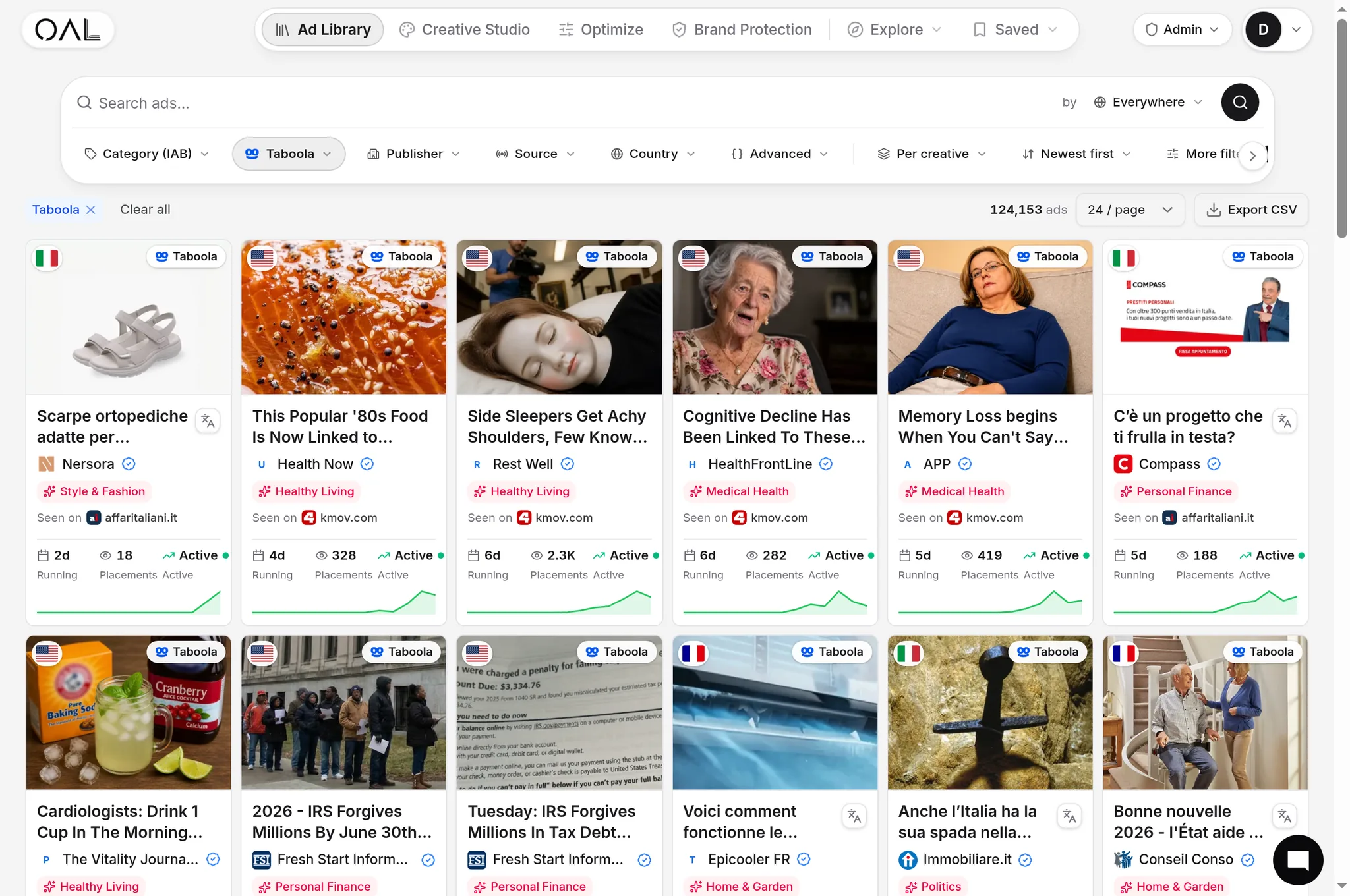
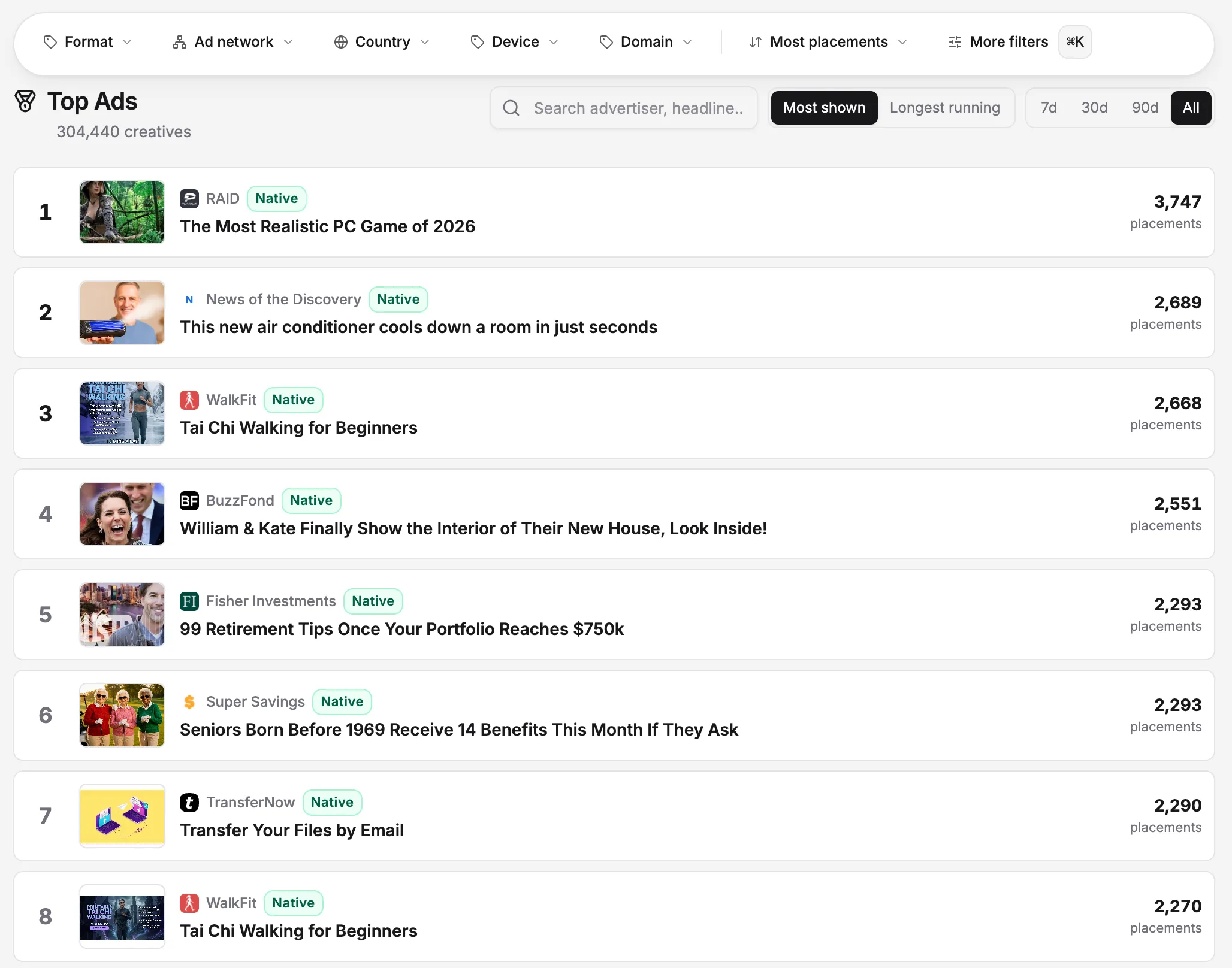
That ad above is a textbook example of what your competitors actually run, versus what they tell people they run. A deadline, a vague authority ("IRS Forgives Millions"), and a brand name ("Fresh Start Information") that is almost certainly an arbitrageur, not the advertiser cashing the checks. Finance is the single biggest vertical we track, with 17,232 creatives, just ahead of insurance (15,629) and health (14,895). If you sell into any of those markets, this is the volume of testing you are up against.
The three channels, and why native is the hard one#
Competitor ads live in three broad places, and each behaves differently when you try to observe it.
| Channel | Examples | How easy to spy on | Best lens |
|---|---|---|---|
| Social | Meta, TikTok, LinkedIn, Pinterest | Easy: official public libraries | Creative angles, hooks, volume |
| Search & display | Google Ads, programmatic display, retargeting | Moderate: partial transparency tools | Keywords, banner sizes, frequency |
| Native | Taboola, Outbrain, MGID, Revcontent, Teads | Hard: fragmented, personalised, fast-rotating | The advertiser behind the ad, the funnel |
Social is the most accessible because the platforms hand you the data. Meta's Ad Library and Google's Ads Transparency Center let you search any advertiser and see active creatives, a baseline every marketer should use. Regulation has pushed this further. Under the EU Digital Services Act, very large platforms must maintain public, searchable ad repositories, and enforcement has teeth: in December 2025 the European Commission fined X 120 million euros, in part for an ad repository regulators deemed too sparse to be useful. Transparency is becoming the default.
Native advertising is where manual research falls apart. A native ad is a sponsored unit styled to match the publisher's content (the "recommended for you" boxes under articles), served through a native ad widget embedded on thousands of independent sites. Three things make native uniquely hard to track by hand:
- Personalisation. What you see is shaped by your location, device and browsing history. Two people on the same article see different ads, so your own browsing is a biased sample of one.
- Rotation speed. Native buyers test dozens of headline-and-image variants per offer and cut losers fast. The ad you screenshot today may be gone tomorrow.
- Fragmentation. The same advertiser runs across hundreds of publishers through a native ad network, each filling slots through a real-time native ad auction. No single page shows you the whole picture.
The scale of that fragmentation is the real problem. Taboola alone accounts for 157,727 creatives in our index, with Outbrain at 84,252 and MGID at 49,689 (OpenAdLibrary, June 2026). You are not trying to catch one ad. You are trying to see a quarter of a million native creatives across the open web and figure out which ones are working.

This is also why the native spy-tool market historically charged $80 to $400 a month: capturing this stream at scale is genuinely hard. It is the specific problem OpenAdLibrary was built to solve at $29.99/mo, and the channel where a dedicated native ad spy tool earns its keep most clearly.
The edge in native isn't seeing one ad. It's seeing the same advertiser's whole rotation across the open web at once, then watching which creatives survive. That survival signal is the closest thing to a confession of profitability you'll ever get.
For a channel-specific walkthrough of capturing Taboola, Outbrain and MGID placements, see our deep dive on how to spy on competitor native ads.
What to actually capture (and what to ignore)#
New researchers hoard screenshots and learn nothing. The point is not volume. It is capturing the few signals that predict performance. For each competitor ad worth tracking, record:
- The creative, at full quality. The image or video plus the exact headline and copy. Low-resolution thumbnails are useless when you want to study the design choices later. Capture the original asset.
- The real advertiser. Native ads route through tracking redirects, so the brand name on the unit is often a content arbitrageur, not the end advertiser. Knowing who is actually paying is what separates intelligence from guesswork.
- The network and supply path. Which platform served it (Taboola vs. Outbrain vs. MGID) and the ad-tech chain behind it. This tells you where your competitor buys traffic.
- The landing page or pre-lander. Where the click goes. The creative is the hook; the landing page is where the money is made or lost. Capture the destination without clicking the live ad.
- First-seen and last-seen dates. The raw material for longevity analysis (below). An ad with no time dimension cannot tell you whether it is winning.
Each network skews toward different verticals, and that pattern alone is intelligence. Taboola's top categories are health (6,048 creatives), finance (5,558) and insurance (4,303). Outbrain leads with finance (2,640) and insurance (2,615). MGID looks completely different: entertainment dominates at 8,904 creatives, miles ahead of anything else. If your competitor is heavy on entertainment angles, MGID is where to look first.

One historical trap worth knowing: "Yahoo native" no longer means a standalone platform. Yahoo shut down its Gemini native ad system in 2023 and made Taboola the exclusive native partner for Yahoo properties, so Yahoo native inventory now flows through Taboola. If you are researching the Yahoo Gemini / Yahoo Native space, you are really looking at Taboola supply. Details like this are why supply-chain labelling beats taking the on-ad branding at face value.
For a full, step-by-step process of finding everything a specific competitor is running, follow how to find out what ads your competitor is running.
How to tell winners from noise#
This is the part most guides skip, and it is the whole game. You cannot see a competitor's spend, ROAS or conversion rate. So you infer performance from public proxy signals, and three matter most.
Longevity. The single strongest signal. Direct-response advertisers are ruthless and cut anything unprofitable within days. So an ad that has run continuously for weeks is almost certainly making money. Nobody keeps paying to serve a loser. When you sort a competitor's ads by how long they have been live, the long-runners at the top are your shortlist of proven angles.
A word on what "long" means in practice. Industry lore loves the "90-day winner," and over a full year that lore holds up. But continuous observation is its own discipline. In our own index right now, the longest continuously observed creatives sit at 28 days: SmartAsset's "Ask a Pro: How Can I Avoid Paying Taxes on IRA Withdrawals?" on Outbrain, Hidden Hearing's "Try next-gen hearing aids" on the Microsoft Audience Network, and a cluster of "My IQ" quiz ads that have been grinding away for the full 28-day window (OpenAdLibrary, June 2026). When the same My IQ quiz angle survives across that many days and multiple creatives, that is not a coincidence. That is a workhorse.

Spread. The same creative appearing across many publishers or placements suggests the advertiser is scaling it, another vote of confidence. A winner that is both old and wide is about as close to a sure thing as competitive intelligence gets.
Concentration. Look at how budget appears to distribute across angles. If a competitor runs twenty creatives but the rotation is dominated by two or three, those two or three are the workhorses. The rest are tests.
Treat these as a combined filter, not individually. A brand-new ad means nothing yet (we capture plenty at day zero, like a fresh ThisRomance dating ad that just went live). An ad that is old, wide, and one of only a few that survived a large test pool is a validated winner you can learn from with high confidence.
From creative to landing page: reverse-engineering the funnel#
A creative in isolation is half the story. The real strategy lives in the sequence: hook, click, pre-lander, offer, checkout. The pre-lander especially (the advertorial or quiz page between the ad and the product) is where native buyers do most of their persuasion, and it is invisible if you only collect creatives.
This is why landing-page capture matters as much as creative capture. We hold 926,259 captured landing pages precisely because the destination is where the selling happens. Reconstructing the full path is how you understand not just what a competitor advertises but how they sell.
We walk through the entire process (matching a creative to its destination, reading the pre-lander's persuasion structure, and mapping the offer) in reverse-engineer a competitor's native ad funnel. This is also where understanding programmatic native advertising helps: knowing how the buy is automated explains why you see the rotation patterns you do.
Where the legal and ethical lines are#
Competitor ad research is legitimate, but a few hard rules keep it that way:
- Don't click live competitor ads. Clicking costs the advertiser money and, done deliberately or at scale, is click fraud. Good tools (OpenAdLibrary included) trace where a click would go without firing it on the live placement. View, capture and analyse. Never click to "see where it goes."
- Don't scrape behind logins or paywalls. Public served ads and public landing pages are fair game. Authenticated areas and private dashboards are not.
- Learn, don't lift. Studying a competitor's angles, formats and funnel structure is research. Copying their creative, trademarks or copy wholesale is infringement. The value is in understanding why something works so you can build something better, not in cloning it.
Stay on the right side of these and competitor ad research is simply good marketing practice.
Turning observation into a workflow#
The biggest failure mode is not a lack of data. It is a folder of screenshots nobody revisits. Intelligence only compounds when it is structured and recurring. The practical shape is:
- Build a watchlist. Define the handful of competitors and advertisers that actually matter to your market, so you are tracking signal, not the whole internet.
- Let changes surface to you. Rather than re-running manual searches, have a tool flag what is new or newly long-running since last week.
- Review on a cadence. Weekly works for most active media buyers: frequent enough to catch angle shifts while they matter, rare enough to ignore noise.
- Convert to action. Every review should end in a decision: a new angle to test, a creative direction to brief, a landing-page idea to model.
We have documented the end-to-end system (from setting up a watchlist to the trigger logic that turns a competitor's move into your next test) in building a competitive ad intelligence workflow. For the specific discipline of a recurring research habit, competitive intelligence for media buyers lays out a weekly routine you can adopt as-is.
This is also where OpenAdLibrary's tooling closes the loop beyond observation. Copy DNA breaks down the patterns in winning copy, Creative Studio helps you build your own variants informed by what you have learned, Optimize connects intelligence to campaign decisions, and an API and MCP let you pull all of it into your own stack or AI agents.
A practical starting sequence#
If you are starting from zero today, do this in order:
- Search your top three competitors in Meta's Ad Library and Google's Ads Transparency Center. Free, instant, and a useful baseline for social and search.
- For native and display (the channels manual browsing cannot cover) use a dedicated platform that captures live placements, identifies the real advertiser, and traces the click to the landing page.
- Sort everything by longevity. The long-runners are your proven shortlist.
- Reverse-engineer the funnels behind those long-runners, pre-lander included.
- Put your competitors on a watchlist and review weekly.
The first two steps tell you what is running. The last three are where the actual edge is, and they are exactly what a purpose-built tool makes repeatable instead of exhausting.
OpenAdLibrary captures live native, display and social ads across Taboola, Outbrain, MGID, Revcontent, Teads and more, records the real creative at full quality, identifies the genuine advertiser behind each ad, and traces the click to the landing page. Open and affordable at $29.99/mo against the $80 to $400 legacy tools charge. You can browse 200 ads free, no card required. Start free and put your first competitor on a watchlist today.