Español
 Português (Brasil)
 Français
 Deutsch
 Italiano
 Nederlands
 Polski
 Svenska
 Türkçe
 Русский
 日本語
日本語 한국어
한국어 简体中文
简体中文 Tiếng Việt
 Bahasa Indonesia
 繁體中文
繁體中文 Čeština
 Dansk
Dansk Norsk (bokmål)
 Suomi
Suomi Ελληνικά
 Română
 Magyar
 Українська
 ไทย
ไทย हिन्दी
 العربية
 עברית
עבריתHow to Set Native Ad Bids: Starting Numbers by Network & Geo
Your first native bid should buy data, not margin. Commonly reported starting ranges for Taboola, Outbrain, MGID and Revcontent by geo and device — and the adjustment playbook that follows.


Start your native ad bid at — or 20–30% above — the network's suggested bid for your geo and device, leave it alone for three to five days while it buys data, then adjust per publisher rather than per campaign. As non-official reference points: media buyers commonly report Tier-1 desktop CPCs of roughly $0.30–$0.90 on Taboola and Outbrain and roughly $0.05–$0.30 on MGID and Revcontent, with mobile typically cheaper and Tier-2/3 geos a fraction of Tier-1 prices. Your vertical, offer, and creative quality will move every one of those numbers, which is why the adjustment process matters more than the opening figure.
How native auctions turn your bid into a price#
Native networks don't simply sell clicks to the highest bidder. Placements are ranked by expected yield per impression — effectively bid × CTR — because the publisher earns from the widget per view, not per click (mechanics in the native ad auction explainer and our guide to how Taboola ads work). Two consequences follow:
- Strong creative subsidizes your bid. An ad with twice the CTR can win the same placement at half the CPC. The best "bid strategy" is often a better headline.
- A low bid with weak CTR doesn't buy cheap clicks — it buys nothing. Under-bid campaigns get relegated to leftover inventory, spend slowly, and generate exactly the thin, ambiguous data that makes buyers give up on a network that would have worked.
Work out your ceiling before your opening#
The suggested bid tells you what the market charges; your economics tell you what you can afford. The ceiling is simple arithmetic: maximum viable CPC = target CPA × expected conversion rate. A $60-payout offer converting cold native traffic at 2% supports a break-even CPC of $1.20; if you want a 30% margin, your working ceiling is about $0.84. Run this before launch, because it catches doomed campaigns early: if the network's suggested bid for your geo already sits above your ceiling, no amount of optimization will save the math — you need a better-converting funnel, a higher payout, or a cheaper market, not a cleverer bid.
If you don't know your conversion rate yet, borrow a conservative stand-in from your vertical's history on other channels, halve it (native runs colder), and refine after the first hundred clicks per cell. The ceiling is a moving estimate, but even a rough one turns "what should I bid?" from a guess into a bounded decision: open near the suggested bid, never above your ceiling.
The starting-bid playbook#
- Read the suggested bid as a floor signal. Networks surface it per geo and device, and it approximates what active campaigns are paying. Dismissing it and bidding half is the most common way to launch a dead campaign.
- Open slightly above it. In week one you are buying information, not margin. Data velocity — enough clicks per day per cell to read — beats efficiency.
- Change nothing for 3–5 days except stop-losses. Early CPCs bounce while the network explores placements for you.
- Trim toward your economics in 10–15% steps, watching volume as you go: if a 10% bid cut costs half your impressions, you found the demand cliff — step back up.
- Split campaigns before micro-tuning bids. Desktop vs mobile and Tier-1 vs Tier-2 belong in separate campaigns, so one blended bid isn't wrong for everything at once.
Commonly reported starting ranges by network#
These are ranges practitioners commonly report, not official rate cards — check each network's current suggested bids at launch, and expect competitive verticals (finance, health, insurance) to price above the top of each range.
| Network | Tier-1 desktop CPC (commonly reported) | Tier-1 mobile | Context |
|---|---|---|---|
| Taboola | ~$0.35–0.90 | ~$0.20–0.50 | Largest premium-publisher supply; hot verticals clear well above this |
| Outbrain | ~$0.35–0.90 | ~$0.20–0.50 | Comparable supply quality and pricing since the Teads merger |
| MGID | ~$0.05–0.30 | ~$0.03–0.20 | Mid-tier global supply with strong Tier-2/3 reach — see how MGID works |
| Revcontent | ~$0.05–0.30 | ~$0.03–0.20 | Smaller marketplace, aggressive pricing |
| MediaGo | ~$0.10–0.40 | ~$0.05–0.25 | Microsoft-ecosystem supply |
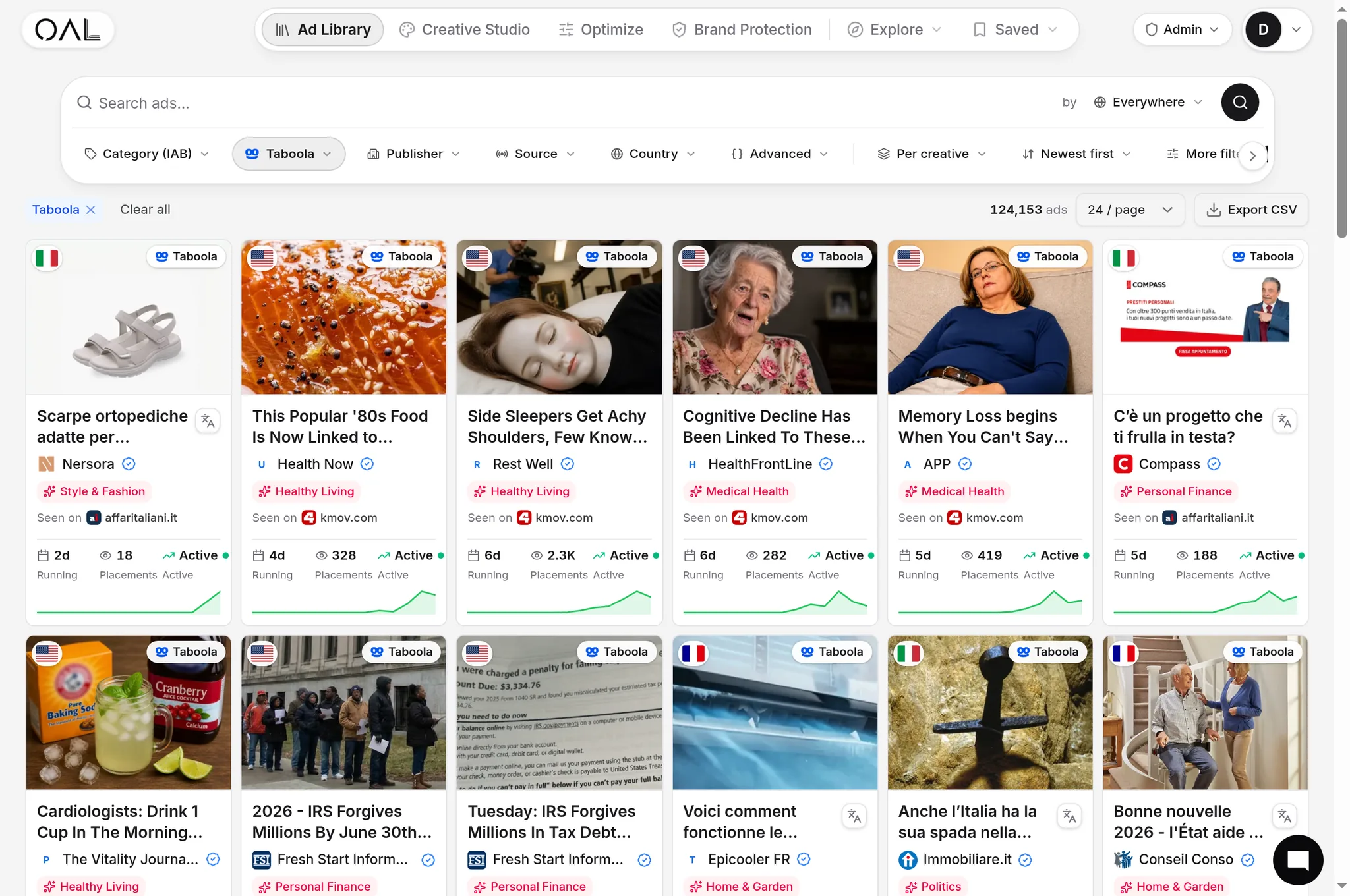
The scale differences behind those floors are visible in the data: OpenAdLibrary's index (June 2026) holds 206,000+ live Taboola creatives against roughly 15,800 on Revcontent — an order of magnitude more advertisers competing for the premium supply is exactly why its floor sits higher. For the fuller cost picture beyond bids, see how much native ads cost.
Geo tiers move bids more than networks do#
The same offer on the same network can clear at several times the price across a border. Tier-1 geos — the US, UK, Canada, Australia, and most of Western Europe — carry the most advertiser demand and the highest CPCs; Tier-2 commonly clears at half Tier-1 or less, and Tier-3 clicks go for pennies. Two cautions before chasing cheap geos: payouts and purchasing power scale down with the geo, and cheap clicks that never convert are the most expensive clicks you can buy. Scaling into new geos covers how to expand deliberately instead of chasing the lowest CPC on the menu.
Devices: split, don't average#
Mobile carries most native volume and its clicks price cheaper; desktop often converts better for high-consideration offers — finance, B2B, bigger-ticket ecommerce. A single campaign with one bid across both is mispriced for each: the blended bid overpays for mobile scroll-past clicks and underbids the desktop placements where your buyers actually are. Run them separately, let each find its own clearing price, and let conversion data — not CPC — decide the budget split between them. Tablet is small enough on most native networks that folding it into desktop rarely distorts anything.
After the first data: publisher-level bidding#
Campaign-level bids are training wheels. Real optimization on native networks happens per site ID, because publisher-level CPC and conversion rates vary enormously inside one campaign. The sequence: blacklist the burners (spend, no conversions), assemble a whitelist of producers, then raise bids selectively inside the whitelist to buy more of what works. A publisher-level raise buys more of a proven placement; a campaign-level raise buys more of everything, including the junk. Once conversion volume is steady, the networks' automated bidding modes can take over the per-placement math — hand over after you have clean conversion data flowing, not before.
Read the competitive density before you pick your number#
Where you land inside those ranges depends mostly on who you're bidding against. Health (≈24,500 classified live creatives), finance (≈24,100), and insurance (≈22,400) are the heaviest verticals in OpenAdLibrary's index of 725,000+ native ads (June 2026) — if that's your market, budget for the top of the range and lead with creative strength. Before launching, scan the live creatives in your vertical on your target network: the Taboola library shows who you're bidding against and how polished the incumbents are. A quiet vertical means you can open at the suggested bid and trim early; a crowded one means opening low just wastes a week.
Five starting-bid mistakes#
- Bidding under the suggested floor "to be safe" — the campaign starves and you learn nothing for a week.
- One bid across devices and geos — always mispriced somewhere; split the campaigns.
- Reacting to day-one CPC noise — the exploration phase is not your steady state.
- Raising the campaign bid when one publisher earned it — buy more of the winner, not more of everything.
- Optimizing CPC instead of margin — the cheapest click is worthless if it never converts; judge placements on return, not price, and keep your ceiling math (target CPA × conversion rate) pinned above the dashboard while you tune.
Get the opening bid roughly right, respect the ceiling, and let publisher-level data make the precise decisions — that ordering wins on every native network, whatever the numbers in your vertical turn out to be.