Español
 Português (Brasil)
 Français
 Deutsch
 Italiano
 Nederlands
 Polski
 Svenska
 Türkçe
 Русский
 日本語
日本語 한국어
한국어 简体中文
简体中文 Tiếng Việt
 Bahasa Indonesia
 繁體中文
繁體中文 Dansk
Dansk Norsk (bokmål)
 Suomi
Suomi Ελληνικά
 Română
 Magyar
 Українська
 ไทย
ไทย हिन्दी
 العربية
 עברית
עבריתIs Revcontent Worth It in 2026? An Evidence-Based Review
Revcontent is a tenth of Taboola's size and proud of it. What 15,789 live creatives reveal about who profits on the network — and who is funding them.


Revcontent is worth it in 2026 for a specific buyer: a direct-response advertiser or affiliate running health, finance or home offers into US-heavy traffic, with enough budget to clear the network's famously high $100/day campaign minimum and enough creatives to feed a CTR-driven auction. For that buyer, Revcontent offers something the giants no longer do — a contested but not saturated auction. For brand advertisers, small-budget testers and buyers who need massive scale from one network, it is the wrong tool. The evidence below comes from live capture data, not the network's marketing.
What Revcontent is in 2026#
Revcontent is a self-serve native ad network serving content-recommendation widgets on publisher sites, historically positioned as the smaller, higher-quality alternative to Taboola and Outbrain — fewer publishers, stricter widget standards, and an auction that heavily rewards click-through rate. The platform mechanics are covered in our guide to how Revcontent works; this review is about whether the network deserves your budget.
The scale reality#
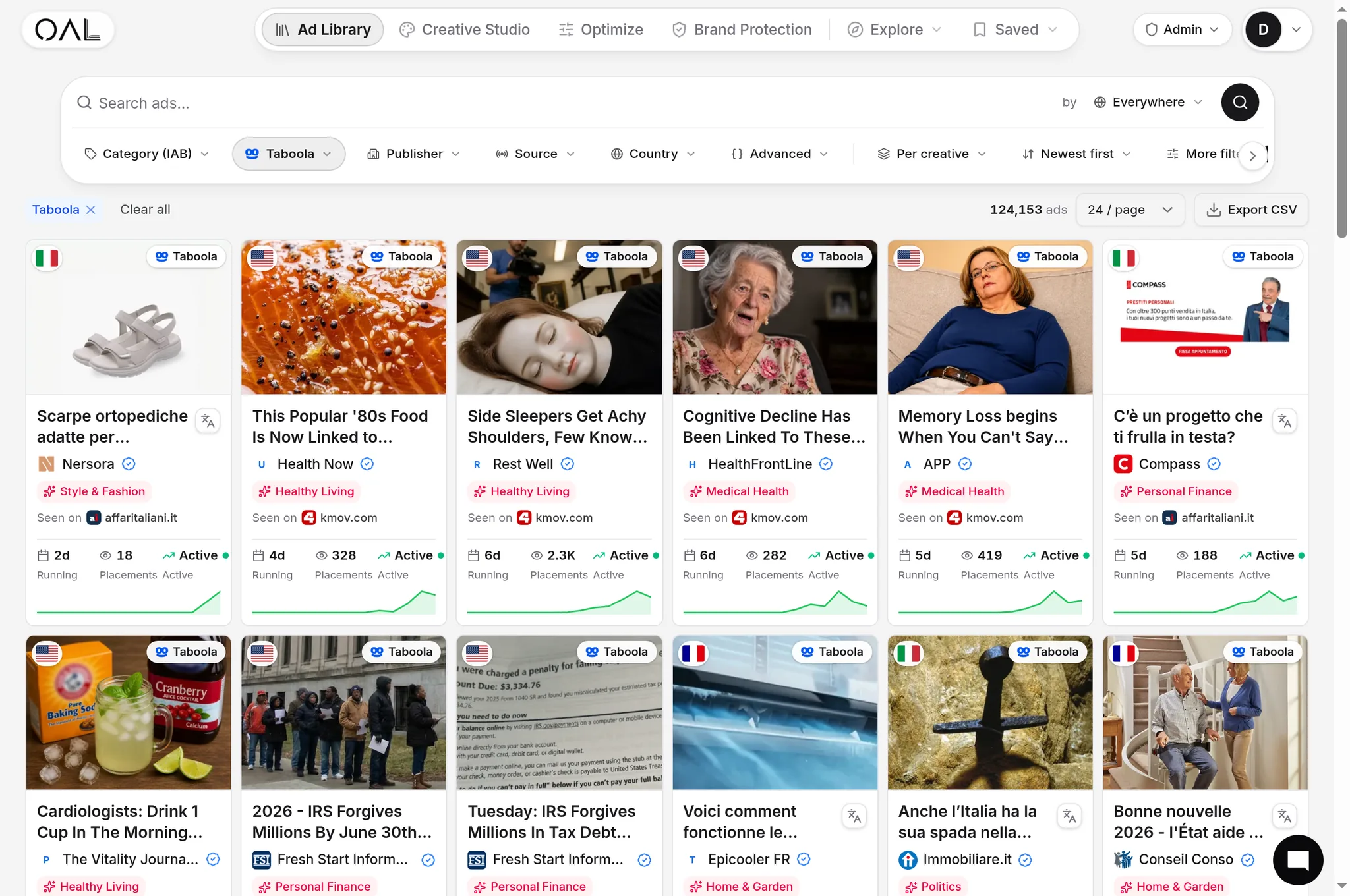
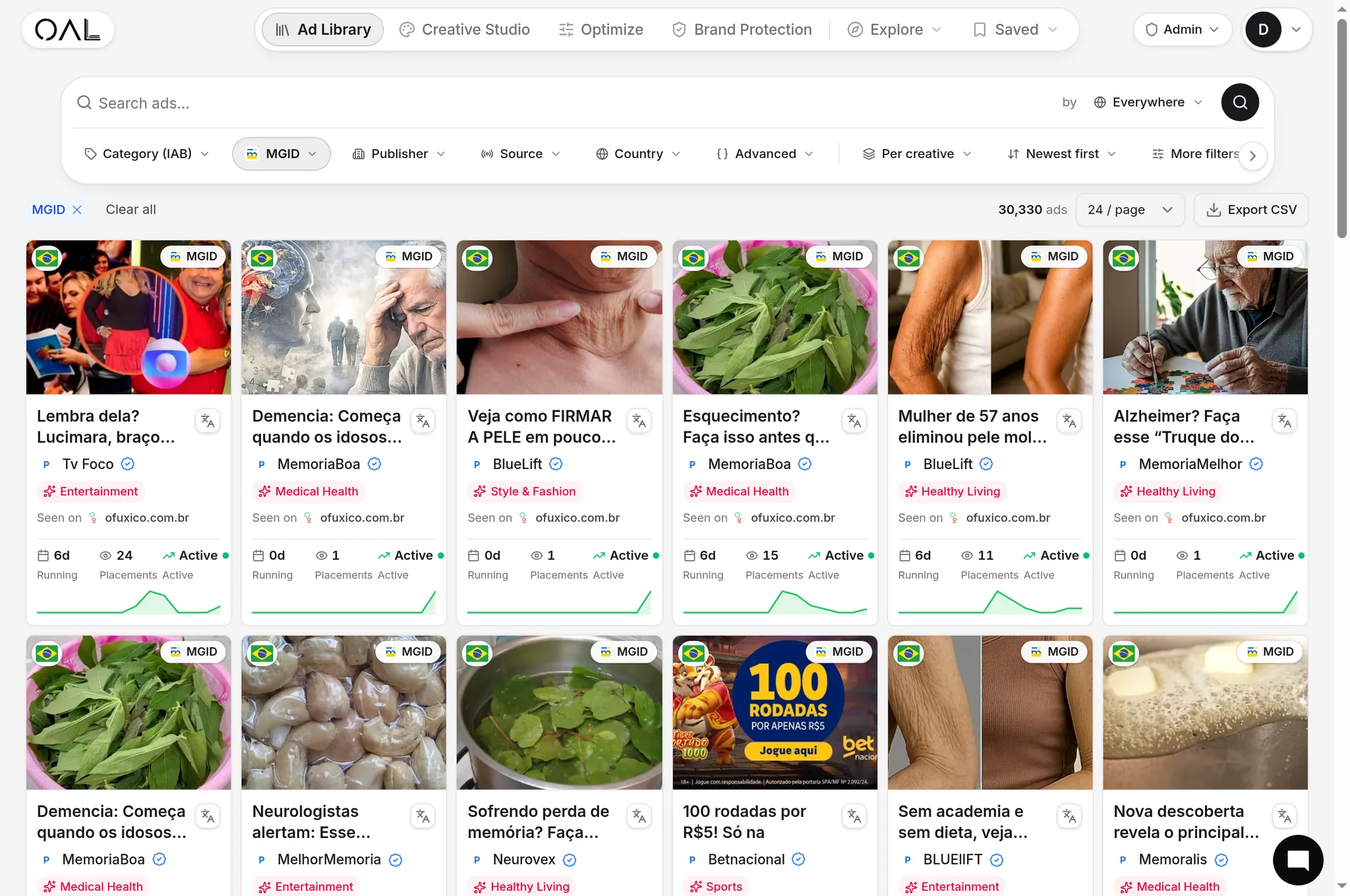
Start with the number most reviews omit. OpenAdLibrary continuously captures live native placements across 49 networks, and as of June 2026 the index holds:
| Network | Live creatives in index (June 2026) |
|---|---|
| Taboola | 206,145 |
| Outbrain | 108,573 |
| MGID | 62,765 |
| Revcontent | 15,789 |
Revcontent's live creative footprint is under a tenth of Taboola's. That is not a knock — it is the single most important fact for setting expectations. It means a winning campaign tops out sooner, placement variety is narrower, and "scale by adding budget" stops working earlier than on the big two. It also means the auction is thinner: fewer advertisers competing for placements, which is exactly why experienced buyers keep a Revcontent line in the portfolio. You can browse everything the index has captured from the network in the Revcontent ad library.
Who actually spends on Revcontent#
The classified vertical mix of live Revcontent creatives tells you who finds the traffic worth buying:
| Vertical | Live Revcontent creatives (June 2026) |
|---|---|
| Health | 2,566 |
| Finance | 816 |
| Home & garden | 789 |
| Insurance | 638 |
| Nutra | 440 |
| Fashion | 247 |
Health dwarfs everything — add nutra and the health-adjacent share is even larger. This is a direct-response network with a direct-response advertiser base. The live captures make the point concretely: "Surgeons: This Simple Trick Will End Knee Pain & Arthritis Quickly," "Endocrinologist: If You Have Diabetes, Read This Before It's Removed!" — both freshly launched health advertorials at capture — alongside senior-targeted lead gen ("Ontario Residents Aged 50-80 Could Get This Benefit") and listicle arbitrage ("Costco Workers Reveal 14 Things They'd Never Buy From The Store," 24 days running). If your offer looks like these, Revcontent's audience already converts on your category. If it does not, you are the experiment.
The case for Revcontent#
- A CTR-rewarding auction you can actually win. Revcontent's auction is aggressive about rewarding engagement: strong creative gets outsized volume at lower effective cost. On thinner competition, a genuinely good hook goes further than it does on Taboola, where a dozen well-funded competitors run the same angle.
- Real US inventory. For its size, the network delivers meaningful US volume — the geo most mid-tier native networks are weakest in. That matters for US-payout offers where Tier-2 traffic does not convert.
- Less spy-tool saturation. Because most competitive research tools focus on the big networks, angles proven on Taboola often arrive on Revcontent late or never. Buyers who port winners across networks find genuinely unworked placements.
- Direct-response tolerance with standards. Advertorial funnels and pre-landers are normal here, within a moderation regime that has tightened over the years. Compliance-clean DR is the sweet spot.
- Support that engages. At spend levels where the giants leave you fully self-serve, Revcontent reps will discuss placements, pacing and policy.
The case against Revcontent#
- The scale ceiling is real. A campaign doing well at $500/day may simply not find another $500/day of quality inventory. Plan Revcontent as a portfolio component, not a primary channel.
- The $100/day minimum filters you in or out. Each campaign must budget at least $100/day, one of the higher entry bars in native. With a proper multi-campaign test, you should plan a few thousand dollars for the first month. Confirm current terms with Revcontent directly — minimums have shifted over time.
- Placement volatility. The publisher list is smaller, so a few widgets can dominate your delivery. When a top placement's audience fatigues, performance swings harder than it would on a network with deeper rotation.
- Arbitrage neighbors. Your ad will frequently sit next to celebrity listicles and shock creative. Fine for DR; disqualifying for brand-sensitive advertisers.
- Fewer targeting refinements. Geo, device, placement and not much more. The optimization surface is placement cutting and creative iteration — if you want algorithmic audience targeting, this is not that.
What Revcontent traffic costs#
There is no public rate card, and Revcontent's auction prices clicks the way every widget network does — by geo, device, placement and your creative's CTR. Media buyers commonly report US clicks in the tens of cents, with contested health and finance placements pushing higher and international traffic pricing well below that; treat those as practitioner folklore rather than official numbers, because your creative quality moves real costs substantially in both directions. Two cost dynamics are worth knowing before you plan a budget. First, the CTR-weighted auction means your effective CPC is partly under your control: a hook that doubles the placement's click-through rate buys the same inventory meaningfully cheaper, so creative testing is bid management here even more than on larger networks. Second, the placements that convert are rarely the placements that are cheap — expect your post-optimization average CPC to rise as you cut junk widgets and concentrate spend on the handful that produce leads. Budget against the converting-placement price, not the campaign average.
Who should run it — and who should not#
Run it if: you have a proven DR offer in health, finance, insurance or home; you can fund $100/day per campaign without flinching; you launch 10+ creatives and track conversions per placement from day one; you already have a winner on another native network and want incremental volume with less competition.
Skip it if: you are testing your first native campaign on a small budget (start where minimums are lower — see MGID vs Revcontent); you need brand-safe premium placements; you expect one network to carry your whole media plan; or your offer requires the audience scale of the biggest native networks.
How to decide with evidence instead of reviews#
The strongest due diligence takes an hour and costs nothing: look at what is actually running. Use the Revcontent spy tool to pull live creatives in your vertical, then check longevity — an ad that has run 30+ days is almost certainly paying for itself. If you find multiple advertisers sustaining campaigns in your category for weeks, the network monetizes your vertical and the remaining question is execution. If your category is a ghost town, that absence is data too. Cross-check expected click costs against our native CPC benchmarks before committing the first deposit.
Verdict#
Worth it — conditionally. Revcontent in 2026 is a specialist: a US-leaning, health-and-finance-heavy, CTR-meritocratic network that rewards prepared DR buyers and wastes everyone else's minimum budget. Its 15,789 live creatives are a fraction of Taboola's footprint, but the advertisers behind them include operators who have run the same campaigns for weeks on end, which is the only endorsement that matters in this channel. Do the free research first, size the test honestly, and treat the network as what it is: a portfolio diversifier that rewards preparation and quietly punishes everything else.