Español
 Português (Brasil)
 Français
 Deutsch
 Italiano
 Nederlands
 Polski
 Svenska
 Türkçe
 Русский
 日本語
日本語 한국어
한국어 简体中文
简体中文 Tiếng Việt
 Bahasa Indonesia
 繁體中文
繁體中文 Čeština
 Dansk
Dansk Norsk (bokmål)
 Suomi
Suomi Ελληνικά
 Română
 Magyar
 Українська
 ไทย
ไทย हिन्दी
 العربية
 עברית
עבריתHow Taboola Ads Work: A Complete Guide for Advertisers (2026)
A working media buyer's breakdown of how Taboola native ads actually run in 2026: the auction, the widget, CPC pricing, and the tracker chain behind every click, shown with live creatives we captured instead of vendor mockups.

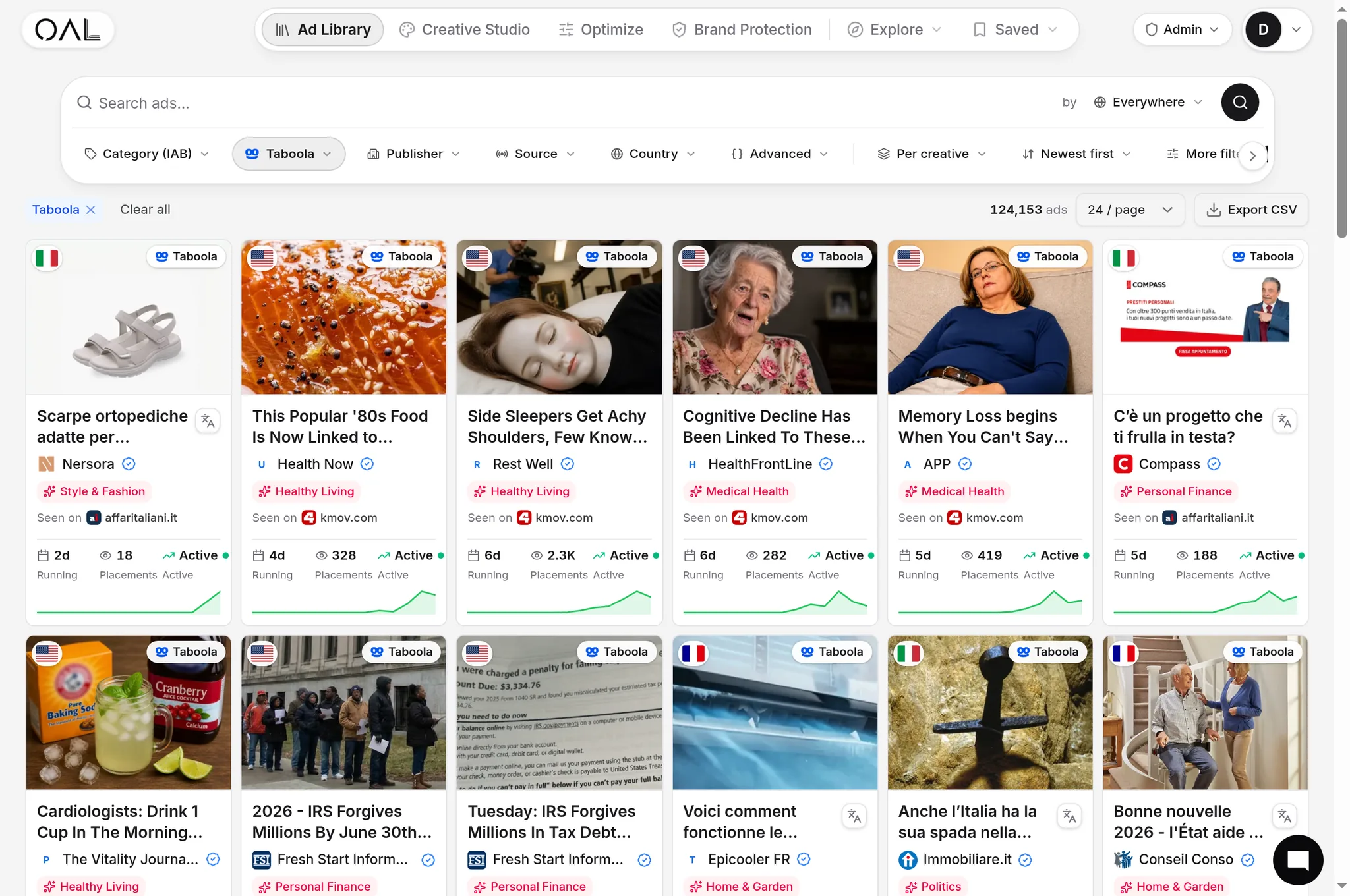
You have scrolled past Taboola a thousand times. It is the grid of "You May Like" thumbnails that sits under the article on a news site, the box promising you that doctors hate one weird trick. Taboola is the biggest content-recommendation network on the open web, and for an advertiser that widget is a door into hundreds of thousands of publisher pages plus, since the two companies signed a 30-year native partnership, all of Yahoo's owned-and-operated inventory.
This guide covers what happens between the moment you set a bid and the moment your ad shows up next to someone's news article. The auction. The widget. CPC pricing. Targeting. And the tracker chain that quietly bolts itself onto every click, which is the part nobody at Taboola will walk you through.
I am going to use real ads to do it. Not the clean examples vendors put in their pitch decks: actual creatives we pulled out of live widgets. We have 157,727 Taboola creatives in the OpenAdLibrary index as of June 2026, and the patterns below (the headline structures, the gap between thumbnail and lander, the trackers that fire on click) are ones you can go check yourself in any Taboola ad spy view of what is running right now.
How Taboola ads work, in one paragraph#
Taboola ads are a CPC-priced native auction. You upload a thumbnail and a short headline, then set a bid. When a reader loads a publisher page carrying a Taboola widget, the platform runs a real-time auction that ranks every eligible ad by predicted value, roughly your bid multiplied by how likely the ad is to be clicked and to convert, and drops the winners into the recommendation box. You pay per click. The algorithm then keeps shifting your budget toward the creative-and-placement pairs that actually perform. That is the whole machine. Everything below is detail.
The three parts of a Taboola ad#
A Taboola ad is deliberately bare. Three moving parts, that is it.
The thumbnail is a single static image, usually rectangular, built to win a click in a context where nobody is paying much attention. Curiosity, faces, and "look at this one strange detail" framing dominate, because the format rewards click-through, not brand polish. Here is a finance ad we captured that does exactly that:

The headline is one short line paired with the image. It gets A/B tested in dozens of variants against the same thumbnail. Notice the deadline in that one ("by June 30th"). Urgency plus a dollar figure is one of the most reused patterns in finance, which is the second-biggest Taboola vertical in our index at 5,558 creatives.
The destination is where the click actually goes, and it is usually not a clean product page. In performance verticals like supplements, finance, and insurance, you almost always land on a pre-lander or an advertorial first.
That third part is where most competitive analysis quietly falls apart. The thumbnail and headline tell you what an advertiser is testing. The landing page tells you what they are selling and how they convert. Tools that only screenshot the widget never see it. OpenAdLibrary follows each click through to the destination without clicking the live ad, so you get the full creative-to-lander funnel, the part competitors assume is hidden.
The thumbnail is the hook. The pre-lander is the business model. Study only the image and you are reverse-engineering the bait while ignoring the trap.
The Taboola auction: how a placement gets decided#
When a page loads, Taboola does not just show the highest bidder. It runs a native ad auction that scores every eligible ad on predicted value, not raw bid. The simplified ranking looks like this:
| Input | What it represents | Why it matters |
|---|---|---|
| Base CPC bid | What you will pay per click | Your ceiling, not your price |
| Predicted CTR (pCTR) | How likely this creative is clicked here | A great creative beats a higher bid |
| Predicted conversion value | Odds the click converts (when optimizing for CV) | Pulls spend toward profitable clicks |
| Placement and context | The exact publisher, page, device, geo | The same ad is priced differently per site |
Two things follow that catch new buyers off guard. First, a cheaper creative with a strong predicted CTR can beat a richer bid, because Taboola makes more money from a clicky ad at a low CPC than a dull ad at a high one. Your creative is, in a real sense, part of your bid. Second, you rarely pay your full max. Taboola has historically run a second-price-style mechanism, where you pay just enough to beat the next-ranked advertiser, though, like most of the ecosystem, parts of its stack have drifted toward first-price dynamics over time. Treat any single reported clearing price as directional and check it against your own delivery reports.
This bid-times-quality model is the same core machinery used across programmatic native advertising. What changes from network to network is the publisher supply, the data the prediction model was trained on, and how aggressively the algorithm reshuffles spend. If you want the format explained end to end before you go deep on any one network, our native advertising pillar guide lays it all out.
The widget: where your ad actually shows up#
Taboola ads live inside the recommendation widget, the boxes labeled "Around the Web," "You May Like," "Recommended For You," and so on. They sit below or beside the editorial content rather than in the page's main banner slots, and that placement is the whole point. A reader who just finished an article is in a content-consuming frame of mind, and the widget is dressed up to look like more articles.
A few placement realities to keep in your head:
Widgets mix organic and paid. A single widget often blends the publisher's own recommendations with paid placements, and the small "Sponsored" or "Ad" label is the only thing separating them. That blur is exactly why native advertising keeps drawing regulatory attention around disclosure.
Position inside the widget is auctioned too. The top-left slot is not free. It is the most valuable real estate in the box and clears at a premium.
The same ad behaves completely differently per publisher. A creative that crushes on a sports site can flatline on a finance site. Site-level performance, not account-level averages, is where the real optimization happens. Look at this hearing-aid ad, which we tracked running for 26 days straight:

Health is the single largest Taboola vertical in our index (6,048 creatives), and hearing, memory, and sleep angles are everywhere in it. An ad surviving 26 days of continuous observation is the market telling you the unit economics work. More on that signal below.
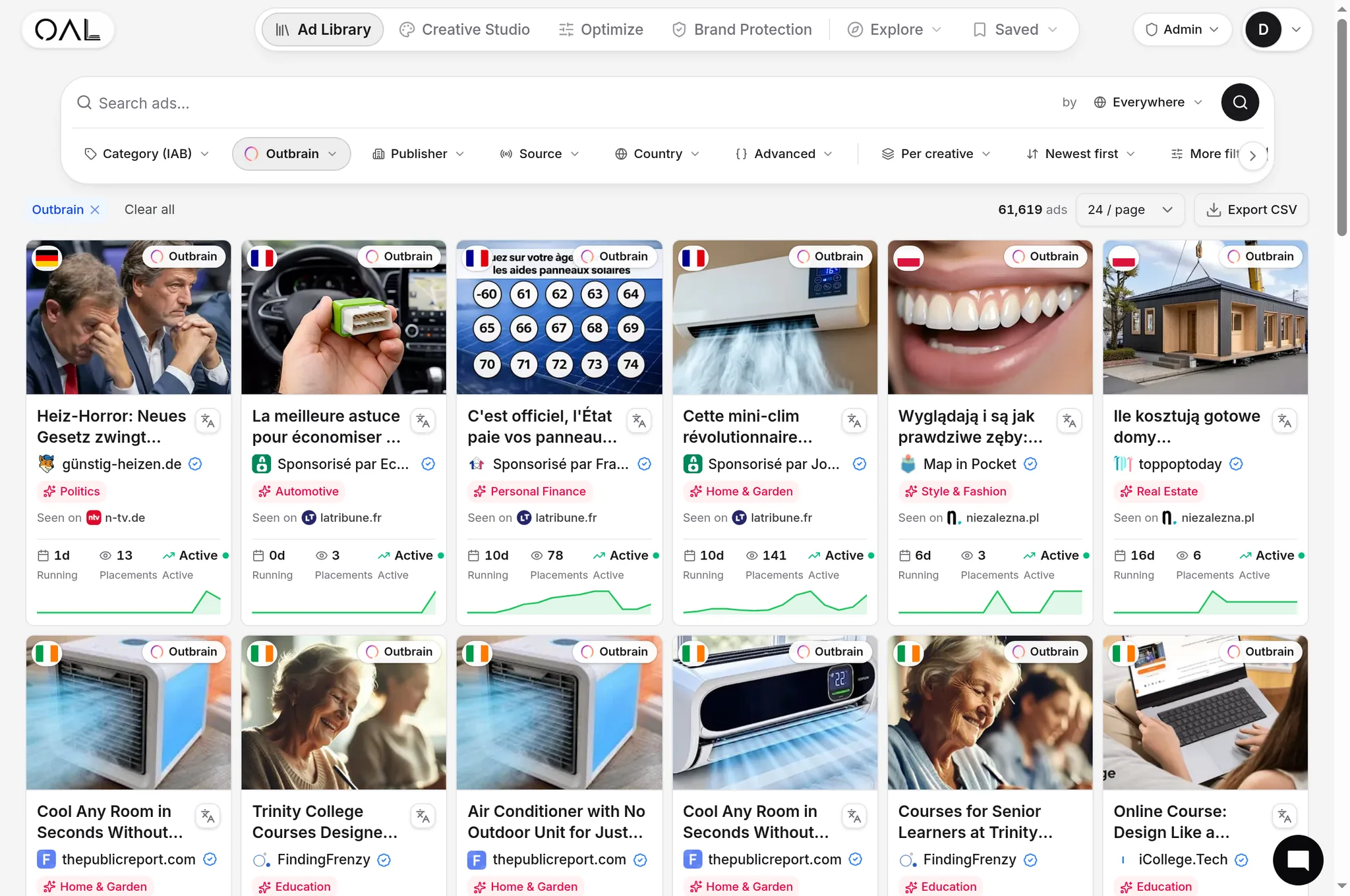
Because the network is anchored by the Yahoo partnership, your widget inventory now spans both independent publishers and Yahoo Finance, Yahoo News, Yahoo Sports, and AOL. That is a different footprint from the competition. Outbrain, which merged with Teads in February 2025 and now runs under the Teads brand, sits on a separate publisher base with a heavier video and branding emphasis. The practical takeaway: the same offer surfaces different competitors and different CPCs on each network, which is why experienced buyers test more than one. If you are mapping the landscape, it is worth comparing how Yahoo native inventory works after the Gemini era next to Taboola, since the two are now commercially joined at the hip.
CPC pricing and budgets: what you actually pay#
Taboola is bought on cost-per-click. You set a base CPC and the auction sets the real price. A few grounded reference points:
Minimum CPCs commonly start in the low single-cent range, around $0.01 to $0.03, for cheap geos and broad verticals. Competitive English-language placements clear well above that.
Daily budgets usually need a sensible floor, often $10 to $50 per campaign, so the optimization algorithm gets enough conversion signal to actually learn. Starving a campaign of data is the most common way people sabotage themselves.
Bid strategy runs from manual CPC to automated smart-bid and target-CPA modes that let Taboola adjust per-placement bids toward a conversion goal.
The honest version: there is no published rate card. Prices swing by vertical, geo, device, and season, and any "average Taboola CPC" figure floating around online is a blend of wildly different campaigns that tells you almost nothing about yours. The reliable way to estimate cost for your niche is to look at who is running right now, how long their creatives have survived, and how many placements they are buying. Longevity and spread are the closest public proxy you have for "this is profitable at the CPC they are paying." Ads live for weeks across many sites are winners. Ads that vanish in days were tests that failed. That signal is exactly what an ad-transparency layer surfaces, and it is the whole reason we time-stamp every observation.
Targeting: how Taboola decides who sees your ad#
Taboola targeting is contextual and audience-based, not the granular interest-graph targeting you know from social. The main levers:
Geo and language, down to country, region, and sometimes city. Device and OS, with separate performance and bidding for desktop, mobile, and tablet. Publisher and placement, via allow-lists and block-lists of specific sites plus the ability to bid up or down per site once data builds up. Audience segments, including first-party retargeting through the Taboola pixel plus lookalike-style and behavioral segments. And dayparting, so you can schedule by time and environment.
Here is a targeting tell you can read straight off a creative. This insurance ad names the country in the headline:

Insurance is the third-largest Taboola vertical in our data (4,303 creatives), and geo-named headlines like that one are a strong hint the advertiser is running tightly geo-fenced campaigns and wants the click pre-qualified before the auction even charges them.
The optimization loop matters more than any single setting. Launch broad, let the algorithm spread your spend, then cut the publishers and creatives that underperform and scale the survivors. Most of the skill in running Taboola is in that pruning discipline, not in clever upfront targeting.
The supply chain behind every placement#
This is the part Taboola's own interface never shows you, and where ad-transparency tooling earns its keep. When a Taboola ad renders and someone clicks, a chain of redirects and tracking pixels fires: Taboola's own click trackers, the advertiser's analytics and attribution tags, affiliate-network parameters, and frequently a third-party verification or cloaking layer on performance offers.
That chain is a fingerprint. It tells you whether an "independent" advertiser is actually an affiliate, which attribution stack they run, and sometimes which network is fulfilling the offer. Two ads with near-identical thumbnails can have completely different chains behind them, and that difference is the difference between a direct brand and an affiliate flipping someone else's product.
Take this one. The brand label reads "Consumer World," but the headline is pure affiliate review-bait:

For each live placement, OpenAdLibrary captures the real creative image at full quality (not a thumbnail crop), the real advertiser behind the placement (classified from the supply chain rather than guessed from the brand name), the click traced through to the landing page or pre-lander, and the longevity-and-spread signals across publishers that tell you which creatives are actually winning. Across the whole platform that is 589,036 creatives, 926,259 landing-page captures, and more than 5.4 million ad observations spanning 42 networks (OpenAdLibrary index, June 2026).
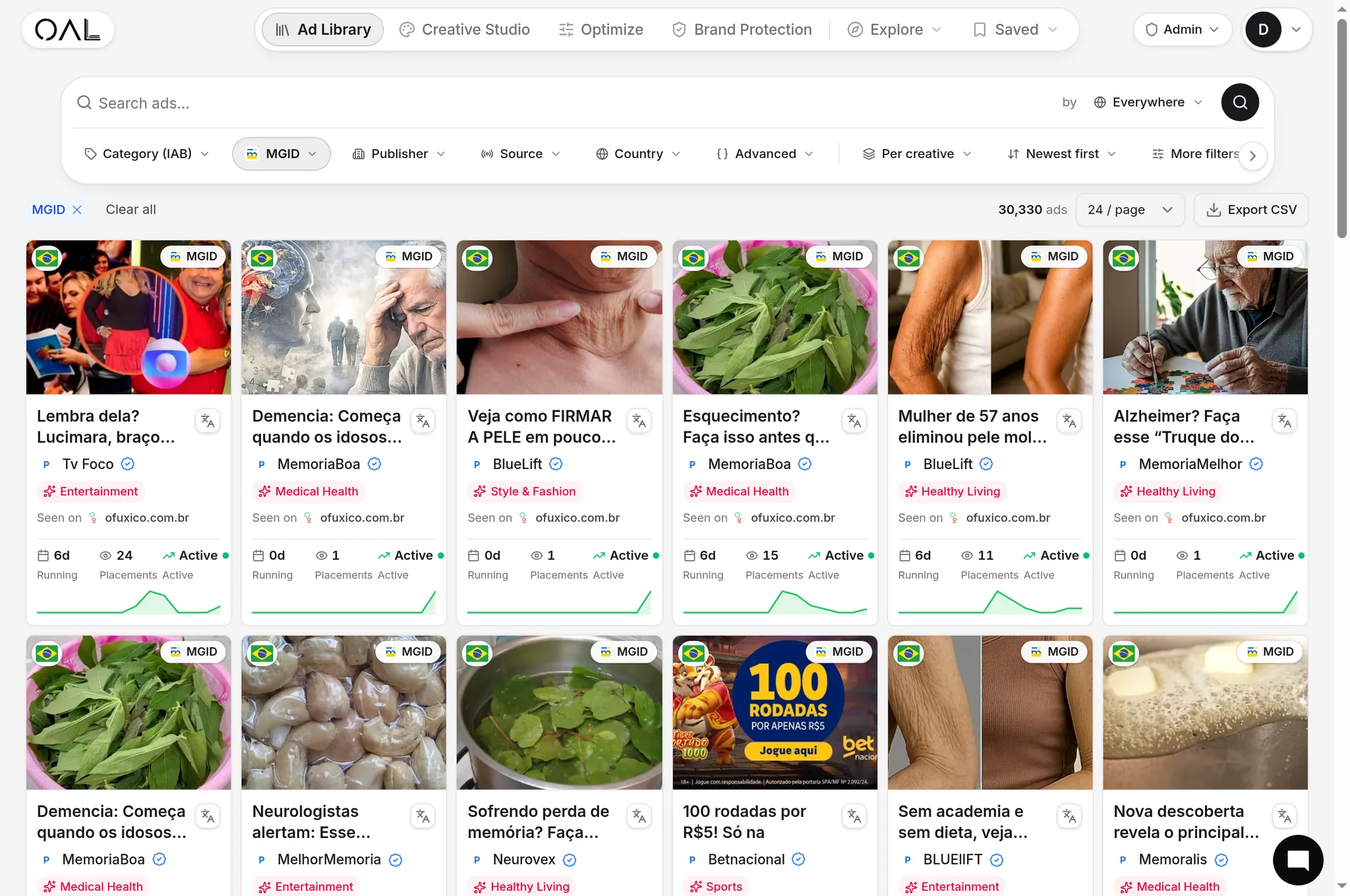
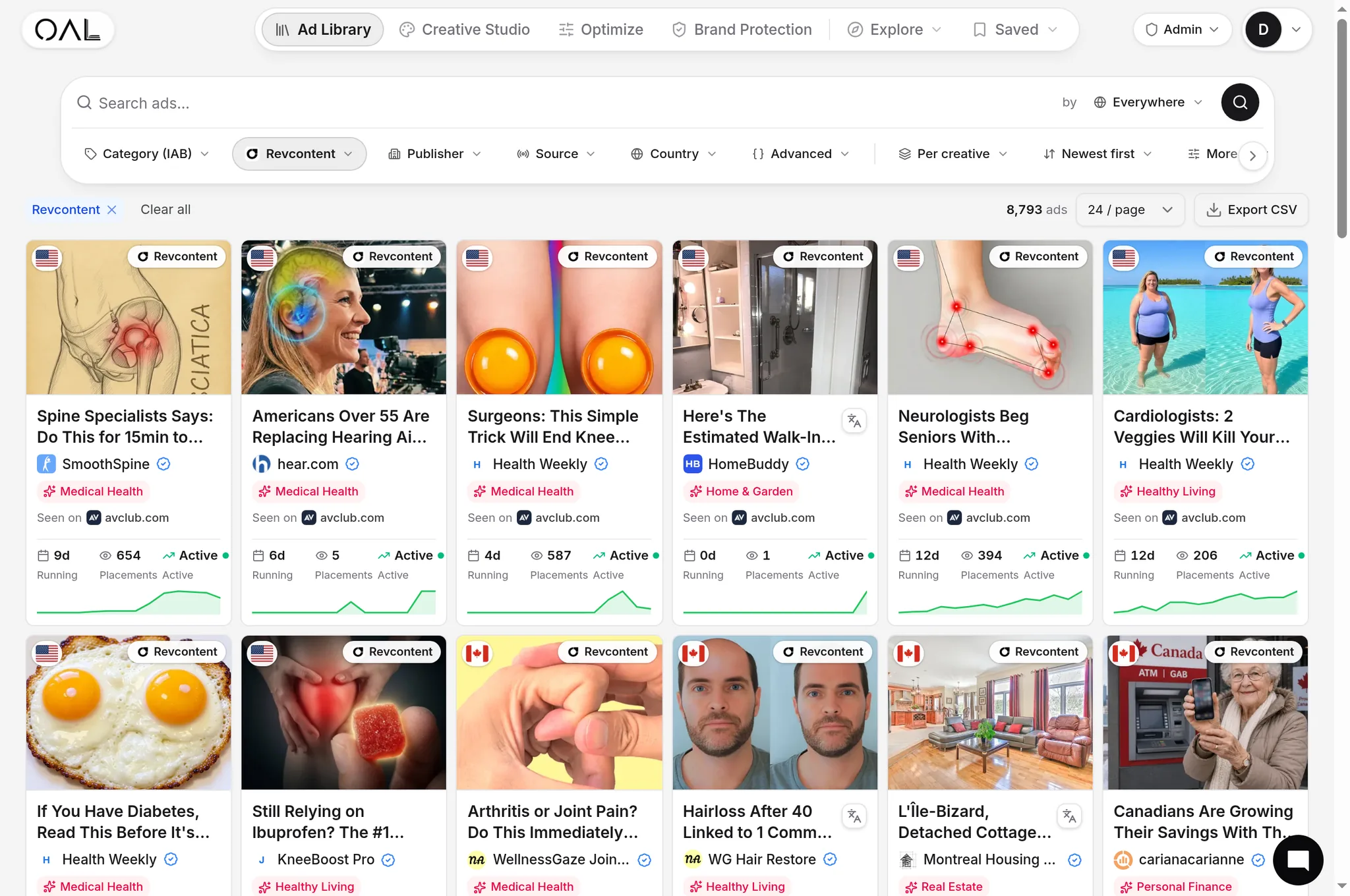
That is a different proposition from the legacy spy tools (Adbeat, AdPlexity, Anstrex) that charge $80 to $400 a month. OpenAdLibrary is open and runs at $29.99 a month, with a free tier that lets you browse 200 ads with no card. The same method applies across the whole native ecosystem, so once you can read Taboola's supply chain you can read MGID's formats and pricing and Revcontent's network the same way. A broader comparison of where each network's inventory actually comes from is covered in our Teads platform explainer.
A practical workflow for studying live Taboola ads#
If you are about to run on Taboola, do this before you spend a dollar.
Find creatives that have survived. Filter to Taboola placements that have been live for a long stretch across multiple publishers. In our index right now the longest continuously observed creatives run up to 28 days (a Cleverst pet ad and a SmartAsset finance ad among them, both on Outbrain), and we have Taboola creatives like a Solar Battery Subsidy home-energy ad observed for 27 days. Longevity is the market voting that the unit economics hold. (Industry lore about "90-day winners" is real enough, but that is general folklore, not something our index measures, so weigh it separately.)
Read the headline-thumbnail pairing. Note the angle, the curiosity gap, the emotional hook. Catalog the patterns showing up in your vertical, because you will reuse the structure, not the exact words.
Follow the click to the lander. This is the conversion mechanism. Advertorial? Quiz? Direct VSL? That structure is the real product, far more than the thumbnail is.
Inspect the supply chain. Identify the actual advertiser and the trackers. Affiliates and direct brands run very different offers behind ads that look nearly identical.
Model your CPC from spread. Heavily distributed creatives are tolerating real competition, which tells you roughly the floor you will face when you launch.
Do that for thirty live competitors and you will understand your niche's Taboola economics better than most agencies do, without launching a single blind test campaign.
Taboola is not complicated once you can see the machinery: a CPC auction that ranks bid times predicted quality, rendering into recommendation widgets across independent publishers and Yahoo, with a supply chain of trackers and landers attached to every click. The advertisers who win are not the ones with the biggest bids. They are the ones who study what is already working, copy the structure of proven funnels, and prune relentlessly. The fastest way to start is to look at the live market. Start free and browse real, currently-running Taboola creatives, with the advertiser, the landing page, and the longevity signal attached, in a few minutes.