Español
 Português (Brasil)
 Français
 Deutsch
 Italiano
 Nederlands
 Polski
 Svenska
 Türkçe
 Русский
 日本語
日本語 한국어
한국어 简体中文
简体中文 Tiếng Việt
 Bahasa Indonesia
 繁體中文
繁體中文 Dansk
Dansk Norsk (bokmål)
 Suomi
Suomi Ελληνικά
 Română
 Magyar
 Українська
 ไทย
ไทย हिन्दी
 العربية
 עברית
עבריתCompetitive Intelligence for Media Buyers: A Weekly Research Routine
The buyers who consistently find winners do not spy when they are stuck, they run a 45-minute weekly routine that turns scattered ad-checking into pattern recognition you can act on.


Most media buyers open a spy tool the way they open the fridge at midnight: only when something is wrong. The campaign is flat, the angle is tired, the account manager wants ideas by Friday. So you browse competitor ads for an hour, screenshot a few, and move on. Next time you do it, you have no memory of what you saw last time, so you cannot tell what actually changed.
That gap is the whole difference between ad spying and competitive intelligence. Spying is a snapshot. Intelligence is the time series. The buyers who reliably find winners before everyone else are not better at staring at ads. They have a routine that turns weekly snapshots into pattern recognition. This guide is that routine: a 45-minute weekly cadence for native media buyers that surfaces new entrants, fresh creatives, and geo expansions, plus a simple log structure that makes the patterns obvious over a month.
What a weekly review actually buys you#
Run a fixed weekly review of competitor ads and you stop reacting to individual creatives and start reading the market. New advertisers entering your vertical, creatives that survive long enough to be profitable, and offers expanding into new countries all show up as changes between snapshots. Those are signals you can act on before they are obvious to everyone scrolling the same feeds.
The reason weekly works for native specifically is rhythm. Buyers on Taboola, Outbrain, MGID and Revcontent typically run a test cycle of a few days to a couple of weeks before they cut losers and scale winners. Check daily and you drown in tests that will be dead by Thursday. Check monthly and the winner has already been copied by a dozen affiliates. Weekly lands on the same beat as the buying it observes.
To put a number on the haystack you are working in: as of June 2026 the OpenAdLibrary index holds 589,036 captured creatives from 25,933 advertisers across 42 networks, with more than 5.4 million individual ad observations behind them. Taboola alone accounts for 157,727 of those creatives, Outbrain 84,252, and MGID 49,689. You are never going to look at all of that. The point of a routine is to make a tiny, deliberate slice of it useful every week.
This is the operational layer of ad intelligence, the discipline that compounds rather than the one-off look. If you want the strategic case for why this matters across native, display and social, the pillar guide on how to spy on competitor ads in 2026 frames the whole landscape. This piece is the narrow, repeatable execution.
The three signals worth watching every week#
You cannot watch everything, and trying to is why most monitoring habits collapse after two weeks. Pick three signals. These are the ones that actually change buying decisions.
1. New entrants#
A new advertiser appearing in your vertical is the single highest-value signal, and the one most buyers miss, because they only check the same five competitors they already know. New money in a vertical means either a fresh offer that is working or a funded player testing your space. Either way you want to know in week one, not when their creatives are everywhere.
Track this by watching the vertical, not just named brands. Finance is the most crowded category in our index at 17,232 creatives, with insurance close behind at 15,629 and health at 14,895. If you buy in those spaces, new entrants land every single week, and a fresh name with a polished funnel is worth a closer look. Filter for your category, sort by first-seen date, and anyone you do not recognise gets a name, a note, and a place on the watchlist. The companion guide on building a competitor watchlist for ad monitoring goes deeper on structuring this so it stays maintainable.

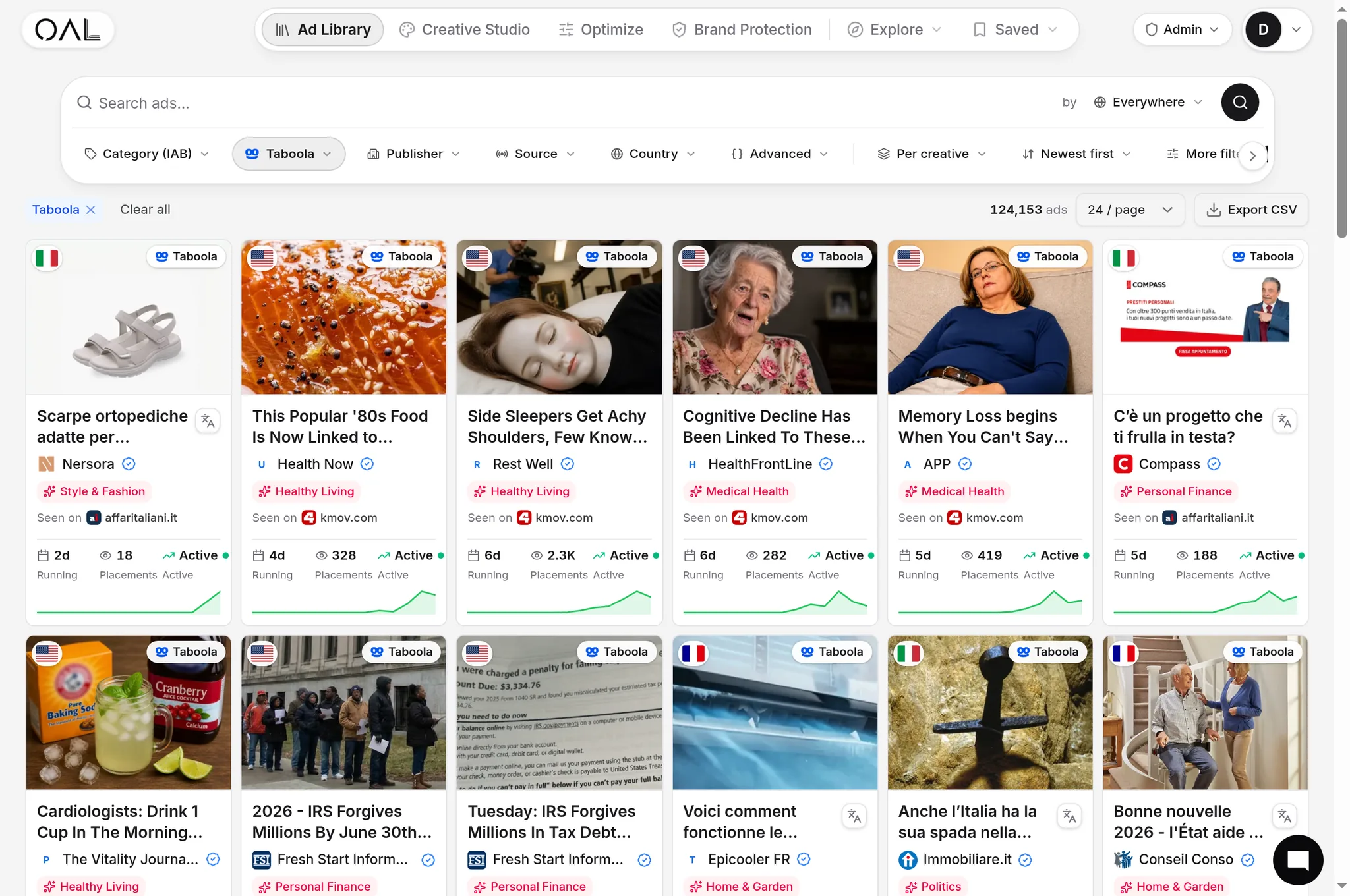
That ad above is the kind of new-entrant signal worth logging: a tax-relief offer with a deadline hook, already running 13 days when we captured it. Thirteen days live in native usually means the math is working.
2. Creative refreshes#
When a competitor swaps creative on an offer that has been running, that is a tell. Either the old angle fatigued (useful: note what they abandoned) or they found a new hook worth scaling (more useful: note what they replaced it with). The pace of refresh is itself a signal. An advertiser cycling through ten new images a week is in aggressive test mode. One running the same three for a month has a control they are protecting.
Health and senior-finance angles refresh constantly, and the headlines tell you what is working without you guessing. The two below are textbook examples of the curiosity-gap formula that dominates the category right now.


Both were only three days old when captured, which is exactly what active testing looks like. When you log the headline, the angle and the date, a pattern of which framings survive past two weeks starts to emerge across the whole vertical.
3. Geo expansion#
An offer moving into a new country is the clearest profitability signal in native. Nobody expands a losing campaign. When a creative that was US-only shows up in the UK, Canada or Australia, the advertiser has decided the unit economics travel. That is a validated offer you can evaluate for your own geos, and a reason to look hard at the landing page, because the localisation choices reveal how seriously they are taking the new market.
| Signal | What you log | Why it matters | Action it triggers |
|---|---|---|---|
| New entrant | Advertiser name, vertical, first-seen date | Fresh money or a new working offer | Add to watchlist, profile the funnel |
| Creative refresh | Old vs new creative, refresh date, cadence | Fatigue point or a scaling hook | Adapt the surviving angle |
| Geo expansion | Offer, old geo, new geo, date | Validated, profitable economics | Evaluate the geo for your own buys |
The 45-minute weekly routine#
Block the same slot every week. The consistency is the point. Same time, same filters, same log, because comparison only works when the conditions are held constant. Here is the sequence.
- Scan new entrants (10 min). Open your vertical, sort by first-seen date, and review anything from the last seven days you do not recognise. Name the real advertiser behind each one. Native ads hide the actual brand behind tracker redirects, so a tool that resolves the supply chain to the genuine advertiser saves you the manual detective work.
- Review your watchlist (15 min). Go advertiser by advertiser through your tracked competitors. For each one, ask three questions. Any new creatives since last week? Any creatives that disappeared? Any new geos? Log the deltas, not the full picture. You only care about what changed.
- Pull the winners (10 min). Sort your watchlist's ads by how long they have been live. Anything running for several weeks across multiple publishers and geos is a probable winner. These are your study targets. Longevity and spread do the work that an impressions estimate only pretends to do, without the guesswork.
- Trace one funnel end to end (10 min). Pick the single most interesting ad of the week and follow it from creative to landing page to offer. Do not click the live ad. That costs the advertiser money and can skew your own retargeting and analytics. Study a capture that already followed the click for you instead. The deep mechanics of this are in the guide to reverse-engineering a competitor's native ad funnel.
That is it. Forty-five minutes, and the only output you carry forward is your log.
The log: where snapshots become patterns#
Every snapshot you take is worthless in isolation and valuable in sequence. The log converts one into the other. Keep it dead simple, a spreadsheet works fine, with one row per observation:
- Date observed, so you can reconstruct the timeline
- Advertiser, the real brand, not the tracker domain
- Network: Taboola, Outbrain (now operating under the Teads brand after its 2025 acquisition of Teads), MGID, Revcontent, Yahoo, MSN
- Signal type: new entrant, refresh, geo expansion
- Creative note: the hook, the angle, the image concept
- Geo, where it ran
- Longevity: first-seen to last-seen, if available
- Link, to the captured ad and its landing page
After four weeks this log starts answering questions a single session never could. Which advertisers refresh creative fastest? Which angles survive across multiple players, a sign the angle and not the brand is what works? Which offers expanded geo right before you saw copycats appear? That rhythm-detection is what separates a media buyer who reacts from one who anticipates.
A note on data hygiene: log the real advertiser every time. Native creatives route clicks through redirect chains, so the brand on the ad is rarely the entity paying for it. If your log is full of tracker domains instead of real advertisers, your pattern recognition is built on sand. Resolving the supply chain to the genuine advertiser is exactly the gap that purpose-built ad intelligence platform tooling closes.
Reading longevity, not novelty#
The most common mistake in this whole exercise is treating the newest creative as the best one. It is the opposite. The newest ad is an untested guess. The oldest ad still running is a proven winner, because no native buyer keeps a losing creative funded.
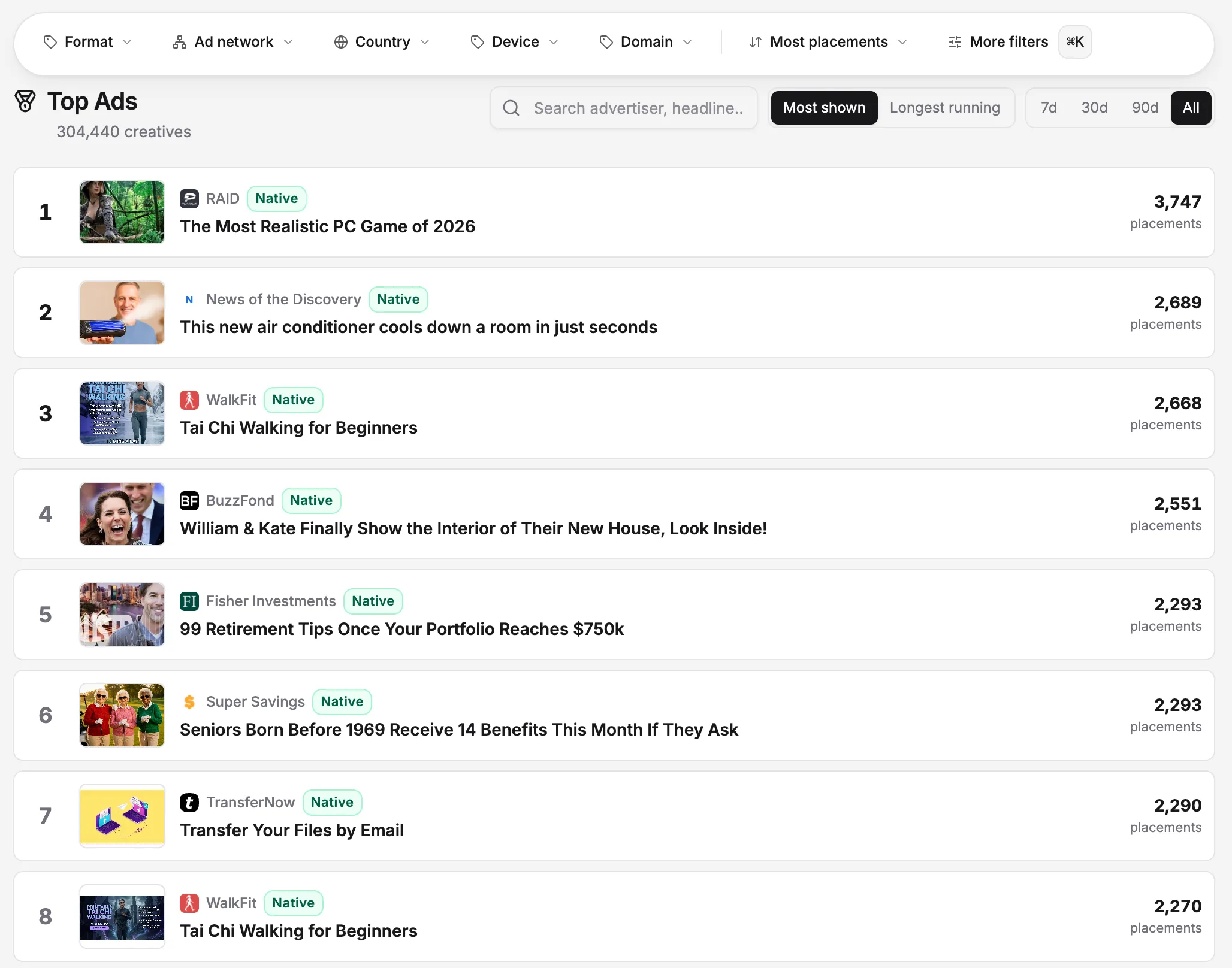
Here is the part worth being honest about. You will read industry posts about "90-day winners" as the gold standard, and across a long enough history that is true. But that is general native lore, not something I can show you from our own data. What we can show is the durable end of what we currently observe. Our index timestamps first-seen and last-seen on every creative, and at the moment the longest continuous runs we have captured sit around 28 days each. SmartAsset has an Outbrain finance ad ("Ask a Pro: How Can I Avoid Paying Taxes on IRA Withdrawals?") at 28 days. Combat Siege has a gaming ad at 28 days. Hidden Hearing and My IQ both have hearing-aid and IQ-quiz creatives clocking the same. When the same advertiser holds a creative steady for nearly a month while everything around it churns, that is the control they are protecting.

The Nebroo hearing-device ad above had been running 26 days when we last checked. In a vertical that refreshes as fast as health, an ad that survives nearly a month is telling you the offer and the angle both work. That is a far better study target than whatever launched yesterday.
Turning the log into action#
Intelligence that does not change a buy is a hobby. Each signal type maps to a specific move:
- A new entrant with a polished funnel means evaluate their offer for your own portfolio, or at minimum understand who is now competing for your placements.
- A creative refresh on a long-running offer means the surviving angle is validated. Adapt it (adapt, do not photocopy) and test it against your control.
- A geo expansion means a proven offer just told you it has room to grow. If it travels for them, it may travel for you.
The cleanest way to keep these moves from getting lost is to wire the routine into a documented workflow rather than relying on memory. The guide to building a competitive ad intelligence workflow shows how the watchlist, the weekly log and the action queue connect into a single loop.
Why native rewards this discipline more than other channels#
Native is uniquely suited to weekly intelligence because the public surface is genuinely informative. Search ads vanish the moment auction conditions change. Social creatives sit behind ad-account walls. Native ads run on open publisher pages, which means a platform that captures the live placement gives you the real creative at full quality, the publisher it ran on, and the path to the landing page. The whole funnel is observable, which is why our index has been able to follow 926,259 landing-page captures so far.
Regulation is widening that window further. Under the EU's Digital Services Act, very large platforms must maintain public repositories of the ads they serve, and the first harmonised transparency reports landed in early 2026. The direction of travel is more ad transparency, not less, which makes a structured weekly routine more valuable over time rather than a passing edge. The detailed network-by-network mechanics for Taboola, Outbrain and MGID live in the guide on spying on competitor native ads.
Common ways the routine fails#
- Watching too much. Three signals, a focused watchlist, a fixed time box. Scope creep kills the habit by week three.
- Logging snapshots instead of deltas. The value is in what changed. Re-recording the full picture every week buries the signal in noise.
- Confusing novelty with performance. The newest creative is not the best one. The oldest one still running is. Longevity beats freshness as a winner signal.
- Clicking live ads to see the funnel. It costs competitors money, trains their algorithm against you, and can corrupt your own attribution. Study captures instead.
- Tracking tracker domains. If your log does not name the real advertiser, you cannot connect a creative to a brand to a funnel, and the patterns never resolve.
Putting it together#
Competitive intelligence for media buyers is not a tool you buy or an hour you spend when you are stuck. It is a weekly habit: three signals, a simple log, and one funnel traced per session. Do it for a month and the market starts narrating itself. Who is new, what is working, where money is moving. Skip it and you are back at the fridge at midnight.
OpenAdLibrary is built for exactly this cadence: live native ad capture across Taboola, Outbrain, MGID, Revcontent, Teads, Yahoo and MSN, the real advertiser behind each ad, first-seen and last-seen dates that reveal longevity, geo spread, and the click followed to the landing page without ever touching a live placement. It is open and costs $29.99 a month against rivals at $80 to $400, with a free tier to browse 200 ads without a card. Start free and run your first weekly review this week.