Español
 Português (Brasil)
 Français
 Deutsch
 Italiano
 Nederlands
 Polski
 Svenska
 Türkçe
 Русский
 日本語
日本語 한국어
한국어 简体中文
简体中文 Tiếng Việt
 Bahasa Indonesia
 繁體中文
繁體中文 Čeština
 Dansk
Dansk Norsk (bokmål)
 Suomi
Suomi Ελληνικά
 Română
 Magyar
 Українська
 ไทย
ไทย हिन्दी
 العربية
 עברית
עבריתOutbrain Traffic Quality: Premium Publishers vs the Long Tail
Outbrain built its name on premium news placements, but its exchange spans a long tail where quality varies wildly. What actually determines the traffic you get — and how to audit it.


Outbrain traffic quality is above the native-network average on its premium tier — the network built its reputation on placements inside established news publishers — but "Outbrain traffic" is not one thing. Quality varies sharply between top-tier publisher sections, long-tail content sites, and resold inventory, and your results depend almost entirely on which slice of that supply your bids actually land on. Buyers who treat quality as a fixed property of the network get burned; buyers who treat it as a variable to manage — with section-level reporting, blocklists, and conversion-based pruning — generally find Outbrain one of the more workable traffic sources in native.
What "traffic quality" actually means on a native network#
"Good traffic" is vague until you break it into measurable parts. On a content-recommendation network, quality is the product of five things:
- Reader attention. Did a human deliberately click your headline after finishing an article, or did a thumb graze a dense mobile grid? Deliberate clicks convert; accidental ones bounce in under two seconds.
- Placement viewability. A below-article widget only earns attention from readers who reached the end of the piece. Placements that load off-screen or beneath sticky video players produce clicks with strange post-click behavior.
- Device and geo mix. Desktop news readers in Tier-1 geos behave very differently from mobile long-tail visitors, even inside the same campaign.
- Invalid traffic share. Every open-web channel carries some bot and click fraud exposure; the question is how much survives the network's filtering and lands on your invoice.
- Post-click behavior. Bounce rate, dwell time, scroll depth, and ultimately conversion rate — the only quality metrics that pay you back.
Native networks have structurally wider quality dispersion than search or social because one auction spans thousands of independent publishers. The same bid can serve your ad under a national newspaper's finance section and on page seven of a slideshow site. Managing that dispersion is the entire game.
Outbrain's premium core#
Outbrain's historical differentiation is publisher quality. Over the years it has publicly worked with major news brands — CNN, Der Spiegel, and Sky News have all been announced partners at various points — and its standard placement is the Smartfeed recommendation unit below article content on those sites. Individual publisher deals rotate constantly, so treat any static roster as a snapshot rather than a promise, but the center of gravity has consistently been established editorial publishers rather than made-for-advertising domains.
Two things follow. First, the audience skews toward genuine news readers — older, more desktop-heavy, and more accustomed to reading long text than the average social scroller. Funnels with substance (advertorials, comparison pages, detailed lead forms) do relatively better here than pure impulse offers. Second, premium supply is priced like premium supply: competition from insurance, finance, and brand advertisers keeps CPCs on top sections meaningfully higher than on the network's long tail.
The 2025 merger with Teads folded Outbrain's feed inventory into a larger omnichannel platform spanning in-article video and display — we cover what changed in Did Outbrain Become Teads? and the combined offering in What Is Teads?. For feed buyers, the day-to-day auction mechanics remain recognizably Outbrain.
Placement types at a glance#
| Placement | Attention profile | Typical quality risk |
|---|---|---|
| Below-article feed (desktop) | Readers who finished an article; deliberate clicks | Higher CPCs from brand and lead-gen competition |
| Below-article feed (mobile) | Mixed; engaged readers plus scroll-past taps | Misclicks on dense grids |
| Mid-article units | Interrupts reading; more impulsive clicks | Lower post-click dwell time |
| Sidebar / right rail | Low attention, low CTR | Cheap but weak intent |
| Long-tail and resold slots | Highly variable | Arbitrage traffic, invalid clicks |
No placement type is "bad" — each has a price at which it works. The failure mode is paying premium-section prices for long-tail attention because you never separated them in reporting.
Where quality drops: the long tail and resold inventory#
Like every native network, Outbrain monetizes far more than its flagship partners. Below the premium core sits a long tail of mid-size and small content sites, and this is where dispersion gets serious:
- Arbitrage publishers. Some long-tail sites buy visitors cheaply and monetize them with recommendation widgets — the model explained in our traffic arbitrage glossary entry. Recycled attention can still convert, but it behaves nothing like destination-news readership.
- Aggressive layouts. Stacked widgets, dense mobile grids, and units crowding interactive page elements generate misclicks. A section showing high click volume with near-zero landing-page dwell time is selling you thumb slips.
- Resold inventory. Native demand increasingly flows through intermediary paths where one network fills another's slots as a demand partner. Each additional hop makes it harder to know what page your ad really rendered on — the mechanics are traced in The Native Ad Supply Chain, Explained.
- Invalid traffic. Sophisticated invalid traffic concentrates wherever moneyed demand meets low oversight. Networks filter continuously, but no filter is perfect — the patterns worth watching are catalogued in our guide to ad fraud in native advertising.
None of this is unique to Outbrain; the same tiers exist on every open-web network. The point is that a single campaign-level CPA figure averages across all of it, and averages hide exactly the information you need.
How to audit the traffic you're actually buying#
Six steps, all practitioner-standard:
- Report at section level from day one. Outbrain exposes publisher- and section-level performance. Judge placements on conversions and post-click engagement, never on clicks delivered.
- Compare platform clicks to tracker sessions. If your tracker records substantially fewer landing-page sessions than the platform bills clicks for, the gap is misclicks, prefetches, or bots. A persistent, large gap on specific sections is a block signal.
- Prune on a conversion rule. The standard discipline: once a section has spent a meaningful multiple of your target acquisition cost with zero conversions, block it and move on. Maintain the exclusion list deliberately — see whitelist / blacklist targeting.
- Split campaigns by device. Desktop premium sections and the mobile long tail have different price floors, different misclick rates, and different funnel behavior. Averaging them in one campaign makes both unmanageable.
- Score conversion quality downstream. For lead-gen, track contact rates and qualification rates per section, not just lead counts. Sections producing cheap unqualified leads are worse than expensive sections that close.
- Re-test quarterly. Publisher mixes, layouts, and demand change. A section blocked in March may be your best performer by September.
What 108,000+ live Outbrain ads reveal about its buyers#
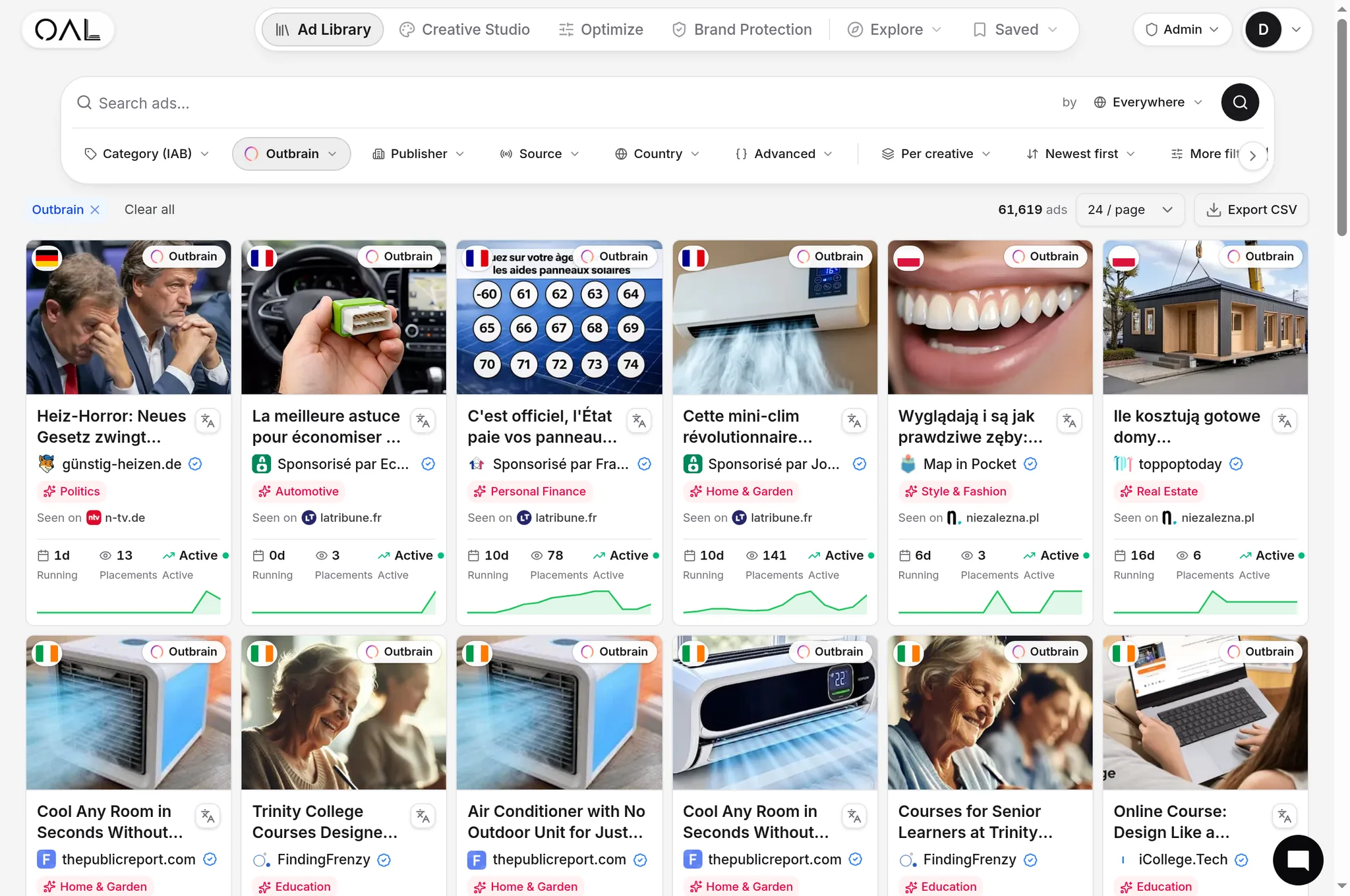
A useful external check on any network's traffic quality: look at who keeps spending on it. OpenAdLibrary's index tracks 108,573 live Outbrain creatives as of June 2026, inside a corpus of 725,000+ native creatives across 49 networks. The vertical mix is telling — insurance (4,345 classified live creatives), finance (3,990), and health (3,102) lead the network. Insurance and finance advertisers measure lead quality ruthlessly; their sustained presence at the top of the network is evidence that, managed properly, the traffic closes.
The index also shows brand-content buyers sitting alongside direct response — corporate storytelling campaigns like SPECTRA by MHI's sustainability series have been observed running for over a month straight, and the longest-running Outbrain creatives in the index have been continuously observed for 38 days. Advertisers do not renew losing placements for weeks on end. Browsing the live Outbrain index — filtering by vertical and sorting by observed longevity — is a fast way to see which advertisers and funnel styles the traffic actually sustains before you spend a dollar of your own.
Verdict: is Outbrain traffic good?#
Yes — conditionally. The premium slice is some of the most legitimate reader attention available on the open web, priced accordingly and best suited to considered-purchase funnels. The long tail is cheaper and noisier, workable only with aggressive section-level pruning. The buyers who complain about Outbrain traffic quality are, almost always, the ones who ran a single campaign across the whole exchange, judged it on the blended average, and never opened the section report. The buyers who quietly scale on it treat supply curation as the core job. Traffic quality on Outbrain is not something you get; it is something you manage.