
 Español
 Português (Brasil)
 Français
 Deutsch
 Italiano
 Nederlands
 Polski
 Svenska
 Türkçe
 Русский
 日本語
日本語 한국어
한국어 简体中文
简体中文 Tiếng Việt
 Bahasa Indonesia
 繁體中文
繁體中文 Čeština
 Dansk
Dansk Norsk (bokmål)
 Suomi
Suomi Ελληνικά
 Română
 Magyar
 Українська
 ไทย
ไทย हिन्दी
 العربية
 עברית
עבריתWhy Did My CPC Go Up? 9 Causes and How to Diagnose Each
CPC increases have nine common causes across three buckets — your account, the auction, and measurement. Here is the telltale signal for each and the fix that actually works.


Nine causes explain almost every CPC increase, and they sort into three buckets: your account (creative fatigue, a targeting change, a budget jump, a bid-strategy reset), the auction (new competitors, seasonality, publisher mix, network-side changes), and measurement (fraud and reporting artifacts that only look like a price increase). The fastest first check is your CTR trend: if CTR fell, the cause is usually inside your account — on CTR-priced networks a weaker click-through rate literally makes your clicks more expensive. If CTR held steady and CPC still rose, the auction around you got hotter.
First, split the problem into three buckets#
| Bucket | Causes | Fast tell |
|---|---|---|
| Your account | Creative fatigue, targeting change, budget jump, bid-strategy recalibration | CTR fell, or the change history shows an edit near the inflection |
| The auction | New competitor, seasonality, publisher-mix shift, network changes | CTR stable, CPC up across many placements at once |
| Measurement | Click fraud, reporting artifacts | Clicks up but landing sessions flat; the "increase" appears in one report but not another |
Work the buckets in that order — account causes are the most common and the only ones you can fix directly.
The nine causes, one by one#
1. Creative fatigue dropped your CTR#
Native and social auctions rank ads by expected yield per impression — effectively bid × CTR (see how the native ad auction works). When creative fatigue erodes your CTR, your effective rank falls, and holding the same placements costs more per click even though nobody outbid you. This is the most common cause of "mystery" CPC creep on native networks, and the one most often misdiagnosed as competition. Tell: CTR down materially from launch while impressions hold. Fix: rotate fresh creatives on a schedule — retire by CTR decay, not by age.
2. A new competitor entered your auction#
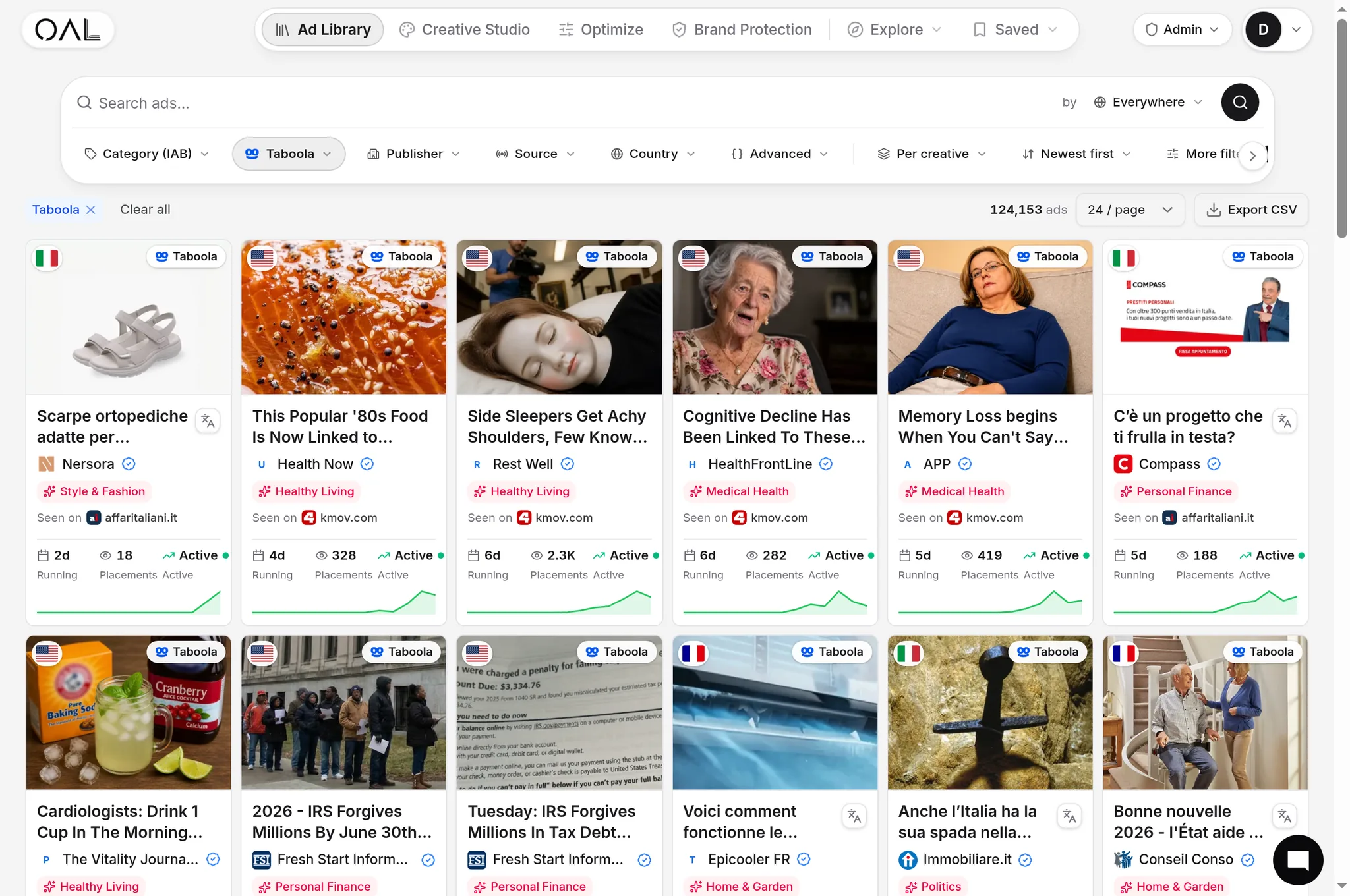
A funded advertiser arriving in your vertical raises clearing prices for everyone bidding on the same audience and placements. You can see this directly instead of guessing: OpenAdLibrary indexes 29,000+ advertisers across 49 networks (June 2026), so a competitor watchlist surfaces new creatives in your niche within days, and what products advertisers are scaling shows where fresh budgets are landing. The ad intelligence platform is the fastest way to check whether your vertical suddenly got crowded. Tell: CPC up, CTR flat, new advertisers visible in your vertical.
3. Seasonality repriced the quarter#
Q4 ecommerce demand, insurance enrollment windows, the New Year health-and-diet surge, tax season for finance offers — every vertical has a season when demand outbids the rest of the year, and CPCs across whole categories rise together. Retail-adjacent verticals feel it from October through December; health and diet spike in January; travel heats up ahead of summer. Tell: the rise is gradual, industry-wide, and matches the same period last year. Fix: none, really — plan margins around it, or rotate spend toward less contested verticals and geos until the season passes.
4. You narrowed your targeting#
Restricting geos, devices, or placements concentrates your spend on the most contested slice of supply. A campaign trimmed from six geos to US-only, or from all devices to desktop-only, is now bidding exclusively where everyone else's budget also concentrates. Tell: the change history shows a targeting edit right before the inflection. Fix: re-widen, or accept the tradeoff consciously because the narrow slice converts better.
5. Your publisher mix shifted#
Campaign CPC is a blended average across sites. If delivery moved toward premium publishers, the blend rises with no single price changing. Check CPC per site ID: if placement-level prices are flat but the mix moved, that's your answer. Manage it with deliberate whitelists and blacklists rather than letting the network choose your mix for you. Tell: placement-level CPC flat, delivery mix changed.
6. You raised the budget#
The cheapest inventory gets bought first. Pushing more budget through the same targeting buys deeper into the auction at higher clearing prices — the classic cost of scaling vertically. Horizontal vs vertical scaling covers the workaround: replicate into new placements, geos, and networks instead of bidding deeper into the same ones. Tell: the CPC rise coincides with the budget change, and eases if you step back down.
7. Smart bidding recalibrated#
Automated strategies re-solve for their target whenever the conversion signal changes. A broken pixel, a slower landing page, an offer-page change, or an attribution-window edit all read to the algorithm as "conversions got scarcer," and smart bidding responds by bidding differently — often up. Tell: conversion tracking changed, broke, or went sparse right before CPC moved. Fix: repair the signal first, then let the strategy re-learn before judging it.
8. The network changed under you#
Floor-price adjustments, a large publisher leaving the supply pool, demand partners reselling inventory, policy shifts that shrink eligible placements — none of it is announced to you personally. You infer this bucket when every other cause is ruled out and the shift is network-wide. Check the network's official documentation and announcements, and compare against a second network running the same offer: if one book repriced and the other didn't, the network moved, not the market.
9. It isn't real: fraud or reporting artifacts#
Bot clicks inflate spend without adding buyers — if clicks rose while landing sessions and conversions stayed flat, work through our guide to ad fraud in native advertising. Subtler artifacts do the same on paper: currency-conversion changes, timezone boundaries splitting days differently, or comparing a 7-day window against a 30-day one. Tell: the click-to-session ratio degraded, or the "increase" exists in one report but not in the platform's own numbers.
The 15-minute diagnostic sequence#
- Change history first. Any edit to targeting, budget, bids, or bid strategy within 48 hours of the inflection is the prime suspect.
- CTR trend. Down = fatigue (cause 1). Flat = keep going.
- Conversion feed health. Missing or delayed conversions point to cause 7.
- Placement-level CPC vs mix. Flat placement prices with a shifted mix = cause 5.
- Vertical scan. Check your watchlist or the index for new entrants (cause 2).
- Calendar. Same movement last year = cause 3.
- Click-to-session ratio. Degraded = cause 9.
Whatever survives that sequence is cause 6 (your budget), cause 4 (your targeting), or cause 8 (the network) — all resolvable from your own records plus elimination.
Fixes that actually move CPC back down#
| Cause | Fix |
|---|---|
| Creative fatigue | Fresh creatives on a schedule; retire by CTR decay, not age |
| New competitor | Differentiate the angle rather than outbid — crowded hooks pay a premium |
| Seasonality | Budget around it; shift geo and vertical mix for the season |
| Targeting change | Re-widen, or split campaigns so premium slices are priced deliberately |
| Publisher mix | Whitelist the earners, blacklist the burners, bid per placement |
| Budget push | Scale horizontally into new placements and geos instead of deeper |
| Smart bidding | Fix the conversion signal, then let it re-learn |
| Network-side | Diversify networks so one repricing can't move your whole book |
| Fraud / reporting | Verify with independent tracking before "optimizing" anything |
When a rising CPC is fine#
CPC is an input, not an outcome. If your EPC or margin per click held while CPC rose — because the pricier clicks convert better — the campaign got healthier, not sicker. A shift toward premium publishers is the classic case: the blended CPC climbs, the conversion rate climbs faster, and the "problem" is actually an upgrade. Plenty of buyers trim their way out of profitable placements chasing a CPC number back to where it used to be. Judge campaigns on margin per click and per placement; treat a CPC alarm as a prompt to run the diagnostic above, not as an instruction to cut.