Español
 Português (Brasil)
 Français
 Deutsch
 Italiano
 Nederlands
 Polski
 Svenska
 Türkçe
 Русский
 日本語
日本語 한국어
한국어 简体中文
简体中文 Bahasa Indonesia
 Čeština
 Dansk
Dansk Norsk (bokmål)
 Suomi
Suomi Ελληνικά
 Română
 Magyar
 Українська
 ไทย
ไทย हिन्दी
 العربية
 עברית
עבריתNative Ads Swipe File: Winning Creatives by Vertical, From Live Data
A swipe file is only as good as its evidence. Real native creatives organized by vertical — each with observed run time — plus the tagging and refresh system that keeps a swipe file useful.

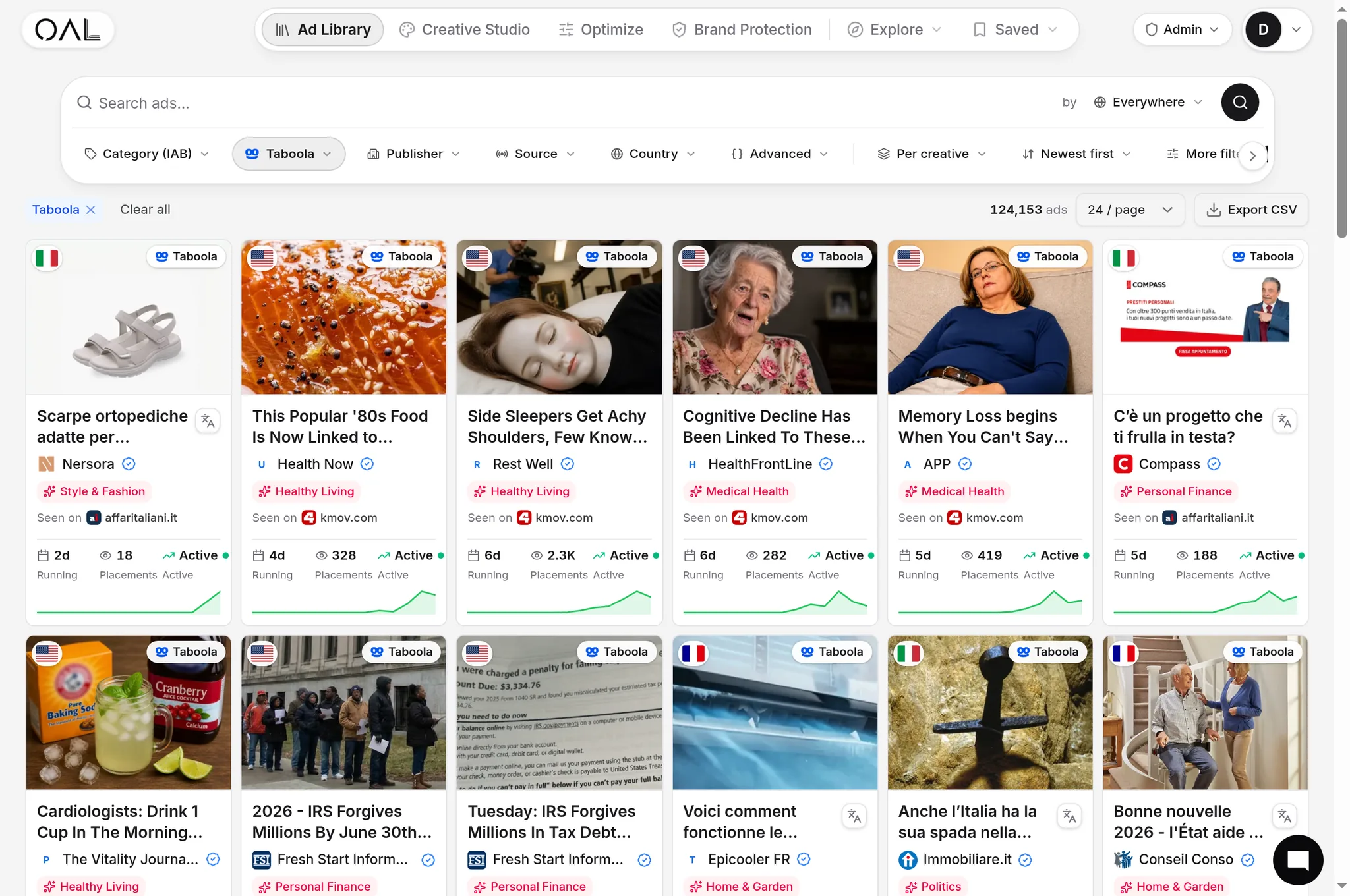
A native ads swipe file is a curated library of proven ad creatives — headlines, images, angles — that you reference when building new campaigns. The difference between a useful swipe file and a folder of screenshots is evidence: you want creatives with observed run time attached, because on native, an ad that keeps being paid for is the closest public signal that it is working. Below is a starter swipe file assembled from OpenAdLibrary's index of 725,000+ live native creatives (June 2026), organized by vertical with observed days running — plus the system for building and maintaining your own.
Why run time beats aesthetics in a swipe file#
Most swipe files are collections of ads someone found clever. That is backwards: native advertisers kill losing creatives within days, so the ads still running after weeks of continuous observation are the ones the market has voted for with money. Longevity is the profitability proxy — a creative observed live for 30+ days has survived dozens of budget reviews. When you swipe, swipe survivors.
The corollary matters just as much: an ad you personally found brilliant that vanished after four days is a documented failure, and it belongs in your notes as an anti-pattern, not in the swipe file as inspiration. The broader signals framework for finding winning ads adds volume, geo spread and variant count on top of run time; all of it beats "this looks good."
The starter swipe file: live creatives by vertical#
Every entry below is a real creative captured from live native placements, with the network and days running observed at capture (June 2026).
Health & hearing#
| Captured headline | Network | Observed running |
|---|---|---|
| "Struggling to Hear Clearly? Discover a Device Transforming Lives" | Taboola | 37 days |
| "Why Your Sciatic Nerve Won't Heal (What Most Doctors Miss)" | Outbrain | 10 days |
| "Doctors Call It 'Nature's Morphine' — Pain Relief Without A Prescription" | MGID | 16 days |
The formula: name the symptom, withhold the mechanism. "What Most Doctors Miss" is the knowledge-gap variant; the question opener qualifies the sufferer before the click.
Beauty & anti-aging#
| Captured headline | Network | Observed running |
|---|---|---|
| "Wrinkles: Most People Use Lotions. Koreans Do This Instead (It's Genius)" | Taboola | 12 days |
| "The Surprising Household Item People Are Using for Hair Regrowth" | Taboola | 31 days |
| "Top 5 Shampoos To Avoid" | Taboola | 21 days |
Three distinct hooks in one vertical: the alternative-method contrast ("X do this instead"), the ordinary-object mystery ("household item"), and the avoid-list — negativity plus self-protection, one of the most durable formulas in the corpus.
Home & garden#
| Captured headline | Network | Observed running |
|---|---|---|
| "My garden had no butterflies for years — then I hung one of these up" | Taboola | 37 days |
| "Retiree Was Tired of Cyclists Cutting Through His Yard—So He Designed the Perfect Trap" | Outbrain | 38 days |
| "A Window Cleaner Explained Why Sprays Make Your Glass Worse" | Taboola | 23 days |
First-person micro-stories with a payoff withheld. The 38-day cyclist-trap ad is structured like a folk tale — character, grievance, invention — and story ads age slower than claim ads because the curiosity gap doesn't wear out on first exposure.
Finance & retirement#
| Captured headline | Network | Observed running |
|---|---|---|
| "Retirees Are Dropping These 12 Costs" | Microsoft Audience Network | 38 days |
| "When Should You Retire?" | Microsoft Audience Network | 38 days |
| "Granny Pods in 2026: Options That May Surprise You" | Taboola | 5 days |
Note how conservative the two 38-day survivors are: a numbered list and a four-word question. Finance runs on trust; the restrained headline is the winning headline, a pattern consistent across the vertical's 24,068 indexed creatives.
Ecommerce & DTC#
| Captured headline | Network | Observed running |
|---|---|---|
| "A bra that not only lifts but also improves your posture." | Taboola | 4 days |
| "🔥Last Day 50% OFF🔥 Gentle Coconut Oil Hair Removal Cream" | MGID | new capture |
| "Dog licks arent kisses. Heres what your dog really means when it licks you." | Outbrain | 38 days |
The bra ad is benefit-stacking ("not only X but also Y"); the MGID ad is pure urgency-discount; and the 38-day pet ad — myth-correction about something the reader sees daily — shows how content-style hooks can front product funnels. Ecommerce is the vertical where hooks transfer most freely from everywhere else, which is exactly why a swipe file organized by hook type pays off here.
The hook formulas this gallery keeps reusing#
Across verticals, the same five structures account for most of what survives:
- The expert reveal — an authority figure plus withheld advice ("What Most Doctors Miss").
- The avoid-list — numbered self-protection ("Top 5 Shampoos To Avoid").
- The story payoff — first-person setup, resolution behind the click (the butterfly and cyclist ads).
- The alternative-method contrast — "most people do X; this group does Y instead."
- The question qualifier — self-selecting the audience ("Struggling to Hear Clearly?").
These map directly onto the 12 proven headline formulas and the hook vs angle vs claim anatomy; the most common native ad angles study quantifies how often each appears in the wild.
How to build and maintain your own swipe file#
A working swipe file is a process, not a bookmark folder:
- Define the beat. Your vertical, your competitors, and two adjacent verticals whose hooks transfer (beauty borrows from health; DTC borrows from everything).
- Collect from live data. In the native ad research tool, filter your vertical, sort by observed run time, and save survivors — OpenAdLibrary's boards let you keep the live creative, its longevity and its traced landing page together in one place, instead of a context-free screenshot.
- Tag by hook, not just vertical. "Avoid-list," "expert reveal," "story payoff." When you need a new angle, you want to pull every story-payoff ad across verticals, not scroll a folder.
- Capture the pair, not the ad. The creative and its landing page are one unit; a swiped headline attached to the wrong funnel type underperforms. Analyzing the full creative-to-lander pattern is what makes a swipe entry actionable.
- Refresh monthly, prune ruthlessly. Ads die of creative fatigue; an entry that stopped running months ago is a hypothesis, not evidence. Re-check your saved ads' status and cut anything stale.
For each entry, record the same six fields so the file stays queryable: the headline, the image concept in a phrase, the hook type, the network and geo it ran on, the observed run time, and the landing-page format it fed (advertorial, listicle, quiz, direct offer). Six fields takes thirty seconds per ad and turns a pile of examples into a database you can actually interrogate — "show me every question-qualifier hook that fed an advertorial and ran 30+ days" is a query a screenshot folder can never answer.
Swipe, don't steal#
A swipe file is for extracting structure: the hook type, the emotional driver, the audience-qualification move. Lifting a competitor's exact headline or image gets you rejected by network review, buried by the original's ad rank, and occasionally into trademark trouble. The practice that compounds: take one surviving structure, rewrite it for your offer's actual mechanism, and test it against your current control. Study the 10 dissected Taboola examples and the patterns from 10,000+ live creatives to see structure-level analysis done properly — then go build a swipe file the market has already validated for you.