Español
 Português (Brasil)
 Français
 Deutsch
 Italiano
 Nederlands
 Polski
 Svenska
 Türkçe
 Русский
 日本語
日本語 한국어
한국어 简体中文
简体中文 Tiếng Việt
 Bahasa Indonesia
 繁體中文
繁體中文 Čeština
 Dansk
Dansk Norsk (bokmål)
 Suomi
Suomi Ελληνικά
 Română
 Magyar
 Українська
 ไทย
ไทย हिन्दी
 العربية
 עברית
עבריתOutbrain Advertising Cost in 2026: CPCs, Minimum Budgets & Benchmarks
Outbrain prices clicks by auction, not rate card. Here are the CPC ranges buyers actually report, the real cost of a decision-grade test, and how the network's premium-editorial skew and Teads merger shape what you pay.


Outbrain advertising runs on a cost-per-click auction: you set the bid, you pay per click, and there is no rate card. Media buyers commonly report Tier-1 desktop CPCs of roughly $0.25–$1.00 and mobile CPCs of $0.10–$0.50 — practitioner-reported ranges, not official prices — with premium editorial placements and crowded verticals like insurance clearing toward the top. Minimum daily budgets are low; a test that produces a real verdict typically costs $1,000–$3,000. And since February 2025, Outbrain is part of Teads, which changes the roadmap more than it changes what a click costs today.
How Outbrain pricing works#
Outbrain sells sponsored slots in recommendation feeds on publisher sites — historically skewing toward premium editorial brands — plus the wider omnichannel inventory it gained when it acquired Teads and adopted its name (the full story is in did Outbrain become Teads). For the feed inventory this guide prices, the model is straightforward: you set a cost-per-click bid and a daily budget, the auction allocates impressions, and you pay only for clicks.
Like every click-paid feed, the auction ranks ads by expected yield — your bid multiplied by predicted CTR — because publishers earn nothing from an ad nobody clicks. The practical consequence: a creative that doubles its click-through rate buys the same exposure at roughly half the bid. Your headline is your real bid on Outbrain, exactly as it is on Taboola.
On top of manual CPC, Outbrain's automated bidding (its Conversion Bid Strategy family) optimizes toward your conversion goal — target-CPA-style and max-conversion-style modes whose exact names and mechanics evolve, so verify details against Outbrain's current documentation. Automated bidding performs when your conversion tracking feeds it steady signal; on a cold account it explores at your expense. Start manual or semi-automatic, earn data, then delegate. The platform mechanics beyond pricing are covered in how Outbrain works.
The CPC ranges buyers report#
Treat this table as a planning heuristic assembled from what practitioners commonly report. It is not an official price list, and vertical, creative quality and account history move every number:
| Traffic segment | Commonly reported CPC range |
|---|---|
| Tier-1 desktop (US, UK, CA, AU) | ~$0.25–$1.00 |
| Tier-1 mobile | ~$0.10–$0.50 |
| Tier-2 desktop (much of Europe, LatAm, parts of Asia) | ~$0.10–$0.45 |
| Tier-2 mobile | ~$0.05–$0.25 |
| Tier-3 geos | ~$0.02–$0.15 |
(Unfamiliar with the tier shorthand? See Tier 1/2/3 geos.) Cross-network context — how Outbrain's ranges sit against Taboola, MGID and Revcontent — lives in the native ads CPC benchmarks.
Competition explains most of the spread. In OpenAdLibrary's index of 108,573 live Outbrain creatives (June 2026), insurance is the most crowded vertical with 4,345 classified live creatives, followed by finance (3,990), health (3,102), ecommerce (2,277), software (1,932) and home & garden (1,545). Insurance and finance buyers on US desktop should budget at the top of the range; a less contested vertical in a Tier-2 geo can clear for a fraction of it.
Two Outbrain-specific pressures push CPCs around within those bands. First, the premium-editorial skew: Outbrain's flagship supply concentrates on large news brands whose impressions clear higher than long-tail content sites. Second, device split behaves differently than buyers expect — premium mobile web inventory is abundant, so mobile CPCs can sit further below desktop than on competing networks. Split campaigns by device and let the numbers speak.
Minimum budgets and what a real test costs#
Outbrain enforces a minimum daily budget per campaign and per-geo minimum CPCs; the figures have shifted over the years and vary by market, so check the current documentation for the numbers that will apply to your account. Historically the daily floor has been low — tens of dollars — which is precisely why it misleads people. The floor lets you launch; it does not let you learn.
The learning budget is arithmetic:
- Creative triage. You need on the order of 100 clicks per creative for a first read, and 6–10 creatives to find one that earns its CTR. At a $0.50 average CPC that is $300–$500 before anything has been proven.
- Conversion validation. Cost per acquisition equals CPC divided by conversion rate: $0.50 CPC at a 1% click-to-conversion rate is a $50 CPA; at 0.5% it is $100. Establishing that rate with confidence takes hundreds more clicks on the surviving creatives.
- Placement hygiene. Some budget inevitably buys clicks from sites you will later block. That spend is tuition, not waste — but it has to be in the plan.
Add it up and the commonly budgeted range for a decision-grade Outbrain test is $1,000–$3,000, the same practical math as any major native network — see how much native ads cost for the channel-wide version. Underfunding a test does not make it cheaper; it makes it inconclusive, and inconclusive tests get paid for twice.
What moves your Outbrain CPC most#
- Geo and device. The largest single multiplier — never blend tiers or devices in one campaign if you want readable numbers.
- Vertical competition. Per the index data above, insurance, finance and health are the expensive rooms on Outbrain.
- Creative CTR. The auction's yield ranking makes CTR a discount mechanism. Most "high CPC" problems are low-CTR problems wearing a disguise.
- Publisher mix. Premium editorial clears higher. Blocking weak sites raises average CPC and usually lowers CPA — optimize for the metric that pays you.
- Bidding mode and account maturity. Automated strategies with rich conversion signal outperform manual bidding; the same strategies on sparse data wander. Sequence them honestly.
How to lower your Outbrain CPC without starving delivery#
- Rewrite before you rebid. A headline that lifts CTR cuts your effective CPC across every impression; a lower bid just buys you fewer impressions. Creative iteration is the only discount that scales.
- Bid down by placement, not account-wide. Use section- and site-level data to trim where clicks are cheap but worthless, and hold or raise bids where conversions actually happen.
- Match bid strategy to data volume. Manual while sparse, automated once conversions flow steadily — running automation on noise produces confident-looking waste.
- Respect the floors. Sitting at the minimum CPC in a Tier-1 geo buys the leftover impressions high-CTR advertisers didn't want. Slightly above the crowd with a strong creative is routinely the cheapest real traffic on the network.
Outbrain vs Taboola on cost#
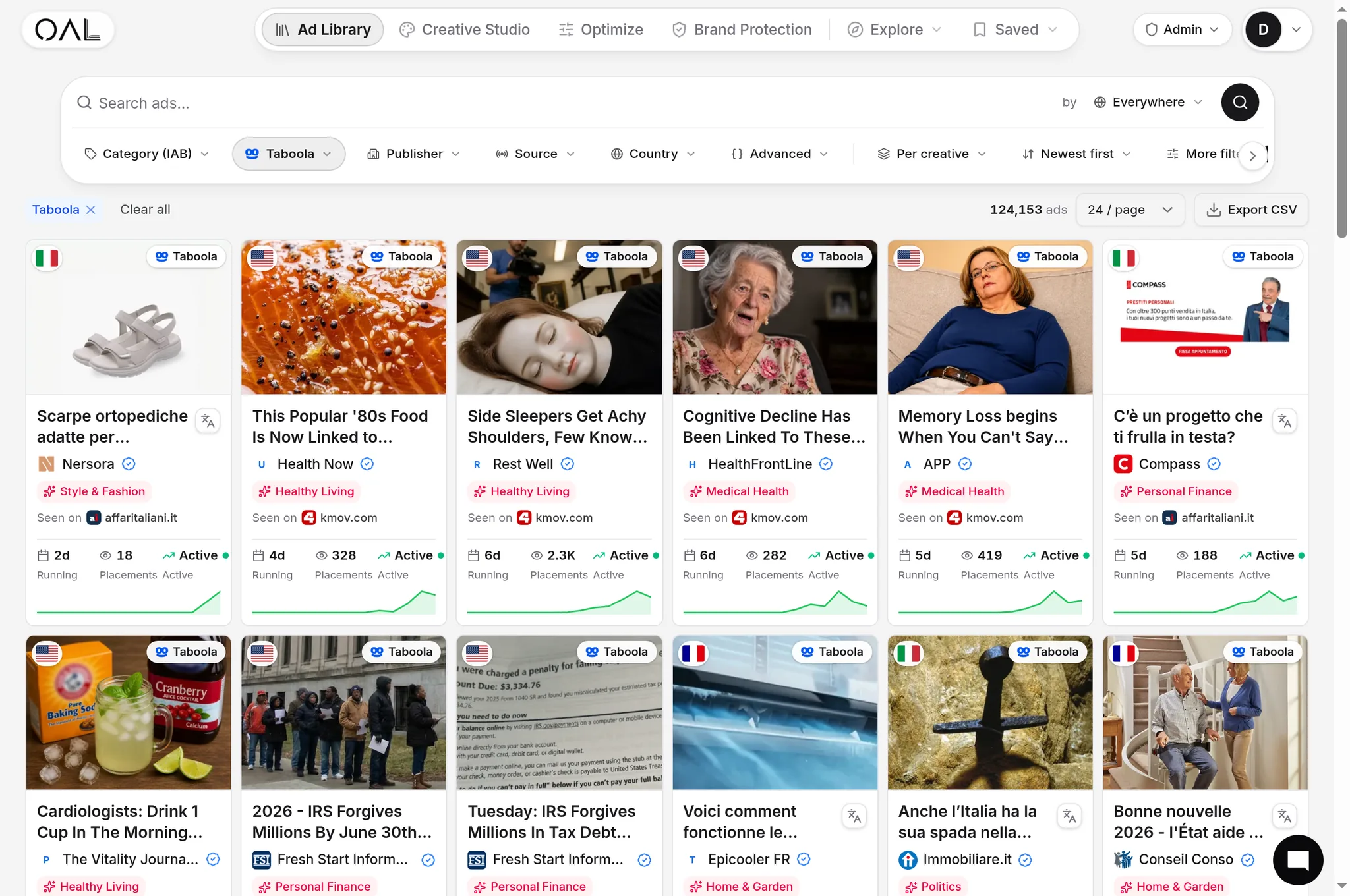
The two networks price similarly because they run the same fundamental machine: CPC auctions over recommendation feeds, yield-ranked by CTR. The commonly reported ranges overlap heavily. The differences that matter are structural — Outbrain's premium-editorial skew versus Taboola's broader reach (plus its Yahoo and Apple supply), different publisher rosters by geo, and now diverging corporate directions after Outbrain's merger into Teads and Taboola's Realize rebrand. Buyers who run both networks usually find one wins per offer and geo, and it is rarely predictable in advance — which is an argument for testing, not guessing. The data-backed matchup is in Taboola vs Outbrain.
Check what current advertisers keep paying for#
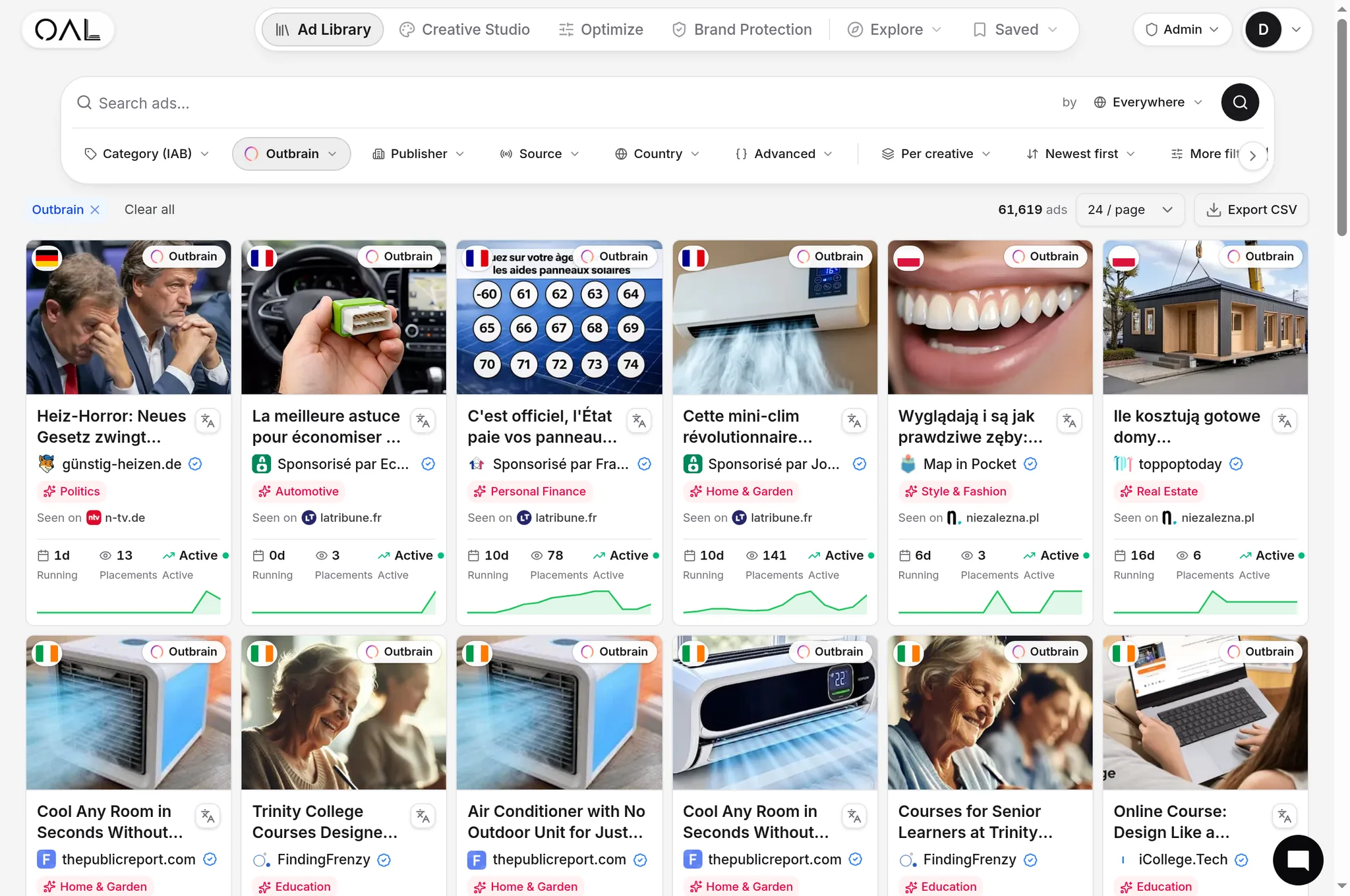
The cheapest research on Outbrain costs nothing: look at what advertisers already paying its CPCs choose to keep running. OpenAdLibrary tracks 108,573 live Outbrain creatives as of June 2026 with resolved advertisers, geo and device data, and observed run durations. In the current snapshot, a story-format advertorial has run for 35 straight days, a skin-care advertorial for 30, and a corporate brand-content series for 34 — month-long paid runs are the closest public evidence that an ad's economics work, a signal unpacked in ad longevity.
Filter the corpus to your vertical and geo at /spy/outbrain (free), sort by longevity, and study the survivors before you fund an account: their hooks tell you what CTR-earning creative looks like in your niche, which — because CTR is the discount mechanism — is the most direct way to lower your future CPC. The Outbrain ad library guide walks through the corpus in detail.
The honest bottom line: Outbrain clicks are cold-traffic clicks at cold-traffic prices — cheaper than search and usually cheaper than social, but they only pay off through funnels built to warm them up. Budget a real test, treat creative as your bid, and let the library show you the competitive bar before your first dollar clears.