Español
 Português (Brasil)
 Français
 Deutsch
 Italiano
 Nederlands
 Polski
 Svenska
 Türkçe
 Русский
 日本語
日本語 한국어
한국어 简体中文
简体中文 Tiếng Việt
 Bahasa Indonesia
 繁體中文
繁體中文 Čeština
 Dansk
Dansk Norsk (bokmål)
 Suomi
Suomi Ελληνικά
 Română
 Magyar
 Українська
 ไทย
ไทย हिन्दी
 العربية
 עברית
עבריתOutbrain Ad Rejected? Why Approval Is So Strict (And How to Pass)
Outbrain enforces the strictest creative and landing-page policies in native advertising. Here is why ads get rejected, how the review process actually works, and the checklist that gets you approved.


If your Outbrain ad was rejected, it almost certainly tripped one of a short list of content policies: an unsubstantiated or sensational claim, a restricted category rule, an image violation, a landing page that fails the quality bar, or a mismatch between what the ad promises and where the click lands. Outbrain — now part of Teads — reviews every creative and every landing page before serving, and it enforces stricter editorial standards than any other major native network because its inventory sits on premium publisher sites. The fix is rarely mysterious: identify which rule you tripped, correct the creative or the page, and resubmit. This guide maps the most common rejection reasons to their fixes, explains how the review process actually works, and ends with a pre-submission checklist that passes review the first time.
Why Outbrain reviews are stricter than everyone else's#
Outbrain's moderation posture is a direct consequence of its supply. The network's placements sit on premium editorial sites, and those publishers hold Outbrain contractually and reputationally responsible for what appears under their articles. After the Teads merger, the combined company also sells brand advertisers on a premium-environment story — which raises the bar further, because one screenshot of a scammy ad next to a brand campaign undermines the entire pitch. How Outbrain works covers the network mechanics; the moderation strictness is the flip side of the premium-inventory positioning.
Contrast this with mid-tier native networks, where moderation tolerates a far more aggressive creative register. The same advertorial that sails through elsewhere gets bounced by Outbrain for a single overreaching claim. If you are coming from those networks, the adjustment is real: Outbrain rejections are usually not arbitrary, they are the policy working as designed.
Strictness cuts both ways, though. Buyers who learn the compliant register get a cleaner auction with less junk competition — and the hard verticals are demonstrably passable. In OpenAdLibrary's index of live Outbrain ads (June 2026), the top classified verticals are insurance (4,345 live creatives), finance (3,990), and health (3,102) — the three most heavily policed categories in native advertising, running at scale. Compliant angles exist in every "difficult" vertical; the advertisers running them simply learned the rules.
How the review process works#
The mechanics are straightforward, and knowing them removes most of the anxiety:
- Submission triggers review of both the creative and the landing page. Outbrain does not approve headlines in isolation — the destination is part of the unit under review. A clean ad pointing at a non-compliant page gets rejected.
- Review combines automated screening with human moderation. Obvious violations (prohibited words, banned categories, malformed pages) are caught automatically; edge cases go to human reviewers.
- Every new creative is reviewed, and edits re-trigger review. Changing a headline or image on an approved ad puts it back in the queue.
- Timing is typically within a business day or two, longer for regulated verticals or accounts without history — check Outbrain's current advertiser documentation rather than planning around a fixed SLA.
- Approval is not permanent. Ads and landing pages are re-checked after approval — on complaints, on periodic audits, and when a page silently changes. A post-approval page swap is treated as the serious violation it is.
Account history matters too. Accounts with a clean record tend to move through review faster; accounts with rejection patterns attract more scrutiny on everything they submit.
Plan campaign timelines around this reality. If a launch date matters — a seasonal offer, a coordinated push — submit creatives several days early, and submit the landing page with the first creative rather than iterating both simultaneously. Buyers who treat review as an asynchronous pipeline (always a batch of creatives in the queue, never a launch blocked on a single approval) feel almost none of the friction that frustrates buyers who submit one ad at a time and wait.
The most common rejection reasons (and the fix for each)#
Across practitioner reports and Outbrain's published guidelines, the same causes come up over and over:
| Rejection reason | What triggers it | The fix |
|---|---|---|
| Misleading or unsubstantiated claims | Cure language, guaranteed outcomes, invented statistics, fake urgency | Rewrite to claims you can substantiate; attribute rather than assert |
| Sensational clickbait constructions | "You won't believe…", withheld-information bait, shock phrasing | Keep the curiosity, describe something real (see below) |
| Image violations | Before/after shots, zoomed body parts, graphic medical imagery, implied celebrity endorsement | Swap to product, lifestyle, or illustrative images |
| Landing page quality | Missing privacy policy or contact info, broken links, aggressive pop-ups, auto-download | Fix page hygiene before resubmitting |
| Ad-to-page mismatch | Headline promises content the page does not deliver | Align the promise with the page, or change the page |
| Restricted category without clearance | Supplements, financial services, gambling, crypto submitted without meeting category rules | Read the category policy; some require geo limits, disclaimers, or pre-approval |
| Trademark and brand misuse | Using a brand's name or logo to imply endorsement | Remove the implication or document authorization |
| Missing advertorial disclosure | A pre-lander styled as editorial with no sponsored-content labeling | Add clear disclosure — required by policy and by the FTC |
Two of these deserve expansion, because they cause the most repeat rejections.
The clickbait line. Native advertising runs on the curiosity gap — a headline that opens a question the click answers. Outbrain does not prohibit curiosity; it prohibits clickbait constructions that withhold the subject entirely or manufacture shock. "Why Your Sciatic Nerve Won't Heal (What Most Doctors Miss)" — a real creative that was live on Outbrain in our June 2026 capture — shows the compliant version: a specific subject, a concrete promise, an authority angle, no fabricated claim. The rejected version of the same ad would be "Doctors Are Hiding This One Trick".
Advertorial disclosure. If your funnel routes through an article-style pre-lander, the page must be identifiable as advertising — clear sponsored-content labeling, a real advertiser identity, no fake news-site branding. This is both an Outbrain policy and a legal requirement; the FTC's disclosure rules for advertorials cover what compliant labeling looks like, and the FTC's endorsement guides are the primary source.
What "restricted" actually means for the big verticals#
Restricted is not banned. The heavily policed verticals — health, supplements, personal finance, insurance, crypto — run on Outbrain every day; they simply carry extra rules:
- Health and supplements: no disease-treatment or cure claims, no before/after imagery, claims limited to what substantiation supports. Structure the angle around the problem and the mechanism, not a promised outcome.
- Finance and insurance: no guaranteed returns, no misrepresenting rates or government affiliation, geo-appropriate licensing. Comparison and education angles clear review far more reliably than promise angles.
- Gambling, crypto, dating: geo-restricted and often require explicit category approval; do not submit and hope.
The index data above makes the practical point: insurance, finance, and health are the three largest classified verticals on Outbrain. The buyers succeeding there are not evading the rules — they found the angles that comply. Study them before writing your own (more on how below).
A concrete rewrite exercise for the two biggest categories:
- Health, non-compliant: "This Supplement Cures Joint Pain in 7 Days". Everything is wrong: cure claim, guaranteed timeline, no substantiation. Compliant register: "Why Knee Discomfort Gets Worse After 50 — and What Specialists Suggest". A specific audience, a mechanism-flavored curiosity gap, an attributed rather than asserted promise, no outcome guarantee.
- Finance, non-compliant: "Guaranteed 12% Returns — Beat the Banks". A promised return is an instant rejection and, in most geos, a regulatory problem. Compliant register: "How Retirees Are Comparing Savings Rates in 2026". Comparison framing, no promised outcome, an audience qualifier that also improves click quality.
The pattern generalizes: move the claim from outcome you guarantee to subject the reader can investigate, attribute anything strong to a source that exists, and qualify the audience. Compliance and CTR are not in tension — the qualified, specific version usually filters out the clicks that were never going to convert.
Fix the funnel, not just the ad#
A large share of "ad rejected" cases are really "landing page rejected" cases, and buyers waste review cycles rewriting headlines while the page keeps failing. Before resubmitting anything, audit the destination the way a moderator would:
- Identity and legal hygiene: a real company or brand identity, a working privacy policy, contact information, and terms — on the pre-lander too, not just the checkout domain.
- Behavioral hygiene: no exit pop-ups that trap the back button, no fake countdown timers, no auto-playing audio, no forced notification prompts. Each of these is individually sufficient for rejection.
- Claims on the page count against the ad. A compliant headline pointing at a page full of cure claims and fabricated testimonials fails review as a unit. Testimonials need to be real and typical-results language matters in health and finance.
- The redirect chain is part of the review. Tracker hops are fine; broken hops, geo-dependent bait-and-switch behavior, or chains that end somewhere other than the reviewed page are not.
Fix the page once and every subsequent creative you submit against it clears faster.
The pre-submission checklist#
Run every campaign through this list before submitting; it covers the causes of the overwhelming majority of first-time rejections:
- Every factual claim in the headline and description is one you can substantiate on request.
- No withheld-subject bait, no shock constructions, no fabricated urgency or scarcity.
- Image: no before/after, no zoomed body parts, no graphic medical content, no implied celebrity endorsement.
- Landing page has working navigation, a privacy policy, real contact information, and a functioning opt-out if it collects data.
- No aggressive interstitials, auto-play audio, auto-downloads, or fake close buttons anywhere in the funnel.
- The page delivers what the headline promises — a reader arriving from the ad should never feel switched.
- Advertorial pre-landers carry clear sponsored-content disclosure and a real advertiser identity (what a compliant pre-lander looks like).
- Restricted-category rules for your vertical and target geos are read and met, not assumed.
- Tracking links resolve correctly through the whole redirect chain — a broken or looping redirect reads as a quality failure.
Rejected anyway? Do this — and never do that#
When a rejection lands: read the stated reason carefully (Outbrain tells you the category of violation), fix that specific issue, and resubmit. Resist the urge to change three things at once — if you rewrite the headline, swap the image, and edit the page simultaneously, an approval teaches you nothing about where the line was, and the next campaign hits the same wall. If the reason seems wrong — it happens, moderation has false positives — reply through support or your account manager with a specific, factual case for why the creative complies. Polite, specific appeals get reviewed; indignant ones do not.
What you must never do is try to route around review. That means no duplicate accounts after a rejection pattern, and above all no cloaking — showing the reviewer a compliant page while sending real traffic elsewhere. Networks at Outbrain's tier actively re-crawl landing pages and compare them against review-time captures. Cloaking detection does not produce another rejection; it produces a permanent account ban, and the economics of a banned account never beat the cost of fixing a landing page.
Occasional rejections are normal and do not meaningfully hurt you. Patterns hurt you: accounts that repeatedly submit borderline creative attract slower, harsher review on everything.
Study the ads that already passed#
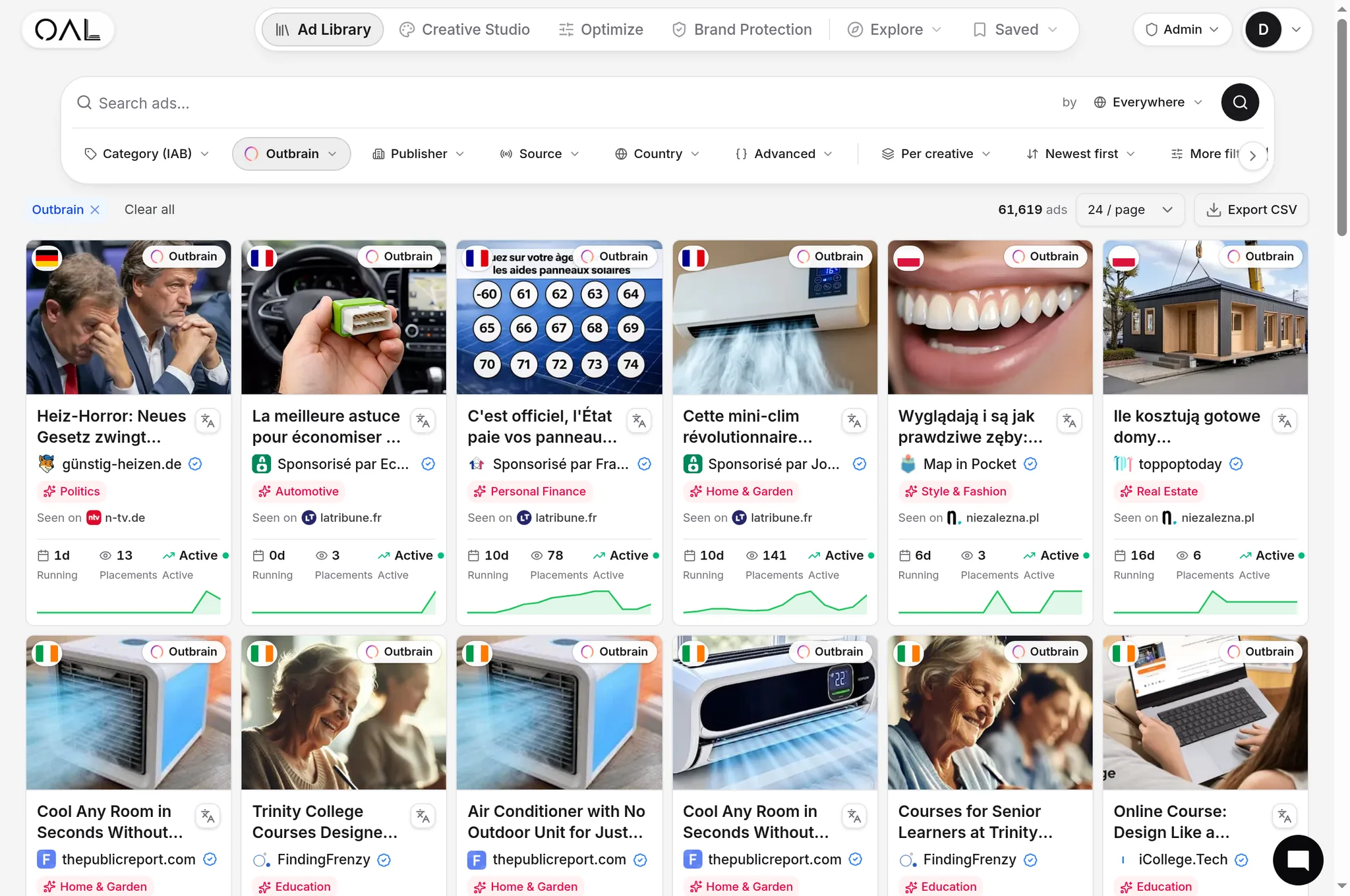
The fastest way to internalize Outbrain's line is to study creatives that are provably on the right side of it. Every one of the 108,573 live Outbrain ads in OpenAdLibrary's index (June 2026) passed moderation — and the long-running ones passed repeatedly, surviving re-review while spending enough to stay live for weeks. That makes ad longevity a compliance signal as well as a profitability signal.
The pattern to look for: creatives that hold attention without overclaiming. A beauty advertorial creative — "Moisturizer Won't Tighten Skin! Use This Household Item Instead" — had been running 30 days in our capture window: it opens a curiosity gap and implies a method, but makes no cure claim and names no fabricated statistic. That is the register that survives review in a policed vertical.
The workflow: open the Outbrain ad library or the Outbrain spy tool, filter to your vertical and geo, sort by longevity, and read 30+ headlines that have been live for two weeks or more. Note the claim structures — what they assert, what they merely imply, how they attribute. Then write your own creative in that register (mirror the structure, never copy the copy — see the headline formulas that recur across compliant native ads). You will pass review faster by imitating the shape of approved claims than by reading policy documents alone — though you should still read the policy documents.
Approval on Outbrain is a solvable problem with a stable solution: substantiated claims, clean images, honest landing pages, disclosed advertorials. Buyers who treat the policy as a design constraint rather than an obstacle end up with creative that not only passes — it converts better, because the audience that premium publishers deliver responds to credibility.