 Español
 Português (Brasil)
 Français
 Deutsch
 Italiano
 Nederlands
 Polski
 Svenska
 Türkçe
 Русский
 日本語
日本語 한국어
한국어 简体中文
简体中文 Tiếng Việt
 Bahasa Indonesia
 繁體中文
繁體中文 Dansk
Dansk Suomi
Suomi Ελληνικά
 Română
 Magyar
 Українська
 ไทย
ไทย हिन्दी
 العربية
 עברית
עבריתNative Ads for Mobile App Installs (Beyond ASA & UAC)
Native networks drive app installs as a web-to-store funnel, not a store-direct channel. Live examples — a fitness app on a 30-day run, a AAA game publisher tying the index longevity record — plus the attribution plumbing and the math.


Native ad networks — Taboola, Outbrain, MGID, MediaGo and the Microsoft Audience Network — can drive mobile app installs at real scale, but they work nothing like Apple Search Ads or Google App Campaigns: you are buying web clicks, not store visits. The pattern that works is a web-to-store funnel — a story-led ad, a landing page that sells the outcome, an OS-aware store handoff — measured through a mobile measurement partner rather than the network's own dashboard. Run that way, native becomes a genuine third user-acquisition channel with less auction competition than the incumbents. This guide covers the live examples, the funnel mechanics, the attribution plumbing and the CPC-to-CPI math.
Why look beyond ASA and UAC at all#
Three reasons keep pushing app marketers toward native:
- Auction saturation. Apple Search Ads and Google App Campaigns are efficient and crowded — every competitor is in the same auction, and incremental volume gets expensive fast. Native inventory is a separate supply pool where app advertisers are still a minority.
- Concentration risk. A UA program that lives entirely inside two auctions is one policy change or CPI spike away from trouble. The reasoning in our guide to diversifying beyond Meta ads applies just as directly to app growth teams.
- Apps that need explaining. Store-direct channels sell to people already searching. Native's editorial format lets you create demand — tell the story of a walking app or a strategy game to someone who wasn't looking for one. If your app's value needs a paragraph rather than a keyword, native fits.
The honest counterweight: native clicks carry lower intent, attribution is harder, and the funnel has an extra step. The rest of this guide is about managing exactly those three problems.
What app advertisers actually run on native#
The index shows app campaigns sustained for weeks — the strongest available signal that the economics work:
| Advertiser | Headline | Network | Days running |
|---|---|---|---|
| WalkFit | "App for Tai Chi Walking. It's Simpler Than You Think." | Microsoft Audience Network | 30 |
| NetEase Games | "Version 1.7 "The Imperial Palace" officially launches May 28 (UTC)!" | Microsoft Audience Network | 38 |
| Rise of Kingdoms | "Play for free in your browser – no download needed!" | MediaGo | 29 |
| Play4Free | "A Real MMO for Grown-Up Gamers" | MediaGo | 17 |
Context from the wider index (June 2026): software is a top-six vertical with roughly 14,900 live creatives, 7,909 of them on the Microsoft Audience Network alone, and MediaGo carries a distinct gaming cluster (218 gaming creatives — its #5 vertical). NetEase's 38-day run ties the longest-running ads in the entire index of 725,000+ creatives — a AAA game publisher sustaining native spend at the same longevity as the best direct-response advertisers.
The web-to-store funnel#
The single biggest mistake is linking the ad straight to the App Store. Native readers were interrupted mid-article; sending that click into a store listing skips the persuasion step the format depends on, and it strands your measurement — no pixel fires, no qualification happens, and the store gives you almost nothing back about where the install came from.
The funnel that works:
- Ad → landing page. An advertorial or focused product page that continues the headline's story and sells the outcome, not the feature list. The principles in our native landing page funnel guide apply directly.
- Landing page → store. OS-detected store buttons (one tap to the right store), with the click ID attached to the outbound link so attribution survives the handoff.
- Store → install → event. Your mobile measurement partner picks up the install and posts it back to your tracker.
The landing page earns its keep twice: it qualifies the click (cheap curiosity clicks bounce there instead of polluting install cohorts) and it fires your pixels, building retargeting audiences even from readers who don't install today.
Gaming adds a variant worth stealing: Rise of Kingdoms' "Play for free in your browser – no download needed!" collapses install friction to zero, gets the player into the game, then upsells the app. If your product has any browser-accessible surface — a demo, a calculator, a trial — leading with it turns the install into a second yes, which is easier than a first one.
Attribution: the hard part, done properly#
The store sits between your click and your install like a black box, so the plumbing matters:
- Use an MMP. AppsFlyer, Adjust, Branch and similar mobile measurement partners exist precisely to bridge web click → store → install. Native networks are web traffic sources to an MMP, configured like any other non-SAN partner.
- Pass the click ID end to end. The network's click ID goes onto your landing page URL, onto the outbound store link, and comes back on the install postback so you can optimize per publisher and per creative — not just per campaign.
- Expect an iOS discount. Apple's App Tracking Transparency reduced deterministic matching; iOS numbers will lean on probabilistic and modeled attribution. Android remains cleaner via the install referrer. Judge iOS with wider error bars, not with denial.
- Measure the funnel in stages. Track landing-page→store click-through and store→install separately. When CPI moves, you need to know which stage moved.
Which networks fit app campaigns#
| Network | Why it's on the list |
|---|---|
| Microsoft Audience Network | The largest slice of our index (~281,800 creatives) and where WalkFit and NetEase sustain app campaigns. Serves both desktop and mobile feeds — see the MSN native ads guide. |
| MediaGo | Baidu-built, algorithm-led, and carries a visible gaming cluster in our index. Browse it in the MediaGo ad library. |
| Taboola | The biggest premium-news reach and mature device/OS targeting for splitting iOS and Android campaigns. |
| Outbrain (Teads) | Premium publisher supply; suits polished consumer apps and subscription products. |
| MGID | Cheapest testing ground; wide Tier-2/Tier-3 geo reach for apps monetizing globally. |
Device targeting is the non-negotiable feature: you need to serve iOS creative to iOS users and Android creative to Android users, or exclude desktop entirely for a mobile-only app. Every network above supports OS-level targeting; confirm the granularity in each network's current documentation when you plan.
One nuance on desktop: for mobile-only apps, desktop clicks are usually waste and should be excluded. But MSN's desktop-heavy feed still sustains app advertisers — WalkFit's 30-day run is health-app demand meeting an older desktop audience that follows through on a phone later. If you test desktop, do it deliberately and measure it separately.
On buying models: native networks sell app traffic on CPC almost universally, with some offering target-CPA or algorithmic bidding modes layered on top. Start on manual CPC regardless of what the platform recommends — automated bidding needs conversion volume to learn from, and a new app funnel doesn't have any to give it yet. Feed installs (or better, a day-one engagement event) back via postback first, run manual until the numbers stabilize, and only then hand the network's algorithm a target it can actually optimize toward. Switching to auto-bidding on day one just teaches the algorithm to find cheap clicks, which is the one thing you didn't need help with.
Creative patterns that drive installs#
- Outcome-first, app-second. WalkFit's headline names the use case ("App for Tai Chi Walking") and then removes the objection ("It's Simpler Than You Think"). It reads like a recommendation, not a store listing — which is exactly the register native rewards. Our native creative best-practices guide covers the image side.
- Friction-collapse hooks for games. "Play for free in your browser – no download needed!" wins because it deletes the ask. Free, instant, no commitment — then convert.
- Content-drop angles for re-engagement. NetEase advertises a version launch, not the game's existence. For live-service apps, updates, seasons and events are an endless supply of fresh angles aimed at lapsed and new players alike.
- Lifestyle imagery over UI screenshots. A native thumbnail is small and sits among editorial images; a person mid-activity outperforms a cropped interface shot that reads as an ad.
- Rotate before fatigue. Native feeds burn creative fast — the same reader sees the same widget daily. Have the next angle ready at launch, not after CTR decays.
The CPC-to-CPI math#
Native networks sell clicks, so your install cost is derived, not bid:
CPI = CPC ÷ (landing→store rate × store→install rate)
An illustrative calculation — not a benchmark: at a $0.25 CPC, a 35% landing-to-store click-through and a 45% store-to-install rate, an install costs about $1.59. Halve the landing page's performance and CPI doubles; that is why the page, not the bid, is where app campaigns are won.
For the click side, work from what buyers report rather than official rates — our native CPC benchmarks and cost guide cover the ranges by network and geo; mid-tier networks and Tier-2 geos sit well below Tier-1 premium feeds. Then back into your allowable CPI from LTV — and apply a retention discount when comparing against ASA or UAC cohorts: native installs skew lower-intent, so judge them on D7/D30 retention, not install volume. Some teams find native cohorts retain nearly as well at a fraction of the CPI; others find the discount eats the saving. Your data decides.
Re-engagement: the underused half#
Install campaigns get the attention, but NetEase's record-tying run is a re-engagement play as much as an acquisition one: a version-launch headline speaks to lapsed players who already have the game (or had it) at the same time as it recruits new ones. Native is well suited to this because it reaches people during idle reading time — exactly when a "new season just dropped" nudge lands.
Two ways to run it deliberately: target your own lapsed users via retargeting audiences built from your web landing pages (another reason the web-to-store funnel beats store-direct — it builds those pools), and use content-drop creative that gives an existing user a concrete reason to reopen the app rather than a generic brand reminder. Deep links matter more here than anywhere: a lapsed player clicking a season announcement should land in the event screen, not on a store page for an app they already have — configure deferred deep links through your MMP so both cases resolve correctly.
A 30-day test plan#
A structure that keeps the first native app test honest:
- Week 1 — plumbing before spend. MMP integration configured for the network, click IDs passing end to end, test installs attributing correctly on both OS paths. One geo, one OS, three creative angles, one landing page. Do not launch until a test click traces through to a postback.
- Week 2 — let it run. Resist daily creative changes; you are buying data. Watch landing→store CTR per creative and per publisher — this number moves first and predicts everything downstream.
- Week 3 — first cuts. Kill publishers with bottom-quartile landing→store rates, kill the weakest angle, add one new angle built from what the winner teaches you. Check early retention (D1/D3) against your other channels to calibrate the intent discount.
- Week 4 — the verdict math. Compute true blended CPI including landing-page drop-off, apply the retention discount, and compare against marginal (not average) CPI on ASA/UAC. Native earns its slot if it beats the incumbents' next dollar, not their average one.
Budget the test so each surviving publisher gets enough clicks to judge — a test spread across every geo and both platforms at once produces a month of noise and no decision.
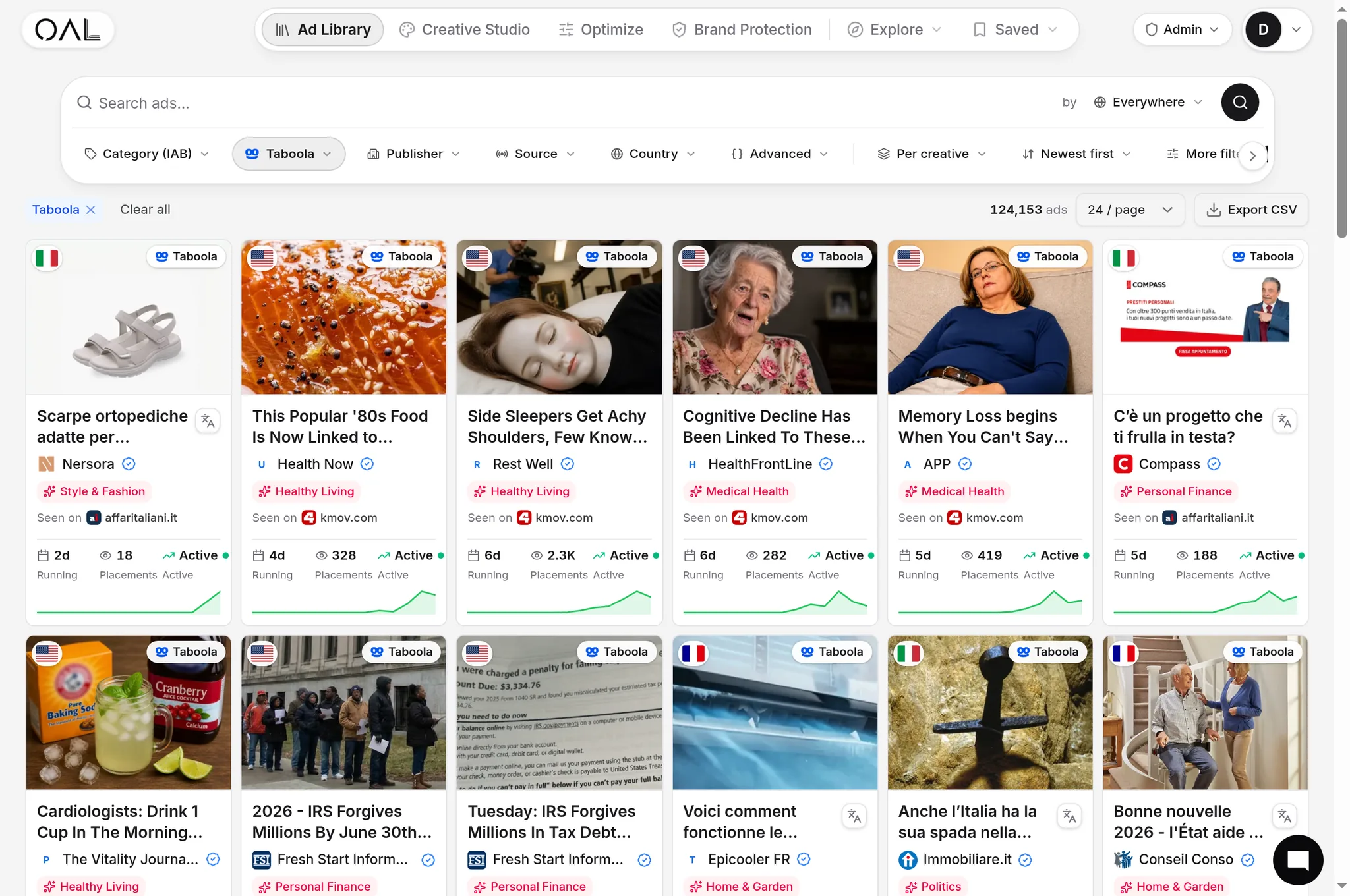
Research the category before you spend#
The fastest way to calibrate whether native can work for your app category is to see who is already sustaining spend in it. OpenAdLibrary captures native ads with device facets (desktop, Android, iOS), advertiser, network, days running and the traced landing page — so you can pull up app advertisers on Taboola or MediaGo, check how long their campaigns have survived, and walk their exact web-to-store funnels before building your own. A 30-day-old app campaign is a funnel worth reverse-engineering.
Pitfalls checklist#
- Linking ads directly to the store (no qualification, no measurement).
- One campaign for both operating systems — split iOS and Android from day one.
- Judging on installs while ignoring D7 retention and downstream events.
- Leaving desktop targeting on by default for a mobile-only app.
- Shipping one creative and waiting — feed fatigue outruns weekly refresh cycles.
- Optimizing the bid while the landing page leaks half the funnel.
The bottom line#
Native won't replace ASA or UAC — it extends them. Treat it as a demand-creation channel with a web funnel bolted to the store: story-led creative, an outcome-selling landing page, click IDs threaded through to MMP postbacks, and honest cohort math against your incumbent channels. The advertisers already doing it — a fitness app on a 30-day run, a AAA publisher tying the index longevity record — are proof the model closes. Start with one OS, one geo, one funnel, and let the numbers argue for the rest.