Español
 Português (Brasil)
 Français
 Deutsch
 Italiano
 Nederlands
 Polski
 Svenska
 Türkçe
 Русский
 日本語
日本語 한국어
한국어 简体中文
简体中文 Tiếng Việt
 Bahasa Indonesia
 繁體中文
繁體中文 Čeština
 Dansk
Dansk Suomi
Suomi Ελληνικά
 Română
 Magyar
 Українська
 ไทย
ไทย हिन्दी
 العربية
 עברית
עבריתPre-Lander Examples: 6 Formats That Win on Native Traffic
The six pre-lander formats that actually convert cold native clicks, mapped to traffic temperature and offer complexity, with real captured ads showing each one in the wild.

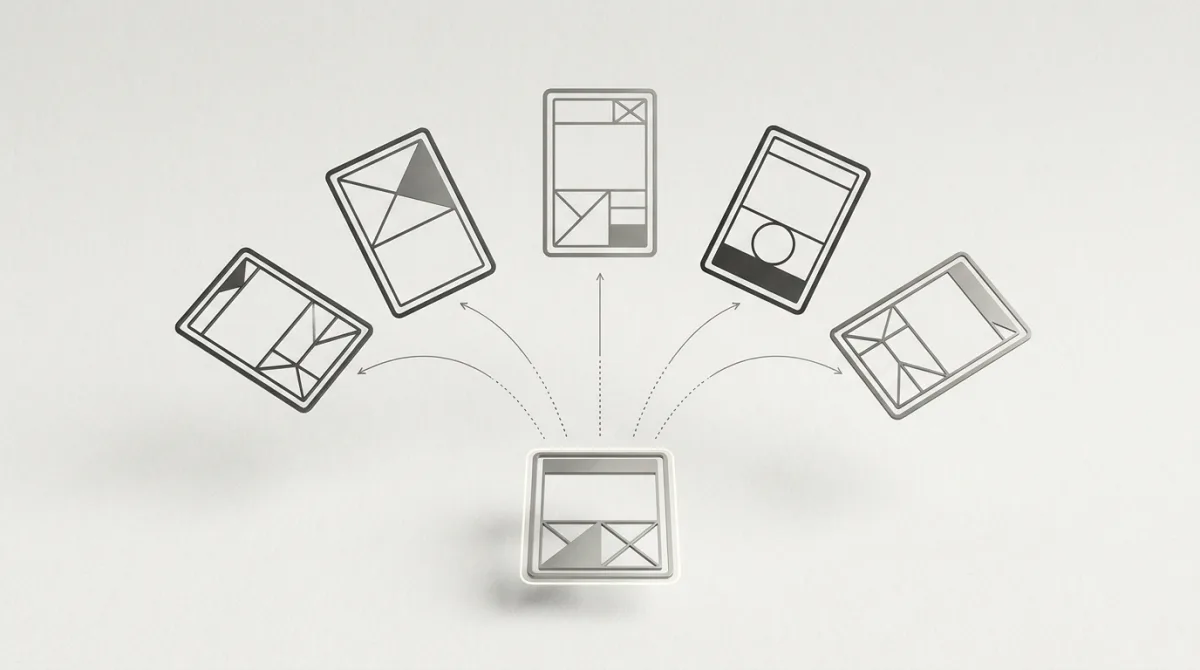
A native click is cold. Someone scrolled to the end of a news article, a native ad widget slid a curiosity headline in front of them, and they tapped it on impulse. Drop that click straight onto a checkout page and most of it evaporates. The pre-lander is the bridge that turns the impulse into intent, and the format you pick decides whether the bridge holds.
What follows is a working taxonomy of the six pre-lander formats that consistently win on native traffic. It is built from landing pages captured downstream of live ads on Taboola, Outbrain, MGID, Revcontent and the rest. For each format you get the structure, the conversion mechanic, and the traffic conditions where it earns its place. If you want the foundational definition first, start with the pillar: What Is a Pre-Lander? Advertorial Funnels Explained.
For scale: as of June 2026 the OpenAdLibrary index holds 589,000+ captured creatives across 42 networks, and we follow those clicks to 926,000+ landing-page captures. Taboola alone accounts for 157,727 of those creatives. So the patterns below are not anecdotes from one account. They are what shows up again and again across the live native ecosystem.
Why native traffic needs its own playbook#
Native traffic is interruption dressed up as discovery. The reader did not search for your product. They were mid-article, a recommendation widget caught their eye, and they arrived curious but unconvinced and totally unaware of your offer. The pre-lander closes that gap by matching the editorial context they just left, building a little belief, and handing a warmer visitor to the money page. Pick the wrong format and you waste the click.
That context is the whole game, because native advertising lives inside editorial real estate. The visitor's head is in "I'm reading" mode, not "I'm shopping" mode. A hard sell snaps that frame and bounces. Every winning format below respects the reading frame first, then converts.
The pre-lander has one job: advance the visitor one step along the awareness curve. If the page does not make a colder reader warmer, it is a speed bump, not a bridge.
Look at the creatives that actually feed these pages and the pattern is obvious. A live Taboola finance ad we captured reads "2026 - IRS Forgives Millions By June 30th Tax Deadline." That is a news headline, not a pitch. The page behind it has to keep that promise before it sells anything.

The 6 formats at a glance#
| Format | Best for traffic that is | Typical length | Time on page | Primary mechanic |
|---|---|---|---|---|
| Advertorial | Cold, skeptical | 800 to 1,500 words | 4 to 6 min | Story plus belief shift |
| Listicle | Warm, product-aware | 5 to 10 short items | 90 to 120 sec | Scannable proof |
| Quiz / survey | Cold, needs personalization | 4 to 8 questions | 2 to 4 min | Commitment plus segmentation |
| Product review | Comparison-shopping | Medium | 2 to 3 min | Third-party credibility |
| VSL pre-lander | High-ticket, needs emotion | Video-led | 5 to 15 min | Sustained narrative |
| Problem / solution | Pain-aware, solution-unaware | Short to medium | 60 to 150 sec | Agitate then resolve |
1. The advertorial#
The advertorial is the default native pre-lander, and for good reason: it looks and reads like the article the visitor was already on. A first-person or journalistic narrative walks through a problem, a discovery, and a resolution that happens to involve the offer. Done right, it is the highest-converting format on cold, doubtful audiences because it earns belief before it asks for anything.
Here is the structure that keeps recurring in the advertorials we capture:
- A hook headline that mirrors the ad's curiosity gap.
- A relatable problem framed as a personal story.
- A turning point ("then I found...") that introduces the mechanism.
- Proof: specifics, before and after, credible detail.
- A soft, contextual call to action into the offer.
The trade-off is engagement over speed. Advertorials pull lower click-through from the page but far longer dwell time, and they out-convert everything else on traffic that needs convincing. This format dominates the verticals where skepticism runs highest. Finance is the single largest vertical in our index at 17,232 creatives, with insurance right behind at 15,629 and health at 14,895. Those are exactly the categories where a cold reader needs a story before a sale, which is why advertorial-style pages cluster there. For the full anatomy with annotated examples, see High-Converting Advertorial Landing Pages.
One non-negotiable: disclosure. The FTC's native advertising guidance is explicit that an ad must not imply it is independent editorial content, and a clear label like "Advertisement" belongs before the headline. The storytelling is legal. The concealment is what draws enforcement. We cover the specifics in FTC Disclosure Rules for Advertorials & Native Ads.
2. The listicle#
The listicle trades depth for scannability. "7 Reasons Shoppers Are Switching to X" or "10 Things to Check Before You Buy Y." Each item is a self-contained proof point the reader can skim, jump around, and absorb without committing to a full narrative.
Listicles win on warmer, more product-aware traffic. The visitor already half-buys the premise. They want reasons, not a saga. The captured listicle pre-landers we see run shorter dwell times, roughly 90 to 120 seconds, but pull higher click-through into the offer because each bullet ends with momentum. They also age well as creative: swapping or reordering items is a cheap way to refresh a page without rebuilding it.
The health vertical leans hard on this format, and you can spot it in the ad itself. A Taboola health creative we captured opens "MDs Identify 10 Medications Now Attached to Memory Problems In Seniors (See the List)." The numbered list is promised before the click even happens.

A practical tell from the evidence: the strongest listicles bury the offer link inside the list, around item 3 or 4, not only at the bottom. Readers who are sold by point three never need to reach point ten.
3. The quiz or survey#
The quiz front-loads micro-commitment. Four to eight light questions ("What's your main goal?", "How long has this been an issue?") pull the visitor into participation before any pitch, and the answers segment them for a personalized result and offer at the end. Interaction is the conversion mechanic. A reader who tapped five answers is psychologically invested in seeing the outcome.
This is not a fringe play. Quiz creatives are some of the most durable ads in our index. Across the longest-running creatives we currently observe, the "My IQ" quiz funnel keeps reappearing with headlines like "Take a 3m quiz to get your IQ" and "What's Your IQ Level? Find Out Now," each sitting at the top of our observed-longevity range of about 28 days of continuous capture. When a format survives that long without being killed off, the math has voted.

Quizzes shine where personalization genuinely changes the recommendation: supplements, skincare, finance, insurance, software fit. They also generate first-party data you can route into follow-up. The risk is friction. Every question is a chance to drop off, so the best quizzes feel like discovery, not a form, and they show a progress bar so the visitor knows the finish line is close.
4. The product review or comparison#
The review pre-lander borrows a third-party voice. It reads as an evaluation ("We tested the top 4 options") that positions the offer as the standout pick. Because the framing is editorial assessment rather than seller pitch, it disarms skepticism in comparison-shopping verticals where the visitor is already weighing alternatives.
You can see the review angle baked into the ad. A Taboola creative from "Consumer World" runs "Tested: Does This $138 AC Run On Almost No Power? The Results Are Baffling!" The word "Tested" is doing all the work. It signals an evaluation, not a sales page, before the reader clicks.

The mechanic is credibility transfer: ratings, pros and cons, a verdict. It maps onto how a native reader behaves after a curiosity click, which is basically "is this actually any good?" Where it crosses a line is fabricated independence. If the review is run by the advertiser, the same disclosure logic from format one applies. A comparison that hides its commercial relationship is exactly the deceptive endorsement pattern the FTC's endorsement guidance targets.
5. The VSL pre-lander#
The video sales letter pre-lander leads with a video and almost no page chrome. It suits high-ticket or emotionally driven offers where text cannot carry the full narrative arc, and where sustained attention is the point. A strong VSL can hold a motivated visitor for ten minutes or more, doing the work a long advertorial would do but with pacing, voice, and visual proof the buyer controls less.
VSLs are heavier to produce and slower to test, so they reward offers with the margin to justify the build. On native traffic specifically, the gating move is the first fifteen seconds. A cold widget click will not sit through a slow open, so the captured winners hook hard and early, often restating the ad's promise on-screen inside the opening frame. Health offers are a natural home here, and our index reflects that pull: Taboola's single biggest vertical by creative count is health at 6,048 creatives, ahead of finance at 5,558 and insurance at 4,303.
6. The problem and solution page#
The leanest format. It opens directly on the visitor's pain ("Tired of X?"), agitates briefly, then presents the offer as the resolution, all in a tight, mobile-first layout. No story arc, no list, just a fast emotional path from ache to answer.
This format fits pain-aware but solution-unaware traffic, and verticals where the problem is acute and the explanation is short. It is the cheapest to build and the easiest to iterate, which makes it a strong first test before you commit production budget to an advertorial or VSL. You can read the pain hook straight off the creative: a Taboola ad from "The Vitality Report" leads with "Cognitive Decline Has Been Tied to This Common Evening Snack. Do You Eat It?" That is pure agitation, designed to make you click for relief.

The discipline is restraint. The moment a problem-solution page tries to also be a listicle or a review, it loses the speed that is its only advantage. Where each of these formats sits inside the larger sequence is the subject of Landing Page Funnels for Native Traffic, and the formal definition lives in the pre-lander glossary entry.
How to match format to traffic#
Format choice is downstream of two variables: how aware the visitor is, and how complex the offer is.
- Awareness. Colder traffic needs more belief-building, which favors advertorials, quizzes and VSLs. Warmer or product-aware traffic favors listicles, reviews and problem-solution pages.
- Complexity. Simple, low-consideration offers do well with short formats. Considered or high-ticket offers need the runway of an advertorial or VSL.
- Vertical norms. Finance and insurance lean on quizzes and comparisons. Supplements and ecommerce lean on advertorials and reviews. Software leans on quizzes and problem-solution. The network you buy on shifts the mix too: on Outbrain, finance (2,640 creatives) and insurance (2,615) lead the pack, while on MGID entertainment runs away with it at 8,904 creatives. Capturing what already runs in your vertical, on your network, beats guessing.
A note on terminology. In some funnels these pages double as a bridge page that pre-frames the offer or pre-qualifies the click before handoff. The label varies. The job, advancing awareness before the money page, does not.
Where the examples come from#
You cannot reverse-engineer a winning pre-lander from a screenshot of the ad alone, because the ad is only the doorway. The page behind it is where the conversion work happens, and it stays invisible until you follow the click. That is the data gap most teams have.
OpenAdLibrary closes it. The platform captures live native ads across Taboola, Outbrain, MGID, Revcontent, Teads, MediaGo, Yahoo and MSN, records the real creative at full quality, then follows each click through to the advertiser's destination, all without clicking live ads. You see the actual pre-lander a competitor is running, which format they chose, and, because the platform tracks how long each ad and funnel stays live, which ones are proven enough to keep paying for.
Longevity is the cheapest signal of a winner. A programmatic native funnel that has run for weeks is one that math, not opinion, has validated. The longest-running creatives we are tracking right now sit at about 28 days of continuous observation, and the survivors are telling. SmartAsset's "Ask a Pro: How Can I Avoid Paying Taxes on IRA Withdrawals?" has held that top tier on Outbrain, a finance advertorial hook that has earned its spend.

For the workflow, see How to Find & Analyze Competitor Landing Pages from Native Ads and the broader full ad funnel analysis.
Putting it to work#
Pick the format your traffic temperature and offer complexity point to, then validate the choice against what is actually live in your vertical, not against what worked for a case study two years ago. The six formats above are levers, not a ranking. The win comes from matching the right one to the right click, capturing real evidence of what competitors are running, and refusing to treat the landing page as the place where conversion starts. It starts at the pre-lander.
Want to study the real pre-landers behind live native ads in your niche, format, angle, longevity and all? Start free and browse 200 ads with no card required.
Sources: FTC Native Advertising: A Guide for Businesses, FTC Endorsements, Influencers, and Reviews.