Español
 Português (Brasil)
 Français
 Deutsch
 Italiano
 Nederlands
 Polski
 Svenska
 Türkçe
 Русский
 日本語
日本語 한국어
한국어 简体中文
简体中文 Tiếng Việt
 Bahasa Indonesia
 繁體中文
繁體中文 Čeština
 Dansk
Dansk Norsk (bokmål)
 Suomi
Suomi Ελληνικά
 Română
 Magyar
 Українська
 ไทย
ไทย हिन्दी
 العربية
 עברית
עבריתTaboola Site Blocking: Build a Placement Block List That Saves Money
Placement waste is the quiet killer of Taboola accounts. Here's the block-list workflow practitioners actually use: spend-based thresholds, block vs bid-down, and graduating winners to whitelists.


Blocking sites on Taboola works like this: open your campaign's site-level report, sort by spend, and block the publishers that are spending money without converting — either for one campaign or across your whole account. The mechanics take thirty seconds. The skill is in the thresholds: block too fast and you shrink your reach based on noise; block too slow and a handful of junk placements quietly eat a third of your budget. This guide covers the mechanics, the data-driven rules practitioners actually use, and how to avoid needing half the blocks in the first place.
How Taboola site blocking works#
Taboola sells run-of-network by default: your campaign is eligible for every publisher in your target geo unless you exclude placements. Three controls matter:
- Campaign-level block. From the site report you can block a publisher for that campaign. This is the everyday tool.
- Account-level block. The same action applied across all campaigns — for placements you never want under any offer (made-for-arbitrage domains, brand-safety failures).
- Per-site bid adjustment. Instead of a hard block, you can bid a placement down (or up). This is the right tool when a site converts but at the wrong price — more on the block-versus-bid decision below.
Each placement is identified by a publisher name and a site ID; block lists are managed against those IDs. Note that Taboola caps how many sites you can block, and the cap has changed over time — check the current documentation before you architect a strategy around thousand-line lists. If you are still setting up your first campaign, the walkthrough in how to advertise on Taboola covers where these controls live.
One thing blocking cannot do: it cannot make a bad offer profitable. Blocking removes the worst traffic from a campaign whose economics already roughly work. If nothing converts anywhere, the problem is the funnel, not the placements.
The site report is your raw material#
Every blocking decision comes from one report: performance broken out by site. The columns that matter are spend, clicks, average CPC, conversions and cost per conversion — which means the report is only as good as your conversion tracking. Wire the pixel or server-side postback before you spend, not after; site-level data you cannot tie to conversions only lets you block on click-quality guesses.
Pull the report daily during the first two weeks of any new campaign. Two patterns show up almost immediately:
- Concentration. A small number of sites take most of the impressions and spend. This is normal — Taboola's supply is heavily skewed, as the tiers described in our publisher-network breakdown make clear.
- CTR bait. Some long-tail placements deliver eye-catching CTRs and CPCs with conversion rates near zero. High-CTR/no-conversion is the classic signature of low-intent or accidental clicks, and these placements are your first block candidates.
Block thresholds that don't lie to you#
The mistake is blocking on feelings — a site "looks" spammy, or had a bad afternoon. The fix is a spend-based rule tied to your target CPA. A common practitioner framework:
| Signal at the site level | Action |
|---|---|
| Spend ≥ 2–3× target CPA, zero conversions | Block |
| Spend ≥ 3× target CPA, CPA more than double target | Bid down 25–50%, re-check in a week |
| CPA within ~50% of target | Leave it, keep watching |
| CPA at or under target | Bid up gradually; candidate for a whitelist campaign |
| Under 1× target CPA in spend | No action — sample too small |
Treat the multipliers as starting points, not physics: long sales cycles justify more patience, cheap lead-gen justifies less. The principle underneath is fixed, though — give every placement a spend budget proportional to your CPA before judging it, and judge on conversions, not CTR. For upstream offers with delayed feedback (call centers, insurance quotes), extend the window rather than tightening the multiplier, or you will block placements whose conversions simply have not landed yet.
Two more rules that save money:
- Never block on a handful of clicks. A placement that spent $3 and converted nobody has told you nothing.
- Log every block with a reason and a date. Placements change — a site that was junk for a sweeps offer can be fine for a home-improvement offer later, and account-level blocks made two years ago silently cap the reach of everything you launch today.
Block or bid down? Choosing the right lever#
Hard blocks are binary and permanent-until-revisited; bid adjustments are proportional and reversible. The decision rule most buyers converge on:
- Block when the traffic is categorically wrong: bot-like click patterns, zero engagement on the landing page, brand-unsafe context, or spend far past threshold with nothing to show.
- Bid down when the placement produces real conversions at a too-high price. Cutting the bid re-prices the inventory to what it is worth to you; on CPC campaigns your effective cost floor moves immediately.
- Bid up on placements beating target — this is the mirror image people forget. Blocking is defense; per-site bid-ups are where a campaign's margin actually grows.
If you run Taboola's automated bidding modes, remember the algorithm is already re-weighting placements toward conversions; aggressive manual blocks on top of smart bidding can starve it of the data it optimizes on. With automated bidding, reserve blocks for genuinely bad placements and let the model handle marginal price differences.
Pre-emptive blocking: research before you spend#
Recycled "master block lists" circulate in every affiliate community, and imported wholesale they cause as much harm as good — a placement that is junk for one vertical prints for another, and stale lists block inventory that changed hands or cleaned up years ago. Use them, at most, as a review queue: a list of sites to scrutinize early, not to block blind.
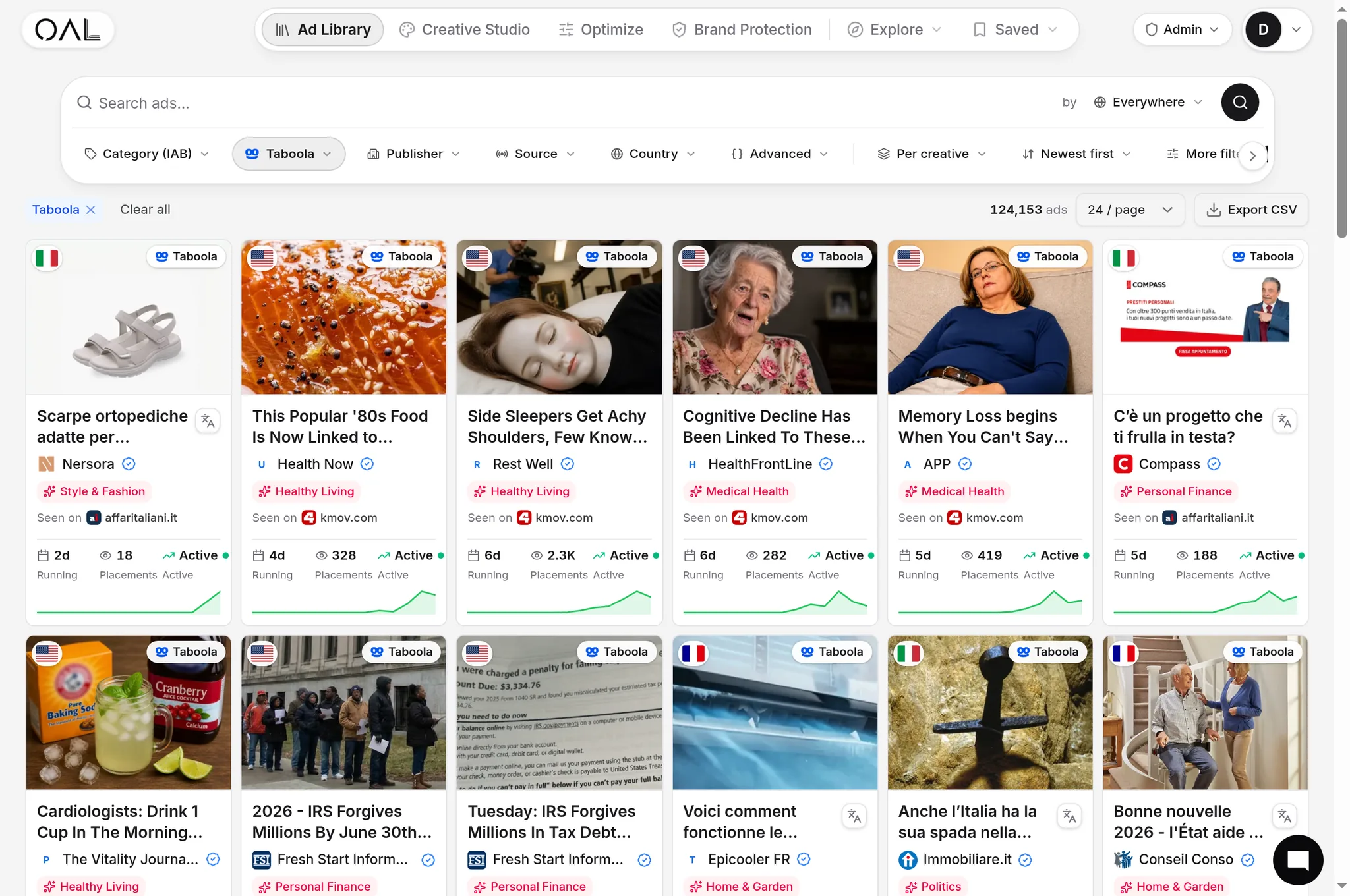
The better pre-launch move is studying what already runs where. OpenAdLibrary's index holds 206,000+ live Taboola creatives (July 2026) with observed first-seen and last-seen dates — and longevity is the strongest public profitability signal in native: nobody keeps paying for a placement mix that loses money for weeks. Before funding your own discovery phase, search your vertical at /spy/taboola and look at which advertisers have sustained campaigns and what their funnels look like. Every dollar of someone else's placement learning you reuse is a dollar you do not spend re-learning it. The Taboola CPC benchmarks piece pairs well with this when you are setting the target CPA your thresholds hang off.
The end state: from block list to whitelist#
Blocking is how a broad campaign gets profitable; whitelisting is how a profitable campaign gets efficient. After a few weeks of disciplined site-report reviews you will know your 10–30 proven placements. The standard play is to graduate them into a dedicated whitelist campaign — site targeting restricted to winners, higher bids, its own budget — while the original run-of-network campaign keeps prospecting for new placements with your block list applied. The whitelist / blacklist glossary entry covers the terminology; the practical effect is that discovery and exploitation stop fighting over the same budget.
Common site-blocking mistakes#
- Blocking on CTR instead of conversions. Low CTR costs you nothing on CPC pricing; low conversion rate does.
- Judging placements on tiny samples. Enforce the spend threshold before acting.
- Ignoring geo and device confounds. A "bad site" is sometimes just a bad site-on-mobile or site-in-one-geo; split the report before you swing the hammer.
- Set-and-forget lists. Review account-level blocks quarterly. Publishers change monetization, templates and audiences.
- Treating blocking as the whole strategy. It is one lever of several — creative, bids, geos and landing pages move numbers at least as much, as any complete native media buying guide will drill into you.
Run the loop — daily site report, spend-based thresholds, block or re-bid, graduate winners — and placement waste stops being the thing that kills your Taboola account.