Español
 Português (Brasil)
 Français
 Deutsch
 Italiano
 Nederlands
 Polski
 Svenska
 Türkçe
 Русский
 日本語
日本語 한국어
한국어 简体中文
简体中文 Tiếng Việt
 Bahasa Indonesia
 繁體中文
繁體中文 Čeština
 Dansk
Dansk Norsk (bokmål)
 Suomi
Suomi Ελληνικά
 Română
 Magyar
 Українська
 ไทย
ไทย हिन्दी
 العربية
 עברית
עבריתHow to Estimate Competitor Native Ad Spend (Methods & Signals)
No tool can hand you a competitor's exact native ad budget, but ad volume, placement breadth, creative longevity and geo spread are observable proxies that get you to a defensible spend tier.


Anyone who promises you a competitor's exact native ad budget is selling you a guess dressed up as a fact. There is no billing feed, no public ledger, no API that reports what a brand actually paid Taboola or Outbrain last month. What you can do, and what experienced media buyers actually do, is read the observable footprint of a campaign and turn it into a defensible spend tier. Done well, that answers the questions that matter: who is spending aggressively, who is scaling, which offers are funded winners, and where the money is concentrated by geo and vertical.
This guide is the method. It runs on signals you can verify yourself: ad volume, placement breadth, creative longevity, and geographic spread. It is also honest about where estimation falls apart. No fabricated dollar figures, no false precision.
For context on the scale here, the OpenAdLibrary index currently holds 589,036 distinct creatives across 42 networks and 25,933 advertisers, with 5.4 million individual ad observations behind them (OpenAdLibrary index, June 2026). That is the raw material every signal below is built from.
What estimating native ad spend actually means#
Estimating competitor native ad spend means inferring a relative spend level from observable campaign signals. How many distinct creatives are live, across how many placements, for how long, in which countries. You are not reading an exact dollar amount, because that number is never public. The output is a defensible tier (low, scaling, heavy), not a billing figure.
That reframing is the whole game. Stop chasing a number nobody can give you and start ranking advertisers by footprint, and the data becomes both attainable and useful. A spend tier tells you who to worry about, who to copy, and which offers are working, without pretending to a precision the data cannot support. For the wider market picture behind these signals, see The State of Native Advertising 2026, which is built from the same live-capture approach.
Why exact budgets are unknowable (and who claims otherwise)#
Be precise about the limits, because a lot of competitive-intelligence marketing is deliberately vague here.
- Networks do not publish per-advertiser spend. Taboola, Outbrain, MGID, Revcontent and the rest treat advertiser budgets as confidential. There is no public spend report to pull.
- Regulation only covers part of the picture. The EU's Digital Services Act (Article 39) requires Very Large Online Platforms to keep searchable ad repositories showing the advertiser's identity, the period an ad ran, and reach broken down by member state. Genuinely useful transparency. But it covers the largest platforms, and most pure-play native networks are not VLOPs. Even where it applies, it reports reach, not spend.
- "Estimated spend" tools are models, not meters. The well-known display and native intelligence platforms produce dollar estimates by crawling high-traffic publisher sites at scale, recording ad frequency, then extrapolating spend from assumed publisher traffic and CPMs. Adbeat, for example, describes performing billions of calculations weekly over freshly crawled data to estimate spend across networks like Taboola, Outbrain, MGID and Revcontent. That is a legitimate methodology. The result is still a modeled figure with wide error bars, not a measured one.
Treat any precise dollar estimate the way you treat a weather app showing "73 degrees." The model is doing real work, but the third significant figure is theater. Compare advertisers measured the same way and don't bank on the absolute number.
The practical takeaway: build your own estimate from primary signals you can see, and use modeled dollar figures only as a directional cross-check.
The four signals that actually proxy spend#
Spend leaves a footprint. These four observable signals, combined, let you rank advertisers reliably without a dollar figure attached.
1. Ad volume (how many distinct creatives are live)#
The number of unique creatives an advertiser has in market is the most immediate spend signal. Running 40 distinct images and headlines takes production budget, testing budget, and media budget to keep them served. A handful usually means a small test. Dozens of concurrent variations means a funded, optimized operation.
To calibrate "a lot," look at network totals. Taboola alone accounts for 157,727 creatives in our index and Outbrain for 84,252 (OpenAdLibrary index, June 2026). That volume is spread across thousands of advertisers, so a single brand fielding dozens of live variations is already punching above the median.
Count distinct creatives, not impressions. Impression counts are noisy and easy to misread. Creative count is a cleaner read on operational scale.

2. Placement breadth (how many publisher widgets carry the ads)#
A native ad widget is the recommendation unit at the bottom of an article ("Around the Web," "You May Like"). The more distinct publisher widgets an advertiser shows up on, the wider their buy. Broad placement across many high-traffic publishers signals either a large managed budget or aggressive programmatic native advertising bidding. Both cost money to sustain.
3. Creative longevity (how long an ad keeps running)#
This is the most underrated signal and arguably the most valuable. Native is bought on performance economics. An advertiser keeps paying to serve a creative only while it returns a positive margin. So an ad that has been live for weeks is, by definition, one the advertiser is actively funding because it works.
Longevity tells you two things at once: ongoing spend, and a validated winner. A momentary impression spike might be a test that gets killed in 48 hours. A long-runner is a proven money-maker someone is still paying for.
Here is where you have to be careful with the lore. You will read that "the best native ads run for 90 days or more." That is a general industry rule of thumb, not something we are claiming as our own finding. What we can show you is continuous observation: our index currently spans up to roughly 28 days of unbroken capture per creative, and a tight cluster of ads have held that full window. SmartAsset's "Ask a Pro: How Can I Avoid Paying Taxes on IRA Withdrawals?" has run the full 28 days on Outbrain. Hidden Hearing's "Try next-gen hearing aids" has done the same on the Microsoft Audience Network. A whole family of "My IQ" quiz ads sits at 28 days too (OpenAdLibrary index, June 2026). When the same creative survives every check you make over a month, that is a funded winner, not a fluke.

We dig into this pattern in The Longest-Running Native Ads (And What Makes Them Evergreen). For spend estimation, longevity should carry the most weight in your model.
4. Geographic spread (how many geos and how deep)#
A campaign live in one country is a different spend class from one running across the US, UK, Canada, Australia and a dozen European markets. You can see this in the captures themselves. Honda Cars India is live on Taboola pushing the new Honda City, while "Real" is running a life-insurance ad explicitly targeted at Australians looking for cover (OpenAdLibrary index, June 2026). Different geos, different creative, same advertiser-level lesson: geo breadth multiplies media cost and signals a brand that has found a winning formula and is scaling it sideways. A narrowing geo footprint can mean the opposite, a pullback or budget reallocation, which is a leading indicator worth watching.

A practical scoring framework#
You do not need a regression model. A simple, transparent rubric turns the four signals into a comparable spend tier. Score each advertiser 1 to 3 per signal, sum, and bucket the total.
| Signal | Low (1) | Medium (2) | High (3) |
|---|---|---|---|
| Distinct live creatives | 1 to 5 | 6 to 20 | 20+ |
| Placement breadth (publisher widgets) | A few sites | Dozens of sites | Broad, network-wide |
| Creative longevity | Days | A few weeks | Many weeks |
| Geo spread | 1 country | 2 to 4 countries | 5+ countries |
Reading the total (out of 12):
- 4 to 6, testing or low spend. A few creatives, narrow placement, short lifespans. Watch for the ones that survive.
- 7 to 9, scaling. Volume is rising, winners are surviving, geos are expanding. This advertiser is committing budget and finding fit.
- 10 to 12, heavy, committed spend. Large creative libraries, broad placement, durable long-runners, multi-geo. Treat as a serious, well-funded competitor.
If you have to break a tie, weight longevity highest. It is the signal least likely to be a fluke. And always compare advertisers within the same vertical. Baselines differ wildly: Finance leads the whole index with 17,232 creatives, followed by Insurance at 15,629 and Health at 14,895, while Education sits near the bottom of the top ten at 6,239 (OpenAdLibrary index, June 2026). A top-tier finance advertiser and a top-tier education advertiser have completely different "normal," so cross-vertical totals are not apples to apples. The vertical-by-vertical baselines in Top Native Ad Verticals in 2026 are a useful calibration point.

Turning signals into a workflow#
Here is how to run the estimate end to end.
- Define the competitor set. Pick the specific advertisers you want to rank, by brand or by the real entity behind the brand. Many native ads route through agencies, arbitrage operators or white-label landing pages, so identifying the actual advertiser behind a creative matters. If you are scoping a network, the share breakdowns in Top Native Advertisers on Taboola, Outbrain & MGID help you find who is even worth tracking.
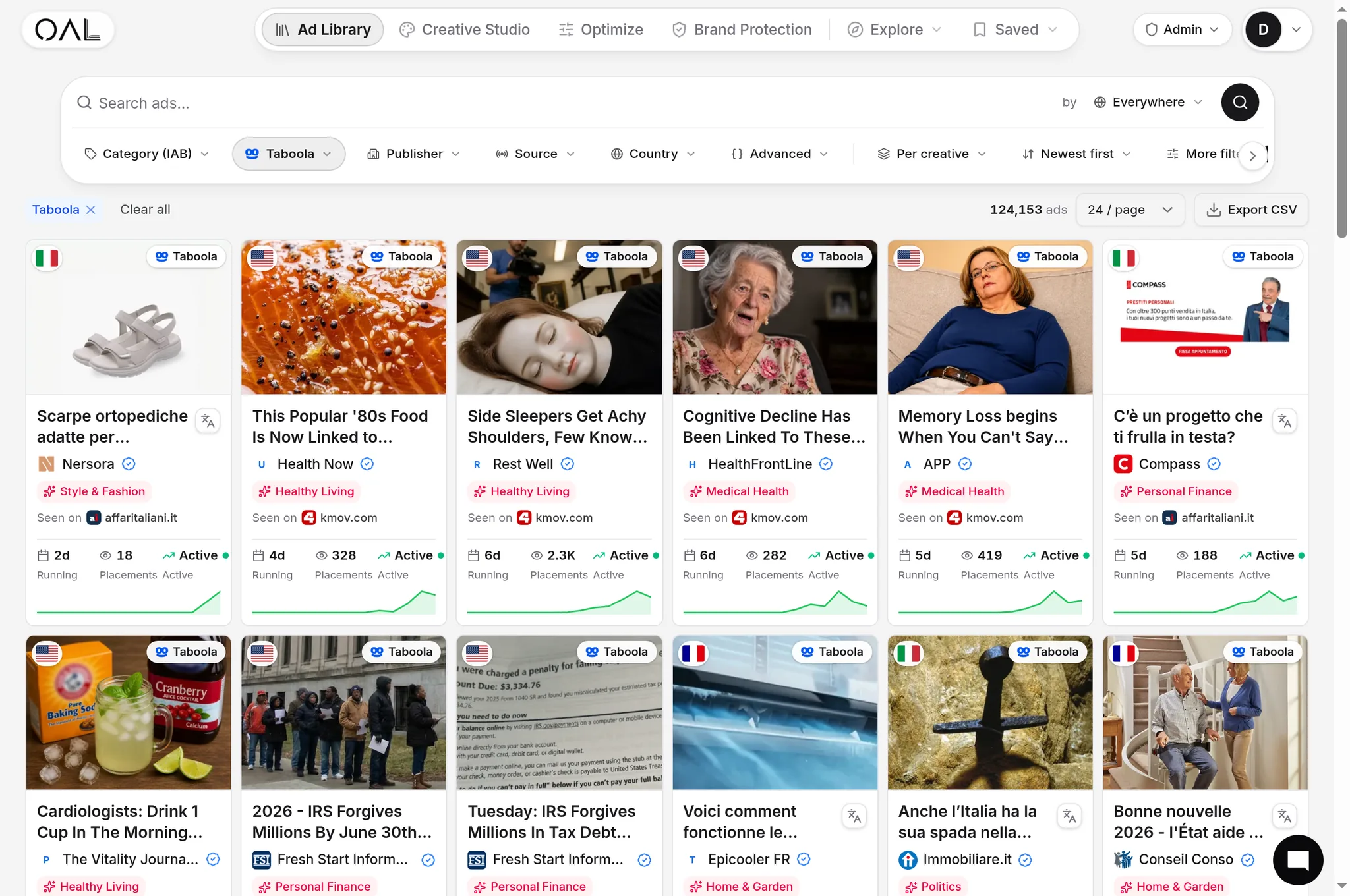
- Capture the live footprint. Pull every live creative per advertiser, with first-seen and last-seen dates, the publisher placements, and the geos. This is the raw material for all four signals.
- Score and tier. Apply the rubric. Record the total and the component scores. The breakdown is more useful than the sum.
- Track the trend, not just the snapshot. A single capture is a photo. Spend estimation is a movie. Re-score every two to four weeks. Rising creative count plus lengthening longevity plus new geos is the unmistakable signature of a competitor scaling a winner, and often the most valuable thing you will learn.
- Cross-check with a modeled estimate (optional). If you have a dollar-estimate tool, use it as a directional sanity check on your tiers, not as the source of truth.
For the qualitative layer, why a competitor's spend is working, pair the spend read with a look at their messaging. The patterns in The Most Common Native Ad Angles help you see whether a high spender is winning on offer, hook or sheer budget.
Where OpenAdLibrary fits#
Every signal in this method depends on one thing: a clean, continuous record of live native placements. That is the gap OpenAdLibrary fills. It captures live public native ads across Taboola, Outbrain, MGID, Revcontent, Teads, MediaGo, Yahoo and MSN. It stores the real creative at full quality with first-seen and last-seen timestamps so longevity is measurable. It records the publisher placements and geos behind each ad, classifies the supply chain and the real advertiser, then follows each click through to the landing page so you can see the offer, all without clicking live ads. To date that adds up to 926,259 landing-page captures behind the creatives in the index (OpenAdLibrary index, June 2026).
Because it is open and low-cost ($29.99/mo, with a free tier to browse 200 ads with no card) rather than the $80 to $400/mo of legacy spy tools, you can run this kind of ongoing competitive read without a procurement battle. And it will not hand you a fabricated spend number. It gives you the observable signals this method is built on, which is the honest foundation for any estimate.
Start free and pull a competitor's live footprint to score it yourself.
The honest bottom line#
You will never know exactly what a competitor paid for native this quarter, and you should be suspicious of anyone who claims they can tell you. What you can do, reliably and repeatably, is read ad spend through its footprint. Count the creatives, map the placements, measure the longevity, track the geos, and watch the trend. That gives you a spend tier you can act on, grounded in how native advertising and the native ad auction actually work, with no invented precision. In competitive intelligence, a well-reasoned tier you can trust beats a fabricated dollar figure you cannot, every single time.