Español
 Português (Brasil)
 Français
 Deutsch
 Italiano
 Nederlands
 Polski
 Svenska
 Türkçe
 Русский
 日本語
日本語 한국어
한국어 简体中文
简体中文 Tiếng Việt
 Bahasa Indonesia
 繁體中文
繁體中文 Dansk
Dansk Norsk (bokmål)
 Suomi
Suomi Ελληνικά
 Română
 Magyar
 Українська
 ไทย
ไทย हिन्दी
9 Outbrain Alternatives for Advertisers in 2026
Taboola, MGID, Revcontent, MediaGo, Microsoft, Yahoo, Google Demand Gen, Nativo, TripleLift: nine real Outbrain alternatives sized with live index data instead of vendor marketing.


The strongest Outbrain alternatives in 2026 are Taboola (the largest direct rival), MGID and Revcontent (lower entry costs and looser moderation), MediaGo (Baidu's machine-learning-driven native platform), Microsoft Audience Network and Yahoo DSP (walled-garden feed inventory), Google Demand Gen (feed-style buying inside the Google stack), and Nativo and TripleLift (brand-side and programmatic native). Which one fits depends on your budget floor, your vertical, and your tolerance for moderation strictness. This comparison sizes each network's real advertiser demand using OpenAdLibrary's live index — 725,882 native ad creatives across 49 networks as of June 2026 — rather than repeating vendor marketing.
Why advertisers look beyond Outbrain#
Outbrain remains a top-two native network, and for many buyers the right answer is to keep running it. But four things push advertisers to diversify:
- The Teads merger changed the center of gravity. Since February 2025, Outbrain operates as Teads, with a stronger pull toward brand and video budgets. Performance buyers report the same feed inventory, but the product roadmap and sales attention now serve a broader mix. How Outbrain works in 2026 covers the post-merger mechanics.
- Approval strictness. Outbrain enforces the tightest creative and landing-page policies in native. Compliant advertisers pass — but if your funnel iterates fast, a looser network can be the difference between testing five angles a week and two.
- CPC pressure in Tier-1. Premium inventory attracts deep bid density. Media buyers commonly report that equivalent audiences cost meaningfully less on mid-tier networks — with a corresponding drop in publisher quality that your funnel may or may not absorb.
- Reach ceilings. Any single network eventually saturates for a given offer and geo. The networks below overlap only partially with Outbrain's supply, so each adds genuinely incremental audience.
How we compared these networks#
Every network claims massive reach. Instead of taking their word for it, we use OpenAdLibrary's independent capture: live creative counts per network are a proxy for the breadth of advertiser demand actually running — a network where 200,000 creatives are live is verifiably carrying more concurrent campaigns than one carrying 6,000. Vertical mixes come from per-creative classification of the same index. All numbers are June 2026. Two honest caveats: creative counts measure demand breadth, not supply reach or your expected ROI; and networks without feed-style public placements (or that we track inside other supply) show no individual count. Where a claim below is qualitative — CPC levels, minimum deposits — it reflects what practitioners commonly report, not official rates; verify current terms with each network.
The nine alternatives at a glance#
| Network | Live creatives in index (June 2026) | Strongest classified verticals | Best for |
|---|---|---|---|
| Taboola | 206,145 | Health, finance, insurance | Like-for-like Outbrain replacement at scale |
| MGID | 62,765 | Entertainment-style content, health | Low minimums, Tier-2/3 geos, fast iteration |
| Revcontent | 15,789 | Health, finance, home & garden | Direct-response verticals, smaller budgets |
| MediaGo | 6,571 | Insurance, home & garden, ecommerce | ML-driven prospecting on MSN-adjacent supply |
| Microsoft Audience Network | 281,839 | Ecommerce, finance, travel | MSN/Windows reach, search-adjacent intent |
| Yahoo DSP (native) | 5,926 | Software, finance | Yahoo owned-and-operated feed inventory |
| Google Demand Gen | not individually tracked | — | Feed-style buying inside Google's stack |
| Nativo | not individually tracked | — | Brand-side sponsored content at scale |
| TripleLift | not individually tracked | — | Programmatic in-feed via your DSP |
1. Taboola — the like-for-like replacement#
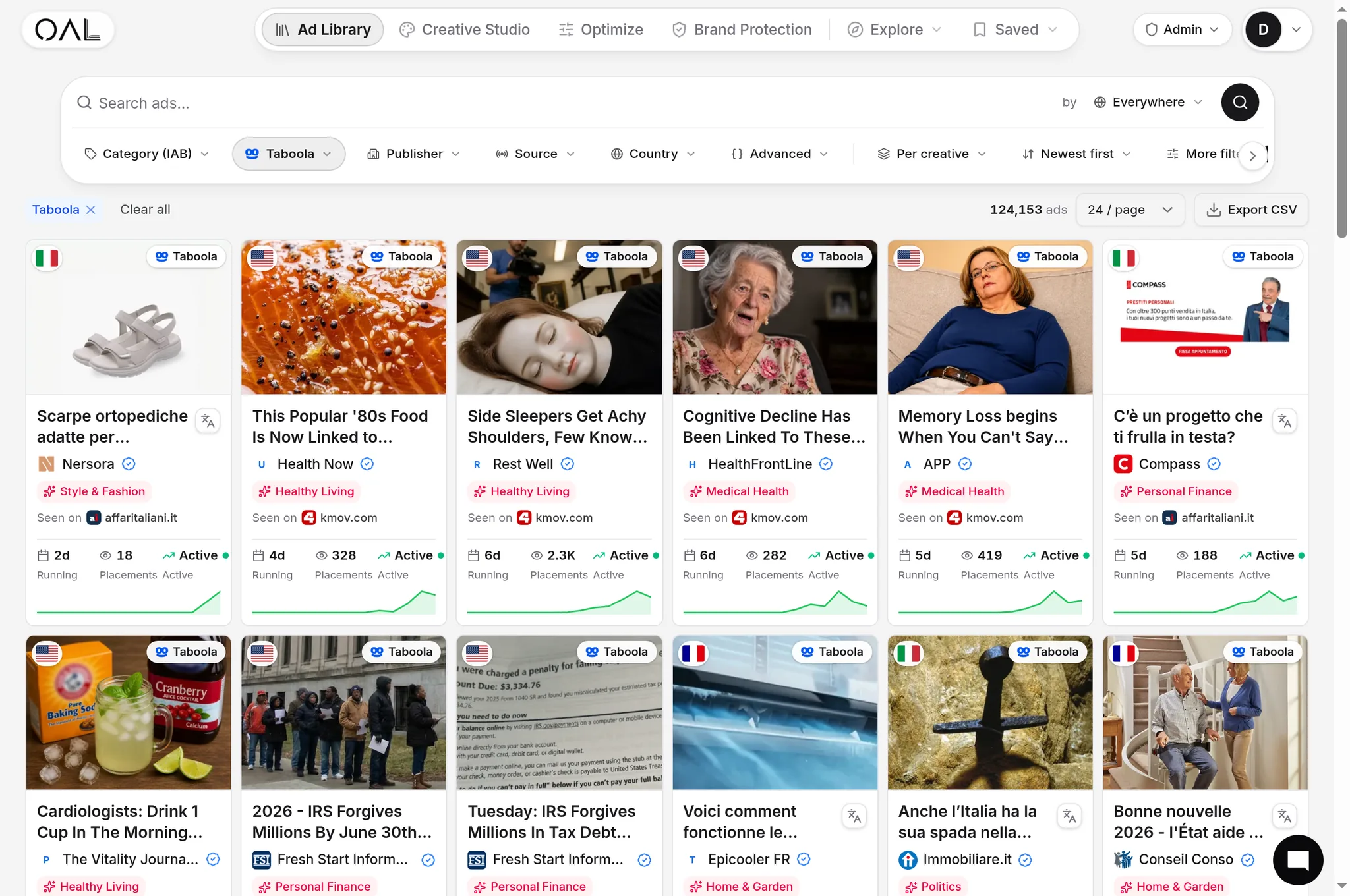
Taboola is the largest feed network in our index at 206,145 live creatives — roughly double Outbrain's 108,573 — and the closest substitute: the same below-article feed format, a comparable premium-publisher pitch, and a similar (if slightly less strict) moderation bar. The vertical mix mirrors Outbrain's, led by health, finance, and insurance, so campaigns usually port with minimal creative rework. If you are leaving Outbrain over reach rather than policy or price, start here; how Taboola ads work covers setup, and the Taboola vs Outbrain comparison quantifies the overlap. Weaknesses: the same Tier-1 CPC pressure, and an auction crowded with sophisticated buyers.
2. MGID — low floor, global supply#
MGID carries 62,765 live creatives in the index, with a distinctly different character: entertainment-style, curiosity-led content dominates the classified mix, supply skews toward Tier-2/3 geos and non-English markets, and moderation tolerates a more aggressive register. Minimum deposits are commonly reported in the low hundreds of dollars — verify at signup — which makes it the lowest-friction way to test native outside the premium duopoly. How MGID works covers formats and pricing mechanics. Weaknesses: publisher quality varies widely, so placement-level blacklisting is mandatory, and Tier-1 premium inventory is thinner.
3. Revcontent — direct-response mid-tier#
Revcontent's index footprint is 15,789 live creatives, concentrated in health, finance, and home — classic direct-response territory. Buyers choose it for lower CPCs than the premium networks, workable US supply, and a moderation bar that accepts advertorial-style funnels that Outbrain would bounce. The MGID vs Revcontent comparison positions the two mid-tier options against each other; broadly, Revcontent skews more US and health, MGID more global. Weaknesses: a smaller supply pool that saturates faster per offer, and quality variance that demands active placement management.
4. MediaGo — Baidu's ML-first native platform#
MediaGo (6,571 live creatives in the index, led by insurance, home & garden, and ecommerce) is Baidu's international native platform, distinguished by machine-learning optimization that leans on its deep-learning bidding rather than manual placement curation, and by supply relationships across MSN and other large portals. Buyers commonly use it as a second-wave network: once an offer works on Taboola or Outbrain, MediaGo often delivers incremental volume on similar audiences. The MediaGo ad library shows what currently runs. Weaknesses: a smaller self-serve ecosystem and fewer levers when the black-box optimization underdelivers.
5. Microsoft Audience Network — the biggest feed you're not buying directly#
The Microsoft Audience Network is the single largest supply source in our index — 281,839 live creatives across MSN, Windows surfaces, and Edge — with a classified mix led by ecommerce, finance, and travel. It is not a native network in the Outbrain mold: you buy through Microsoft Advertising, audiences are search-adjacent (LinkedIn profile and search-intent signals), and creative standards follow Microsoft's ad policies. For advertisers already running Microsoft search, extending into the audience network is the cheapest test available. The MSN native ads guide covers placements and mechanics. Weaknesses: less transparent placement reporting and a very different optimization surface from classic native.
6. Yahoo DSP — the survivor of Gemini#
Yahoo's native inventory (5,926 live creatives in the index, led by software and finance) is bought through the Yahoo DSP since the retirement of Yahoo Gemini's self-serve platform. Supply is concentrated on Yahoo's owned-and-operated properties — Yahoo home, mail, finance, sports — which delivers an older, finance-heavy audience that some verticals (insurance, investing tools, subscription software) convert exceptionally well. How Yahoo native ads work after Gemini explains the current buying path. Weaknesses: DSP minimums put it out of reach for small budgets, and reach outside Yahoo properties is modest.
7. Google Demand Gen — feed buying inside Google#
Google Demand Gen campaigns place image and video creatives across Discover, Gmail, and YouTube feeds — functionally native placements, bought with Google's targeting and measurement. It is not tracked as a separate network in our index, but it belongs on any alternatives list because it answers the same brief: feed-style prospecting at scale. Strengths: Google's audience data, conversion-based bidding, and no new platform relationship to manage. Weaknesses: less placement transparency than classic native networks, creative constraints that favor polished brand-style assets, and policy enforcement that treats advertorial funnels harshly.
8. Nativo — brand-side sponsored content#
Nativo places full sponsored articles — not just feed cards — directly into publisher content wells, sold managed-service and programmatically. It suits brand and content teams whose unit of creative is the article itself, with measurement oriented to attention and engagement rather than last-click CPA. Weaknesses for performance buyers: higher effective entry costs, slower creative iteration, and a model that rewards editorial-quality content production.
9. TripleLift — programmatic in-feed via your DSP#
TripleLift is a supply-side platform that templates native in-feed placements across a large publisher footprint, bought programmatically through DSPs rather than a self-serve native dashboard. For teams already running a DSP seat, it adds native formats to existing programmatic plumbing — same audiences, same measurement, new format. Weaknesses: no standalone self-serve entry point, and creative automation that trades some native-context punch for scale.
How to choose: match the network to your reason for leaving#
- Leaving over reach? Taboola first, then Microsoft Audience Network — the two biggest demand pools in the index.
- Leaving over price? MGID and Revcontent commonly deliver the lowest CPCs, with placement quality as the trade; native CPC benchmarks frames what buyers report across networks.
- Leaving over moderation? MGID and Revcontent accept a more aggressive register — but read their policies; nothing on this list accepts what the FTC prohibits.
- Brand or content-led? Nativo for full sponsored articles, Google Demand Gen for polished feed creative, Teads-side video if you stay with the merged entity.
- Already on Microsoft or a DSP? Microsoft Audience Network and TripleLift respectively add native reach with no new platform relationship.
- Budget under four figures? MGID or Revcontent; the premium networks and DSP paths will spend a small test budget before producing signal.
Run two networks, not nine. The standard playbook is one premium network (Outbrain or Taboola) plus one mid-tier (MGID or Revcontent), with the walled gardens added once creative is proven — a spread that captures most of the available supply while keeping optimization workload sane. Our ranking of native networks by real ad volume goes deeper on the full landscape.
Porting an Outbrain campaign: what transfers and what doesn't#
Moving a working campaign to an alternative is not a copy-paste job, and knowing what carries over saves a wasted test budget:
- Angles transfer; creatives may not. The underlying angle that works on Outbrain — the problem, the audience, the promise structure — usually works on Taboola with the same images and headlines. On MGID and Revcontent, expect to shift register: the curiosity-led, story-flavored teaser style that dominates mid-tier supply typically outperforms the cleaner premium-network version of the same angle. Rewrite headlines for the destination network's native register rather than assuming your winners port intact.
- Landing pages transfer with a compliance re-read. A funnel that passed Outbrain's review will pass almost anywhere. The reverse is emphatically untrue — do not port a mid-tier-approved funnel to Outbrain or Taboola without re-auditing claims and disclosures.
- Bids do not transfer. Every network's auction has its own clearing prices per geo and vertical. Start from the destination platform's suggested bids and your own delivery data, not from your Outbrain CPCs.
- Placement knowledge does not transfer. Your Outbrain section blacklist means nothing on MGID's supply. Budget for a fresh placement-learning phase — cutting weak widgets is the first two weeks of any mid-tier campaign.
- Tracking transfers cleanly. Swap the click-ID macros and postback configuration for the new network and the rest of your measurement stack stays intact. Verify with a test conversion before spending.
Sequence the migration deliberately: keep Outbrain running while the alternative ramps, split the test budget so the new network gets enough volume to produce signal (a starved test proves nothing), and compare on cost per conversion after the new network's learning phase — not during its first noisy days.
The case for keeping Outbrain in the mix#
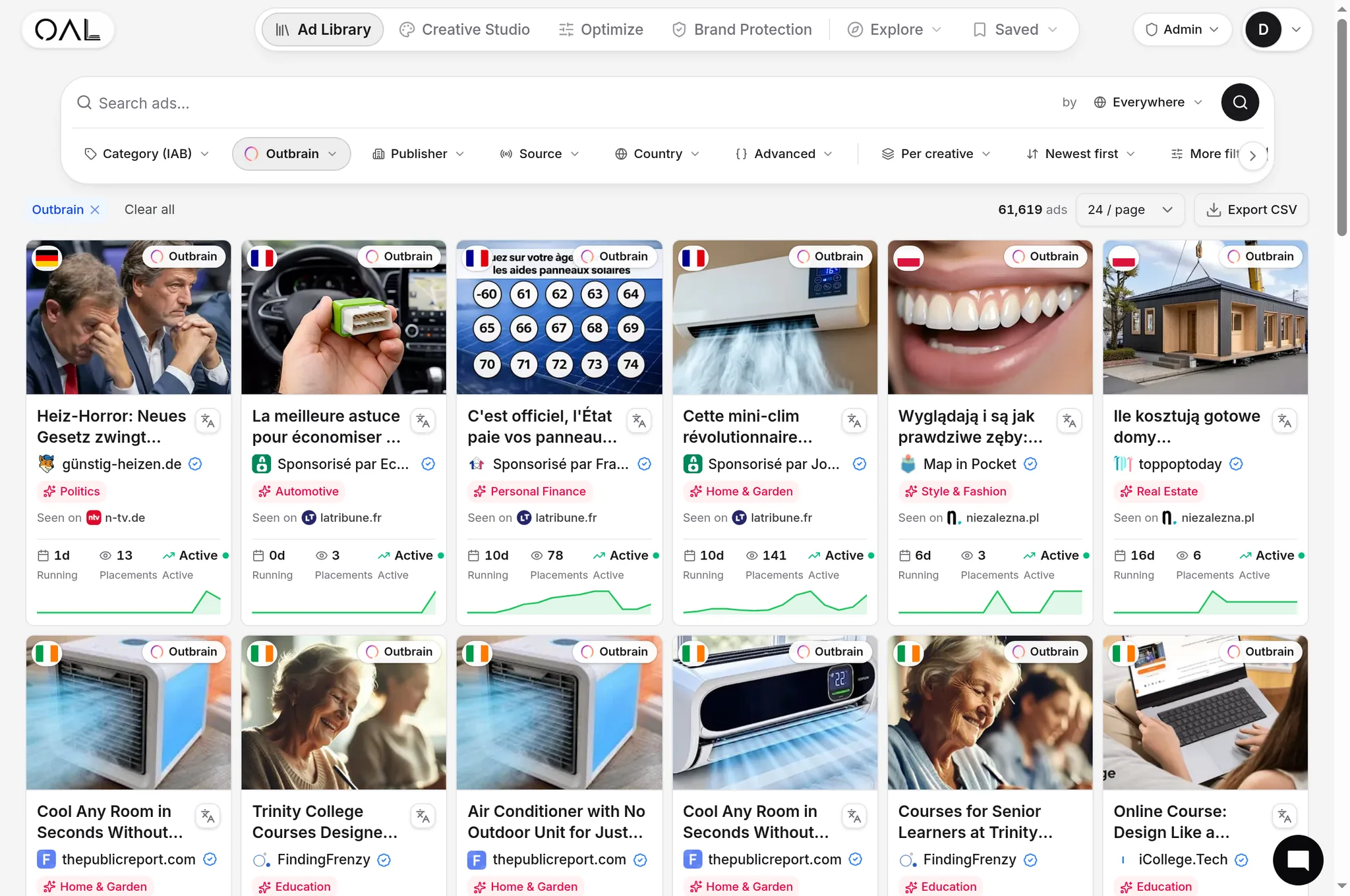
One honest note to close the comparison: most advertisers researching alternatives should diversify, not leave. Outbrain's post-merger demand remains the second-largest feed pool in our index, its premium supply converts audiences the mid-tier networks cannot reach, and an approved, aged account with placement history is an asset that takes months to rebuild. The buyers who get this right treat alternatives as additions — a second and third supply pool with independent auctions — and let performance data decide the budget split quarter by quarter. The ones who get it wrong ragequit a working network over one rejection and restart their learning curve from zero somewhere else.
Research any network before you deposit#
Every network on this list will happily take a deposit before showing you what actually runs on its supply. Reverse the order: look at the live ads first. OpenAdLibrary captures creatives, advertisers, longevity, and landing pages across all the feed networks above — browse a network's real advertiser mix in the native ad spy tool, or go straight to live Taboola creatives to compare against what you saw on Outbrain. Ten minutes of looking at which advertisers run for weeks in your vertical — on which networks, in which geos — answers the alternatives question with evidence instead of sales copy. If your vertical is thin on a network's index, that is a signal too: either an untapped opportunity or, more often, a network whose supply never worked for that vertical.
The alternatives exist, they are real, and several of them are verifiably larger than they were two years ago. Pick by evidence, enter with a test budget, and keep whichever two networks earn their place in the mix.