Español
 Português (Brasil)
 Français
 Deutsch
 Italiano
 Nederlands
 Polski
 Svenska
 Türkçe
 Русский
 日本語
日本語 한국어
한국어 简体中文
简体中文 Tiếng Việt
 Bahasa Indonesia
 繁體中文
繁體中文 Čeština
 Dansk
Dansk Norsk (bokmål)
 Suomi
Suomi Ελληνικά
 Română
 Magyar
 Українська
 ไทย
ไทย हिन्दी
 العربية
 עברית
עבריתBest Native Ad Networks for Small Publishers (Low Traffic Minimums)
Taboola and Outbrain are graduation targets, not starting points. Here are the native ad networks that realistically accept small publishers, what demand you'll actually serve, and the checks to run before you embed a widget.


If your site is under roughly half a million monthly pageviews, the native ad networks realistically open to you are MGID and Revcontent, with a long tail of lower-bar networks behind them. Taboola and Outbrain — the two biggest names in native — generally reserve direct publisher partnerships for sites with traffic well into the six or seven figures per month, which makes them graduation targets rather than starting points. But "who will accept me" is only half the decision. The other half is whose demand will actually pay, and what those ad cards will look like sitting under your content — and you can check that before you ever apply.
How native ad networks evaluate small publishers#
Every native ad network runs a two-sided marketplace. Advertisers put money in; publishers supply the audience. The network protects advertiser budgets by filtering publishers, which is why joining is an application, not a checkout. Across networks, reviewers weigh some combination of:
- Traffic volume and stability. Not just raw pageviews but consistency. A site that spiked once on a viral post looks worse to a reviewer than a smaller site with a flat, steady baseline, because advertisers plan against predictable inventory.
- Geo mix. Advertiser budgets concentrate in Tier-1 geos — the US, UK, Canada, Australia and Western Europe. A 60,000-pageview site with a mostly US readership is more attractive than a 300,000-pageview site whose traffic the network's advertisers don't target.
- Engagement quality. Time on page, scroll depth and returning visitors signal that a widget placed below your articles will actually be seen. Several networks now weight this more heavily than raw volume.
- Content originality and cadence. Scraped, spun or AI-flooded content is the fastest route to rejection. A modest site publishing original articles on a regular schedule clears this bar easily.
- Brand safety. No pirated media, no adult content, no medical misinformation — nothing that would embarrass an advertiser whose card renders next to it. On most networks a human checks this.
- Technical readiness. A working ads.txt file, a functioning consent setup where your traffic requires one, and page speed that won't bury the widget below a ten-second load.
None of these thresholds are published precisely, and they move. Where an exact number matters, check the network's current publisher documentation rather than any blog post — including this one.
One scope note before the list: this article ranks networks from the publisher's side. If you're a media buyer deciding where to spend, that's a different ranking — see the advertiser-side breakdown of the best native ad networks by live ad volume.
The shortlist at a glance#
| Network | Entry bar for a small publisher | Live creatives indexed (June 2026) | Demand skew | Best fit |
|---|---|---|---|---|
| MGID | Lowest among the majors; mixed-geo sites accepted | 62,000+ | Entertainment-style content, health, insurance | First native widget; global or Tier-2/3 audiences |
| Revcontent | Selective, but weighs engagement over raw traffic | 15,700+ | Health, finance, home & garden | US-heavy content sites with engaged readers |
| Taboola | High; direct deals skew to large sites | 206,000+ | Health, finance, insurance, ecommerce | The graduation target once traffic scales |
| Outbrain (Teads) | High; premium editorial standards | 108,000+ | Insurance, finance, health | Editorial brands approaching real scale |
Creative counts come from OpenAdLibrary's index of 725,000+ live native ad creatives across 49 networks (June 2026). They're a useful proxy for demand depth: more live creatives generally means more advertisers competing for your impressions, which supports steadier rates.
Two networks you might expect on this list are missing for a reason. Microsoft's native feed and Yahoo's native inventory both run primarily through owned properties and large media partners rather than an open publisher program a small site can simply join, so they don't factor into a small publisher's decision — check their current partner documentation if your traffic eventually justifies the conversation.
1. MGID: the most realistic first native network#
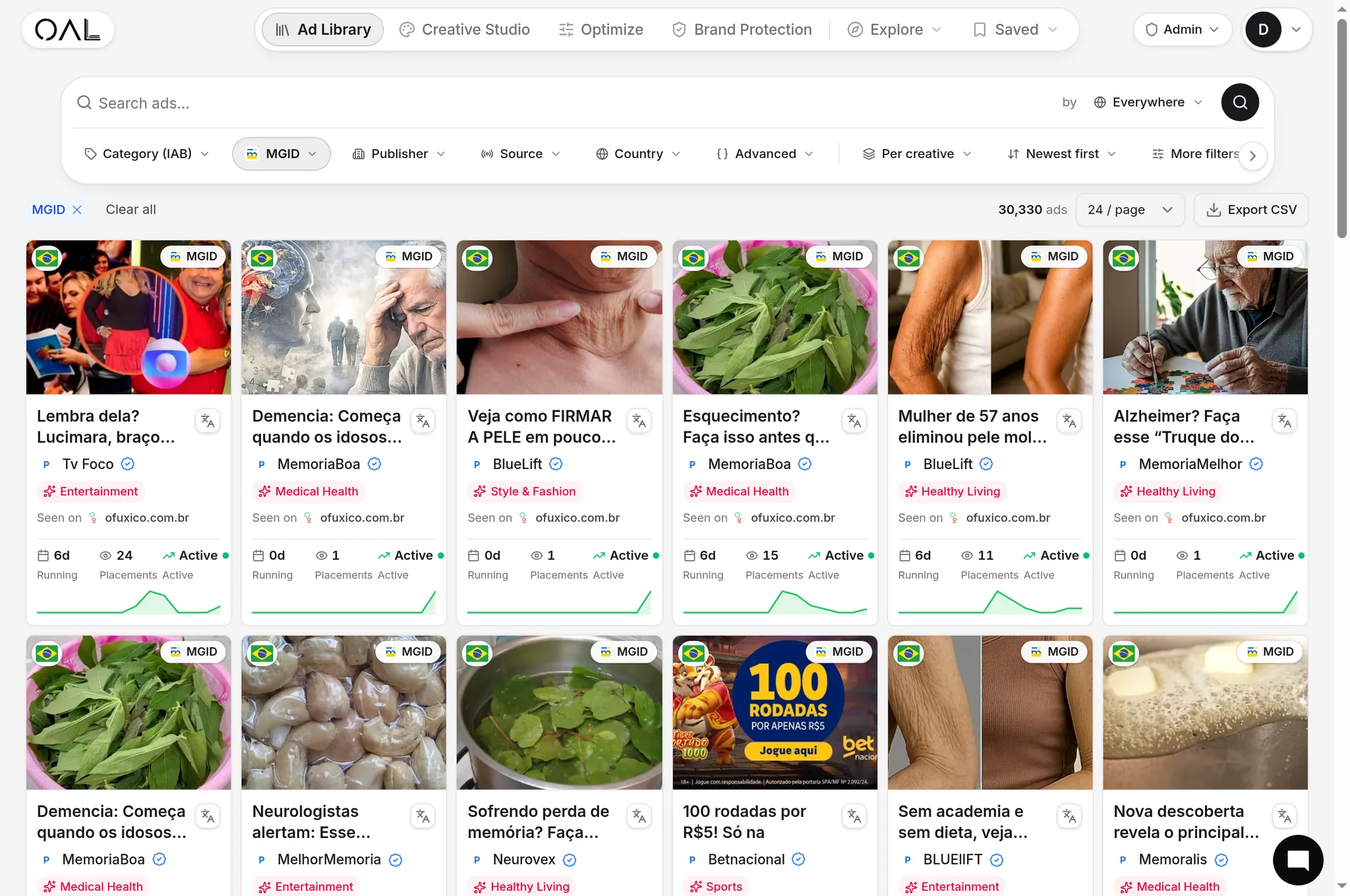
MGID is where most small publishers actually start with native, for a simple reason: it's the largest network whose entry bar a small site can clear. There is no publicly enforced traffic wall comparable to the majors, mixed-geo audiences aren't disqualifying, and the review focuses on whether your content is original and brand-safe. The formats are the familiar ones — under-article widgets, sidebar units, in-content cards — and the full mechanics are covered in our guide to how MGID works.
What you'll be serving matters more than the acceptance email, though. In OpenAdLibrary's index, MGID carries about 62,700 live creatives, and entertainment-style content dominates the classified portion — roughly 14,000 creatives, more than ten times the next-largest vertical. In practice, that means a meaningful share of MGID demand is content-arbitrage and curiosity-click material: celebrity stories, "you won't believe" galleries, aggressive health teasers. Scroll the live MGID creative feed and judge for yourself how many of those cards you'd be comfortable seeing under your own byline.
Two practical consequences follow:
- Use the quality controls from day one. MGID gives publishers category- and advertiser-level blocking. Block sensitive categories at setup, not after the first reader complaint. Your blocklist is the single biggest lever on how the widget feels to your audience.
- Expect earnings volatility. Arbitrage-heavy demand bids opportunistically. Publishers commonly report native widget RPMs anywhere from well under a dollar to a few dollars on Tier-1 traffic, and lower outside it — these are unofficial, widely varying figures. Treat any promised number with suspicion and run your own 30-day test before judging.
For a small publisher with international or Tier-2/3 traffic, MGID is usually not just the first option — it's the only major one that will say yes today.
2. Revcontent: engagement quality over raw traffic#
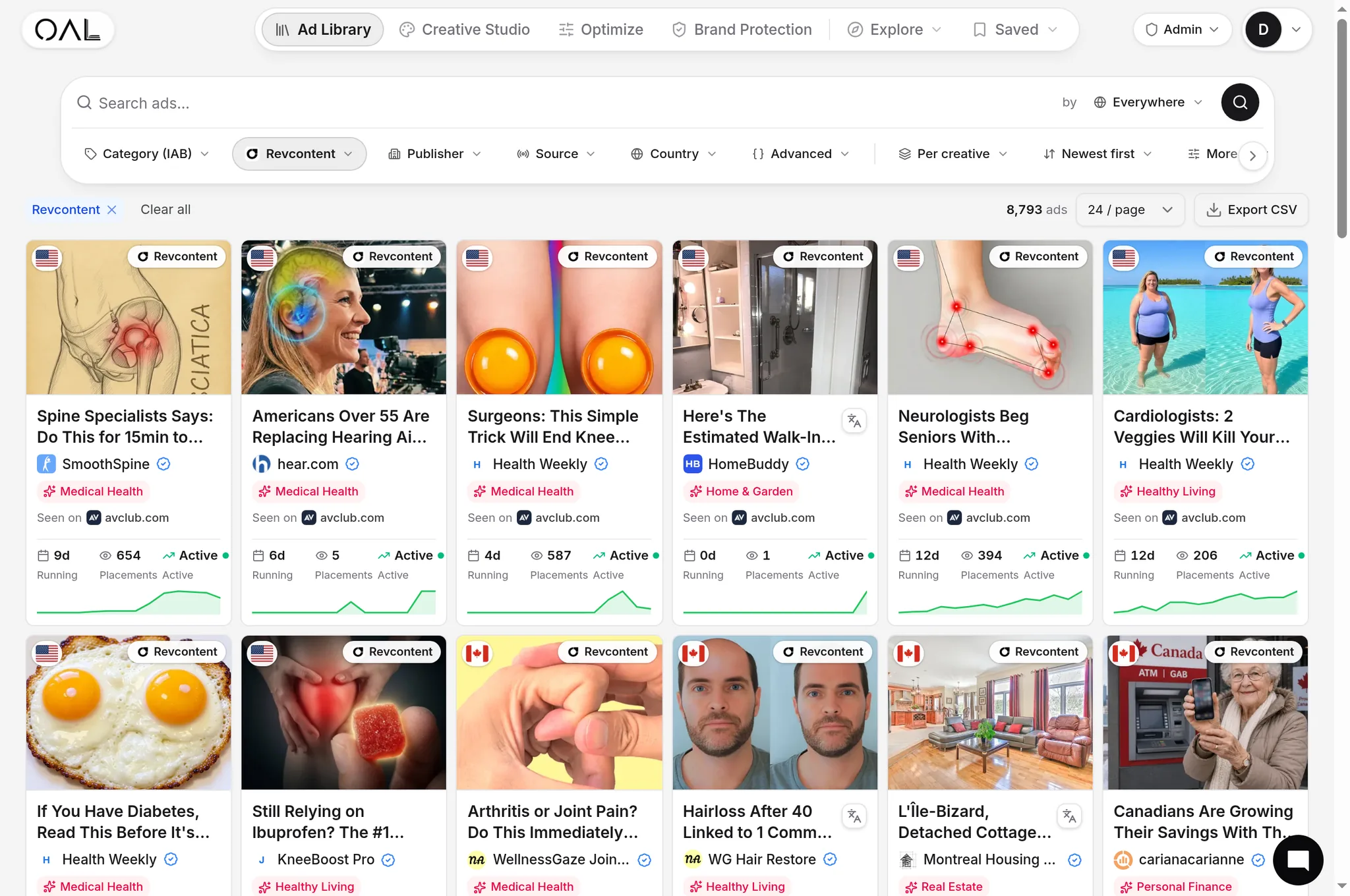
Revcontent has long positioned itself as the picky mid-tier network: it rejects a large share of publisher applications, but the bar is engagement and content quality more than pageview volume. That combination is exactly what a small-but-serious publisher wants to hear. A 70,000-pageview site with strong time-on-page and a US-heavy audience has a realistic shot, where the same site would not get a Taboola conversation started.
Demand-wise, Revcontent is a classic direct-response feed. Health is the largest classified vertical in our index — about 2,600 of its 15,700+ live creatives — followed by finance, home & garden, insurance and nutra. The cards lean advertorial: knee-pain remedies, benefit-eligibility checkers, home-upgrade offers. That mix monetizes engaged, older-skewing Tier-1 audiences well, and does very little for a young international readership. Our guide to how Revcontent works covers the formats and mechanics; the live Revcontent feed shows exactly what's running this week.
Application notes that come up repeatedly among publishers:
- Apply with your engagement story, not just your traffic number. Reviewers look at the site the way readers do. Clean navigation, original writing and real session depth carry more weight than a marginally bigger pageview count.
- Rejection isn't permanent. Publishers report acceptance on reapplication after improving engagement metrics or pruning thin content. Fix the weakest sections first, then try again.
- Expect geo concentration to show in earnings. The feed's US-heavy direct-response demand means international impressions will often go unfilled or fill at token rates — budget your expectations around your US share, not your total pageviews.
3. Taboola: the graduation target#
Taboola runs the deepest native demand pool in our index — 206,000+ live creatives spanning health (roughly 12,000 classified), finance (8,200), insurance (7,400) and ecommerce (5,200). Depth matters to publishers: more advertisers competing in each auction generally means stronger, steadier earnings for comparable audiences. That's why nearly every content publisher wants in eventually.
The catch is the entry bar. Taboola's direct publisher partnerships skew heavily toward large sites — think hundreds of thousands to millions of monthly pageviews, with exact thresholds unpublished and shifting. For most small publishers the honest plan is: monetize with an accessible network now, grow, and apply when your analytics can carry the conversation. If you want to understand the advertiser side you'd be serving, how Taboola ads work walks through it.
One warning while you wait: because the direct door is heavy, a cottage industry of intermediaries offers "Taboola demand" to smaller sites. Some are legitimate resellers; others are stacked revenue shares that leave you with a fraction of the auction price. Before signing with any intermediary, ask exactly how your inventory will be declared — a legitimate partner can show you the specific ads.txt lines and sellers.json entries involved, in writing.
4. Outbrain (Teads): the premium editorial bar#
Outbrain — now merged with Teads — has always courted premium editorial publishers, and its demand mix shows it. Insurance (about 4,300 classified creatives), finance (about 4,000) and health (3,100) lead its 108,000+ live creatives, with a visibly higher share of brand and regulated advertisers than the mid-tier networks carry. Cleaner demand, higher standards: the same filter that keeps junk ads out also keeps small publishers waiting.
For a small publisher, the realistic take mirrors Taboola's: keep it on the roadmap rather than the to-do list. If your site is an editorial brand with a growing newsroom rhythm — not a niche content play — Outbrain/Teads is the door to knock on once your traffic and engagement numbers are defensible.
The low-bar long tail (and why to be careful)#
Below the four names above sits a long tail of networks that will accept nearly any site with a pulse. Some are honest businesses serving audiences the majors ignore; others will fill your pages with malvertising and pay you in excuses. Because the names on this tier change quickly, evaluate any low-bar network on criteria rather than reputation:
- Transparency infrastructure. Do they give you exact entries for the ads.txt specification and appear consistently in sellers.json files across their existing publishers? Evasiveness here is disqualifying.
- Advertiser policies you can read. If the network publishes no rules about what its advertisers may run, assume there are none.
- Payment terms in writing. Net-30 versus net-90, minimum payout thresholds, and whether "invalid traffic" deductions are itemized or just subtracted. Most publisher disputes live in these three lines.
- Demand you can inspect. If you can't see examples of the ads they serve before signing, assume the worst — with the majors, you can always look first.
The pattern to avoid is any network whose entire pitch is a higher RPM. Guaranteed-rate promises are usually funded by ad quality you'll regret within a month.
Vet the demand before you embed the widget#
This is the step most small publishers skip, and it's the cheapest one in the whole process. A native widget isn't a banner ad in the margins — the cards render inside your editorial flow, styled to match your design. Whatever the network serves becomes, visually, something you published.
An ad library lets you audit that before applying. OpenAdLibrary indexes 725,000+ live native creatives across 49 networks from 29,000+ advertisers (June 2026), each with the creative, the resolved advertiser and its observed run time — so you can scroll a network's actual current feed the way your readers would encounter it: the same health advertorials, insurance checkers and ecommerce offers that would rotate through your pages.
Two checks worth running before any application:
- Scroll 50 cards on each network you're considering. Count how many you'd accept under your own byline. The percentage differs sharply between networks — and between verticals within a single network. Ten minutes here beats a month of reader complaints later.
- Look up sites similar to yours. Our walkthrough of finding who is buying ads on a website shows how to identify which networks and advertisers already monetize publishers like you — the fastest shortcut to the network that fits your niche, and a preview of the exact advertisers you'd inherit.
Observed run time is a useful second signal while you scroll. Creatives that have been live for weeks are the ones advertisers keep funding, so a feed full of long-running ads points to stable, profitable demand rather than a churn of one-week tests — and stable demand is what keeps a small publisher's earnings predictable month to month.
Placement and terms: mechanics that matter more than the network#
Network choice sets your ceiling; implementation sets what you actually earn under it.
- Placement position. Below-article is the standard and safest slot. Mid-content placements lift clicks but burn trust fast with a small, loyal readership — which is exactly the audience a small publisher lives on.
- One widget per page. Stacking widgets from two networks cannibalizes the same clicks, slows the page and doubles the visual clutter. Pick one, measure a full month, then decide.
- Load the widget after your content. Lazy-load the network's script so it never competes with your article for first paint. A slow third-party tag is the most common page-speed regression small publishers introduce, and it costs both rankings and viewability.
- Styling within disclosure rules. Native earns its rates because it's visually integrated, but "Sponsored" and "Promoted" labels must stay clearly legible. Deceptive integration is a short-term rate trick with long-term audience cost.
- Know the arbitrage loop you're joining. A slice of native demand is traffic arbitrage — advertisers buying your readers to resell their attention on made-for-advertising pages. It pays, but heavy exposure to it correlates with the spammiest creatives on your pages; category blocks are your lever.
- Re-test quarterly. Demand mixes shift as advertisers enter and leave a network. The feed you audited in January is not the feed you're serving in June, and neither is the RPM.
Choosing: match the network to your audience#
Strip away the branding and the decision is mostly mechanical:
- Mixed or Tier-2/3 geo, any size: start with MGID and curate categories aggressively from day one.
- US-heavy, engaged readership, even at modest scale: apply to Revcontent, with MGID as the fallback while you wait.
- Several hundred thousand monthly pageviews and climbing: open conversations with Taboola — and with Outbrain/Teads if you're an editorial brand rather than a niche content site.
- Whichever you pick: audit the live demand first, embed one widget, and measure a full month of RPM by geo and placement before you judge the network.
Small publishers don't get to choose from every native network — but they do get to choose with open eyes. The demand these networks serve is public, observable and searchable. Look before you embed.