Español
 Português (Brasil)
 Français
 Deutsch
 Italiano
 Nederlands
 Polski
 Svenska
 Türkçe
 Русский
 日本語
日本語 한국어
한국어 简体中文
简体中文 Bahasa Indonesia
 繁體中文
繁體中文 Dansk
Dansk Norsk (bokmål)
 Suomi
Suomi Ελληνικά
 Română
 Magyar
 Українська
 ไทย
ไทย हिन्दी
 العربية
 עברית
עבריתBest Traffic Sources for Nutra Offers (Native-First, 2026)
Nutra lives or dies by traffic-source choice. A native-first ranking of Taboola, Outbrain, MGID, Revcontent, Meta, push and search — grounded in what 24,000+ live health creatives show is actually running.


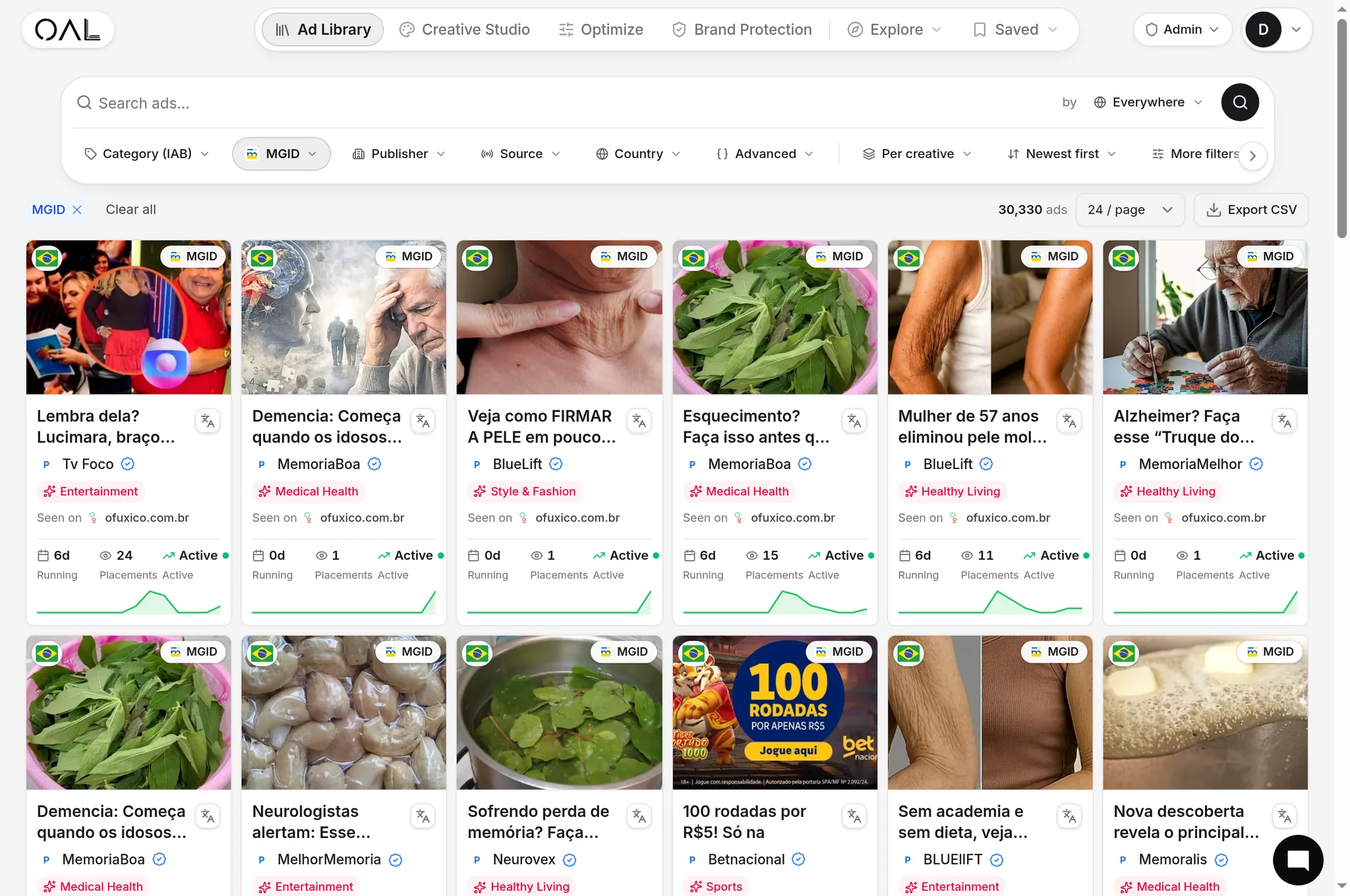
The best traffic sources for nutra offers in 2026 are native ad networks — Taboola, Outbrain, MGID, and Revcontent — followed by Meta for strictly compliant offers, push traffic for cheap trial volume, and search for the narrow keyword set that survives editorial review. Native wins because it stacks everything nutra needs: mainstream news audiences that skew 45 and older, tolerance for advertorial funnels, CPCs low enough to leave room for a pre-lander step, and enough volume to scale a winner. The spend patterns back this up: health is the single largest vertical in OpenAdLibrary's index of 725,000+ live native creatives across 49 networks, with 24,472 live health creatives captured as of July 2026 — a direct, observable measure of where nutra and health money actually goes.
Why nutra is a traffic-source decision first#
Nutra — supplements, skincare ingestibles, joint and pain products, weight management, nootropics — is unusual among affiliate verticals in that the audience is everywhere but the permission to advertise is not. Every major platform restricts health claims. So the question "where should I buy traffic for this offer?" is really "which source tolerates my funnel and claim level at a price the payout supports?"
Three things follow from that:
- The source determines the funnel. Native expects an advertorial or listicle pre-lander between ad and offer. Search expects a compliant brand-style page. Push expects a short, aggressive hop to the offer. You don't pick a funnel and then a source; you pick them together.
- The source determines the claim ceiling. A headline that sails through a mid-tier native network's review will never run on Meta, and one that runs on Meta may be too tame to earn a profitable CTR on push.
- The source determines the audience age. Most nutra buyers are 45+. Native's supply — news sites, portals like MSN, content-recommendation widgets under articles — is exactly where that demographic spends reading time.
This guide ranks the sources against those constraints. For the offer-side view — which nutra offers to run, angle construction, and compliance realities — see our companion piece on nutra offers, angles and compliance.
How the main traffic sources compare#
| Source | Scale for nutra | Audience fit | Funnel tolerance | Where it fits |
|---|---|---|---|---|
| Taboola / Outbrain (top-tier native) | Very high | Excellent (45+, news readers) | Advertorials standard; review is real | Primary channel for compliant and gray-hat-lite offers |
| MGID / Revcontent (mid-tier native) | Moderate | Good | Most tolerant of aggressive angles | Testing ground; international geos; harder offers |
| Meta / Instagram | Highest overall | Good but broad | Strictest health-claims policy; ban risk | White-hat brand-style offers only |
| TikTok | High | Skews younger — a mismatch for most nutra | Strict | Beauty-adjacent gummies, fitness; not joint/anti-aging |
| Push notifications | Moderate | Low intent, desensitized lists | Very tolerant | Cheap trial volume, low-payout offers, remarketing |
| Search (Google/Bing) | Low for nutra | High intent | Very strict on health terms | Brand terms, a thin slice of compliant keywords |
| Email / newsletters | Varies | Can be excellent | Depends on the list owner | Supplementary; good for proven offers |
The rest of this guide goes deep on the native tier — it is where the volume is and where the observable data lives — then covers the others briefly.
Native networks: the nutra workhorse#
Across the OpenAdLibrary index, the health vertical is not just large in aggregate; it is the top classified vertical on Taboola and Revcontent, and a top-three vertical on Outbrain. Here is how the four main networks break down for a nutra buyer.
Taboola: the biggest shelf, the most review#
Taboola is the largest native network in our index with 206,145 live creatives, and health is its single biggest classified vertical at 11,982 live creatives (July 2026). That tells you two things: the volume for nutra is there, and so is the competition.
Practical notes from what actually runs:
- Taboola's editorial review is genuine. Aggressive cure-claims get rejected or taken down; what persists is the professional advertorial — a named product, a plausible mechanism story, disclaimers on the lander.
- The audience is the classic native demographic: desktop and mobile news readers, heavily 45+. Joint pain, hearing, vision, energy, and anti-aging offers match it naturally. A live example from our capture: "Struggling to Hear Clearly? Discover a Device Transforming Lives" (Audika) had been running 37 days when last observed — on Taboola, longevity like that is the closest public signal that a campaign is paying.
- Media buyers commonly report Tier-1 desktop CPCs roughly in the $0.20–$0.90 range on Taboola, with mobile lower — treat that as a non-official heuristic; your niche, geo and bid strategy move it a lot.
Outbrain (now Teads): premium supply, stricter gate#
Outbrain — merged with Teads — holds 108,573 live creatives in our index, 3,102 of them classified health. Its publisher list skews premium (large news brands), and its review is the strictest of the native group.
Don't assume that means only soft content runs. Captured on Outbrain in the same window: "Will This 'Brain-Boosting' Supplement Be Banned?" (a nootropic advertorial, 3 days running at capture) and "Cardiologist: 2 Veggies Will Kill Your Belly Fat Overnight! (Try It)" from Health Weekly, which had survived 22 days. Aggressive-sounding curiosity angles do pass — what gets policed hardest is the landing page claim set, not the headline's energy.
MGID: the international testing ground#
MGID carries 62,765 live creatives in our index with a strong international footprint — it is often the first stop for testing nutra angles in Tier-2 and Tier-3 geos before committing Tier-1 budget. Review is lighter than Taboola's, and the supply includes a long tail of publishers where CPCs are low enough to test many angles cheaply. A representative capture: "Doctors Call It 'Nature's Morphine' — Pain Relief Without A Prescription" (Healthy66) had been live 16 days — an authority-plus-curiosity construction that would struggle on stricter networks. For mechanics — formats, targeting, pricing model — see how MGID works.
Revcontent: the most nutra-dense network in the index#
Revcontent is smaller — 15,789 live creatives — but it is the only network in our index where nutra appears as a named top-six vertical in its own right (440 creatives classified NUTRA), alongside health as its largest classified vertical (2,566 creatives). Proportionally, that makes Revcontent the most health/nutra-concentrated network we track. Live captures like "Endocrinologist: If You Have Diabetes, Read This Before It's Removed!" (Health Weekly) show the claim style the network's review currently lets through. Volume ceilings are real, though: Revcontent is a place to prove angles and print modest profits, not to scale a Tier-1 winner tenfold. Full network guide: how Revcontent works; for choosing between the two mid-tiers, see MGID vs Revcontent.
One cross-network pattern worth internalizing: the same advertisers appear across networks. Health Weekly creatives show up in both our Outbrain and Revcontent captures. Winning nutra angles get ported network to network — which means proof of an angle anywhere is evidence it can work everywhere the audience matches.
The rest of the field#
Meta. Still the largest ad platform on earth, and still viable for genuinely white-hat nutra — established brands, compliant creative, no disease claims, no personal-attribute callouts. The economics can beat native for offers with broad appeal. The risk is structural: account and domain bans hit entire operations, not single campaigns. Most experienced nutra buyers treat Meta as a scaling channel for angles proven elsewhere, run from well-aged assets, rather than a testing ground.
TikTok. The demographic mismatch is the problem: most nutra buyers are 45+, most TikTok engagement is not. Gummies, beauty-ingestibles and fitness offers targeted younger can work; joint pain and hearing aids will not.
Push and pop. Push notification traffic is cheap, tolerant, and low-intent. It suits low-payout trial offers and remarketing sequences where you need volume at minimal CPC, and it fails for offers that need an educated buyer. List fatigue is severe — creatives burn out in days. Use it as incremental volume once a funnel converts, not as the primary source.
Search. High intent, tiny surface. Most nutra terms trigger health-claim restrictions, and the compliant remainder is expensive. Worth running for brand-name searches of your own product (protecting your funnel from competitors) and little else.
Email and newsletters. Sponsorships in health newsletters can convert extremely well for proven offers. Placement is relationship-driven and inventory is finite, so treat it as a channel you add after native has told you which angle wins — the newsletter buy then rides validated creative instead of gambling fresh copy on a one-shot send.
Matching the source to your offer#
Decision criteria that actually separate the options:
- Payout size. Higher-payout offers (straight-sale supplements with upsell paths) can afford Taboola/Outbrain CPCs and the advertorial funnel. Low-payout trials need push or mid-tier native CPCs to make the math work.
- Claim aggressiveness. Be honest about your angle's claim level, then pick the network whose review it survives durably — an approved campaign that dies at the first re-review wastes the test budget. Mid-tier native tolerates more; Meta tolerates least.
- Geo strategy. For Tier-2/Tier-3 arbitrage, MGID's international supply is the standard entry. If you plan to expand geo-by-geo, structure campaigns per-geo from day one — our guide to scaling into new geos covers the sequencing.
- Funnel type. Quiz funnels and advertorials belong on native. Straight-to-offer belongs on push. Brand-style DTC pages belong on Meta and search.
Validate the source before you fund it#
The cheapest test is the one you don't run. Before committing budget to a network, look at what is already running there — sustained spend by others is the strongest available evidence that the network converts for your offer type:
- Search your niche across networks. In OpenAdLibrary you can search the live index by keyword and filter by network and vertical — see in one query whether joint-pain offers are running on Revcontent or whether your subniche only shows up on MGID.
- Sort by longevity. An ad that has run 30+ days is almost certainly profitable — the logic is laid out in why ad longevity is the winning signal. Count how many long-runners your niche has per network; that is a proxy for how many buyers are sustaining spend there.
- Read the angles. The headlines that persist tell you the claim ceiling the network actually enforces, which beats reading its policy page. Our framework for finding winning native ad angles turns this into a repeatable step.
- Trace the funnels. Follow captured ads through to their landing pages to see the pre-lander format and offer type the network's reviewers are approving right now.
Thirty minutes of this reliably kills bad network choices before they cost a test budget.
Common mistakes when picking a nutra traffic source#
Five patterns that burn test budgets, seen over and over:
- Testing the offer and the source at once. If the offer is unproven and the network is new to you, a failed test tells you nothing. Validate the offer on the source where it demonstrably already runs (the index shows you which), then expand.
- Reading a network's policy page instead of its feed. Policies describe the ceiling in theory; the ads that persist for weeks describe it in practice. The gap between the two is where profitable angles live — and where naive buyers get rejected for angles that were never going to pass.
- Porting Meta creative to native unchanged. Social creative is polished and brand-forward; native creative that wins is editorial and problem-forward. The same offer needs a different ad and a different funnel, not a resize.
- Ignoring device split. Nutra buyers convert differently on desktop and mobile, and native networks price the two differently. Launching device-blended and reading a blended CPA hides where the offer actually works.
- Scaling on the source that tested cheapest instead of the one that scales. Revcontent may prove the angle for the least money, but its volume ceiling means the growth curve lives on Taboola or MSN. Cheap validation and scalable volume are usually two different networks — plan the handoff from the start.
Budget reality and the scaling path#
Two framing rules practitioners converge on:
- Test budgets are a multiple of payout, not a round number. Expect to spend several multiples of one conversion's payout per angle-network combination before the data says anything. If that number frightens the bankroll, drop to a cheaper network tier (or a cheaper geo) rather than starving the test.
- Scale horizontally before vertically. Once an angle converts on one network, the highest-probability next dollar is the same angle on an adjacent network or geo — the cross-network advertiser pattern in our index shows this is exactly what successful nutra operations do. Raising budget on the winning campaign (vertical scaling) comes after. The mechanics are covered in how to scale affiliate campaigns without killing ROI.
A realistic 2026 sequence for a mid-payout nutra offer: prove the angle on MGID or Revcontent in a cheap geo → port to Taboola Tier-1 with a cleaned-up advertorial → add Outbrain for premium supply → only then consider Meta with a fully compliant rebuild. Each step reuses validated creative intelligence, so each step is cheaper than the last one was blind.