

 Español
 Português (Brasil)
 Français
 Deutsch
 Italiano
 Nederlands
 Polski
 Svenska
 Türkçe
 Русский
 日本語
日本語 한국어
한국어 简体中文
简体中文 Tiếng Việt
 Bahasa Indonesia
 繁體中文
繁體中文 Čeština
 Dansk
Dansk Norsk (bokmål)
 Suomi
Suomi Ελληνικά
 Română
 Magyar
 Українська
 ไทย
ไทย हिन्दी
 العربية
 עברית
עברית
Competitor Ad Research
How to Find Ads by Keyword Across Native Networks
Native ads don't live in one searchable place the way Meta or Google ads do. Here's how keyword search actually works across networks, and what it can and can't tell you.
How-to and workflow content for spying on, analyzing, and monitoring competitor advertising, building watchlists, reverse-engineering funnels, estimating spend, and tracking share of voice using live native-ad evidence.
Native ads don't live in one searchable place the way Meta or Google ads do. Here's how keyword search actually works across networks, and what it can and can't tell you.

Every ad spend estimate you've seen from a competitive intelligence tool is a model's guess, not an observed fact. Here's how that guess is built, and what to trust instead.

Not seeing an ad this week doesn't mean a competitor stopped running it. Here's how to check last-seen dates and creative volume properly, and what a confirmed stop usually signals.

Reading ten competitor ads one at a time gives you ten opinions. Pulling hundreds and tagging by hook type gives you an actual market signal. Here's the method.

Most swipe files die within a month because they're just screenshots with no context. Here's how to build one organized by pattern, with metadata attached, that you'll actually reopen.

Knowing your competitor runs an ad tells you nothing about why it works. Creative intelligence breaks the ad apart to find the mechanic actually driving performance.

Finding out about a new competitor by accident means you're already weeks behind. A fixed weekly check on your category's ad inventory closes that gap.

There's no master archive of native ads going back years. Historical ad data is only as deep as a tool's own continuous capture, and knowing that changes how you should research.

Search volume tells you people are curious. Ad intelligence tells you whether anyone has found a profitable way to advertise into that curiosity. Here's how to check before you spend.

Copying a competitor's ad word for word teaches you nothing and can get you flagged. Here's how to extract the angle that's working and rebuild it in your own voice.

A competitor's landing page usually changes more often than the ad pointing to it. Here's a practical way to capture, diff, and get alerted to those changes without manually revisiting URLs.

You can't see a competitor's real conversion data, but longevity, angle reuse, and placement spread reliably indicate which of their ads are actually winning. Here's how to read the signals.
ads.txt and sellers.json are two free, publicly hosted files that let you verify who's actually authorized to sell a publisher's inventory. Here's a practical workflow for using them in ad research.

A single visit to a competitor's ad or landing page won't identify you. Here's what actually shows up in their analytics, what does tip advertisers off, and how professional research tools avoid it.

Nobody publishes real competitor ad spend, on any channel. Here's what Google Ads, Meta's Ads Library, and native networks actually show you instead, and how to build a defensible estimate from the proxies that remain.

The Meta Ad Library is free and requires no login, but it hides spend and targeting for ordinary commercial ads. Here's how to search it properly and where its real limits are.

Google's Ads Transparency Center is the free, official way to see a competitor's Google ads. Here's how to search it properly, and the entire ad category it doesn't cover at all.

What the State of Native Advertising report covers, its five headline findings — from MSN's surprising scale to the health–finance–insurance demand triopoly — and how to cite the data.

Eighteen real questions marketers ask about native advertising — what it is, what it costs, whether Taboola works, the labeling rules, and how to research competitors — answered without fluff.

Ten standout native ads from this month's live index — picked by longevity, not taste — with the headline patterns behind each one and how to run the same analysis yourself.

Agencies need different things from an ad spy tool than solo buyers: multi-vertical coverage, client-ready evidence, shared boards and sane seat pricing. Here are the five workflows where the tool earns its fee, and the checklist to buy against.

Adbeat still owns the deepest display supply-path data in the category — but it's enterprise-priced, native feeds sit outside its center of gravity, and the research output that built its reputation has gone dormant. Who it's still for.

BigSpy wins on price and loses on noise. Where the budget multi-platform ad spy genuinely earns its cost, where the database-size marketing misleads, and a 20-minute protocol to test it in your own niche.

Minea answers one question well: which product should I sell next? If your question is which advertiser is scaling, on what placements, into what funnel — you need a different tool. The alternatives, grouped by job.

Nearly every PowerAdSpy review online carries an affiliate link. This one doesn't. What the social-first ad spy tool genuinely does well, where it falls short for performance buyers, and how to pressure-test it in thirty minutes.

Ideas, angles, and offers are free to borrow; expression is not. Where the legal lines sit when you copy a competitor's ad — and the workflow that beats copying anyway.

Regulators hold brands responsible for what their affiliates run. Here is the monitoring program that catches non-compliant affiliate ads before customers, networks, or the FTC do.

Run time is the closest thing public ad data has to a profitability signal. Where each major ad library hides its dates, and the five caveats that keep the number honest.

Every paid channel leaves fingerprints. Work through four evidence layers — landing URLs, official libraries, redirect chains, observed placements — and a competitor's channel mix falls out in under an hour.

A spy tool competes against your testing budget, not your software budget. Here is the break-even math, the cases where it clearly pays, and the cases where you should keep your money.

Official ad libraries won't tell you when a competitor launches something new — you have to keep checking. Alerts flip that: continuous observation, diffed daily, delivered to you.

Taboola has no official ad library, but any brand's Taboola ads are still findable. The exact lookup workflow, the five signals in a brand's footprint, and what to do when a search comes up empty.

What a live index of 725,000+ native creatives shows about the channel right now: network volume, vertical concentration, platform consolidation, and a repeatable routine for tracking trends yourself.

A corpus-backed way to score native ad headlines: the structural patterns behind long-running ads, a two-minute rubric, and how to check any draft against 725,000+ live creatives.

Six calculations cover almost every native ads budgeting question: break-even CPC, click volume, campaign budget, test spend, break-even ROAS and CPA forecasting — with worked examples you can copy.

SpyOver is one of the longer-standing native ad spy tools. A competing ad library reviews what it does well, where it falls short, and the 20-minute trial test to run before you pay.

Watching the ads your competitors run in public is legal, and regulators are forcing platforms to make those ads even easier to see; the legal line is copying the creative, not researching it.
A practitioner's four-stage framework for turning a competitor's live native ads into a ranked list of winning angles, a relative-spend estimate, and a creative backlog you can test next week.

A watchlist is only useful if it tiers competitors by threat and feeds continuous monitoring, so here is how to build one and wire every advertiser into native-ad tracking and alerts.

The buyers who consistently find winners do not spy when they are stuck, they run a 45-minute weekly routine that turns scattered ad-checking into pattern recognition you can act on.

Most teams check competitor ads once a quarter and call it research; a real intelligence workflow runs every week with a scoped watchlist, a fixed cadence, a creative scoring rubric, and a clean handoff into media buying.

A native ad is just the doorway; here is how to walk the full chain behind it, from creative to SSP to click tracker to pre-lander to offer page, and read what each link reveals about a competitor's strategy.

A practitioner's walkthrough for finding the ads a competitor is actively running: search by brand or domain to surface live native creatives, the networks behind them, and the landing page each ad points to, plus exactly where Meta and TikTok go dark.
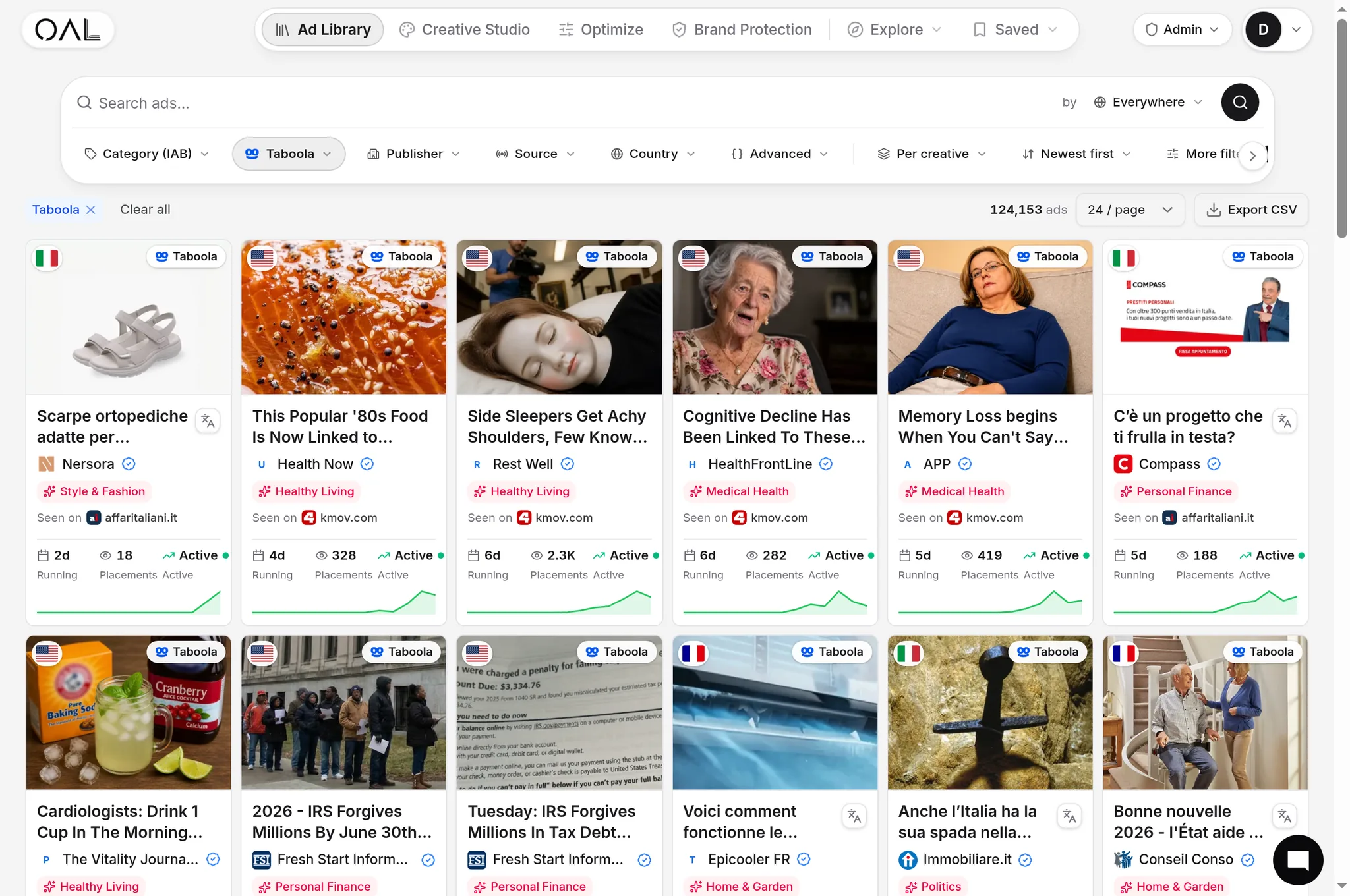
Native ads hide in plain sight at the bottom of every article, and here is how to find who is really buying them, read the creative and supply chain behind each placement, and trace the click to the landing page without ever firing a live ad.
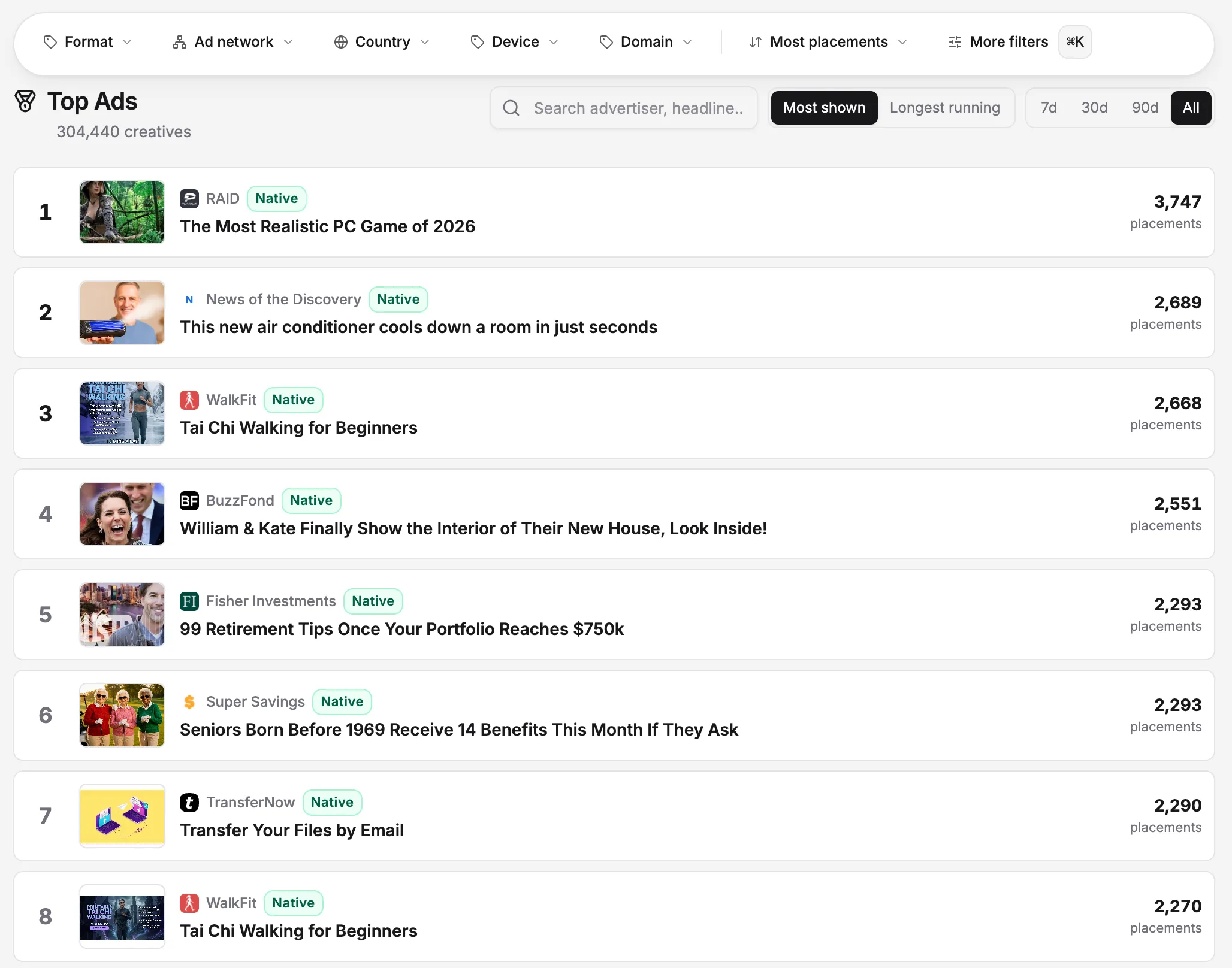
A practitioner's guide to spying on competitor ads across native, display and social: what to capture, how to tell real winners from noise, where the legal lines sit, and a weekly workflow that turns scattered screenshots into decisions.