Español
 Português (Brasil)
 Français
 Deutsch
 Italiano
 Nederlands
 Polski
 Svenska
 Türkçe
 Русский
 Bahasa Indonesia
 Čeština
 Dansk
Dansk Norsk (bokmål)
 Suomi
Suomi Ελληνικά
 Română
 Magyar
 Українська
 ไทย
ไทย हिन्दी
 العربية
 עברית
עבריתNative Ad Networks List (2026): Every Major Network, With Live Ad Counts
A native ad networks list with receipts: the seven major networks of 2026 — Taboola, Outbrain (Teads), MGID, RevContent, the Microsoft Audience Network, MediaGo and Yahoo — each with live creative counts from OpenAdLibrary's million-creative capture corpus, who each network suits, and the churn data that governs them all.


If you just want the answer: the major native ad networks in 2026 are Taboola, Outbrain (Teads), MGID, RevContent, the Microsoft Audience Network (MSN), Baidu's MediaGo and Yahoo — seven platforms that between them serve the overwhelming majority of sponsored-content recommendation inventory on the open web. Updated July 2026.
Most "native ad networks list" articles are recycled press releases: a logo wall, a paragraph of marketing copy per network, and no way to tell which platforms actually carry volume. This list is different. OpenAdLibrary continuously captures live ads from 50 native networks via direct API collection — 1,041,637 creatives tracked and 615,327 of them live in the last 30 days as of July 2026 — so every network below comes with a real, current ad count instead of a vendor claim. You can click through and inspect the individual ads behind every number.
A note on how to read the counts: "creatives tracked" is everything we have captured on a network since our current tracking window opened on June 2, 2026; "live in the last 30 days" is the subset observed in a real feed within the trailing month. The gap between the two tells you how fast a network churns its inventory — and as you'll see at the end of this guide, native churns fast.
What counts as a native ad network?#
For this list, a native ad network is a platform that sells in-feed sponsored content placements — the "recommended for you" style ads that match the look of the editorial around them — across a marketplace of third-party publishers. That definition excludes three neighboring categories that often muddy other lists: walled-garden social feeds (Meta, TikTok and X sell native-format ads, but only on their own properties), pure programmatic exchanges that merely pass native bid requests through, and content-marketing platforms that place articles rather than ads. What's left is the open-web discovery ecosystem: two premium giants, a tier of challengers, one enormous feed run by Microsoft, and a long tail of regional players. The seven below are the ones with enough live volume to matter, ordered roughly by the size of their currently active creative pool.
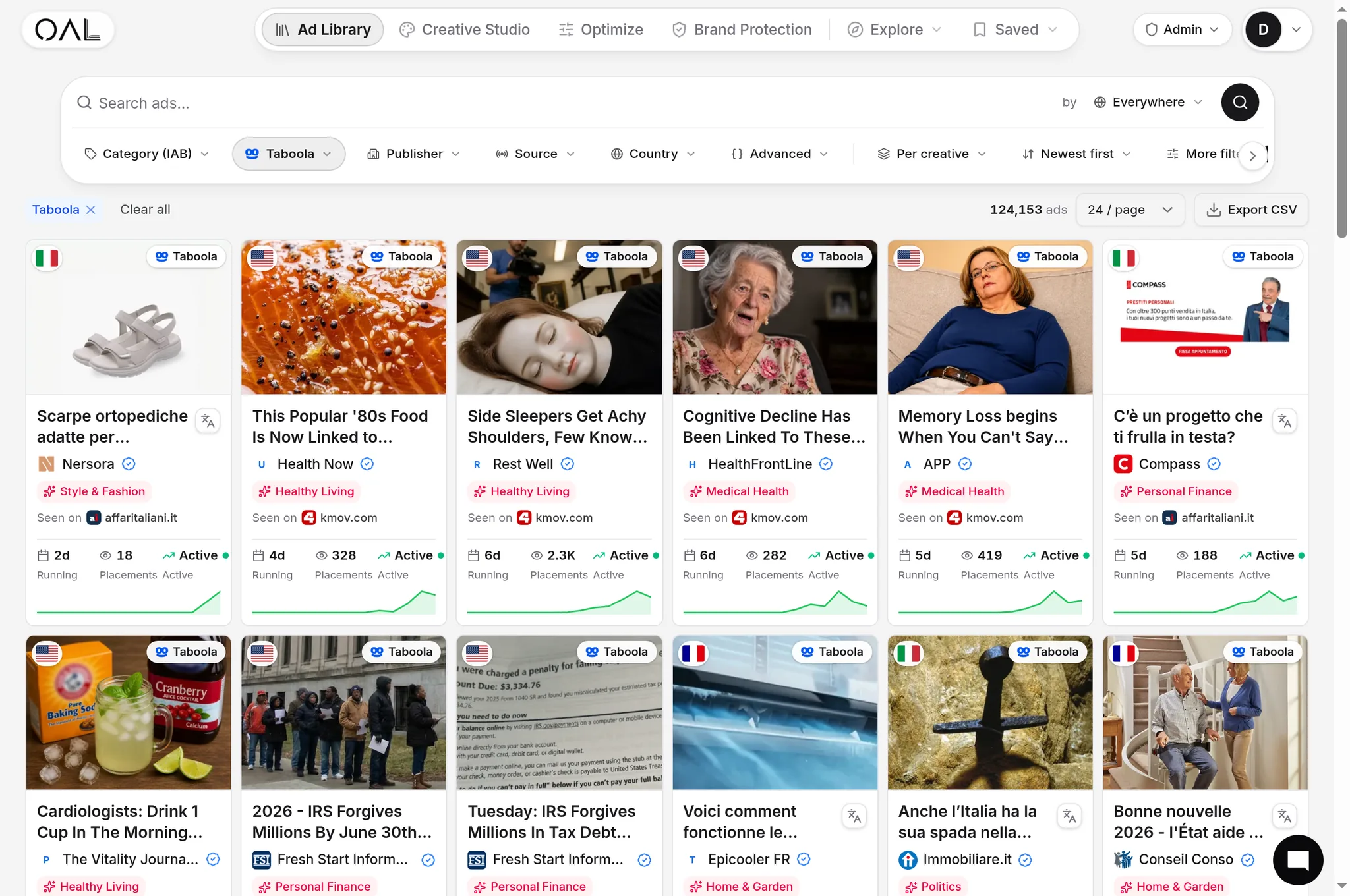
Taboola#
Taboola is the network most people picture when they hear "native advertising": the sponsored recommendation feeds that run below and beside articles on thousands of publisher sites, including exclusive placements across Yahoo's properties following the two companies' 30-year partnership deal. Founded in 2007, it is one of the two original giants of the category, with self-serve access, deep audience data from years of feed optimization, and the strictest content policies of the discovery networks alongside Outbrain.
OpenAdLibrary currently tracks 352,392 creatives on Taboola, 254,020 of them live in the last 30 days, as of July 2026. That makes Taboola the single largest native network in our index by both measures — and its 72% live share means the feed is dominated by recently active ads, not archive residue. The longest-running Taboola creative currently live has been running for at least 55 days, the full length of our observation window.
Who it suits: advertisers with compliant offers and real budgets — insurance, finance, health, home services, subscription ecommerce — who want premium publisher placements at scale. Taboola's review process filters out the aggressive clickbait that thrives on smaller networks, so competition is professional and the winning creatives repay study. Browse the live corpus yourself at our Taboola spy page.
Practical buying notes: Taboola is self-serve with campaign-level geo, platform and audience targeting, per-site bid adjustments, and an editorial review that typically clears compliant creatives quickly but genuinely rejects misleading ones. Creative format is the classic native unit — an image plus a headline of roughly 60 characters — which means the headline carries most of the persuasion load; studying which headline patterns survive on the feed is worth more than any best-practices deck.
Outbrain (Teads)#
Outbrain is the other founding giant of content recommendation, and since completing its merger with Teads in 2025 it operates under the Teads name as a combined "omnichannel outcomes" platform — pairing Outbrain's classic below-article recommendation feeds with Teads' in-article video and display inventory on premium publishers. For a media buyer the practical reality is unchanged: it is the second pillar of premium native, with publisher relationships that skew slightly more editorial and international than Taboola's.
OpenAdLibrary currently tracks 150,462 creatives on Outbrain, 91,668 of them live in the last 30 days, as of July 2026. Outbrain also shares the crown for the longest-running current creative in our index: at least 56 days and counting.
Who it suits: the same regulated, budget-backed verticals as Taboola — the two are usually tested in parallel — plus brand advertisers who want the Teads video layer. If your angle works on one, porting it to the other is the cheapest expansion test in native. Outbrain's platform is likewise self-serve, with conversion-based bid strategies and section-level placement controls; its post-merger pitch adds CTV and video extensions on top of the recommendation core. See what's running now at our Outbrain spy page.
MGID#
MGID, founded in 2008, is the largest of the "challenger" native networks: a global recommendation platform with particular strength in Europe, Asia and Latin America, lower minimum budgets than the premium duo, and a noticeably more permissive content posture. Its feed is where direct-response marketers, content-arbitrage operators and international affiliates test aggressive angles that the premium networks would reject — which makes it simultaneously rougher inventory and a richer laboratory for hooks.
OpenAdLibrary currently tracks 96,139 creatives on MGID, 59,604 of them live in the last 30 days, as of July 2026. The longest-running current MGID creative has been live for at least 55 days.
Who it suits: performance advertisers and affiliates who want cheap clicks, international reach and fast creative iteration without a heavyweight approval process. It is also the single best network to study raw direct-response copywriting, because the survival pressure on angles is merciless. Browse the live feed at our MGID spy page.
Two practical cautions: publisher quality varies widely, so placement blacklisting is not optional housekeeping but the core optimization activity; and because the network is popular with arbitrage operators, the competitive set on any given placement can be sophisticated in ways that aren't obvious from the creatives' rough aesthetics.
RevContent#
RevContent is a US-focused native network that positions itself between the premium duo and the permissive long tail: a curated publisher base, a lighter-weight self-serve platform, and a feed dominated by classic direct-response verticals — home services, comparison shopping, health offers and lead generation. It is smaller than the networks above, but that is part of its appeal: less competition per placement and a publisher list that still includes recognizable mid-tier US media.
OpenAdLibrary currently tracks 23,040 creatives on RevContent, 15,891 of them live in the last 30 days, as of July 2026. Its longest-running current creative has been live for at least 55 days — proof that even mid-size networks carry a stubborn evergreen core.
Who it suits: US direct-response advertisers who find Taboola CPCs uncomfortable and MGID quality too loose. RevContent is a common second network for lead-gen buyers scaling out of the majors. Inspect the current inventory at our RevContent spy page.
Microsoft Audience Network (MSN)#
The Microsoft Audience Network is the most under-researched large ad feed in the industry. Bought through the Microsoft Advertising platform (often as an extension of Bing search campaigns), it places native ads across MSN.com, the Edge browser's new-tab page, Outlook.com and Microsoft's syndication partners — an enormous default-audience surface that most competitive-research tools ignore entirely, because Microsoft publishes no official ad library for it.
OpenAdLibrary currently tracks 332,883 creatives on the Microsoft Audience Network, 132,784 of them live in the last 30 days, as of July 2026. That library is within touching distance of Taboola's, yet its 40% live share is the lowest of the majors — the MSN feed swaps creatives in and out faster than any other big network. Its longest-running current creative has been live for at least 56 days, tied for the longest in our index. We tracked this feed in depth in our MSN native ads guide.
Who it suits: advertisers already running Microsoft/Bing search who can extend campaigns into the audience network with a checkbox, and anyone targeting the older, higher-income demographic that lives on MSN and Edge defaults. For researchers, it is the closest thing native has to an untapped edge: a Taboola-sized feed with almost no coverage.
Buying is done through Microsoft Advertising — audience campaigns can run standalone or as an extension of search — with image-plus-headline creatives, LinkedIn-profile targeting as a differentiator, and Microsoft's first-party intent data doing the matching. The trade-off for the cheap, underexplored reach is feed volatility: with only two in five tracked creatives live in the last 30 days, whatever you learn from a snapshot of this feed goes stale quickly, so continuous monitoring matters more here than anywhere else.
Baidu MediaGo#
MediaGo is Baidu's international demand-side platform for native advertising — the route by which advertisers (historically many of them cross-border Chinese ecommerce brands) buy native placements on premium Western supply, including MSN and other large portals. It is powered by Baidu's machine-learning stack and pitched primarily at performance ecommerce.
OpenAdLibrary currently tracks 7,002 creatives on MediaGo, 797 of them live in the last 30 days, as of July 2026. It is the smallest slice of our majors list, and its 11% live share is the lowest in the table — a small, fast-rotating demand pool rather than a broad marketplace. Its longest-running current creative has still clocked at least 55 days. See the current pool at our MediaGo spy page.
Who it suits: ecommerce and app advertisers — especially cross-border sellers — who want algorithmic access to MSN-class supply without buying through Microsoft directly.
Yahoo#
Yahoo's native inventory covers sponsored placements observed across Yahoo's owned-and-operated properties — the homepage, Yahoo Mail, Yahoo Finance and the rest of one of the web's largest remaining portal audiences. Following Yahoo's advertising restructuring and its long-term Taboola partnership, the demand paths into this inventory have shifted over the years, but the audience itself remains enormous, loyal and older-skewing.
OpenAdLibrary currently tracks 14,389 creatives on Yahoo, 12,473 of them live in the last 30 days, as of July 2026. That 87% live share is the highest of any network in our index: Yahoo's is the most stable creative pool we track, with a longest-running current creative at 55+ days.
Who it suits: finance, insurance and subscription advertisers chasing the portal demographic — Yahoo Finance adjacency is genuinely valuable for money verticals. Browse what's live at our Yahoo spy page.
The big seven, side by side#
| Network | Creatives tracked | Live (last 30 days) | Longest-running current ad |
|---|---|---|---|
| Taboola | 352,392 | 254,020 | 55+ days |
| Microsoft Audience Network | 332,883 | 132,784 | 56+ days |
| Outbrain (Teads) | 150,462 | 91,668 | 56+ days |
| MGID | 96,139 | 59,604 | 55+ days |
| RevContent | 23,040 | 15,891 | 55+ days |
| Yahoo | 14,389 | 12,473 | 55+ days |
| MediaGo | 7,002 | 797 | 55+ days |
All figures are OpenAdLibrary capture data, July 2026. Longest-running figures are "at least N days": our current tracking window opened on June 2, 2026, so a creative shown at 56 days has been running for a minimum of 56 days — many of these ads predate the window.
Beyond these seven, OpenAdLibrary monitors 50 native networks in total; the remaining long tail — regional recommendation widgets, exchange-traded native supply and smaller platforms — accounts for the balance of the 1,041,637-creative index. For a ranked buying guide rather than a census, see our companion piece on the best native ad networks.
How to choose between them#
If the table hasn't already decided for you, three questions usually do:
- Will your offer pass premium review? Regulated but legitimate verticals (insurance, finance, health) belong on Taboola and Outbrain, where the audience quality justifies the compliance work. Offers that lean aggressive will burn review cycles there and should start on MGID or RevContent instead.
- Where is your audience geographically? Taboola, Outbrain and the Microsoft Audience Network are strongest in North America and Western Europe; MGID's edge is Europe, Asia and Latin America; RevContent and Yahoo skew US; MediaGo is the cross-border ecommerce route.
- How fast can you make creatives? The churn data at the end of this page is the real constraint. A network is only as useful as your ability to feed it: if you can produce and test a handful of new creatives a week, the premium networks' slower, higher-stakes cadence fits; if you can produce dozens, the challenger networks let you iterate at full speed.
Most scaled native advertisers end up on two or three of these networks, not one — typically a premium anchor (Taboola or Outbrain), a challenger for cheap testing (MGID or RevContent), and the Microsoft feed once search campaigns are already running.
How to research these networks before spending#
The single biggest mistake new native buyers make is launching from imagination. Every network above has thousands of live ads you can study first — the angles, the imagery, the landing pages, and crucially which creatives have survived long enough to be provably profitable.
Three ways in:
- Start with a spy tool. Our native ad spy tool searches the full cross-network corpus — filter by network, keyword, language or longevity and work backwards from ads that have earned their run. For the category landscape, see our comparison of the best native ad spy tools.
- Understand the mechanics of the network you're entering. Our guide to how Taboola ads work covers the auction, targeting and creative-format rules that shape what wins on premium discovery feeds — most of it transfers to Outbrain and the challengers.
- Calibrate against the data. Our native advertising statistics page holds the full July 2026 snapshot — network volumes, vertical mix and the complete churn curve — every number citable and reproducible in the product.
The catch: whatever network you pick, the ads die fast#
One last dataset to keep you honest. Across the whole index, 59% of native ad creatives are never seen again after their first day in the feed. Only 25.2% survive at least 7 days, just 10.7% survive at least 30 days, and the average matured creative lasts 7.1 days (OpenAdLibrary, July 2026).
Read that as the operating manual for the entire channel: every network on this list is a high-churn testing machine wrapped around a small evergreen core. The buyers who win treat the churn as information — they study the tiny minority of ads that survive a month, because on a feed where nine in ten creatives die young, longevity is the closest thing native advertising has to a public profit signal. Pick your network from the table above, then go study its survivors.