

 Español
 Português (Brasil)
 Français
 Deutsch
 Italiano
 Nederlands
 Polski
 Svenska
 Türkçe
 Русский
 日本語
日本語 한국어
한국어 简体中文
简体中文 Tiếng Việt
 Bahasa Indonesia
 繁體中文
繁體中文 Čeština
 Dansk
Dansk Norsk (bokmål)
 Suomi
Suomi Ελληνικά
 Română
 Magyar
 Українська
 ไทย
ไทย हिन्दी
 العربية
 עברית
עברית
Affiliate & Media Buying
Bid Adjustments by Device & Geo: Modifiers That Move ROAS
A flat bid across every device and geo is subsidizing your worst segments with your best. Here's how to build device and geo modifiers that actually move ROAS.
Performance-marketing playbooks for affiliates and media buyers: finding winning products and offers, validating offers, scaling campaigns, vertical research, and media-buying fundamentals on native traffic.
A flat bid across every device and geo is subsidizing your worst segments with your best. Here's how to build device and geo modifiers that actually move ROAS.

Native costs have generally risen, but the pressure concentrates heavily in a few verticals and Tier-1 geos. Here's what's actually driving the trend and how to check if it applies to you.

70/20/10 gets repeated as gospel, but the right testing vs scaling split depends on your winner inventory and fatigue rate, not a fixed percentage. Here's the framework instead.

There's no single native ad CPM. Here's the rough ordering across major networks, the four factors that actually move your rate, and how to sanity-check it against live data.

Performance across publishers in the same native campaign can vary 5x or more. Publisher-level bidding is the underused lever that turns that variance into profit instead of waste.

Q4 pushes native ad CPCs up across most verticals as holiday and year-end budgets compete for the same inventory. Ecommerce and finance advertisers feel it hardest.

The CPC on your network dashboard is only one line item. Landing pages, creative refresh cycles, tracking tools and research time all add up to the real cost of running native ads.

Ten dollars a day on native ads buys a small trickle of clicks, enough to check your tracking and rough CPC, but not enough to declare an offer dead or profitable on day one.

News sites sell ad inventory through at least two channels with completely different price floors: negotiated direct or programmatic display, and self-serve native feed placements.

Automated CPA bidding can work on native networks, but native auctions are thinner than search or social, so the volume threshold for it to work is higher than most media buyers expect.

Most bid mistakes come from moving too often on too little data. Here's the cadence, thresholds and signals that separate a real trend from normal auction noise.

Native ad pricing isn't your bid amount, it's a live auction shaped by predicted CTR, floor prices and competing demand. Here's the mechanics behind why your CPC moves.

The learning phase is when a native campaign's delivery is least predictable, and also when media buyers do the most damage by touching it too much. Here's how to survive it.

CPC and CPM solve different problems. Here's how to pick the right one for a native campaign, plus how eCPC and smart bidding blend the two.

Rented agency ad accounts solve a real access problem, but they shift ownership, appeal rights and payment risk onto you while the agency keeps control. Here's what actually goes wrong.

Crypto advertising is allowed on every major native network, but all of them gate it behind pre-approval and stricter creative rules. Here's what to expect and how to stay compliant.

Insurance and finance dominate native ad inventory because the format is built for lead gen. Here's the volume data by network, how the funnel works, and where compliance gets strict.

CPA marketing isn't a rival to affiliate marketing, it's a payout structure inside it. Here's how CPA, CPL and revshare actually differ, and which one fits native ad traffic best.

Media buying is one of the few marketing careers you can start without a job offer. Here are the two real paths in, the skills that matter, and how to build proof of skill on a small budget.

Should a new media buyer start in Tier 1 or Tier 3? Here's the budget-based framework experienced buyers actually use, plus how to scale between tiers once an angle proves out.

The channel isn't saturated, but plenty of specific vertical-geo-angle combinations are. Here's how to tell which situation you're actually in before you spend a testing budget finding out.

Native ad affiliate income spans a huge range, from steady losses during testing to real full-time revenue for a small top tier. Here's what actually separates those outcomes.

Buying cheap native traffic and monetizing it with AdSense display ads still works for a narrower set of buyers than it used to. Here's what changed, what still holds up, and the alternative most media buyers moved to.

You don't need to own or build a website to run native ads for affiliate offers, but every click still needs somewhere compliant to land. Here's what actually satisfies that requirement.

Whitelisting locks your native campaign to publisher placements you've already proven convert, instead of letting the algorithm spread budget across untested inventory. Here's when that trade-off pays off.

There's no fixed number of campaigns that guarantees profitability, but there is a realistic range and a way to test that actually produces usable signal. Here's the framework.

Sweepstakes offers are legal almost everywhere, provided they're structured correctly. Here's the legal test behind that rule and where affiliate campaigns actually go wrong.

Most ad network bans trace back to one of six avoidable triggers. Here's what actually gets affiliate accounts suspended, and the pre-launch checks that prevent it.

Not every affiliate network fits native traffic. Here's what actually separates a network worth joining for Taboola, Outbrain or MGID campaigns from one that will waste your time.

Paid traffic pays off in affiliate marketing only when the payout, conversion rate and testing budget line up on paper first. Here's the framework for checking your own numbers before you spend.

Ad blockers catch a real share of native ad traffic, but not all of it. Here's why widget domains get filtered while publisher-rendered native content often doesn't.

Native ad targeting isn't one mechanism, it's five or six overlapping layers: contextual, interest, retargeting, geo, device and schedule. Here's how each one actually works.

A native ad and an advertorial aren't competing formats, they're two links in the same chain: one earns the click, the other converts it. Here's how media buyers actually use both.

CTR alone will mislead you. Here's the full metric stack for measuring native advertising, plus the one signal, ad longevity, that doesn't exist in search or social reporting.

Merger headlines and a shuttered Yahoo brand read like decline, but the live advertiser and creative data across 49 native networks tells a very different, and much healthier, story.

The ad you see in a "you may also like" widget wasn't chosen by the highest bidder alone. It won a real-time auction that weighs bid against how likely you specifically are to click it.

Native CPCs run lower than Facebook or Google because you're bidding on attention instead of intent, across far more inventory. That's also exactly why a cheap click can still be a wasted one.

Native ads are more forgiving to start with than Facebook or Google, but the format's simplicity hides real work in angle testing, compliance, and patience.

Native buys you cheap, context-driven reach at the cost of targeting precision and creative consistency. Here's a practical checklist for when that trade is worth making, and when it isn't.

Native is strong for broad, cost-efficient reach across publisher content and weak for building a consistent visual brand identity. Knowing which awareness job you actually need decides whether it fits.

CTR benchmarks vary too much by context to answer this honestly. Observed run length is the better proof: advertisers don't keep funding creative that isn't converting, and plenty of native ads run for weeks.

The thumbnail-plus-headline tile under every news article isn't disguised by accident, it's built from the same content-recommendation components the publisher uses for its own stories. Here's the mechanic and where disclosure is supposed to sit.

Native advertising isn't inherently deceptive, but the format's biggest strength, blending into content, is also what makes bad actors gravitate toward it. Here's the real ethical line and how regulators actually draw it.

Native advertising gets you lower CPCs, format resilience and platform diversification, but weaker targeting, slower testing and a real brand-perception issue come with it. Here's the honest tradeoff.

Native ads borrow the visual grammar of content to avoid banner blindness, then rely on curiosity-gap headlines to do the actual persuading. Here's the full mechanism, and where it breaks down.

Analyzing one competitor ad with AI tells you almost nothing. Here's the batch-based prompt sequence that actually surfaces which hooks and claims a competitor is leaning on.

There's no single best AI ad creative tool, because the job splits into image, video, copy, and research. Here's how media buyers should actually split the stack.

AI-generated ads are genuinely useful for production speed and genuinely bad at inventing a hook from nothing. Here's where they actually help, where they fail, and how to test them fairly.

Yahoo DSP, StackAdapt, Zemanta, The Trade Desk, DV360 — the DSPs that genuinely buy native inventory, and a straight decision framework for when a self-serve network is the smarter buy.

The per-impression auction behind programmatic, end to end: SSPs, DSPs, exchanges, first-price clearing, header bidding, OpenRTB — and why native networks play by different rules.

What native ad agencies actually do, the four types you'll meet, how pricing models tilt incentives — and the one-hour ad-library audit that verifies an agency's real work.

Real SaaS ads captured live from native networks: the hooks, the networks they run on, the funnels behind them — and a 20-minute workflow for building your own swipe file.

Four ad library APIs matter in 2026 — Meta's, TikTok's, Google's political dataset and OpenAdLibrary's. How they compare on access friction, coverage, fields and cost.

The Meta Ad Library is free, official — and silent on performance, spend, history, targeting and the entire open web. The seven limitations that matter, and the workaround for each.

Google's Transparency Center shows every verified advertiser's ads across Search, YouTube and Display — but no spend, no keywords, no landing pages, and none of the native ads on news sites. Here is how to use it, and where to look when it goes quiet.

TikTok actually has two ad libraries — a regulator-mandated archive and a marketing showcase — and they answer different questions. How to use each, where the data stops, and how to see the rest of an advertiser's playbook.

Every ad library link you bookmark is on a timer: when the campaign stops, the ad usually vanishes. Here are the saving methods that survive — screenshots done properly, metadata capture, and libraries with permanent boards.

That ad you half-remember is findable. Work out which system served it, search the matching ad library, then fall back to browser history and reverse image search — here is the full method, in order of success rate.

Connect Claude or ChatGPT to a live native ad index over MCP and competitor research becomes a conversation: teardowns, angle mining, geo scouting and watchlist monitoring — five workflows, with the prompts.

AI Overviews are ending the search contract: your content feeds the answer, the click never comes. Here is why native advertising is the natural hedge for search-dependent businesses, and a 30-day plan to build it.

OpenAI has the leadership, commerce rails and audience for an ads business. What advertisers can verify today, why the ad unit will likely look native, and five ways to prepare.

Payout tables don't tell you which CPA networks work on native traffic — redirect-chain evidence does. The affiliate networks whose offers keep running behind live native campaigns, and how to vet an offer before funding it.

Finance is native advertising's #2 vertical; crypto is its most restricted corner. Where crypto and trading offers actually run, and the compliance frame that decides who gets to scale.

Roofing, gutter, solar and remodel offers are a natural native vertical. The live angle library, the zip-code funnel that converts, and the seasonality that times it all.

Insurance is the #3 vertical in our index, and Medicare lead gen drives much of it. The AEP/OEP media calendar, the live senior-benefit creatives, and the CMS rules that govern them.

Five angle families dominate live supplement creative on native feeds. The taxonomy, the live headlines behind it, and the claim patterns that get nutra creatives rejected in review.

Casino and betting offers do run on native networks — inside a strict geo-licensing frame. Where iGaming native advertising actually happens, and the compliance rails that keep accounts alive.

Yes, $500 buys a real native ads test — on the right network, in one geo, on one device, measured as data rather than profit. Here is the network-by-network viability call and the phase-by-phase plan.

A stage-gate framework for scaling native campaigns: what each budget level must prove before the next, which levers to pull vertically and horizontally, and the spend signals that say a winner can absorb more.

Buy cheap native clicks, monetize them at a higher RPM — the arbitrage model has shifted from display listicles to RSOC search feeds. Live examples from the ad index show who is running it and how.

Native, search, social, push, pop — ranked for affiliates on the five criteria that matter: scale, click economics, intent, funnel tolerance, and whether you can see the competition before you spend.

On native networks, the placement report moves CPA more than any bid or creative change. Here are the placement-quality signals that matter and a weekly blacklisting workflow that compounds.

One campaign per offer, geo, and device; five to ten creatives built as angle clusters; whitelist campaigns for proven publishers. The working default, plus what creative-count patterns among long-running advertisers reveal.

The click-ID round trip that makes native conversion data trustworthy: setting up S2S postbacks on Taboola, Outbrain, MGID, and Revcontent, testing the loop before you spend, and the failure modes that silently eat conversions.

Voluum, RedTrack, Binom, and Keitaro from a native buyer's seat: cloud versus self-hosted economics, cost sync with Taboola and MGID, redirect latency, and the setup decisions that determine whether your data is trustworthy.

Taboola offers Smart Bid Max Conversions, Smart Bid Target CPA, and Fixed CPC. An independent guide to how each behaves, the data each one needs, and the campaign types where automation fights you instead of helping.

Native ad units are a thumbnail and a headline, so testing order decides how fast you learn. What to test first, how to split traffic on networks that won't do it for you, and what the index shows top advertisers actually rotating.

The Q4 buyers who win test in September, lock funnels by early November, harvest through Black Friday and pivot after Christmas. The week-by-week calendar and the creative angles that recur every holiday season.

From December 26 to mid-January, ad auctions get cheap while attention peaks — the fifth quarter. What drives the window, which offers convert, and the launch plan that has to be ready before Christmas.

Native auction prices climb through Q4, cliff-drop after Christmas, and reset through the year — with Medicare enrollment, tax season and resolution season layered on top. A month-by-month planning map for media buyers.

Ten ads have survived every single day of our current observation window. Who they are, why seniors dominate the list, and how to mine proven longevity for your own campaigns.

No universal native CVR benchmark survives contact with real funnels. Compute your breakeven conversion rate, sanity-check it against funnel-type patterns, and verify with live longevity data.

The join key between your ad spend and your conversions is a macro. Here is the full Taboola set, the Outbrain, MGID and Revcontent equivalents, and the template mistakes that quietly break tracking.

Five categories of AI tooling genuinely save media buyers time in 2026 — research copilots on live ad data, variant generation, translation, threshold rules and creative clustering. The rest is a chat box on a dashboard.

No vendor PR, no unverifiable ROAS: 12 live native campaigns — Domain.com.au, Flight Centre, Fisher Investments, search-arbitrage farms and more — decoded from observable capture data: longevity, creative sets, networks and funnels.

25 real advertorial teasers captured live from Taboola, Outbrain, MGID, Revcontent and the Microsoft Audience Network — sorted into the five formats that dominate native feeds, with run times and the patterns underneath.

Real weight loss ad examples captured live from Taboola, Outbrain and MGID — the authority hooks, "do this instead" formulas and advertorial funnels behind native’s biggest vertical, and how to research them before you spend.

Two of the longest-running creatives in the entire index are hearing aid ads. Why the niche fits native feeds so well — demographics, economics, stigma — and what its five recurring angles teach any media buyer.

The DTC ads that survive native feeds cluster into four patterns — plain-benefit sentences, discovery stories, retail urgency, and identity offers. Live examples of each, with run times and the funnel each one needs.

Travel is the only native vertical where the price does the selling from inside the headline. Live examples — including a $5,299 vs $5,999 split test caught mid-flight — and how to read a vertical built on creative churn.

Home & garden holds 11,032 live creatives in the index, and three of its ads have run 37+ days. The three angles that dominate the vertical, with live examples and what each teaches.

Eight live nutra creatives from the index, reduced to a six-family hook taxonomy — plus the advertorial funnel anatomy and the compliance line that decides how long an account survives.

Medicare Advantage is the highest-stakes lead-gen vertical on native: huge payouts, CMS marketing rules and annual enrollment seasonality. Here is the compliant playbook and the angle patterns running live.

Taboola and Outbrain are graduation targets, not starting points. Here are the native ad networks that realistically accept small publishers, what demand you'll actually serve, and the checks to run before you embed a widget.

Payout math, traffic permissions and payment terms matter more than any ranking. How the major CPA networks stack up for advertorial-driven native campaigns — and how to actually get approved.

Site-level reporting, postbacks and cost sync decide whether native campaigns scale or stall. How the major hosted and self-hosted ad trackers compare for native buying.

Advertorial-ready templates, sub-second loads and tracker tokens beat drag-and-drop polish. How eight landing page builders stack up for native and affiliate funnels.

Sixty ad angles organized by vertical, each with the psychological mechanism behind it and a live native ad example captured from the OpenAdLibrary index. Steal the mechanism, not the headline.

Native ads compliance has three layers — FTC rules, network policies, and vertical-specific traps. This checklist audits all three across the ad unit, the pre-lander and the landing page.

Most native campaigns that die in week one fail on tracking or economics, not creative. This seven-phase pre-flight checklist catches those failures before the first dollar is spent.

Nearly every profitable native pre-lander is built on one of six structures. Here is the block-by-block skeleton for each — hook, mechanism, proof, CTA — plus decision criteria for matching template to offer.

Same articles, opposite economics. How native advertising and content marketing actually differ in speed, cost and control — and how the best teams run them as one discipline with two throttles.

Search captures demand people already have; native creates demand they didn't know they had. The cost economics, creative demands, and funnel roles of each — and the playbook for running them together.

Outbrain sells premium Tier-1 editorial reach under strict policies; MGID sells flexible, affiliate-friendly traffic across Tier-2/3 geos. What 171,000+ live creatives reveal about which network fits your offer.

Taboola sells performance clicks from content feeds; Teads — the merged Outbrain-Teads company — sells premium in-article attention. How the two differ on formats, cost, advertiser mix, and when each is the right buy.

Meta finds your buyer fast and burns creative in days; Taboola's cheaper clicks feed advertorial funnels that run for weeks. How the two channels differ on cost, intent, creative, and risk — and the playbook for running both.

Same-looking native ad unit, completely different machinery: Taboola's open-web publisher network versus Microsoft's own surfaces powered by Bing intent and LinkedIn profile targeting. Live index data on both feeds.

Taboola is the scale play; MediaGo is Baidu's algorithm-first native platform riding premium Microsoft-weighted supply. Live index data on both networks, and a sequencing playbook for using each where it wins.

Every native network bans miracle cures on paper; they differ wildly in enforcement. A tolerance-ranked guide to choosing nutra networks, grounded in where live health creatives actually concentrate.

Insurance is the third-largest vertical in our live native index. Where its 22,000+ creatives concentrate is a working map of which networks insurance advertisers should buy first.

The GLP-1 wave split weight loss into two games: compliant telehealth funnels on the big feeds and aggressive supplement angles on tolerant networks. Here is the full offer, angle and rules map.

Most native networks accept crypto advertising — conditionally. A practitioner's map of how Taboola, Outbrain, MGID, MediaGo and MSN treat the four crypto offer classes, why geo is the real policy layer, and the compliance checklist that keeps campaigns alive.

Native networks drive app installs as a web-to-store funnel, not a store-direct channel. Live examples — a fitness app on a 30-day run, a AAA game publisher tying the index longevity record — plus the attribution plumbing and the math.

The longest-running ads in the native ecosystem overwhelmingly target the 55+ audience. Here is why native is the senior channel, the headline and funnel patterns behind the 38-day runners, and the compliance lines you cannot cross.

Native feeds don't sell job-title targeting — the B2B advertisers who win make the headline and the funnel do the qualifying. Live examples from the index, the three plays that keep working, and how to pick a network.

Live campaigns — from enterprise content programs to $950-audit lead gen — show how software companies make native feeds produce B2B pipeline without LinkedIn's CPCs.

Travel is one of native advertising's biggest verticals, and 13,793 live creatives show exactly how it runs — including Flight Centre's captured price tests, a free masterclass in travel ad copy.

Game advertisers are quietly running month-long native campaigns while most UA teams never look outside the walled gardens. Who the feed audience really is, what live game ads teach, and how to build the funnel.

Legal lead generation quietly became one of native advertising's most technical verticals. How the mass tort funnel works end to end, what claimant leads cost, and the compliance rules that decide who survives.

Solar is native's highest-payout, highest-scrutiny lead vertical. Funnel mechanics, angles that survived the 2025 federal credit sunset, lead economics, geo strategy and the compliance bar for 2026.

Home-services lead gen is native's most reliable qualification play. The angles running 38 days straight, the ad-to-sold-lead funnel, network mix, and the compliance rails that keep accounts alive.

Beauty advertorials are among the most durable ads in native. The five angles running 20–30+ days right now, the funnel behind them, and the creative and network choices that make the economics work.

Nutra lives or dies by traffic-source choice. A native-first ranking of Taboola, Outbrain, MGID, Revcontent, Meta, push and search — grounded in what 24,000+ live health creatives show is actually running.

Written policies say one thing; the live index shows another. What actually gets health ads approved, rejected or banned on Taboola, Outbrain, MGID and Revcontent — and how to build funnels that survive all three enforcement layers.

Finance is the second-largest native ad vertical, with 24,068 live creatives in the index. Where the money runs, the five angles that dominate, and how to build a funnel that survives compliance.

Ranked by evidence, not opinion: which traffic sources actually carry insurance lead generation, based on 22,427 live insurance creatives across 49 networks — with per-source economics and a budget sequencing plan.
AI ad creative works when it's grounded in live market data and filtered hard. A five-step production pipeline from angle research to launch cadence.

AI has already taken the mechanical middle of media buying. What's genuinely automated, what structurally isn't, and how the role is being reshaped.

The sticker minimum and the real minimum are different numbers. Here is what each major native network commonly requires to open an account — and what you actually need to run a test that produces a decision.

Break-even ROAS is 1 ÷ margin — everything else is context. Realistic native ROAS targets by business model, plus the six levers to pull when you're short.

Your first native bid should buy data, not margin. Commonly reported starting ranges for Taboola, Outbrain, MGID and Revcontent by geo and device — and the adjustment playbook that follows.

Test budgets are a formula: target CPA × conversions per cell × cells, plus buffer. Here is how to compute yours — and how research shrinks it before you spend a dollar.

CPC increases have nine common causes across three buckets — your account, the auction, and measurement. Here is the telltale signal for each and the fix that actually works.

Tier-1 payouts, Tier-2 margins, Tier-3 volume: how to pick native ad geos on the payout-to-click-cost spread, and how to validate a market before spending a dollar.

The business model hiding behind every cost-question headline in your news feed: how search arbitrage buys native clicks low and resells them to search advertisers high.

Campaigns die from indecision, not bad luck. The stop-loss framework native buyers use to decide — before launch — exactly when a creative, placement or campaign gets killed.

Breakeven CPC converts an offer's terms into a maximum bid: payout × conversion rate. The formula, worked examples across funnel types, the pre-lander multiplication, and the per-segment discipline that separates scaling from donating.

Trackers are join engines, not magic. Here is the honest threshold for when a spreadsheet and sub-IDs are enough, the five signs you've outgrown them, and what native networks specifically demand from your tracking setup.

Cloaking sits in a legal grey zone — but the deception it conceals usually doesn't. What the law actually says, why every ad network bans it, how it gets detected, and what the ban-cycle economics really look like.

Whitehat and blackhat affiliate marketing differ less in ethics than in risk profile: one compounds into a business, the other runs on borrowed time. Here is what each actually looks like, the grey zone between, and the economics the course screenshots leave out.

Direct linking is a validation tool; landing pages are a scaling tool. Here is the math that separates them, what live native funnels actually do, and a five-question test to pick the right setup for your campaign.

Nobody publishes their native ROI, so most benchmarks are fiction. The breakeven math, per-model margin profiles, and public spend signals that show what profitable really looks like.

The easy-arbitrage era is dead; the market isn't. What live capture data says about who still profits from native ads in 2026 — and the math that separates them from everyone else.

Minimum deposits say hundreds; reality says more. The click-level math behind a real native ads starting budget, where the money goes, and how research cuts the number.

Insurance and finance dominate native because lead gen works there. The ad-to-form funnel, backward CPL math, quality controls and compliance lines for native lead generation.

Mobile owns native volume; desktop often owns conversion quality. How to split campaigns, bids, creative and landers by device — and read competitors' device strategy before spending.

Forget the mythical average. Stage-by-stage native conversion benchmarks, the levers that actually move CVR, and how to benchmark against competitors whose long-running ads prove their funnels convert.

GDN buys cheap banner reach; native buys deliberate editorial clicks. A practitioner's comparison of cost, click quality, targeting and creative — with decision rules for choosing.

Native ads work — conditionally. The evidence from 725,000+ live creatives across 49 networks, where the channel wins and fails, and a 20-minute check to run before you spend.

SOFTWARE is a top-six vertical on almost every major native network we track. Who actually runs B2B native, which networks fit, and the playbook that makes the lead economics work.

There is no audited statistic for how much native ad creative is AI-generated. Here is what observing 725,000+ live native ads suggests, and a defensible method for measuring the share in your own vertical.

Image generators, copy models, remix engines and the research layer that feeds them — how the AI creative stack actually fits together for native ads, from a team that ships one.

Health is native advertising's biggest vertical and its most policed. Real captured weight-loss creatives, the formulas behind them, and the FTC and network rules that separate durable ads from banned ones.

SOI, DOI or CC-submit — sweeps economics are decided by which user action the advertiser pays for. A practitioner's guide to running sweepstakes offers on native traffic without burning accounts.

Search arbitrage is a spread trade on click prices: buy cheap native clicks, monetize them with search-feed ads. Here is how RSOC funnels actually work, with live examples captured from Yahoo and MediaGo.

Health direct response dominates the affiliate inventory on Taboola, MGID and Revcontent. Here is how to see which ClickBank and BuyGoods offers are live right now — and how to validate one before you spend.

Network share of 725,882 live native creatives across 49 networks: Microsoft, Taboola and Outbrain hold roughly 82% of observed volume. Full table, methodology and caveats inside.

The honest version of native CTR benchmarks: practitioner-reported bands by device and placement, the factors that genuinely move click-through rate, and the market signals you can verify.

Live capture data on the advertiser mix across MGID, Revcontent and MediaGo: the verticals, the named advertisers, and the five archetypes that dominate mid-tier native networks.

Brands, performance advertisers and arbitrage players: the three layers of Outbrain's advertiser base, mapped with live index data and real running creatives.

How to go from broad Taboola buys to a proven-site whitelist in three phases — and how to shortcut the expensive discovery phase with observation data.

An independent Outbrain optimization playbook: platform splits, headline testing, section pruning and conversion bidding — illustrated with live, long-running Outbrain creatives.

The five levers that actually move Taboola performance — structure, creative rotation, site pruning, bidding and conversion feedback — benchmarked against what 30-day advertisers visibly do.

The same skincare advertiser is running 'Koreans Do This Instead' on two networks at once — because the formula works. A breakdown of that headline family and four other live skincare creatives, with run times.

Health is native advertising's biggest vertical: 24,472 live creatives in the index. These 12 captured ads show the authority, contrarian, curiosity and avoid-list hooks that keep winning.

Insurance is the third-largest native vertical, with 22,427 live creatives in the index. These seven captured ads — and the five angles behind them — show what actually survives.

The seven advertorial skeletons that keep converting on native traffic — each with its full section structure, when to use it, where it fails, and the disclosure rules that keep it legal.

One master image, four crops, every major native network covered. The working image-size defaults for Taboola, Outbrain, MGID, Revcontent, MediaGo, MSN and Yahoo — plus the crop-survival rules that matter more than pixels.

Native ads earn engagement by looking like content; display ads buy visibility in banner slots. How the two formats differ on cost, creative, attention, and funnel role — and when each one is the right buy.

GDN is the broadest cheap-reach machine in advertising; Taboola is a native feed that supports advertorial funnels banners cannot. A practitioner framework — backed by live ad data — for deciding which job to give each channel.

One is an open-web recommendation network spanning thousands of publisher sites; the other is a single US local-news app. That structural difference decides which channel performs for you.

Insurance is the #3 native advertising vertical, with 22,427 live creatives in our index. This playbook maps where the volume runs, the funnel that converts, the angles that survive, and the compliance lines that end accounts.

If Meta is 90% of your spend, you don't have a marketing channel, you have a single point of failure; here's how to add native as a second engine and use competitive recon to de-risk every step.

Native advertising wins for a narrow slice of dropshipping products, and here's the data-backed case for when it beats social, drawn from live native ad captures.

Native traffic arrives cold and curious, so the brands that win ecommerce on Taboola and Outbrain sell the next click, not the product, and route every visitor through an advertorial before the cart.

Nutra is the loudest, most heavily policed vertical on native, and this is how its winning offers, angles, networks, and click destinations actually work in 2026, shown through real captured creatives.

Most "best vertical" lists are opinion, so we ranked native-ad verticals using three things you can actually see in live ad data: advertiser density, creative volume, and how long ads keep running.

Geo expansion is the cheapest scaling lever in native media buying, and here is how to duplicate a proven campaign into a new market using geo-tagged capture that shows where offers already run and where the whitespace sits.

Vertical scaling pushes more budget into a proven ad set while horizontal scaling clones the winner across new geos, networks, and angles, and reading competitor expansion patterns tells you the exact order to do it in.

Scaling is where most affiliate ROI dies, so here's a disciplined framework (gentle budget steps, horizontal duplication, and new-geo expansion) plus how to use live native-ad spy data to find proven demand before you spend.
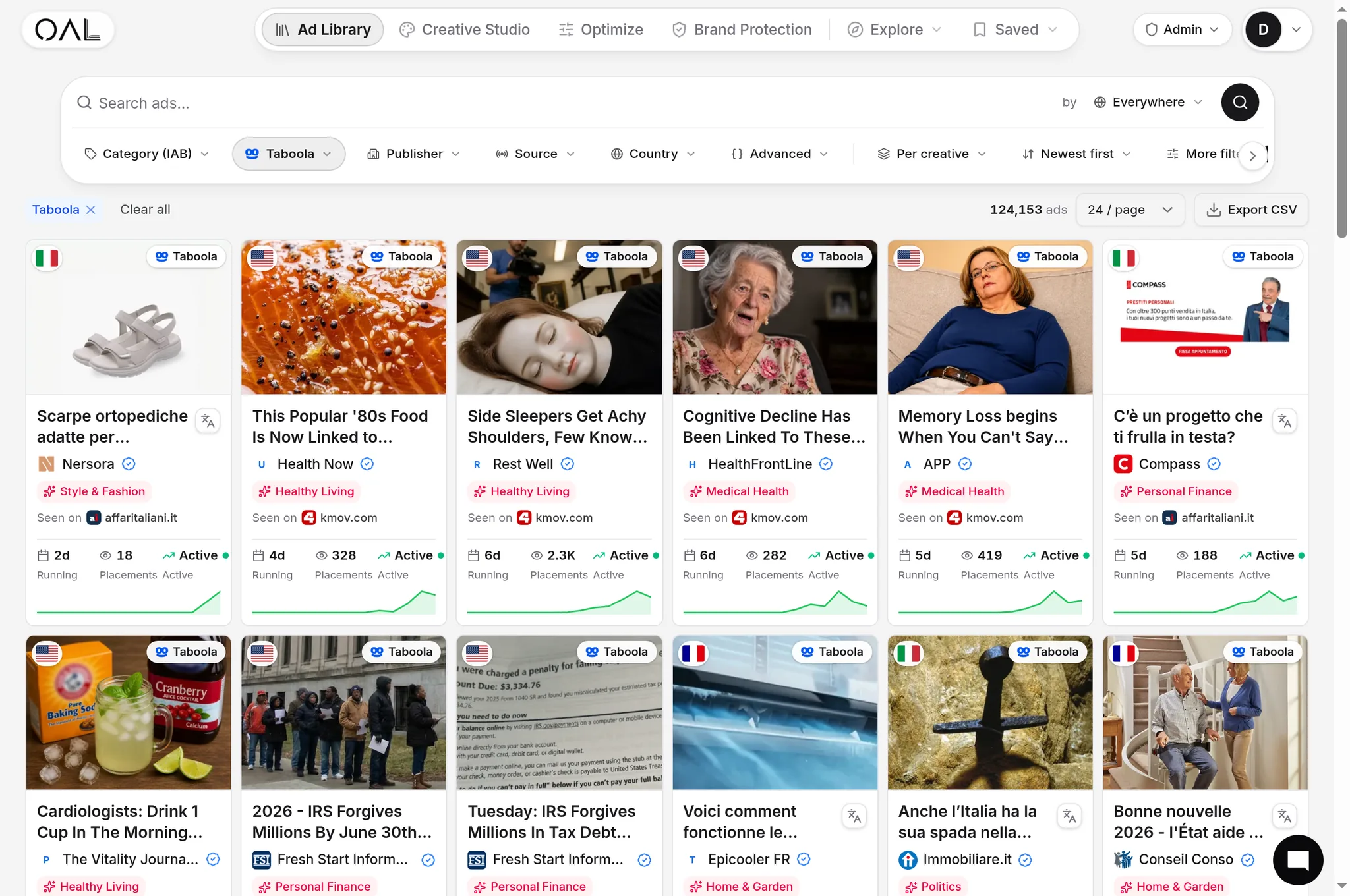
Most Taboola guides stop at "write a curiosity headline." This one walks the full Realize setup, budget math, Maximize Conversions, targeting, tracking, then shows what winning native creatives actually look like using live captured ads.

Native media buying is a four-part loop (offer, creative, bid, scale), and this 2026 playbook walks each step with concrete settings, live cross-network examples, and the metrics that actually move money.
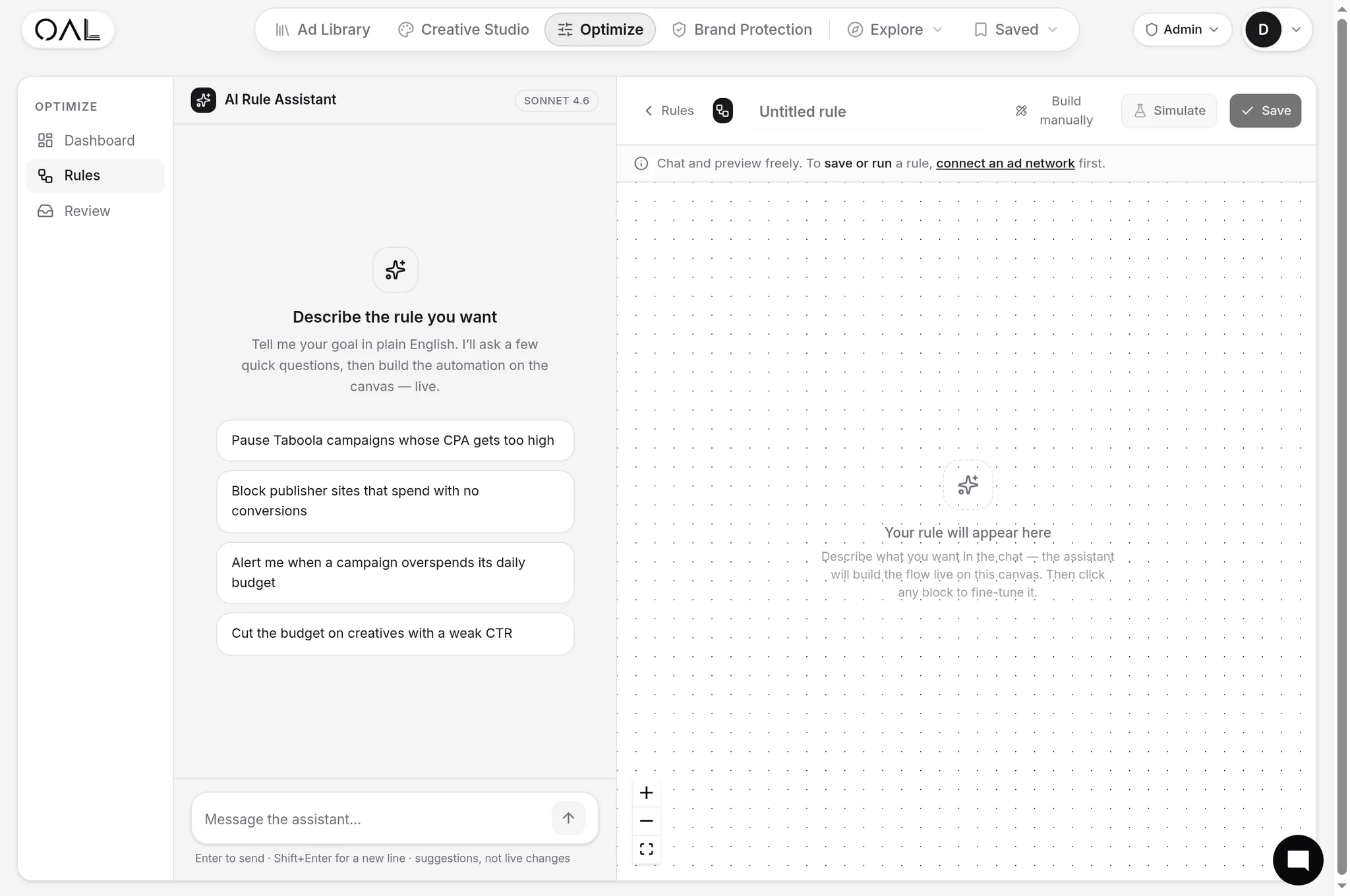
A practitioner's playbook for running native profitably as an affiliate in 2026: offer selection, creative angles, pre-landers, the test loop, and using live competitor ads to find proven winners and new geos.