Español
 Português (Brasil)
 Français
 Deutsch
 Italiano
 Nederlands
 Polski
 Svenska
 Türkçe
 Русский
 日本語
日本語 한국어
한국어 简体中文
简体中文 Tiếng Việt
 Bahasa Indonesia
 繁體中文
繁體中文 Čeština
 Dansk
Dansk Norsk (bokmål)
 Suomi
Suomi Ελληνικά
 Română
 Magyar
 Українська
 ไทย
ไทย हिन्दी
 العربية
 עברית
עבריתHow to Spy on Competitor Native Ads (Taboola, Outbrain, MGID)
Native ads hide in plain sight at the bottom of every article, and here is how to find who is really buying them, read the creative and supply chain behind each placement, and trace the click to the landing page without ever firing a live ad.

Native ads are the hardest format to spy on and the most rewarding once you crack it. On Facebook you get Meta's Ad Library handing you every active ad by Page. Native gives you nothing like that. Demand is scattered across Taboola, Outbrain, MGID, Revcontent and a dozen smaller exchanges, each running its own auction, its own publisher network, and no central record of what is live. Those "Around the Web" and "You May Like" widgets at the bottom of every news article are a multi-billion-dollar market with almost no built-in transparency.
That opacity is exactly why native is where competitive research pays off. The affiliates and direct-response buyers who live on these networks do not post case studies. But every winning creative is sitting in plain sight on some publisher page right now. You just have to capture it, work out who is actually behind it, and follow it to the offer. For context on scale: our index currently holds 589,036 native creatives from 25,933 advertisers across 42 networks, tied to 5.4 million live ad observations (OpenAdLibrary index, June 2026). That is the haystack. This guide is the native-specific drill-down from the broader how to spy on competitor ads playbook, and it covers the three moves that matter: search the right way, read the creative and its supply chain, then trace the click to the landing page.
How to spy on competitor native ads#
To spy on competitor native ads, use a native ad intelligence platform to search live captured placements by advertiser, network and geo, read each creative's headline and supply-chain labels, then follow the captured click URL to the advertiser's landing page. Prioritise creatives with high longevity and wide publisher spread. Those are the proven winners worth modelling, not the ones that ran for a day and vanished.
Why native resists normal ad-spy tools#
Most "ad spy" tools were built for social. They poll Meta's Ad Library API or scrape the TikTok Creative Center, both of which hand over structured data on request. Native has no such gift. To see a native ad you have to actually load a publisher page, in the right country, on the right device, at the moment the auction fills your slot. And even then the widget shows you a campaign label, not the company paying for it.
Three structural facts make native uniquely tricky:
- No central library. There is no official cross-network "native ad library." Each network only exposes its own inventory to its own logged-in advertisers, and only their own account at that.
- Geo and device gating. A US desktop session and an AU mobile session see completely different fills on the same article. Capture has to be deliberately spread across geos to be representative.
- Obscured advertisers. The brand on the widget is frequently a content arbitrage site or a throwaway campaign name. The real advertiser only shows itself when you follow the click.
Here is a live example of the genre. This Taboola finance ad ran under the brand "Fresh Start Information," which tells you nothing about the company behind it. The headline does all the work.

The single biggest mistake in native research is reading the widget label as the advertiser. On native, the headline is the bait and the click chain is the truth, and they are almost never the same company.
This is also why native intelligence is a capture problem, not a search problem. You cannot query data nobody has collected. The quality of your research is capped by how broadly and how continuously someone is observing live placements across publishers and geos.
Step 1: Search by advertiser, network and geo#
Once you are working from a corpus of continuously captured placements, the first move is to narrow it three ways. Each axis answers a different question.
Search by advertiser when you already know who you are watching. Type the brand or domain and pull every native creative tied to it. This is the fastest route from "I want to study Brand X" to a wall of their actual running ads, and it is the same starting point as finding out what ads a competitor is running across every channel, just scoped to native.
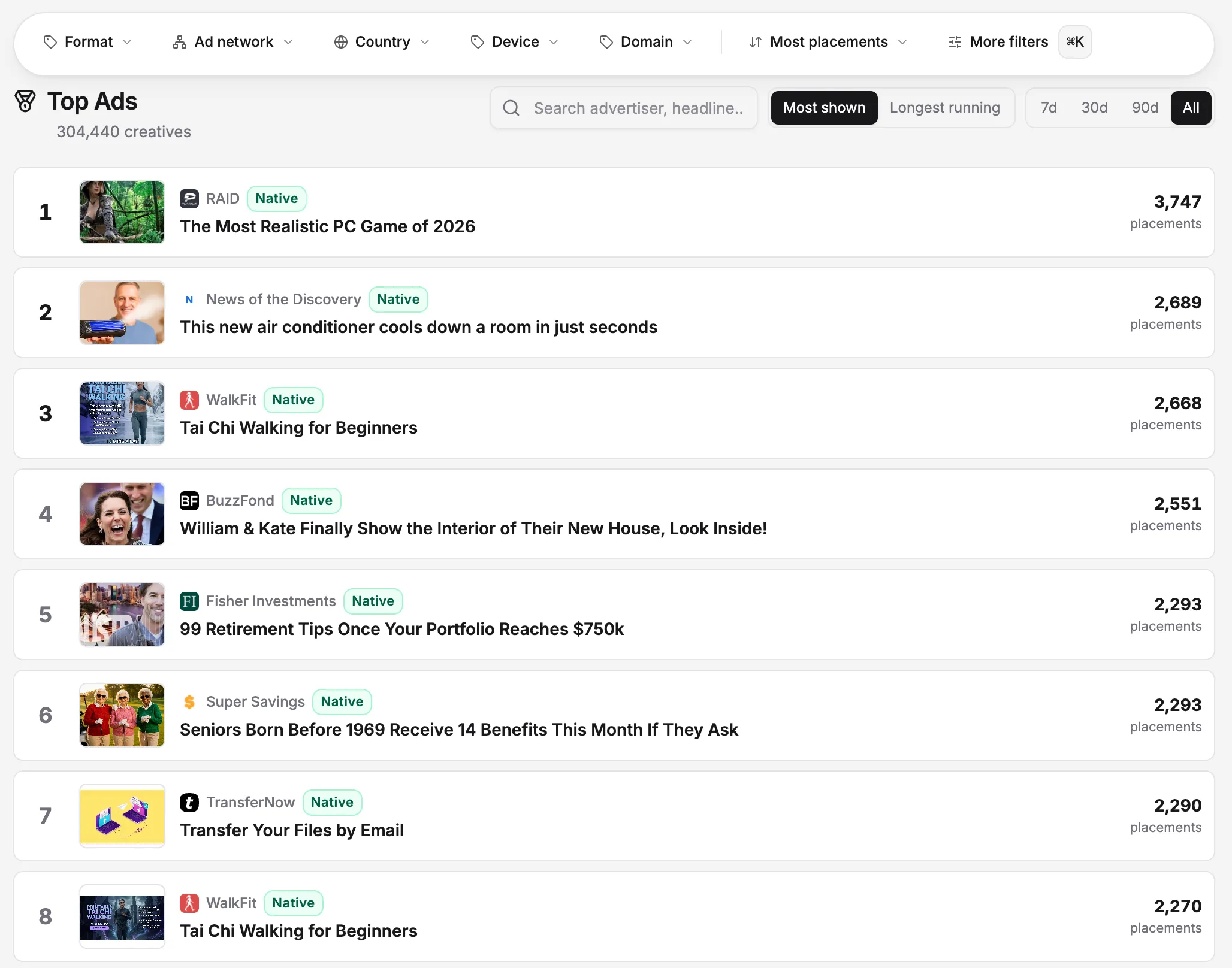
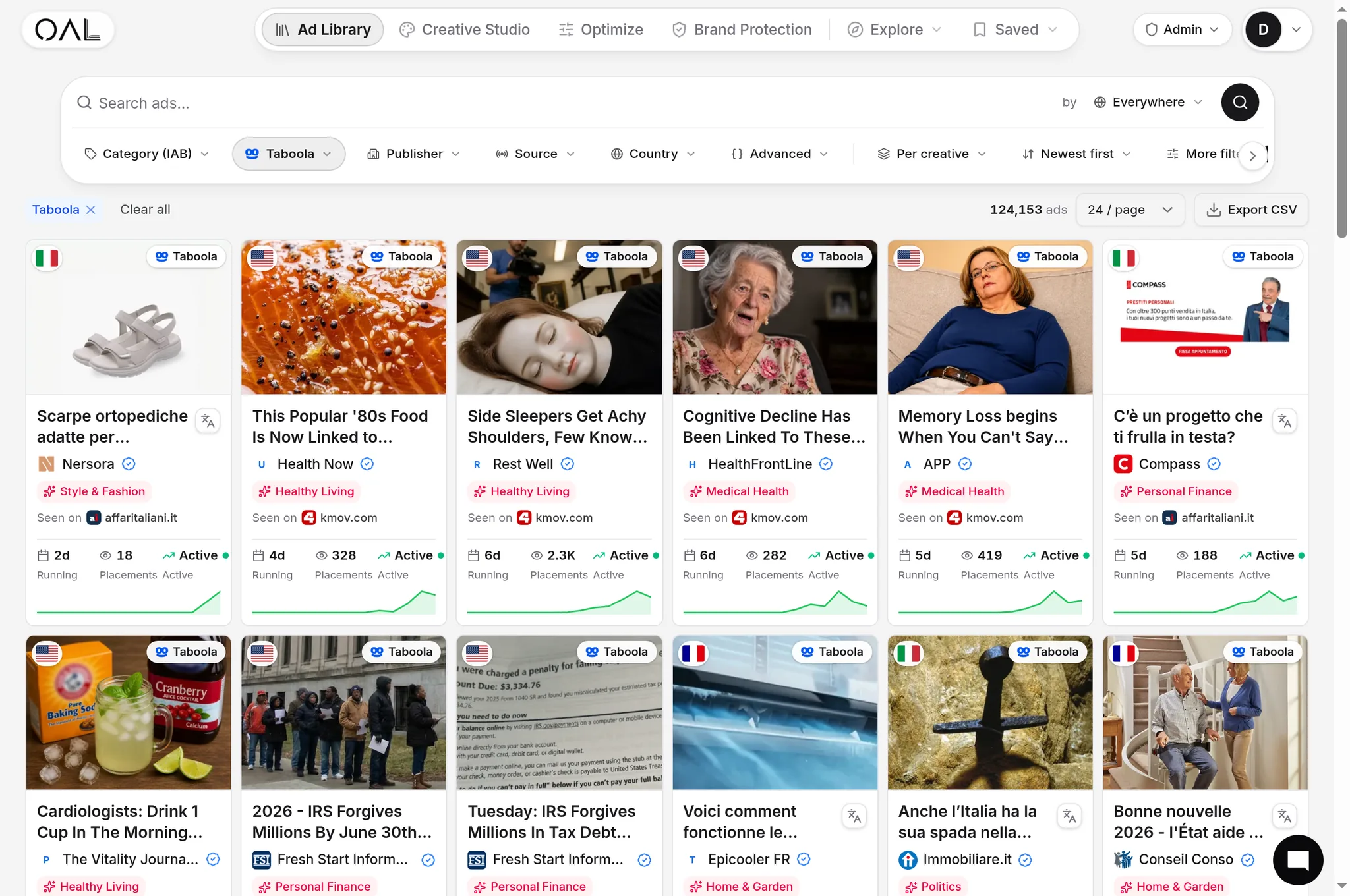
Search by network when you want to understand a platform's playbook. Filtering to Taboola ad spy results, for example, shows you what direct-response looks like on Taboola specifically. Taboola is the biggest exchange in our index by a wide margin at 157,727 creatives, versus 84,252 on Outbrain and 49,689 on MGID (OpenAdLibrary, June 2026). The networks also do not look alike. On Taboola the heaviest verticals are health (6,048 creatives), finance (5,558) and insurance (4,303). MGID is a different animal entirely: entertainment dominates it with 8,904 creatives, mostly IQ quizzes, games and arbitrage content. Outbrain (now operating under the Teads brand after completing its acquisition of Teads in February 2025) skews finance and insurance first. Comparing the same advertiser across networks tells you where they concentrate budget.
Search by geo because native is geo-fragmented to its core. The winners in US health supplements look nothing like the winners in DACH finance. If you sell into a specific market, filter to it. Otherwise you are studying ads aimed at someone else.
| Search axis | Best for | The question it answers |
|---|---|---|
| Advertiser / domain | Tracking a known competitor | "What is Brand X running on native right now?" |
| Network (Taboola, Outbrain, MGID) | Learning a platform's conventions | "What wins on this specific exchange?" |
| Geo | Market-specific buying | "What works in the country I actually sell to?" |
In practice you combine all three: this advertiser, on this network, in this geo. That intersection is where you find the handful of creatives worth tearing apart. One more thing the aggregate data tells you: finance (17,232 creatives), insurance (15,629) and health (14,895) are the three largest verticals across the whole native index. If you compete in any of those, expect crowded auctions and a lot of competitors to track.
Step 2: Read the creative and the supply chain#
A native creative carries two layers of intelligence. The obvious layer is what a human sees. The valuable layer is the plumbing behind it.
The creative layer is the thumbnail and headline. Native lives and dies on these two elements, so study them as a craft:
- Headline pattern. Curiosity gap, list, warning, regional hook ("Drivers in [City] are switching to..."), or authority claim. Catalogue the formulas your competitors lean on. The health space is a masterclass in this. Look at the punctuation tricks below: zero-width characters are spliced into "Cognitive Decline" to slip past automated moderation, and the doctor authority hook ("MDs Identify...") does the persuading.

- Thumbnail style. Native winners trend toward "ugly" authentic imagery: screenshots, hands holding objects, before-and-afters, because it outperforms polished stock. Note which style each advertiser commits to.
- Capture quality matters. Capturing the creative at full resolution, not a blurry widget crop, is what lets you read the on-image text and judge production value. Low-quality capture quietly destroys this entire step.
The supply-chain layer is what separates real native intelligence from a screenshot folder. Every placement carries metadata about how it was served: which network brokered it, which native ad widget format it ran in, which publisher site it appeared on, and the programmatic native trackers and SSPs in the chain. Reading this tells you:
- Network and exchange to confirm whether a creative is a Taboola buy, an Outbrain/Teads buy, or resold through an intermediary.
- Publisher spread, the list of sites a single creative appears on. Wide spread is a budget and confidence signal.
- Longevity, how long the creative has stayed live.
Longevity and spread together are the closest thing native gives you to a spend signal. Nobody will show you a competitor's exact budget. But a creative that has run for weeks across dozens of publisher sites in your geo is unambiguously a winner, and it tells you where the money is concentrated. To put real numbers on this: the longest-running creatives in our index have held continuous placement for 28 straight days of observation (OpenAdLibrary, June 2026). One that has earned that kind of staying power is this Outbrain finance ad from SmartAsset, an established brand running a plain advice angle rather than a clickbait one.

One caveat worth being honest about. Our continuous observation window currently spans up to about 28 days per creative, so when you hear affiliates talk about "90-day winners," that is industry lore about ads that outlive any single tracking window, not something we are claiming to have measured end to end. What we can say with confidence is that a creative still live at the 28-day mark is a tested, profitable buy. OpenAdLibrary surfaces longevity and spread on every captured ad, so you rank by proven performance instead of guessing from a single impression.
Step 3: Follow the click to the landing page#
Reading the ad is half the job. The other half, the half almost nobody does properly, is following the click to the destination, because the offer and the funnel are where competitors actually make money.
The critical rule first: do not click live native ads. A real click fires a billable event on your competitor's campaign, pollutes their data, and can flag your IP. Proper native intelligence resolves the destination from the captured click URL and redirect chain rather than triggering a live click. You see exactly where the ad goes without ever touching the competitor's budget. (Across the index we have already resolved 926,259 landing-page captures this way, so the destination is usually already on file.)
When you trace a native click, you follow a chain, not a single hop:
- Network tracker. The click first hits the exchange's redirect (Taboola's
popup.taboola.com-style URLs, Outbrain'soutbrain.com/r/paths, and so on), which confirms the true network. - Intermediary redirects. Affiliate trackers, cloakers or arbitrage hops may sit in between. The chain itself is intelligence. A long redirect chain often signals an affiliate offer rather than a brand-direct buy.
- Pre-lander. Many native funnels route through an advertorial or quiz before the offer. The pre-lander is usually where the real persuasion happens, and the part competitors guard most.
- Final landing page. The advertiser's actual domain and offer. This is where you finally learn the real advertiser behind a vague widget label.
Take this insurance ad. It ran on Taboola under the brand "Real" with a geo-targeted hook aimed straight at one market. The widget label barely identifies a company. Resolving the click chain is the only way to know who is buying it and what they are selling.

Resolving the chain is what turns "an ad exists" into a complete competitive picture: real advertiser, full funnel, and offer. The full teardown (pricing, angle, page structure, and how to model it) is its own discipline, covered in reverse-engineering a competitor's native ad funnel.
From one ad to a system#
Doing this once for one competitor is useful. Doing it continuously, across a watchlist, is where native intelligence becomes a durable edge. The three steps compound:
- Searching by advertiser, network and geo gives you the inventory.
- Reading creative plus supply chain gives you the performance ranking (longevity and spread).
- Following the click gives you the funnel and the real advertiser.
Stack those across the competitors that matter and you have a live map of who is winning, with what creative, on which network, pointing at which offer. The next move is to make it routine rather than a one-off dig: build the watchlist, set a cadence, turn observations into action. That operating model is laid out in the competitive ad intelligence workflow, and the practical first step is simply building a competitor watchlist of the advertisers and networks worth tracking.
A quick comparison of where native research usually breaks down versus what good capture gives you:
| Native research challenge | Weak approach | What proper capture delivers |
|---|---|---|
| Finding ads at all | Manually browsing news sites | Continuous capture across publishers and geos |
| Identifying the advertiser | Trusting the widget label | Click traced to the labelled landing-page owner |
| Judging what's working | Guessing from one impression | Longevity plus publisher-spread signals per creative |
| Seeing the offer | Clicking the live ad (don't) | Click chain resolved without firing a real click |
| Reading the creative | Blurry widget screenshot | Full-resolution captured image |
Where OpenAdLibrary fits#
Everything above describes how OpenAdLibrary is built. It continuously captures live public native ads across Taboola, Outbrain/Teads, MGID, Revcontent, MediaGo, Yahoo and MSN; preserves the real creative image at full quality; classifies the ad-tech supply chain behind each placement; and follows the click to the advertiser's landing page, without ever clicking a live ad. You can search 589,036 captured creatives by advertiser, network and geo, rank by longevity and spread, and read the full funnel. It is the open, low-cost alternative to the $80 to $400 per month incumbents, with a free tier to browse 200 ads and no card required.
Start free and pull your first competitor's native creatives in a couple of minutes.