Español
 Português (Brasil)
 Français
 Deutsch
 Italiano
 Nederlands
 Polski
 Svenska
 Türkçe
 Русский
 日本語
日本語 한국어
한국어 简体中文
简体中文 Bahasa Indonesia
 繁體中文
繁體中文 Čeština
 Dansk
Dansk Suomi
Suomi Ελληνικά
 Română
 Magyar
 Українська
 ไทย
ไทย हिन्दी
 العربية
 עברית
עבריתNative Advertising for B2B and SaaS: What Actually Works
SOFTWARE is a top-six vertical on almost every major native network we track. Who actually runs B2B native, which networks fit, and the playbook that makes the lead economics work.


Native advertising works for B2B and SaaS — but only when it is bought as a content-distribution channel with lead economics, not as a demo-request machine. The evidence that serious B2B money already runs here: SOFTWARE is a top-six advertiser vertical on nearly every major network in OpenAdLibrary's index, with roughly 14,900 SOFTWARE-vertical creatives live across networks as of June 2026. The playbook that fits the channel has an educational asset in the middle, an advertorial bridge in front of it, and success measured on cost per lead and pipeline contribution rather than last-click ROAS.
Who actually runs B2B native (what the index shows)#
The stereotype says native feeds are all diet offers and celebrity bait. The data says otherwise. Counting SOFTWARE-vertical creatives by network in our index (June 2026):
| Network | SOFTWARE creatives | Where it ranks |
|---|---|---|
| MSN / Microsoft Audience Network | ~7,900 | Top-five vertical on the network |
| Taboola | ~3,700 | Top-six vertical |
| Outbrain | ~1,900 | Top-five vertical |
| Yahoo | ~470 | The network's largest classified vertical |
And the live creatives show three distinct B2B strategies in action:
- Direct-response B2B lead gen. Perpetual Ad Tech runs MGID ads with headlines like "The $950 Audit That Shows Where Your Marketing Loses Money" and "Paying An Agency $3k/Month? A Machine Does It For A Flat Fee" — pure performance copy, specific numbers, a named business pain, running on a network better known for consumer offers.
- Corporate content distribution. SPECTRA by MHI — Mitsubishi Heavy Industries' content brand — distributes thought-leadership pieces like "From trash to treasure: Waste to energy explained" through Outbrain. No form fill in sight; the KPI is qualified attention.
- Professional education. Georgetown University promotes its professional master's programs ("Become a Leader in the Cybersecurity Field") through Teads — B2B-adjacent demand generation aimed at working professionals reading premium editorial.
Add the long tail — like MONOBUNT, a German agency advertising professional ecommerce builds on the Microsoft Audience Network — and the picture is clear: B2B native is not hypothetical. Your competitors may already be in the feed.
Why B2B native is different from B2C native#
Everything unusual about B2B native follows from one fact: you are interrupting a professional reading the news, not catching a buyer mid-search.
- No firmographic targeting. Native networks do not offer job-title or company-size targeting the way LinkedIn does. Targeting is contextual, geographic, and device-level — which means the headline does the targeting. "Paying An Agency $3k/Month?" filters for people who pay agencies; everyone else scrolls past. Self-selection through creative is the core B2B native skill.
- The asset is the offer. Cold feed traffic will not book a demo. It will download a benchmark report, use a calculator, or read a genuinely useful guide. You are buying the top of a long funnel, so the click must land on something worth a stranger's time.
- CPL math replaces ROAS math. A B2B lead's value realizes over a sales cycle measured in months. Buy against a cost-per-lead target derived from your pipeline conversion rates — the arithmetic lives in CPL — and judge the channel on pipeline created per dollar, not this month's closed revenue.
- Brand safety expectations are higher. The clickbait styles that work for consumer offers actively damage a B2B brand. The Perpetual Ad Tech examples above are aggressive but factual — specific numbers, no fake scarcity.
- Desktop matters again. B2B research happens at work, on a desktop, during business hours. That flips the usual native device logic.
Which networks fit B2B#
- Microsoft Audience Network (MSN feed). The strongest structural fit: MSN, Edge, and Windows surfaces reach an at-work desktop audience by default, and the network holds the largest SOFTWARE creative pool in our index. Start with the MSN native ads guide — the network behaves differently from the widget networks.
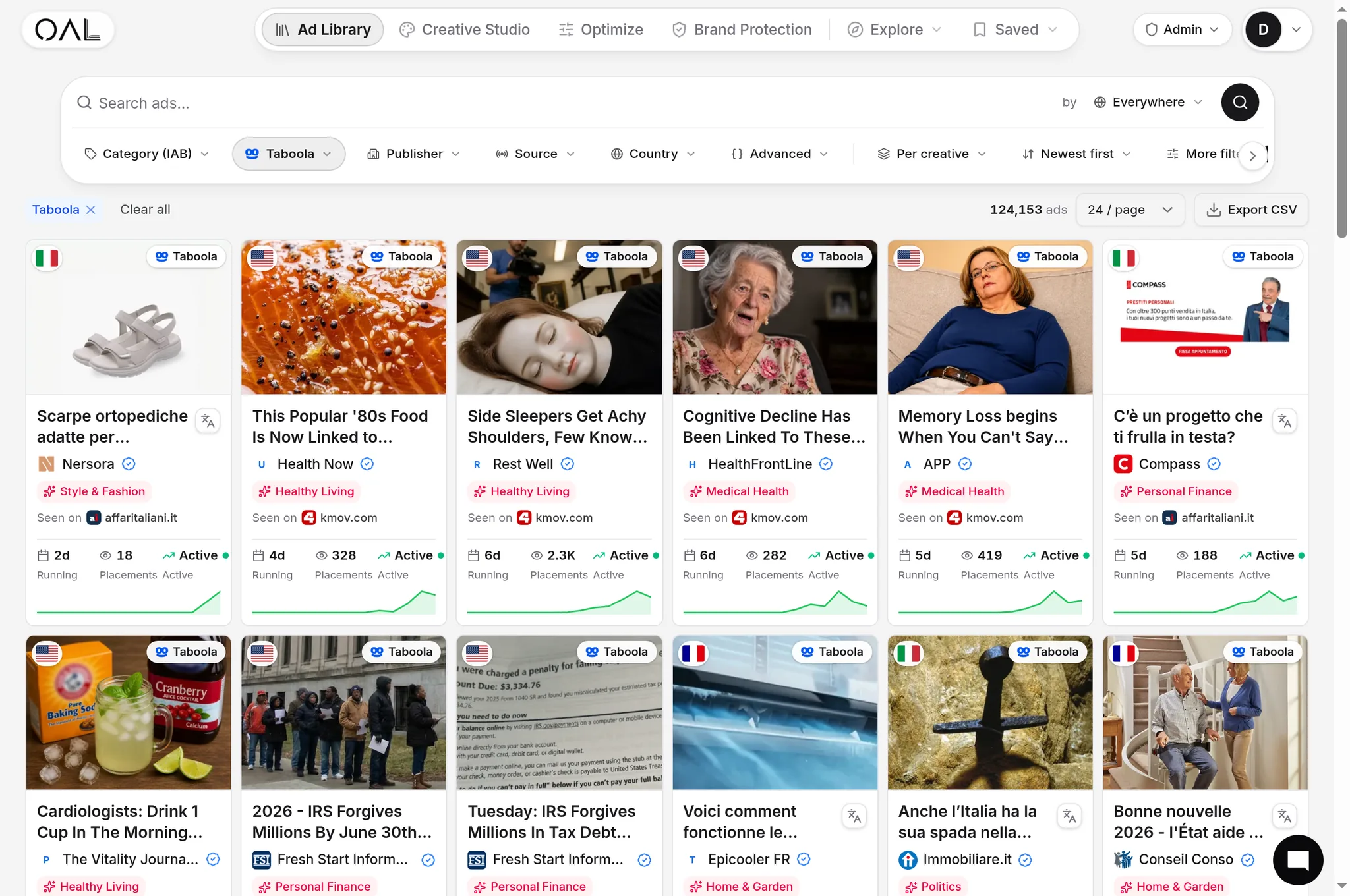
- Taboola. Scale and publisher breadth; a top-six SOFTWARE vertical means the auction already prices B2B demand. Mechanics in how Taboola ads work.
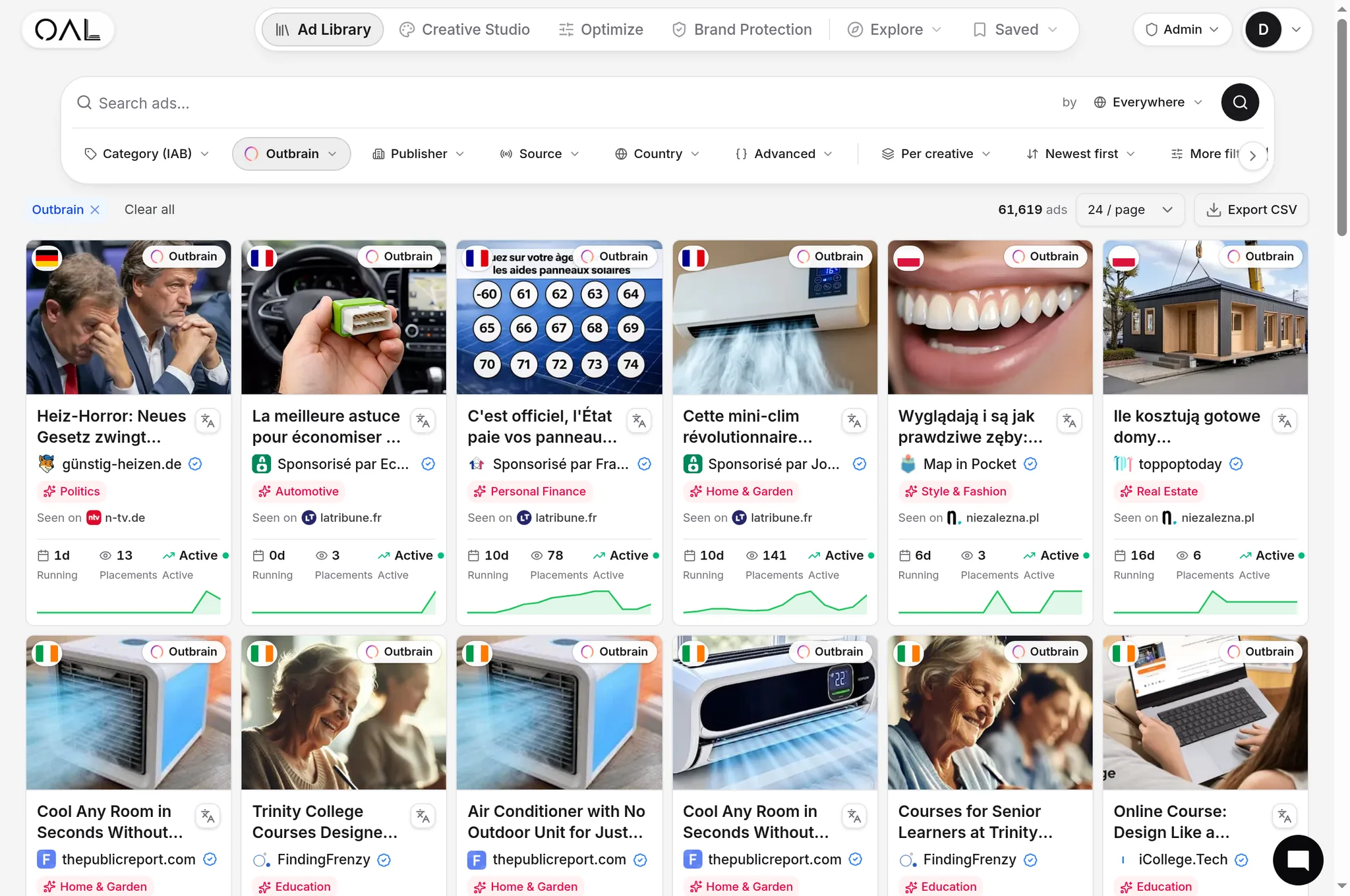
- Outbrain (now Teads). Historically the premium-editorial lean of the two big widgets, and the natural home for content-distribution plays like the MHI example — see how Outbrain works and what Teads is after the merger.
- Yahoo. Smaller pool, but SOFTWARE is its top classified vertical in our index — worth a test if your audience skews finance/professional. Background in how Yahoo native ads work.
- MGID / Revcontent. Cheaper inventory, more mixed adjacency. Best for direct-response B2B offers with strong self-selecting headlines, as the live examples prove.
The B2B native playbook#
- Research the incumbents first. Search your category and watch what runs. Which SaaS brands are live, what assets they promote, which headlines have persisted for weeks — a weekly competitive routine answers this in an hour. You can browse live SOFTWARE-vertical creatives by network in the Outbrain index or the Taboola index without paying anything.
- Pick the asset before the ad. A benchmark report, a cost calculator, an honest buying guide, a template pack. The ad sells the asset; the asset sells the meeting. If you have no asset worth a download, fix that before spending a dollar on distribution.
- Build the advertorial bridge. Feed traffic converts through an editorial-style page that continues the article-reading experience before any form appears — the same pre-lander logic that drives consumer native, executed with professional restraint.
- Gate late, qualify progressively. Ask for the email at the point of value, qualify with one or two fields, enrich the rest later. Every added form field on cold traffic is paid for in CPL.
- Do the math before launch. Media buyers commonly report Tier-1 desktop CPCs from roughly $0.20 to $0.90 on the major native networks — unofficial, and your niche will move it. At a $0.50 CPC and a 3% visitor-to-lead rate, a lead costs about $17; at 1%, $50. Whether that works depends entirely on your lead-to-opportunity rate, which is why the budget conversation starts at what native ads cost and gets calibrated against the network CPC benchmarks.
- Retarget and nurture. Most of what you bought is future pipeline. Retarget engaged readers with the next asset, hand only qualified leads to sales, and report the channel on a quarter's lag, not a week's.
Creative patterns that work (from captured ads)#
The B2B creatives that persist in the index share mechanics:
- Specific numbers beat adjectives. "$950 audit" and "$3k/month" outperform "affordable" and "enterprise-grade" because specificity is credibility — and it self-selects the reader who recognizes the number.
- Name the pain, not the product. Persistent headlines describe the reader's situation ("where your marketing loses money") rather than the vendor's feature list.
- Editorial photography over stock gloss. The creative sits between news thumbnails; it should look like one.
- Curiosity with a professional payoff. The curiosity gap works in B2B too — it just has to resolve into substance on the other side of the click, or the CPL is wasted.
Pitfalls that kill B2B native#
- Sending feed traffic to a demo form. The single most common failure. Cold interruption traffic needs the asset-and-bridge funnel, every time.
- Judging on last-click in a 90-day cycle. Native will look terrible in week two and reasonable in month four. Decide the evaluation window before launch or the channel gets killed by an impatient dashboard.
- Ignoring placement quality. Review publisher-level performance and block aggressively; B2B tolerance for junk adjacency is low.
- Borrowing consumer clickbait. It gets clicks and burns trust with exactly the audience you are trying to build pipeline with.
B2B native is a patience trade: cheaper attention than search or LinkedIn, bought earlier in the buying journey, monetized over quarters. The buyers who win it treat the feed as a publishing channel with a bid attached — and they check what their competitors are publishing before they write a brief.