Español
 Português (Brasil)
 Français
 Deutsch
 Italiano
 Nederlands
 Polski
 Svenska
 Türkçe
 Русский
 日本語
日本語 한국어
한국어 简体中文
简体中文 Tiếng Việt
 Bahasa Indonesia
 繁體中文
繁體中文 Čeština
 Dansk
Dansk Norsk (bokmål)
 Suomi
Suomi Ελληνικά
 Română
 Magyar
 Українська
 ไทย
ไทย हिन्दी
 العربية
 עברית
עבריתNative Advertising for Affiliate Marketing: The 2026 Playbook
A practitioner's playbook for running native profitably as an affiliate in 2026: offer selection, creative angles, pre-landers, the test loop, and using live competitor ads to find proven winners and new geos.

Native is where affiliate media buyers still buy scale outside the walled gardens. Meta keeps tightening, Google keeps crowding affiliate offers out of the auction, and the open web just keeps moving volume through recommendation widgets that sit under and beside editorial. For a CPA buyer that means cheap clicks, looser policy surfaces, and a discovery audience you can warm up with story-led creative. It also means a harder game: cold traffic, thin margins, and creatives that decay in days. This is the hub for running native profitably as an affiliate in 2026, and it links out to the deep-dives for each stage.
One number for context before we start. We have captured 589,036 creatives across 42 networks and 25,933 advertisers (OpenAdLibrary index, June 2026). That is the live market you are competing against, and most of it is sitting in plain sight.
What native advertising for affiliate marketing actually is#
Native advertising for affiliate marketing means buying recommendation-widget placements (the "you may also like" units under articles) on networks like Taboola and Outbrain to push cold traffic to a bridge page and then an affiliate offer. You pay per click, you pre-sell with an advertorial, and you earn a CPA or revshare commission when the reader converts. The edge comes from creative angles and disciplined testing, not from clever bidding.
If you want the textbook versions, start with Native Advertising and Affiliate Marketing in the glossary. Short version: native ads match the form and feel of the page around them so they read as content, and affiliate marketing pays you for driving a tracked action to someone else's offer. Put them together and you get a performance channel where the creative does the heavy lifting.
Here is the single mental shift paid-social buyers have to make. Your reader was not searching for your product and was not scrolling a feed of ads. They were reading an article about something else. You get one headline and one thumbnail to interrupt that, then one bridge page to earn the conversion. Look at a real captured unit and you can see how hard that interruption works:

That deadline plus a round number plus a hint of free money is not an accident. It is a tested angle, and at the point we captured it the ad had been running 13 days straight, which on native is a meaningful vote of confidence.
The mechanics run on a Native Ad Widget embedded by the publisher and filled in real time by a Native Ad Auction. Most modern native is bought programmatically, so it pays to understand Programmatic Native Advertising and Programmatic Advertising as the plumbing under the dashboards.
Why native still works for affiliates in 2026#
Three structural facts keep native relevant.
Reach without the policy minefield. The open web is enormous. Taboola's Yahoo partnership, now live, exclusively powers native recommendations across Yahoo Finance, Sports, News, AOL and more, putting hundreds of millions of monthly users behind one buying platform. That is reach you cannot touch on Meta with a cloaked funnel. On Taboola alone we are sitting on 157,727 captured creatives (OpenAdLibrary index, June 2026), and the volume leaders there are exactly the affiliate-friendly verticals: Health (6,048), Finance (5,558), and Insurance (4,303).
Discovery intent is monetizable. Search captures people who already want the thing. Native creates the want. For nutra, financial education, insurance lead-gen, and survivalist or DIY products, the "I didn't know I needed this" moment is where the commission lives. Across the whole index the heaviest verticals are Finance (17,232 creatives), Insurance (15,629), Health (14,895), and Ecommerce (13,872). If thousands of advertisers are pouring creative into a vertical that hard, the demand is real. (For a vertical-by-vertical breakdown, see our companion guide on the best affiliate verticals for native.)
Creative still beats budget. On the walled gardens the algorithm decides who sees what. On native a sharp angle and a clean pre-lander can carry a mediocre bid. The buyer who tests more angles wins, which rewards craft over capital.
The flip side is real too. Native traffic is colder, click quality swings wildly by publisher, bot and accidental clicks exist, and a winner can fatigue in days once competitors copy it. The whole discipline below exists to manage those risks.
The affiliate native workflow, end to end#
Here is the loop experienced buyers actually run. Each stage links to a deeper guide where it earns one.
1. Pick an offer that fits the channel#
Not every offer survives native. The best candidates pay enough to absorb cold-traffic CPAs (think payout comfortably above your expected click cost times your funnel conversion rate), have a story you can tell in an advertorial, and accept the traffic source in their terms. Single-opt-in lead gen, trials, and straight-sale nutra are classic fits. High-consideration, long-sales-cycle offers usually are not.
A quick gut-check table for offer selection:
| Factor | Strong native fit | Weak native fit |
|---|---|---|
| Payout | High enough to fund a pre-lander funnel | Thin margin, no room for a bridge page |
| Intent | Discovery, curiosity-driven | Bottom-funnel, brand search captures it |
| Story | Has a hook, transformation, or "secret" | Commodity with no narrative |
| Compliance | Allows native plus advertorials | Bans bridge pages or specific claims |
| Attribution | Tolerates 1-3 day windows | Demands last-click, short window only |
2. Research what is already winning#
This is where amateurs skip and pros live. Before you write a single headline, study the ads competitors are already running profitably. You are mining for angles (the emotional or logical premise), hooks (the first three words that stop the scroll), the offer-to-page flow, and which creatives have staying power.
The trick is reading longevity and spread as profitability proxies. You cannot see a competitor's spend. You can see how long an ad has run and across how many publisher widgets. An ad live for weeks on dozens of placements is almost certainly profitable, because nobody funds a loser that long. Right now the oldest continuously observed creatives in our index have been running about 28 days unbroken, which is the ceiling of what we have watched so far, not a hard cap on the ad's real life. One of those 28-day survivors is a finance lead-gen angle from SmartAsset:

A question framing, a specific pain (taxes on retirement money), and an authority cue ("Ask a Pro"). It has held for the full window we have on it. That is the kind of ad you reverse-engineer, not the kind you ignore.
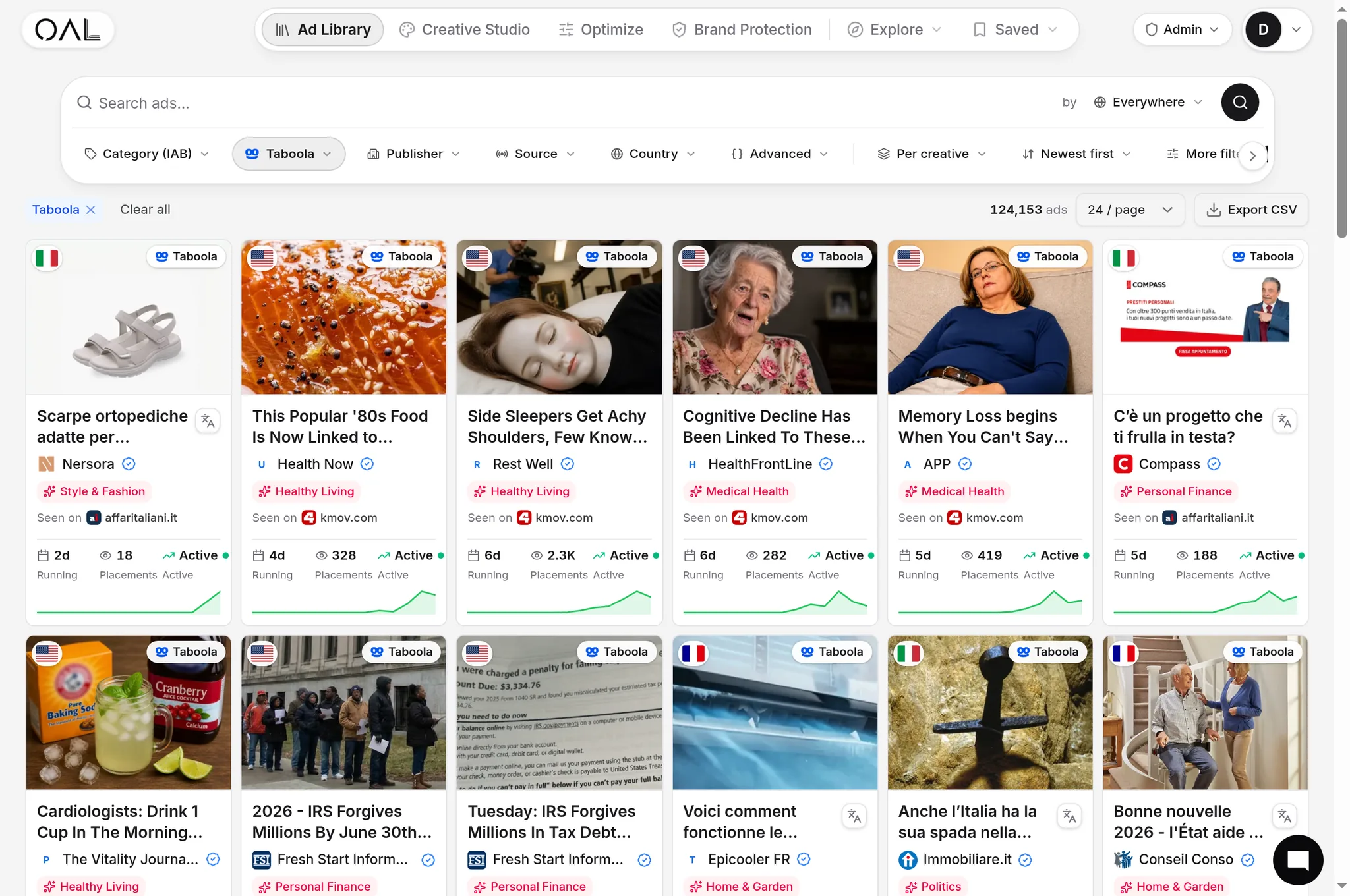
A native ad spy tool that captures live ads, records first-seen and last-seen dates, grabs the real creative image at full quality, and follows the click to the actual landing page turns this from guesswork into a sortable list of proven winners. That is OpenAdLibrary's core. We capture live public native ads across Taboola, Outbrain, MGID, Revcontent, Teads, MediaGo, Yahoo, and MSN, identify the real advertiser behind each one, and trace the click through to the landing page and pre-lander without ever clicking the live ad. We have logged 5,424,757 ad observations and 926,259 landing-page captures to date (OpenAdLibrary index, June 2026), so you see not just the creative but the funnel a winner is using, plus the longevity and spread signals that tell you it is working.
3. Build the creative and the pre-lander#
Native creative is a headline plus a thumbnail, full stop. That is your entire above-the-fold pitch. The pre-lander (advertorial, listicle, or quiz) is where you do the real selling: re-state the ad's promise, build context, handle objections, and warm the reader so the offer page you do not control receives someone who is already half sold. Most of your conversion lift comes from this bridge page.
Look at how curiosity gets weaponised in the health vertical, which is the busiest category on Taboola in our data:

The "(See the List)" is the whole game. It promises the payoff is one click away, then the advertorial drip-feeds the list and the offer. Notice it is a fresh creative (3 days in at capture), which tells you the advertiser is still testing this angle. Compare that to a long-runner in the same category:

Same vertical, completely different maturity. The Nebroo ad had been live 26 days at capture. When you can see a fresh test and a proven winner side by side, you stop guessing which angles survive contact with cold traffic.
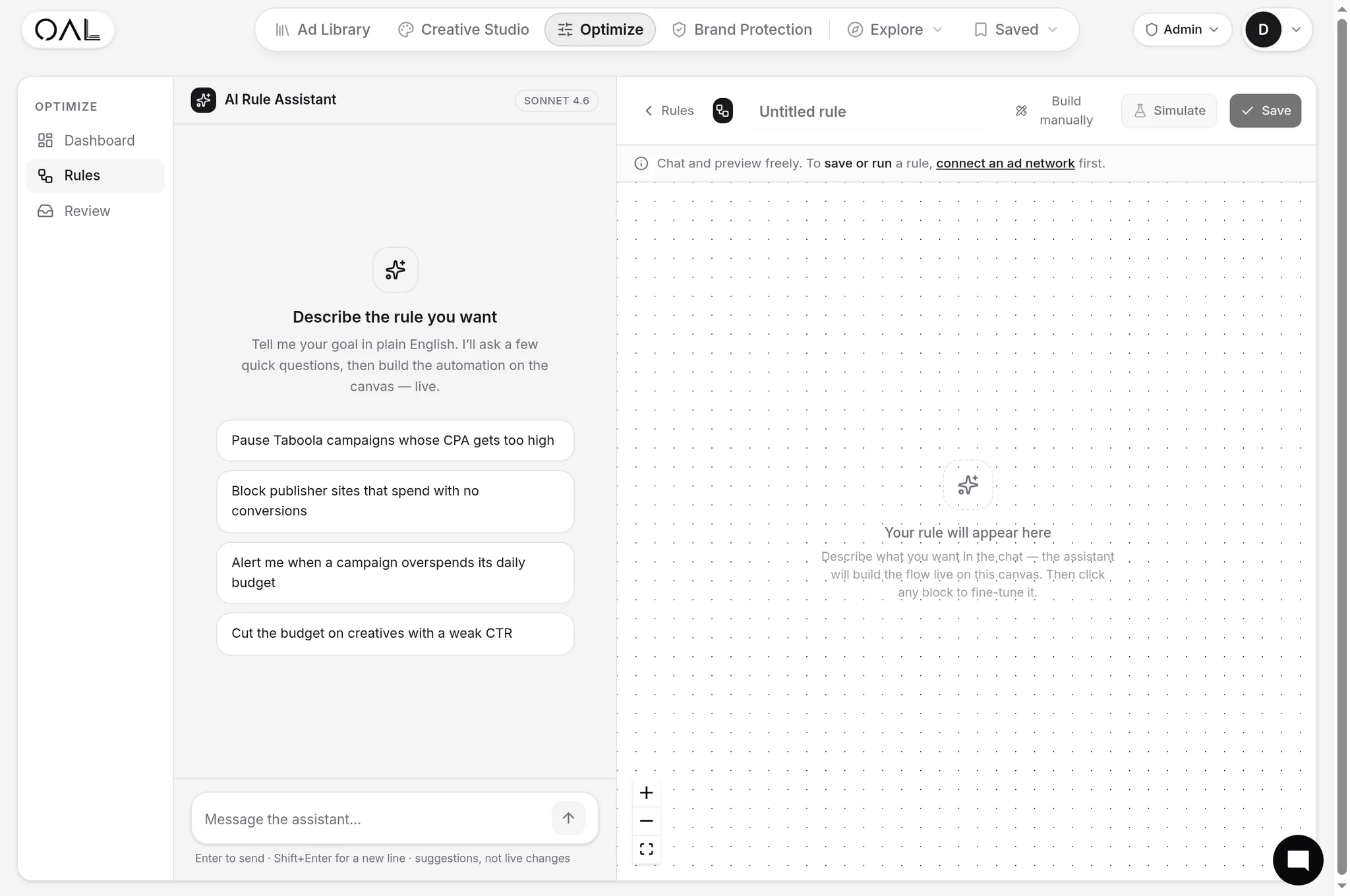
Plan to launch 5 to 15 distinct angles per offer. Vary the emotional premise, not just the wording. "Doctors are furious about this" and "I tried it for 30 days, here is what happened" are different angles. Two rewordings of the same claim are not. Our Creative Studio and Copy DNA tools exist to accelerate this step, turning patterns you find in winning ads into your own original variations.
4. Launch, test, and read the data honestly#
Set up tracking before you spend a dollar so you can attribute conversions to creative, placement, and audience. Then fund the test properly: budget roughly 3x your target payout per ad-set so you gather enough conversions to judge a creative rather than guessing on three clicks. Kill clear losers fast, but give borderline creatives enough data to mean something. The most common native failure is not a bad creative. It is calling a winner or loser on too little data.
If you are new to the buying side, Media Buying for Native Ads: A Beginner's Guide (2026) walks through account structure, bidding, and the launch checklist. For platform specifics, How to Advertise on Taboola: Step-by-Step Campaign Setup covers the largest native network end to end, from pixel to first campaign.
5. Scale without destroying your margin#
Once a creative prints, the goal shifts from finding winners to extracting volume without crushing ROI. This is its own discipline, and the wrong move here burns more money than any bad test. How to Scale Affiliate Campaigns Without Killing ROI lays out the systematic approach.
Two levers matter. Vertical scaling pushes more budget into proven winners on the same source. Horizontal scaling duplicates into new placements, networks, or geos. They behave very differently under pressure, and Horizontal vs Vertical Scaling in Native Media Buying explains when each one helps and when it backfires. When you have squeezed your home market, expanding into cheaper, less-contested regions is often the highest-ROI move available. We see plenty of geo-specific angles in the index, like this Australian insurance lead-gen play:

Naming the country in the headline is a geo signal you can copy. Scaling to New Geos: Find Tier-2/Tier-3 Native Opportunities shows how to find offers and angles that travel.
The data layer: stop guessing, start spying#
Everything above runs better when you can see the market. Affiliate native has always been an intelligence game played in private, and the buyers who win are the ones who know what is working before they spend. The problem has been cost. Legacy spy tools run from roughly $80 to $400 a month, which prices out new buyers and small teams.
OpenAdLibrary was built to break that. It is an open, low-cost ad-transparency platform, free to browse 200 ads with no card, $29.99/mo for full access, designed as an alternative to Adbeat, AdPlexity, AdSpy, and Anstrex. The parts that matter for affiliates:
- The real advertiser behind each ad. We classify the ad-tech supply chain so you can see who is actually buying, not just the creative.
- Click traced to the landing page. We follow each ad to the advertiser's landing page and pre-lander without clicking live ads, so you see the whole funnel.
- Longevity and spread signals. First-seen, last-seen, and placement counts let you sort proven winners from fresh tests at a glance.
- Tools on top of the data. Creative Studio, Optimize, and Copy DNA take you from insight to launched creative, and an API plus MCP server let you wire the data into your own stack and AI agents.
One note on ethics and compliance. Studying angles, structure, and funnel flow is fair game and standard practice. Lifting a competitor's exact creative image, body copy, or trademarked assets is not. The durable advantage is understanding why a winner works and building your own version. And the FTC requires native ads to be clearly and conspicuously labeled as advertising. Cloaking that hides the ad nature is a compliance risk and increasingly a reason offers get pulled.
A 30-day starting plan#
If you are launching your first native affiliate campaign, run this sequence.
- Days 1-3: Pick one offer that fits the table above. Confirm the network and offer terms allow native and bridge pages.
- Days 4-7: Spy the vertical. Pull 20 to 30 long-running competitor ads, save their angles, and study the pre-lander each winner sends traffic to.
- Days 8-12: Build one pre-lander and 8 to 10 creative angles. Set up conversion tracking end to end and verify a test conversion fires.
- Days 13-20: Launch, fund each ad-set to roughly 3x payout, and cut obvious losers daily while protecting borderline creatives.
- Days 21-30: Identify your one or two winners, then scale, vertical first on the proven source, horizontal once that ceiling is hit.
Then repeat. The buyers who compound are not the ones with the biggest budgets. They are the ones who run this loop fastest and read the market most clearly.
Want to see what is winning in your vertical right now? Start free and browse 200 live native ads, with the real advertiser and landing page behind each one, no card required.