Español
 Français
 Deutsch
 Italiano
 Nederlands
 Polski
 Svenska
 Türkçe
 Русский
 日本語
日本語 한국어
한국어 简体中文
简体中文 Tiếng Việt
 Bahasa Indonesia
 繁體中文
繁體中文 Čeština
 Dansk
Dansk Norsk (bokmål)
 Suomi
Suomi Ελληνικά
 Română
 Magyar
 Українська
 ไทย
ไทย हिन्दी
 العربية
 עברית
עבריתNative Advertising for Ecommerce: The Complete 2026 Guide
Native traffic arrives cold and curious, so the brands that win ecommerce on Taboola and Outbrain sell the next click, not the product, and route every visitor through an advertorial before the cart.


Most brands that crush it on Meta or Google Shopping fail on native, and they fail for the same reason every time. They buy a click, drop it on a product page, and watch the budget drain. Native does not work like that. It is a curiosity channel, not an intent channel, and the money is made in the funnel between the ad and the cart, not in the ad itself.
This is the full version: how native works for direct-to-consumer brands, which networks matter in 2026, the ad-to-advertorial-to-offer funnel that actually converts cold readers, and how to track the whole thing so you know what is profitable. And rather than theorize, I will point you at live campaigns from real advertisers throughout, pulled from our own index of captured ads.
A bit of scale to set the stage. As of June 2026, OpenAdLibrary has logged 589,036 creatives from 25,933 advertisers across 42 networks, plus 5.4 million ad observations and 926,000 landing-page captures. Ecommerce is the fourth-largest vertical in that index, with 13,872 creatives, sitting just behind finance, insurance, and health. So this is a busy channel. It is just busy in a way that most ecommerce teams are not set up to compete in yet.
What native actually means for ecommerce#
Native advertising for ecommerce is promoting products through ads that match the form and feel of the editorial content around them, the "recommended for you" and "from around the web" modules on news and publisher sites, then routing that cold, low-intent traffic through an advertorial that builds desire before it ever sees the offer. It is top-of-funnel discovery. It is not bottom-of-funnel capture.
That one distinction explains nearly every native win and loss. On Google Shopping, someone is already typing "merino base layer" and you just need to show up and price well. On native, nobody is searching for anything. They came to read an article, and your ad is a flicker of curiosity in their peripheral vision. The creative's job is not to sell. It is to earn the click. The page they land on does the selling.
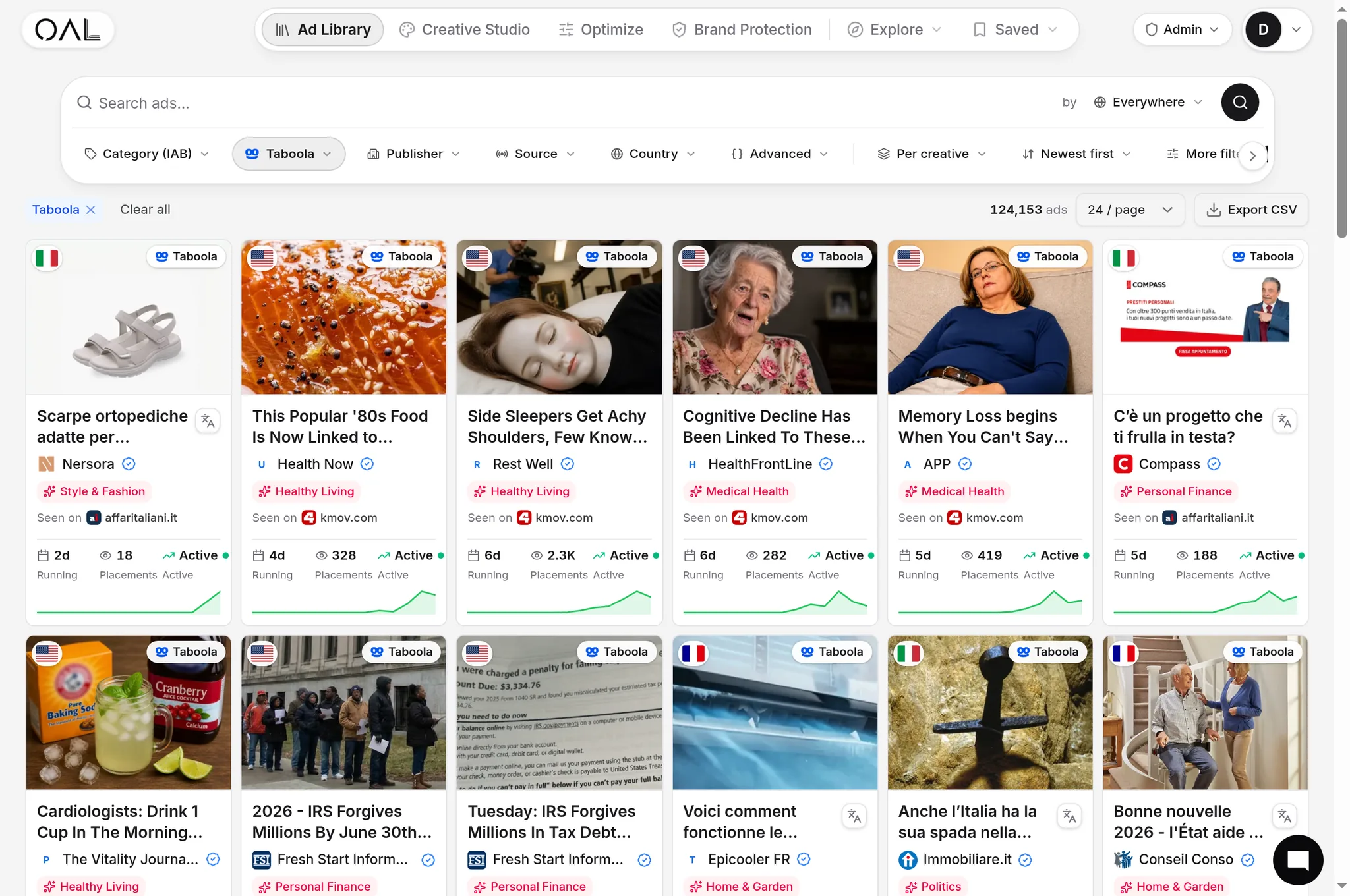
Look at what real native creative looks like and the point lands fast.

None of that screams "buy now." It promises information. That is the native instinct you have to build, and it is the opposite of the direct-response reflex most ecommerce buyers bring to the channel.
The native ad does not sell the product. It sells the next click. Everything that converts happens after the click, on a page you control.
If the channel vocabulary is new to you, the Native Advertising and Native Ad Network glossary entries cover the basics. This guide assumes you want the ecommerce application.
Why DTC brands use native, and where it fits#
Native earns a slot in the mix for a few concrete reasons.
Scale beyond saturated channels. Meta and Google auctions are crowded and expensive. Native taps a different supply, the open web of publisher content, where CPMs are often far lower and competition for your specific angle is thinner.
Cold-audience discovery. Native is one of the few paid channels genuinely good at putting a product in front of people who have never heard of it and are not searching for it. That makes it strong for launches and for demand creation, not just demand capture.
Room to tell a story. The advertorial gives you space to explain a differentiated or education-heavy product, the kind a 15-second video or a product grid cannot. The captured ads make this obvious. The longest-running ecommerce-adjacent creatives in our index lean hard on the "you did not know this" angle, like Rest Well's "Side Sleepers Get Achy Shoulders, Few Know This Side Sleeper Trick," which we have observed running for 14 days straight.

Credibility on premium inventory. A native unit on a major news site borrows that site's authority. Engagement reflects it: native placements typically pull meaningfully higher click-through than standard display banners, because they read as recommendations, not interruptions (AiDigital benchmarks).
Where native does not fit: ultra-thin-margin commodity products that cannot support a multi-step funnel, and brands with no capacity to make editorial content. Native is a content channel. If you will not make advertorials, pick something else.
The networks that matter in 2026#
Native inventory runs through a handful of dominant networks plus a long tail of specialists. The landscape consolidated when Outbrain completed its acquisition of Teads in February 2025 and the combined company rebranded to Teads Holding Co. in June 2025, though the Outbrain recommendation widget still operates as its own buying surface.
Two networks dominate what we capture. Taboola accounts for 157,727 creatives in our index and Outbrain for 84,252, which is why most DTC native tests start with one of them. The vertical split between the two is telling. On both, finance, insurance, and health crowd the top, but ecommerce is a real presence: 3,330 ecommerce creatives on Taboola and 1,479 on Outbrain (OpenAdLibrary index, June 2026). You are not early to an empty channel. You are competing against operators who already know the playbook.
| Network | Strength for ecommerce | Notes |
|---|---|---|
| Taboola | Largest reach, deepest publisher inventory, strong optimization | The default first network for most DTC native tests; 157K+ creatives in our index |
| Outbrain | Premium publisher relationships, now part of Teads | Often paired with Taboola for reach diversification; 84K+ creatives captured |
| MGID | Aggressive, performance-leaning, good for angle testing | Popular with affiliates and lean DTC teams |
| Revcontent | High-volume, lower-cost inventory | Quality varies; strong for high-velocity testing |
| Teads / MediaGo / Yahoo / MSN | Video and premium contextual reach | Useful as you diversify past the big two |
The practical sequence for a new advertiser: prove the funnel on one network (Taboola or Outbrain), expand to a second for reach, then add specialists to chase incremental volume. Starting on Taboola? Our step-by-step Taboola campaign setup walks the account mechanics. For the buying discipline across networks, the media buying for native ads beginner's guide is the companion to this piece. The Ad Network glossary entry explains how these intermediaries sit between you and publisher inventory, and Programmatic Native Advertising covers the auction layer underneath.
The ad-to-advertorial-to-offer funnel#
This is the core of ecommerce native, and the part newcomers skip. Three stages, each with one job.
Stage 1: the native ad earns the click#
The ad is a thumbnail image and a headline rendered inside a native ad widget on a publisher page. Its only goal is a high-quality click. That means curiosity over hard sell. "Why podiatrists are recommending these shoes" beats "20% off running shoes." You are competing with the article the reader came for, not with other ads.
It means native-looking imagery. Stock-photo polish reads as an ad and gets ignored. Slightly editorial, authentic images blend in and pull clicks. And it means headline-image congruence: the image sets up the headline's curiosity gap, and the page pays it off, or you bounce traffic and burn cash.
The captured ads show how far operators push this. Consumer World's Taboola ad reads "Tested: Does This $138 AC Run On Almost No Power? The Results Are Baffling!" That is a product ad disguised as a product test, which is exactly the point.

Stage 2: the advertorial builds desire#
The click lands on an advertorial, an editorial-styled page that reads like an article, not a sales page. This is where the conversion is actually won. A strong ecommerce advertorial does five things in order.
It opens with the hook the ad promised, so the reader feels continuity. It frames a problem the reader recognizes, then agitates it just enough. It introduces the product as the discovery, with proof: reviews, demonstrations, mechanism of action, a founder story. It handles objections (price, "does it really work," returns) before the reader thinks of them. And it drives to the offer with a clear, repeated call to action.
The advertorial does the warming that, on Meta, the social-proof and retargeting machinery does for you. Skip it and your cold native traffic has no reason to buy.
Stage 3: the offer closes a pre-sold buyer#
Only now does the reader reach the product or cart page. Because they arrived pre-sold, this page can be simpler than what you would build for paid search. The persuasion already happened. Keep the path short, the value proposition consistent with the advertorial, and friction low.
The metric that ties all three stages together is conversion rate (CVR) at each step: ad CTR, advertorial-to-offer click, and offer-to-purchase. A leak at any stage kills the whole funnel, so you instrument all three. Which brings us to tracking.
Tracking native ecommerce campaigns#
Native tracking is messier than walled-garden tracking, because the click crosses domains (publisher, then your advertorial, then your store) and the networks never see your backend. You have to stitch the journey yourself.
The practical setup has three pieces.
A tracker or UTM scheme that carries network, campaign, ad, and publisher or site ID through every hop. Site-level data is the gold on native. Performance swings wildly by publisher, and your single biggest lever is blocking junk sites and scaling winners.
Server-side conversion tracking wherever you can manage it, so iOS and ad-blocker losses do not blind you. Native networks increasingly accept server-side conversion feeds for their own optimization.
Per-creative and per-advertorial attribution, because you are testing multiple ad concepts against multiple advertorial angles and need to know which combination prints money.
Then watch the three CVR checkpoints as a chain. High CTR but low advertorial-to-offer means the ad over-promised. Good advertorial clicks but a dead offer page means your price or offer is the problem. Diagnosing which link is broken is most of the job.
Study the advertisers already winning#
You do not have to invent your funnel from a blank page. The fastest way to shortcut the learning curve is to watch DTC brands already buying native: what they promote, what their advertorials look like, and which creatives they have kept running long enough to imply profit.
This is where an ad-intelligence layer pays for itself. OpenAdLibrary captures live public native ads across Taboola, Outbrain, MGID, Revcontent, Teads and more, records the real creative image at full quality, classifies the ad-tech supply chain behind each placement, and follows the click through to the advertiser's landing page and advertorial without ever clicking a live ad. You see the whole funnel: the ad, the pre-lander, and the offer, for real advertisers in your category.
Two signals matter most when you study competitors.
Longevity. An ad that has been running for weeks is almost certainly profitable. Nobody pays to keep a loser live. A note on what "weeks" means in practice: our continuous-observation window currently tops out around 28 days, so the steadiest performers in our index, like SmartAsset's finance ad "Ask a Pro: How Can I Avoid Paying Taxes on IRA Withdrawals?" and Nebroo's "Americans Are Ditching Hearing Aids for This New Device" (26 days observed), are the ones still live at the edge of what we have tracked. That is our measured number. The industry lore about 90-day evergreen winners is a separate thing, and you should treat it as lore, not as our data.

Spread. A creative running across many publishers and geos is one a competitor scaled with confidence. Spread is the tell that an angle has legs. You will see the same offer localized hard, too, like Honda Cars India's "Step Into the All New Vibe of The New Honda City" on Taboola, which is the same native machinery aimed at a specific market.
Pair those signals with the platform's funnel capture and you can reverse-engineer a working ad-to-advertorial-to-offer flow in your vertical, then build your own version instead of copying. Tools like Creative Studio, Optimize, and Copy DNA turn that intelligence into your own tested creatives and angles. OpenAdLibrary is open and runs at $29.99/mo, with a free tier to browse 200 ads and no card required, against rivals charging $80 to $400/mo. That gap matters when you are validating a channel before you have proven it. Start free and look up who is running native in your niche before you spend a dollar on traffic.
Scaling without giving back your margin#
Once a funnel is profitable, scaling native is its own discipline, and the wrong move hands back your margin fast. Two patterns dominate.
Vertical scaling pushes more budget into proven creatives, sites, and geos. Horizontal scaling duplicates into new creatives, new advertorial angles, new networks, and new markets. Knowing which to apply when is the difference between compounding and stalling, and our breakdown of horizontal vs vertical scaling in native media buying goes deep on the mechanics.
A common high-leverage move once a domestic offer is proven is geographic expansion. Scaling to new Tier-2/Tier-3 geos often finds cheaper traffic and softer competition for an offer that already works at home. And because native CPCs creep as you scale, scaling affiliate campaigns without killing ROI applies directly to DTC: protect the unit economics as volume grows.
The strategic frame for all of it, how native fits a broader paid-acquisition strategy and why the channel rewards content and patience over hacks, lives in our pillar, the Native Advertising for Affiliate Marketing playbook. Ecommerce and affiliate native share the same engine. The difference is mostly who owns the offer.
The takeaway#
Native is not a worse version of Facebook ads. It is a different machine with different rules. You win by treating it as a content-and-funnel channel: an ad that earns a curious click, an advertorial that builds desire, and an offer that closes a buyer who is already sold. Instrument the three CVR checkpoints so you can see exactly where money leaks, study the brands already winning before you build, and scale deliberately so growth does not eat your margin. Do that and native opens a supply of cold-audience demand the crowded walled gardens simply cannot match.