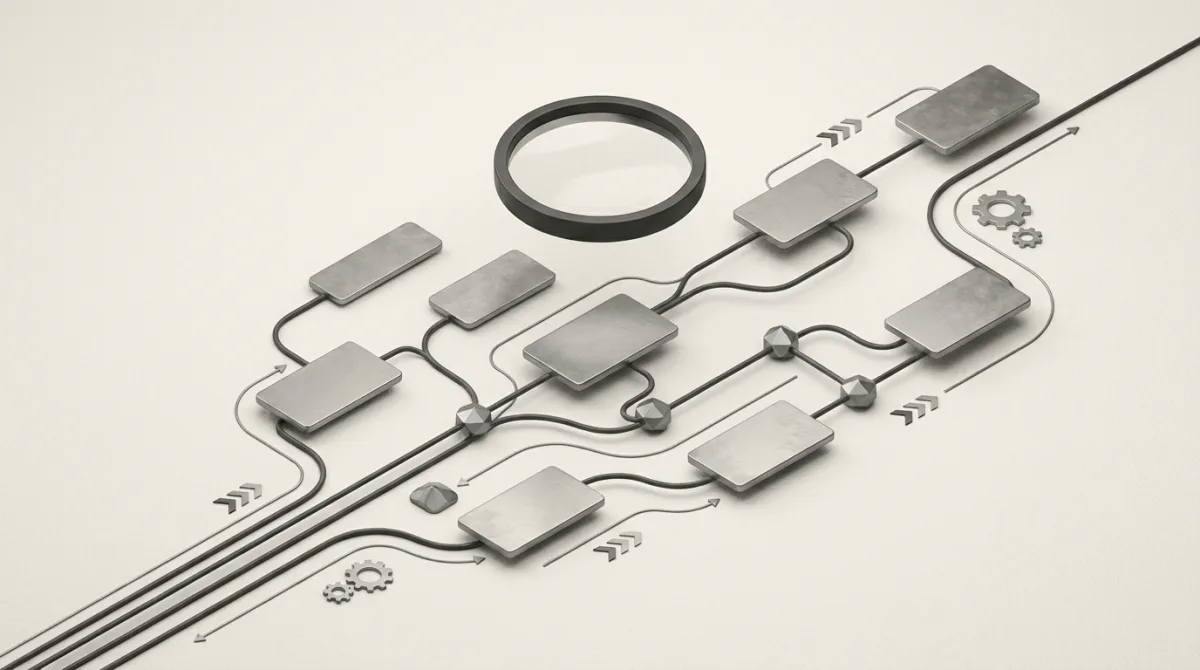
Español
 Português (Brasil)
 Français
 Deutsch
 Italiano
 Nederlands
 Polski
 Svenska
 Türkçe
 Русский
 Tiếng Việt
 Bahasa Indonesia
 Čeština
 Dansk
Dansk Norsk (bokmål)
 Suomi
Suomi Ελληνικά
 Română
 Magyar
 Українська
 ไทย
ไทย हिन्दी
 العربية
 עברית
עבריתWhat Is a Native Ad Spy Tool? How to Spy on Taboola & Outbrain Ads
A native ad spy tool turns the scattered, public-but-invisible world of Taboola and Outbrain into a searchable record: the real creative, the advertiser behind it, and the landing page the click actually leads to.


If you've scrolled to the bottom of a news article and hit a grid of "You won't believe what this celebrity looks like now" thumbnails, you've already met native advertising. Those slots are some of the most profitable real estate on the open web. They're also nearly invisible to the people buying ads on Meta and Google. A native ad spy tool exists to make that hidden market readable: which creatives are running, who is actually behind them, and where the clicks go.
Explore the live native ad spy tool and search current campaigns across Taboola, Outbrain, MGID, and more while you follow this guide.
This guide walks through how that works in concrete terms. Not the brochure version, the actual pipeline: how a creative gets captured, how the ad-tech supply chain gets untangled, and how a click gets followed to a landing page without firing a live ad. I'll use OpenAdLibrary's own capture stack across Taboola, Outbrain, MGID, Revcontent, Teads, MediaGo, Yahoo and MSN as the worked example, because the mechanics are easier to trust when someone spells them out.
For scale, our index currently holds 589,036 captured creatives tied to 25,933 advertisers, stitched from 5.4 million ad observations across 42 networks (OpenAdLibrary index, June 2026). That volume is the whole point. A single screenshot tells you nothing. A few million tells you who is winning.
What is a native ad spy tool?#
A native ad spy tool is software that continuously crawls publisher websites, records the native ads served on them, and rebuilds the campaign behind each one. It captures the real creative image and headline at full quality, identifies the demand network and the advertiser, and follows the click path to the landing page. The output is a research-grade view of campaigns that keep no public archive of their own.
The "spy" framing is a bit dramatic. Nothing here is covert. These ads run publicly, shown to every visitor on every page they appear on. What the tool does is systematize that public exposure: visit pages at scale, dedupe what it sees, and turn a fleeting impression into a permanent, searchable record. The hard part is engineering, not access.

That ad above is a real capture. Clickbaity, urgency-driven, dressed up as editorial. That's not an exception, it's the native playbook. Finance is the single largest vertical in our index at 17,232 creatives, just ahead of insurance (15,629) and health (14,895). If you sell in those niches, you are fishing in the most crowded pond on the open web, and you need to see what the regulars are catching.
Why native ads are uniquely hard to spy on#
It helps to understand why a dedicated category exists at all. Social ad transparency is comparatively easy because it's centralized. Meta runs an official Ad Library you can query directly. Native advertising has no such thing.
Native inventory is decentralized and programmatic. A single advertiser's campaign on Taboola might surface across thousands of independent publishers: local news sites, sports blogs, recipe aggregators, each rendering the same recommendation widget through its own template. There is no master list. The only way to know an ad exists is to be on the page when it serves.
That decentralization sits on top of consolidation. The native landscape in 2026 runs on a handful of demand networks, and our capture counts show how lopsided it is:
| Network | What it is | Creatives in our index |
|---|---|---|
| Taboola | Largest open-web recommendation network, now powers Yahoo native inventory | 157,727 |
| Outbrain / Teads | Recommendation plus video, merged in 2025 | 84,252 |
| MGID | High-volume performance native, big in arbitrage and affiliate | 49,689 |
| Revcontent | Performance content network, popular with direct-response buyers | 11,478 |
| Teads, MediaGo, MSN | Video and premium / Microsoft inventory | Often missed by single-network tools |
Taboola alone accounts for roughly a quarter of everything we've captured. The verticals split by personality, too. Taboola leans health and finance. MGID is overwhelmingly entertainment (8,904 of its creatives sit in that bucket, by far its biggest). Knowing that shape up front saves you from researching the wrong network for your offer.
Because demand is concentrated but supply is scattered, a credible native spy tool has to do two jobs at once: crawl broadly enough to catch ads wherever they land, and classify precisely enough to map each one back to the right network and advertiser. Tools that watch a couple of networks, or sample a few big publishers, miss most of the market.
How a native ad spy tool actually captures a creative#
This is where implementations split hard, and where it pays to be specific. There are two broad ways to capture native ads, and they produce very different data.
The brittle way is synthetic browser clicks. Some tools spin up automated browsers, load publisher pages, and screenshot whatever widget appears. It works, but it's slow, expensive, and it fires real impressions (sometimes real clicks) into the ad network. That costs advertisers money and contaminates the very data you're trying to read.
The robust way is direct-API capture. OpenAdLibrary takes the API-only path. Native widgets fetch their recommendations from documented endpoints, the same calls a publisher's page makes to fill the widget. By speaking that protocol directly, the platform pulls the creative, headline, advertiser metadata and click URL without rendering a live ad slot and without clicking it. It runs far cheaper at scale, and it doesn't generate phantom impressions on a competitor's campaign.
The single most important quality signal in a native spy tool is whether it captures the real creative image at full resolution. Blurry thumbnails or reconstructed text mean the tool is screenshotting from a distance. Sharp original assets mean it pulled the creative from source.

Look at the detail in that hearing-device ad. The product, the typography, the framing all came through clean because the asset was pulled from the source, not photographed from across the room. Once captured, every creative gets fingerprinted and deduplicated, so the same ad seen on 80 publishers becomes one record with 80 placements attached instead of 80 noisy duplicates. That dedupe step is what turns raw crawling into a clean, countable dataset. (For a deeper teardown of every stage, see our companion piece on how ad spy tools capture native ads.)
Classifying the ad-tech supply chain#
Capturing the creative is half the job. A thumbnail with a headline tells you what is being advertised, not who is behind it or how it's served. Rebuilding that chain is the analytical core of a native ad spy tool.
For each captured ad, the pipeline resolves a short sequence of questions:
- Which demand network served it? The widget's source endpoint and tracking parameters identify whether it came through Taboola, Outbrain, MGID, Revcontent or another network. This is read straight from the native ad widget, not guessed.
- Who is the disclosed advertiser? Networks attach an advertiser or "sponsored by" label. The tool normalizes these, collapsing dozens of spelling variants and shell account names into a single advertiser entity, so you see everything one buyer is running rather than fragmented slices. That normalization is how we got from millions of raw observations down to 25,933 distinct advertisers.
- What's in the click chain? Between the ad and the landing page sit tracking redirects, affiliate networks and cloaking layers. Identifying these reveals the supply path and often the affiliate program or DSP in play. This is the programmatic native advertising plumbing that decides who actually gets paid.
The payoff of classification is that you stop looking at isolated ads and start looking at advertisers. You can ask "show me every creative this competitor has run on MGID in the last 90 days" instead of stumbling across one ad at a time.
Following the click to the landing page#
A native creative is bait. The money is made on the landing page: the pre-lander, the advertorial, the offer page. That's the part most casual researchers never see, because manually clicking native ads is tedious and risks distorting the campaign you're studying.
A native ad spy tool follows the click programmatically. It traverses the redirect chain from the ad's click URL all the way to the final destination and records what's there: the pre-lander angle, the offer, the call to action, the funnel structure. Done correctly, this happens without clicking the live ad. The chain is followed from the captured URL, so no fraudulent click lands on the advertiser's campaign. We've stored 926,259 landing-page captures this way, which means most of the time the funnel is already sitting there waiting for you.

This is where competitive intelligence gets genuinely actionable. Seeing a winning creative is useful. Seeing the full creative-to-landing-page funnel that monetizes it is what lets you reverse-engineer a working campaign. The solar-battery ad above has been observed running for 27 days straight, which tells you the offer behind it is converting. For affiliates and direct-response buyers, the landing page often matters more than the ad, and capturing it is the feature that separates a real native spy tool from a screenshot gallery. We go deeper on this for performance marketers in our guide to the best ad spy tools for affiliate marketers.
Reading the data like a media buyer#
Capturing ads is mechanical. Interpreting them is the skill. Three signals do most of the work.
- Longevity. How long has a creative been continuously observed? Nobody runs a losing native ad for three weeks. Sustained runtime is the closest thing to a public profitability signal you'll get.
- Spread. How many distinct publishers and geos is it appearing on? Broad, growing distribution means the advertiser is scaling spend behind it. Another winner tell.
- Re-observation frequency. How often does the crawler keep seeing it? Frequent re-observation across many placements implies real budget, not a token test.
One honest caveat on longevity, because plenty of vendors fudge this. Our index observes each creative over a window, and the longest continuous runs we currently track sit around 28 days. The SmartAsset IRA-tax ad on Outbrain, the "Dog licks aren't kisses" piece, several "My IQ" quiz creatives on the Microsoft Audience Network: all sitting at 28 days of unbroken observation in our data. That's a strong profitability signal grounded in what we actually saw. The "this creative has run for 90 days straight" claim you'll hear elsewhere is industry lore, not something we present as our own measured finding. Be wary of any tool that conflates the two.

Used together, these signals let you rank a competitor's portfolio by likely winners instead of guessing from one screenshot. OpenAdLibrary surfaces longevity and spread directly on each creative, then pairs them with tools to act on what you find: Copy DNA for breaking down winning angles, Creative Studio for adaptation, and Optimize for managing your own campaigns once you've learned what works. There's also an API and an MCP server if you want to pull this intelligence into your own stack.
What no tool can give you is exact spend. That number lives inside the advertiser's billing account and nowhere else. Be skeptical of any product claiming a precise dollar figure. The honest signal is evidence of profitability (longevity, spread, frequency), not a fabricated spend estimate.
How to start spying on Taboola and Outbrain ads#
The practical workflow is short:
- Pick your target. Search by competitor name, by offer keyword, or by network. For example, browse the Taboola ad spy view to see what's live right now.
- Filter to winners. Sort by longevity and spread to push the long-running, widely distributed creatives to the top. Ignore one-off tests.
- Open the funnel. For each winner, study the creative angle, then follow it through to the captured landing page to see the full offer.
- Compare across networks. Look up the same advertiser on Outbrain, MGID and Revcontent. Buyers who win on one network usually port the offer to others, and the variations tell you what they're testing.
- Adapt, don't copy. Use the patterns to inform your own angles and pre-landers.
You don't need a paid plan to check that this works for your niche. OpenAdLibrary's free tier lets you browse roughly 200 ads with no credit card, enough to verify coverage against advertisers you already recognize. We cover the no-cost options, including the limits to watch for, in our rundown of the free native ad spy tool tier. To see where it sits against the legacy players, our tested and ranked roundup of the best native ad spy tools puts the whole category side by side.
The short version: native ad spying is no longer a premium-only capability. The pipeline (direct-API creative capture, supply-chain classification, click-to-landing-page tracing) is well understood, and an open, affordable platform now does all three for a fraction of what Adbeat, AdPlexity or Anstrex charge. Start free and look up your top competitor's native campaigns before your next test budget goes out the door.