Español
 Français
 Deutsch
 Italiano
 Nederlands
 Polski
 Svenska
 Türkçe
 Русский
 日本語
日本語 한국어
한국어 简体中文
简体中文 Tiếng Việt
 Bahasa Indonesia
 繁體中文
繁體中文 Dansk
Dansk Norsk (bokmål)
 Suomi
Suomi Ελληνικά
 Română
 Magyar
 Українська
 ไทย
ไทย हिन्दी
 العربية
 עברית
עבריתMicrosoft Audience Network Review 2026: 281,000+ Live Ads Analyzed
The Microsoft Audience Network is the largest native channel in OpenAdLibrary's index — 281,839 live creatives. Here is what that corpus says about whether it deserves your budget.


The Microsoft Audience Network — the native ad system behind MSN, the Microsoft Edge new-tab feed, and Outlook.com — is the largest native channel most media buyers have never seriously tested. OpenAdLibrary tracks 281,839 live Microsoft Audience Network creatives as of July 2026, the single biggest network corpus in our index of 725,000+ native ads — more than a third larger than our Taboola corpus. The short version of this review: cheap clicks at real scale, an older desktop-heavy audience that converts for finance, insurance, home and health offers, and genuinely differentiated targeting via LinkedIn profile data — offset by uneven placement transparency, a buying interface built for search marketers, and an audience that is flatly wrong for youth-skewed offers.
MSN, Microsoft Audience Network, audience ads — the naming, sorted#
Three names, one channel, endless confusion:
- MSN is the consumer portal (msn.com, now largely branded Microsoft Start) where much of the inventory renders. When buyers say "MSN native ads," this is what they picture.
- Microsoft Audience Network (MSAN) is the ad product: native placements across MSN/Start, the Edge new-tab feed, Outlook.com, and syndication partners.
- Audience ads / audience campaigns is what the buying interface inside Microsoft Advertising calls the campaigns themselves.
You buy it all in the same Microsoft Advertising account you would use for Bing search — which is both a convenience and, as we will get to, a trap. For placement-by-placement mechanics, our MSN native ads guide goes deeper; this review is about whether the channel deserves budget.
What you are actually buying#
Placements. In-feed native cards inside the MSN/Microsoft Start news feed, the Edge new-tab page, Outlook.com inboxes, and partner properties. The Edge new-tab feed matters more than people realize: every default Edge install opens onto it, many times a day. That is default-on attention at a scale few ad products can claim.
Formats. Responsive image-based native ads: you supply images in a few aspect ratios plus headlines and descriptions, and Microsoft assembles them per placement. There is no meaningful creative canvas beyond that — your levers are the image and the headline, the same as on every native network.
Targeting. Microsoft's first-party intent data (search and browsing signals), in-market audiences and remarketing — plus LinkedIn profile targeting by company, industry and job function. No other native network offers anything comparable for B2B. The exact audience menu changes over time, so check Microsoft Advertising's current documentation before planning around any single option.
Pricing. CPC auction, no rate card. Media buyers commonly report Tier-1 desktop CPCs landing roughly between $0.10 and $0.80 — unofficial numbers that swing hard by vertical, geo and creative, but the right order of magnitude. Where that sits against other networks is mapped in our native ads CPC benchmarks.
What 281,839 live ads say about who wins here#
Index composition reflects our capture coverage as well as network scale, so treat these as a deep sample rather than a census. Still, the sample is deep. Top classified verticals among live Microsoft Audience Network creatives, July 2026:
| Vertical | Live creatives |
|---|---|
| Ecommerce | 9,978 |
| Finance | 9,029 |
| Travel | 8,830 |
| Insurance | 8,406 |
| Software | 7,909 |
| Education | 5,025 |
Two things stand out against the rest of the native ecosystem (full numbers live in our native advertising statistics roundup):
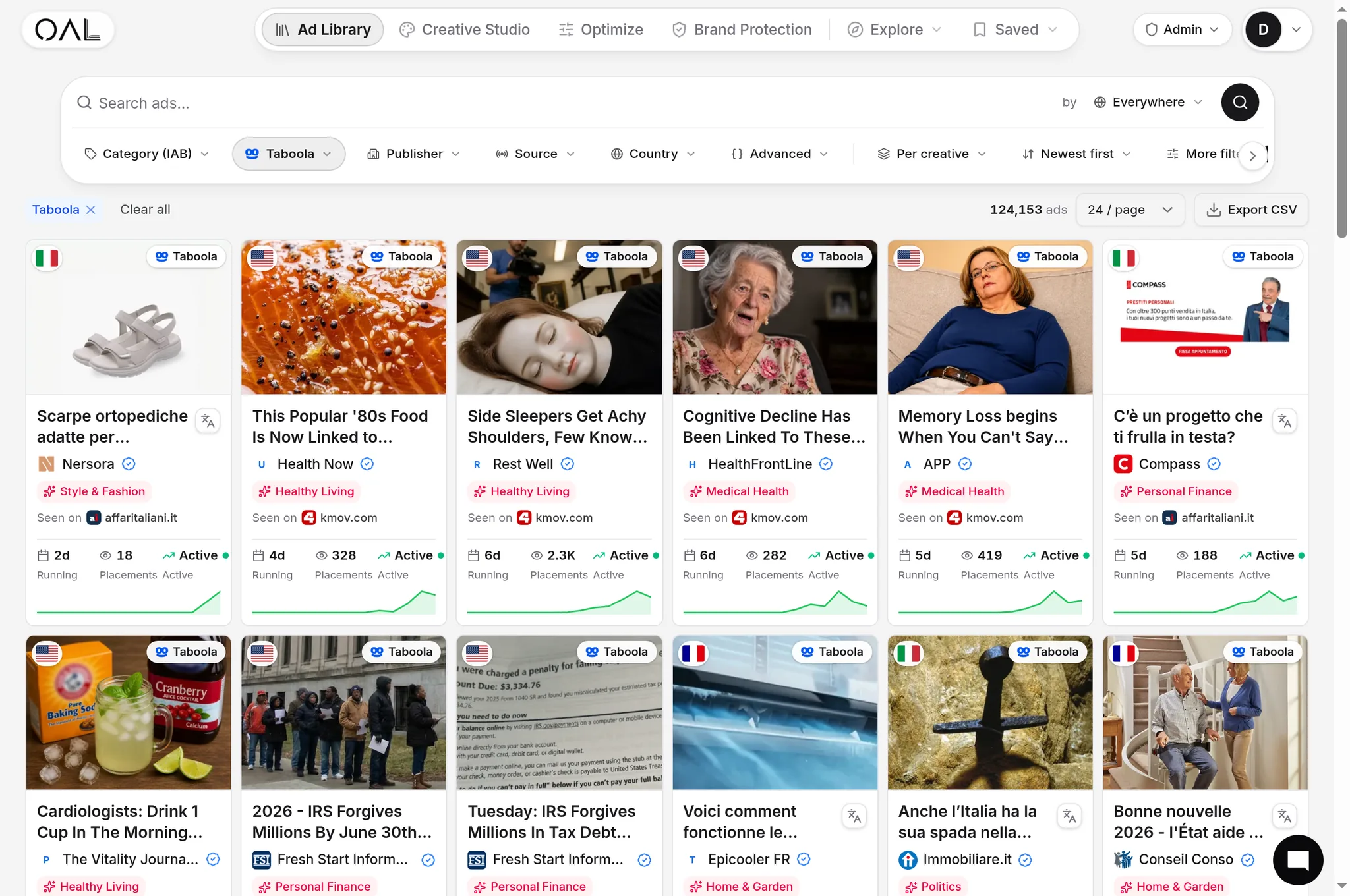
- The mix is broader than Taboola's. Taboola's corpus is health-dominant; MSAN demand spreads across commerce, finance, travel, insurance and software far more evenly. That is the fingerprint of brand and mid-funnel budgets coexisting with direct response — not just affiliate demand.
- The inventory is global and localized. Live MSAN creatives in our index run in German, Spanish and Portuguese, from regional B2B agencies to Amazon's Brazilian storefront. If you operate outside the US, the inventory is there.
The strongest signal is longevity. At capture, seven of the ten longest-running ads in our entire index — across every network we track — were Microsoft Audience Network creatives: Fisher Investments asking "When Should You Retire?", Boots Hearingcare, retiree cost-cutting listicles, senior home-upgrade lead gen, all at 38 days of continuous observation. Advertisers do not sustain spend on losers; ad longevity is the closest thing to a public profitability signal that native advertising has. The pattern across the longest-running native ads is unambiguous: offers aimed at an older demographic keep paying out on this network.
Strengths: why buyers quietly scale it#
- CPCs a fraction of search, on intent-adjacent inventory. You lose the keyword, but you keep Microsoft's behavioral signals — a better trade than most native networks offer.
- An older, desktop-heavy audience nobody else sells at this scale. MSN, Edge and Outlook users skew 45-plus. If your offer monetizes that demographic — retirement finance, insurance, hearing care, home services — this audience is the product.
- LinkedIn profile targeting. Ordinary native networks make B2B a spray-and-pray exercise. Industry and job-function layers make MSAN the only native channel where a niche B2B advertiser can buy sanely.
- Search-grade measurement. UET tagging, conversion goals, shared account structure with Bing search. Nothing exotic, everything functional.
- Thin competition. Most native specialists are busy on Taboola and Outbrain; most Microsoft Advertising users are search people who never open the audience side. Gaps like that are where margins live.
Weaknesses: where it will burn you#
- Placement transparency is mediocre. Reporting on where your ads actually served is coarse, and the long tail of syndication inventory varies in quality. Review placement performance in week one and exclude aggressively.
- The search-first interface breeds mistakes. Microsoft has historically nudged search campaigns to extend onto audience inventory. Never let search and native share a campaign, a budget or a bid strategy — native clicks behave nothing like search clicks, and blended settings quietly misallocate money.
- Creative review is stricter than mid-tier native. Advertorial-style angles that sail through MGID or Revcontent get disapproved here. Plan cleaner angles and softer claims.
- The demographic cuts both ways. Offers built for under-35s die on this inventory, no matter how good the creative.
- Scale thins outside Tier-1. Coverage is real in major markets and shrinks fast in smaller geos.
Who should (and should not) buy it#
Strong fit: finance and insurance advertisers, senior-targeted health and home offers, B2B with defined job-function targets, ecommerce whose buyers skew 40-plus, and any Bing search advertiser with conversion history ready to feed the audience side.
Weak fit: youth-skewed DTC, aggressive affiliate angles that depend on lax review, app installs chasing young users, and buyers who need granular placement-level control from day one.
The verdict#
The Microsoft Audience Network is under-bought relative to its inventory quality, and the live-ad evidence backs that up: the advertisers who commit to it renew their spend week after week, which they would not do at a loss. It rewards buyers who treat it as its own channel — separate campaigns, native-specific creative, placement hygiene — and punishes search marketers who toggle it on as an afterthought. If your offer matches its audience, it belongs in your top three native tests this year, alongside the incumbents in any ranking of the best native ad networks.
Before spending, look at what already runs there. OpenAdLibrary's native ad spy tool lets you browse the full 281,839-creative MSAN corpus — filter by vertical, geo and language, sort by longevity, and trace creatives to their landing pages — free to start, with full access at $29.99/month. The research workflow itself is covered step by step in how to spy on competitor native ads. It is also worth knowing how the channel got here: MSAN absorbed much of the demand that Yahoo Gemini's native business left behind, which is part of why its advertiser mix looks so much more established than its public profile suggests.