Español
 Português (Brasil)
 Français
 Deutsch
 Italiano
 Nederlands
 Polski
 Svenska
 Türkçe
 Русский
 日本語
日本語 한국어
한국어 简体中文
简体中文 Tiếng Việt
 Bahasa Indonesia
 繁體中文
繁體中文 Čeština
 Dansk
Dansk Suomi
Suomi Ελληνικά
 Română
 Magyar
 Українська
 ไทย
ไทย हिन्दी
 العربية
 עברית
עבריתTaboola vs Teads: Performance Feed vs Premium Attention
Taboola sells performance clicks from content feeds; Teads — the merged Outbrain-Teads company — sells premium in-article attention. How the two differ on formats, cost, advertiser mix, and when each is the right buy.


Taboola and Teads both get called "native advertising networks," but they sell fundamentally different products. Taboola is a performance platform: it auctions cost-per-click traffic from content-recommendation feeds across one of the largest open-web publisher footprints in the industry, and its advertiser book is dominated by direct-response marketers running advertorial funnels. Teads — which since February 2025 means the merged Outbrain-Teads company — is built around premium in-article video and display, bought mostly on CPM by brand advertisers who pay for attention and viewability rather than clicks. Choose Taboola when you need scalable, measurable clicks into a conversion funnel. Choose Teads when you need brand reach on curated editorial. Everything else in this comparison flows from that split.
Two different products wearing the same "native" label#
"Native" covers any ad that adopts the form of the content around it, which is exactly why this comparison confuses people. Taboola and Teads both qualify — but they occupy opposite ends of the funnel and opposite ends of the buying culture.
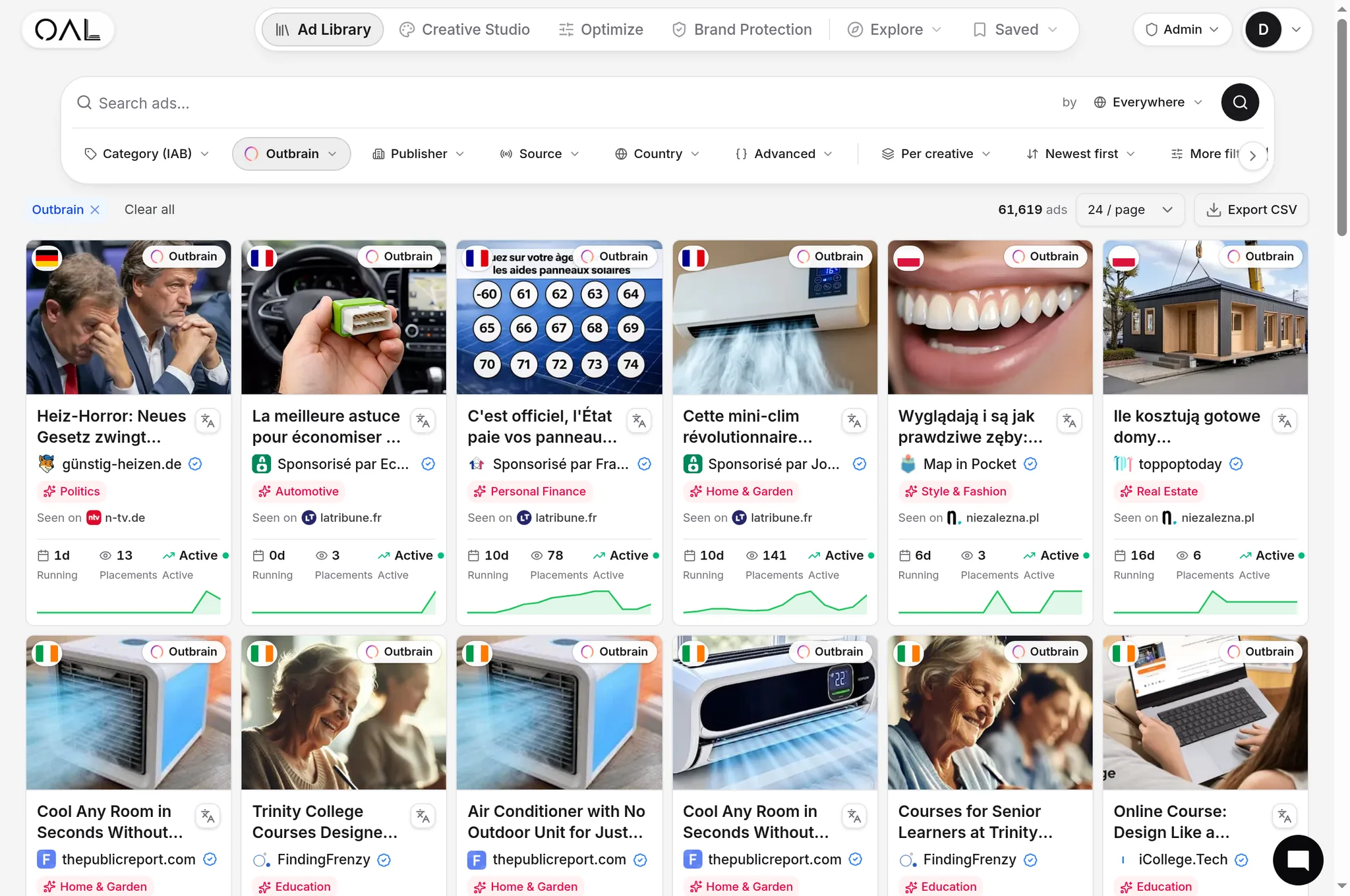
Taboola runs content-recommendation widgets and feeds — the sponsored-story modules below and within articles on news and content sites. The unit is an image plus a headline written to read like editorial. Buyers pay per click, and the click usually lands on an advertorial or a product page. Taboola's entire system — the auction, the reporting, the performance platform it rebranded as Realize in 2025 — is organized around squeezing conversions out of that click. The full mechanics are covered in How Taboola Ads Work.
Teads built its business on the opposite unit: the in-article placement that appears between paragraphs as a reader scrolls. Teads is credited with inventing outstream video — video that plays inside article content rather than before another video — and sold it to brand advertisers as a viewable, brand-safe alternative to pre-roll. The typical buyer is an agency running a CPM campaign measured on completion rate, viewability, and attention metrics, not clicks or cost per acquisition.
So while both networks put ads inside editorial content, one is selling you traffic and the other is selling you attention. That single difference drives everything downstream: pricing, creative requirements, publisher mix, targeting philosophy, and which advertisers you will actually find on each network.
The merger changed what "Teads" means#
You cannot compare these two accurately without the corporate history. In February 2025, Outbrain — Taboola's long-time direct competitor in feed recommendations — completed its acquisition of Teads and adopted the Teads name for the combined company. We unpacked the deal in Did Outbrain Become Teads? and the merged platform itself in What Is Teads?.
The practical consequence is that "Teads" now houses two distinct inventory types:
- The legacy Teads side — premium in-article video and display on curated editorial. Brand-first, CPM-first, agency-facing.
- The legacy Outbrain side — feed and recommendation placements that compete head-to-head with Taboola for performance budgets. If that is the comparison you actually need, read Taboola vs Outbrain instead.
This article compares Taboola against what "Teads" is known for — the premium in-article, attention-focused product — because that is what buyers usually mean by the question. Just be aware that a Teads sales conversation in 2026 can cover both sides of the house, and the right response to each pitch is different.
Formats, buying models, and publisher footprint#
| Dimension | Taboola | Teads |
|---|---|---|
| Core unit | Image + headline in recommendation feeds and widgets | In-article video and display between paragraphs |
| Primary buying model | CPC auction | Predominantly CPM (managed and programmatic) |
| Typical goal | Conversions: leads, sales, subscriptions | Brand: reach, attention, completion, lift |
| Creative input | Editorial-style image + headline variants | Video assets, rich display, high-impact formats |
| Publisher base | Very large open-web footprint, incl. major portals | Curated premium editorial; fewer, higher-tier sites |
| Entry path | Self-serve with low practical minimums | Skews managed/IO and DSP deals; self-serve exists |
| Measurement | CPA, ROAS, click-to-conversion tracking | Viewability, attention metrics, brand-lift studies |
Two footnotes matter here. First, Taboola holds a long-term exclusive deal to power native advertising across Yahoo's properties, which stacks enormous portal inventory on top of its open-web publisher network. Second, Teads invested early in cookieless contextual targeting and attention measurement — if your KPI framework is built on attention units rather than clicks, that is genuinely its home turf. Both platforms revise their format lists constantly, so verify any specific unit against the network's current documentation before you build a plan around it.
What the live index shows about advertiser mix#
Networks describe themselves in sales language; their live creative books tell you what they actually are. OpenAdLibrary's index holds 725,000+ live native ad creatives across 49 networks as of June 2026, including 206,145 from Taboola — and the contrast with Teads is stark.
Taboola's book is direct-response. The top verticals among classified Taboola creatives in the index are health (11,982), finance (8,200), insurance (7,422), ecommerce (5,185), home and garden (4,414), and software (3,665). Scroll the live creatives and you see the classic native playbook in action: a beauty advertorial headlined "Wrinkles: Most People Use Lotions. Koreans Do This Instead (It's Genius)" that has been running for 12 days, a hearing-clinic ad from Audika observed for 37 days straight, a curiosity hook — "My garden had no butterflies for years — then I hung one of these up" — also at 37 days. These are funnels, not brand statements: headlines engineered to earn a click and hand off to a pre-lander.
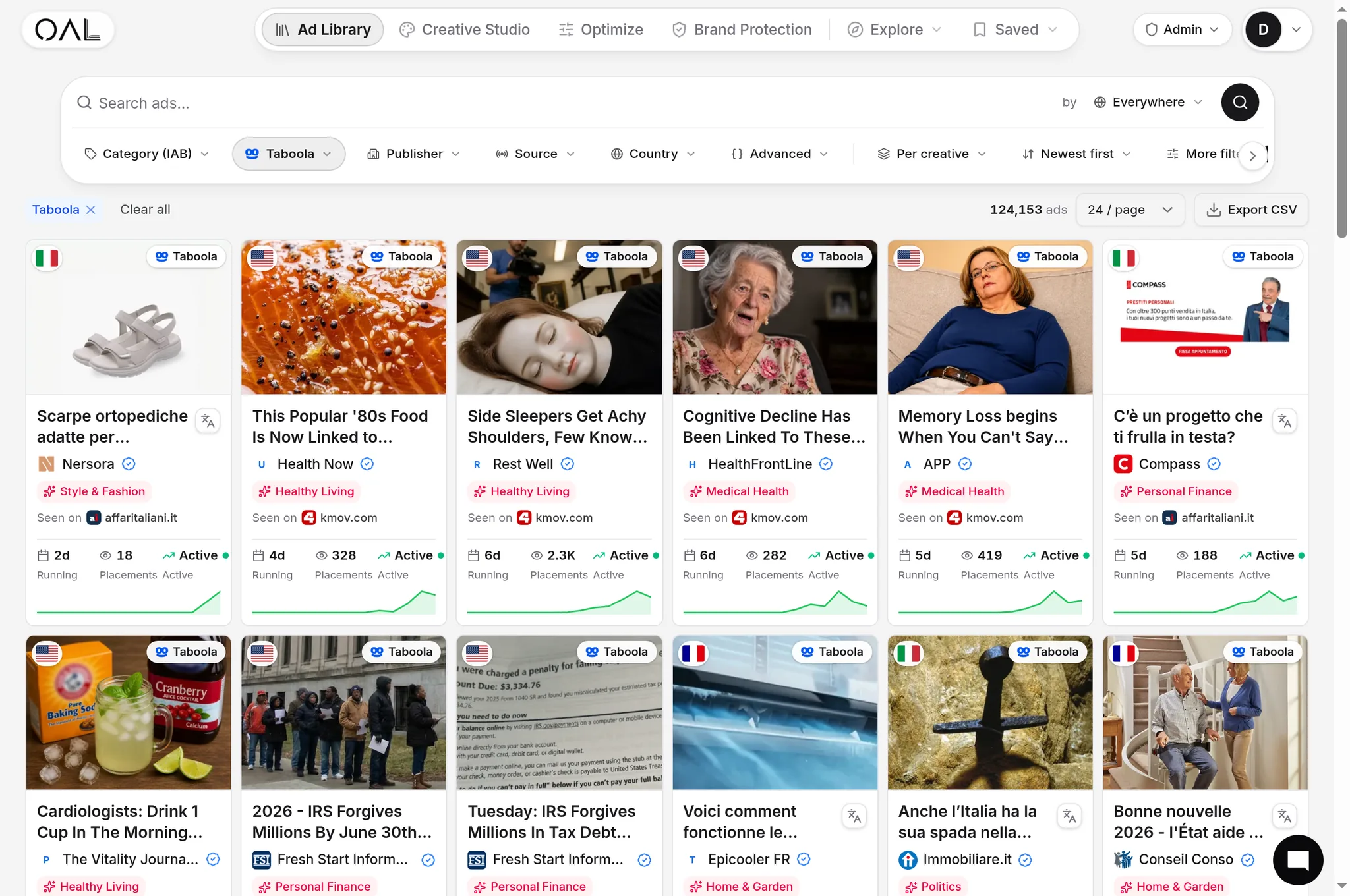
The Teads creatives we capture are brand ads. Our Teads index is small — 113 creatives as of June 2026 — and the smallness is itself the finding. Legacy-Teads inventory is in-article video and display for brand campaigns: ephemeral, often sold through private deals, and not built on the persistent feed widgets that native capture methodologies key on. What we do capture skews travel (22 creatives), ecommerce (9), finance and education (4 each): Flight Centre advertising New Zealand holiday packages with real prices in the headline, Georgetown University promoting graduate programs, a nursery chain selling same-day landscaping. Real brands making direct offers, with none of the advertorial misdirection that defines the feed economy.
That is the cleanest summary of this comparison you will find anywhere: one network's book is curiosity headlines feeding advertorials, the other's is brands stating offers. You can browse both books live — advertiser, geo, device, and observed run length for every creative — at /spy/taboola and /spy/teads.
Cost: CPC clicks vs CPM attention#
Neither network publishes a rate card, so treat everything in this section as practitioner-reported and directional.
Taboola is a CPC auction. Media buyers commonly report Tier-1 desktop CPCs from roughly $0.20 to $0.90, with mobile typically cheaper and competitive verticals like finance and health at the top of the range — your geo, device split, and creative CTR move these numbers a lot. The figure that matters is not the CPC itself but the arithmetic behind it: click cost times funnel conversion rate against payout or margin. Our native CPC benchmarks piece breaks the ranges down by network and geo tier.
Teads is bought on CPM, and premium in-article video CPMs live in a different economic universe. Brand buyers are paying for verified attention on quality editorial; on an effective-cost-per-click basis, the same budget buys far fewer clicks than any feed network would deliver. That is not a flaw — clicks are not the KPI. But it explains a common failure mode: a direct-response marketer evaluating Teads on CPA math will almost always conclude it is "too expensive," while a brand marketer evaluating Taboola on attention metrics will conclude the feed is "low quality." Both are measuring the other's product with the wrong ruler.
Budget fit follows directly. Taboola rewards buyers who can feed it dozens of creative variants, read CPC and conversion data daily, and kill losers fast. Teads rewards buyers who arrive with finished video assets and a reach-and-frequency plan.
Creative requirements: curiosity vs polish#
The two networks demand different creative muscles, and underestimating this is the most common way buyers waste their first budget.
Taboola creative is a headline business. The image earns the glance; the headline earns the click; the advertorial earns the conversion. Winning Taboola ads read like the editorial around them — specific, curious, slightly incomplete — and the craft is testable and learnable. Our breakdown of native headline formulas that get clicks catalogs the recurring patterns, and they are everywhere in Taboola's live book.
Teads creative is production. A fifteen- or thirty-second video that survives sound-off autoplay between paragraphs, brand-legible in the first two seconds, is a fundamentally different asset than an advertorial thumbnail. If you do not already have video creative — or budget to produce it properly — Teads' core product is not usable, no matter how attractive the inventory.
Targeting and optimization#
Taboola: geo, device, OS and platform targeting; audience segments; publisher-level transparency and blocking — reviewing where spend lands and cutting weak sites is the core optimization loop — plus automated bidding toward conversion goals. The workflow is classic performance media: launch broad, prune publishers and creatives aggressively, scale what survives.
Teads: contextual and cookieless targeting on editorial categories, attention-based optimization, brand-safety controls, and measurement partnerships for lift studies. The optimization loop is a media plan, not a kill list — you tune reach, frequency, and context rather than pausing publishers on CPA.
Both platforms change their targeting menus frequently; verify specifics in current network documentation rather than relying on any third-party summary, including this one.
Which should you buy?#
Choose Taboola if:
- You are an affiliate, lead-gen, or DTC buyer measured on CPA or ROAS.
- Your funnel runs through advertorials or pre-landers — feed clicks convert through content, not cold product pages.
- You need self-serve control, granular publisher data, and fast creative iteration.
- Your budget needs CPC economics to survive the testing phase.
Choose Teads if:
- You have video assets and a brand KPI: awareness, attention, completion, lift.
- Premium editorial adjacency and brand safety are requirements, not preferences.
- You buy through an agency or DSP and plan in reach and frequency, not clicks.
Run both if you are a brand with a genuine full-funnel plan: Teads-style in-article video builds the awareness pool, and Taboola-style feed traffic converts it downstream. The two products barely overlap, which ironically makes them easy to stack without cannibalization.
What a first test looks like on each#
The shape of a sensible first commitment differs as much as the products do.
A first Taboola test is a self-serve performance sprint. You launch one campaign per geo-device combination, load ten to twenty headline-image variants against a single proven funnel, and set CPC bids conservatively enough to gather data without buying the whole feed. The first week is triage: kill creatives with weak CTR, kill publishers that eat budget without converting, and let the survivors define the angle. Expect to spend real money learning before the account stabilizes — native testing is an iteration cost, not a setup cost — and size the test budget so that at typical Tier-1 click prices you can afford several hundred clicks per variant before judging it. The step-by-step version of this workflow, from account structure to pruning cadence, applies to any feed network.
A first Teads engagement usually starts as a conversation, not a launch. You bring video assets (or a production plan), a target audience defined in contextual and demographic terms, a reach-and-frequency goal, and a measurement plan — ideally a brand-lift study or attention benchmark agreed before the flight. The evaluation window is the flight, not the day; you are not going to pause a Teads campaign after 48 hours over CPA the way you would kill a Taboola creative. Buyers accustomed to performance dashboards should decide in advance what "working" means, because the platform will report attention and completion, and it is your job to connect those to business outcomes.
If the two paragraphs above describe two different jobs — they do. Staff accordingly.
Scout both books before you commit budget#
Whichever way you lean, do not fund an account blind. Twenty minutes of research answers the questions a sales deck will not:
- Is your category actually there? Search your vertical on each network. If nobody who looks like you is running, that is a signal — either an open lane or a graveyard, and the rest of the book usually tells you which.
- What survives? Sort by observed run length. A creative that has run 30+ days is almost certainly paying for itself, for reasons laid out in why ad longevity is the strongest public signal. Long-running ads are the closest thing native advertising has to a public P&L.
- What does the house style look like? Taboola winners look like curiosity-driven editorial; the Teads book looks like polished brand assets. Your creative budget should match the house style of the network you pick, not fight it.
OpenAdLibrary tracks both networks continuously — creatives, resolved advertisers, geos, devices, landing pages, and run lengths — inside an index of 725,000+ live native ads across 49 networks. It is the fastest way to ground a Taboola-vs-Teads decision in what advertisers are actually doing rather than what either sales team says.