Español
 Português (Brasil)
 Français
 Deutsch
 Italiano
 Nederlands
 Polski
 Svenska
 Türkçe
 Русский
 日本語
 한국어
 简体中文
 Tiếng Việt
 Bahasa Indonesia
 繁體中文
 Čeština
 Dansk
 Norsk (bokmål)
 Suomi
 Ελληνικά
 Română
 Magyar
 Українська
 ไทย
 हिन्दी
 العربية
 עברית
Outbrain Minimum Budget: Daily Spend Rules & Smarter Test Sizes
The platform will accept the minimum; it just won't teach you anything at that spend. How to size an Outbrain test from your CPA instead of from the floor.


Outbrain's help center sets a minimum campaign budget of 20 USD, 20 EUR or 20 GBP per day; monthly budgets must be at least $600, and campaign-length budgets at least the equivalent of $20 for each day of the campaign. The public help pages reviewed for this guide do not state a minimum CPC. Check the current Outbrain documentation and your campaign setup screen, because these settings can change. The more useful answer: the platform minimum and a meaningful test budget are different things. The floor is what Outbrain will accept; a test that can tell you something is sized from your target CPA, which often means hundreds of dollars over the test rather than one day's minimum.
The platform floors, and why they exist#
Ad platforms may set floors such as a minimum budget, deposit or bid. The floor Outbrain documents is the $20-a-day budget minimum. It charges only for clicks received, so a $20 daily budget is a ceiling rather than a guaranteed spend, although daily spend can run up to 20% over the budget. The floor says nothing about the CPC you will need, because your bid still competes in the auction for placements.
Outbrain completed its acquisition of Teads in February 2025, and the combined company operates under the Teads name (the platform side of that story is covered in Did Outbrain become Teads?). Managed or programmatic buying through Teads may carry different terms from the self-serve Outbrain dashboard, so treat any figure on a third-party blog, including this one, as a pointer to verify against current documentation.
The trap is anchoring on the floor. "The minimum is about $20/day, so I'll test with $20/day for a week" is an easy way for small advertisers to waste a first native budget: they spend enough to be charged, but not enough to learn anything.
Why the minimum is not a test budget#
Run the arithmetic with illustrative inputs. Outbrain's help center gives recommended starting bids rather than market rates: one article (last updated September 2022) lists $0.52 to $1.74 by default and $0.80 to $1.00 for desktop. Your actual CPC depends on niche, geo and device. Assume a $0.50 CPC for the example: a minimum-sized $20/day campaign would buy about 40 clicks a day.
Now suppose your funnel converts cold native traffic at 1% click-to-sale, an assumed rate for illustration rather than a benchmark. Forty clicks a day is 0.4 expected conversions per day. After a full week you have spent $140 and expect roughly three conversions — a sample from which you can conclude almost nothing. Zero conversions in that week would be entirely consistent with a profitable funnel; three conversions would be consistent with a losing one. You paid for seven days of noise.
That is the core insight behind every budget rule that follows: the unit of learning in native is not days running — it is clicks through each variant, and conversions through the funnel.
Sizing a test the practitioner way#
Forget the platform floor and build the budget from your economics:
| Input | Where it comes from |
|---|---|
| Target CPA | Your payout or margin: what a conversion is worth minus required profit |
| Expected CPC | Your own early data; Outbrain's recommended starting bids are a reference, not a market rate (native CPC benchmarks discusses network-level context) |
| Creatives to test | However many angles you genuinely want read; fewer is better on a small budget |
| Read threshold | Clicks per creative before judging it, and total spend before judging the campaign |
Planning rules of thumb, not Outbrain requirements or measured thresholds:
- Per creative: let each variant collect on the order of 100+ clicks before declaring it dead. At the illustrative $0.50 CPC that is roughly $50 per creative.
- Per campaign: plan to spend 5–10× your target CPA before rendering a verdict on the offer/funnel combination. Testing a $40-CPA offer? Budget $200–$400 for the verdict, however many days that takes.
- Per placement: expect site-level variance to consume some budget as tuition — a chunk of early spend goes to discovering which publishers work, which is unavoidable on a run-of-network start.
Under these rules an illustrative small test on Outbrain looks like this: 3–4 creatives × ~$50 each, plus placement-discovery slack, or roughly $250–$500 in media, deployed at whatever daily rate keeps delivery stable and never below the $20 daily minimum. Add Outbrain's card processing fee (about 3%), any applicable taxes and any country surcharges, such as the 2.05% UK fee. The daily budget is an outcome of the math, not the starting point. If that total is genuinely out of reach, the honest move is a different channel, a higher-margin offer or waiting, not a thinner test; how much native ads cost walks the full budgeting stack.
Daily budget mechanics worth knowing#
Two delivery details change how you deploy whatever total you settle on:
Budget type sets the pacing. Outbrain's help center says daily budgets use accelerated pacing only, spending as quickly as possible until the budget is reached, and that daily spend can run up to 20% over the daily budget because readers can still click ads served before it capped. Monthly and campaign-length budgets can use standard pacing to spread spend evenly. Whether a low daily budget skews early data toward particular placements is not documented, so compare placement reports rather than assuming. Set budgets at the level you think in. Keep one campaign per test cell and give it the whole cell's budget, rather than splitting a small total across parallel campaigns that each run at the floor. Consolidated spend reaches creative- and placement-level read thresholds sooner, which is the point of the test.
Neither mechanic changes the arithmetic above; both change how fast you get to a verdict for the same money.
Where small budgets go to die#
Four failure modes that can waste a starter budget:
- Spreading across geos and devices. One geo, one device class per campaign. A $30/day budget split across five countries and three devices is fifteen micro-tests, each too small to read. Start with your single best geo tier and expand from strength.
- Testing ten creatives at once. Ten variants on a $20-a-day budget at an illustrative $0.50 CPC means about 4 clicks each per day, too few to compare quickly. Outbrain suggests 5 to 10 pieces of content per campaign, but on a small budget fewer, stronger angles are easier to read.
- Sending clicks straight to a product page. Native visitors usually arrive from a recommendation rather than a search, so test whether a pre-lander that explains the offer improves conversion. It adds no media cost, but it adds a step and must meet Outbrain's landing-page rules, including an 'Advertisement' or 'Advertorial' label at the top of advertorial pages.
- No conversion signal. If conversions are not recorded in Outbrain, you cannot judge sections or creatives on conversions, and Conversion Bid Strategy has only network-level learnings to work from. Wire tracking before the first dollar.
Cut the discovery tax with research#
Part of any test budget goes to discovery: finding out which angles, hooks and funnel structures work for your offer on this network. Reviewing what other advertisers have run can narrow the options, but it cannot tell you what worked for them.
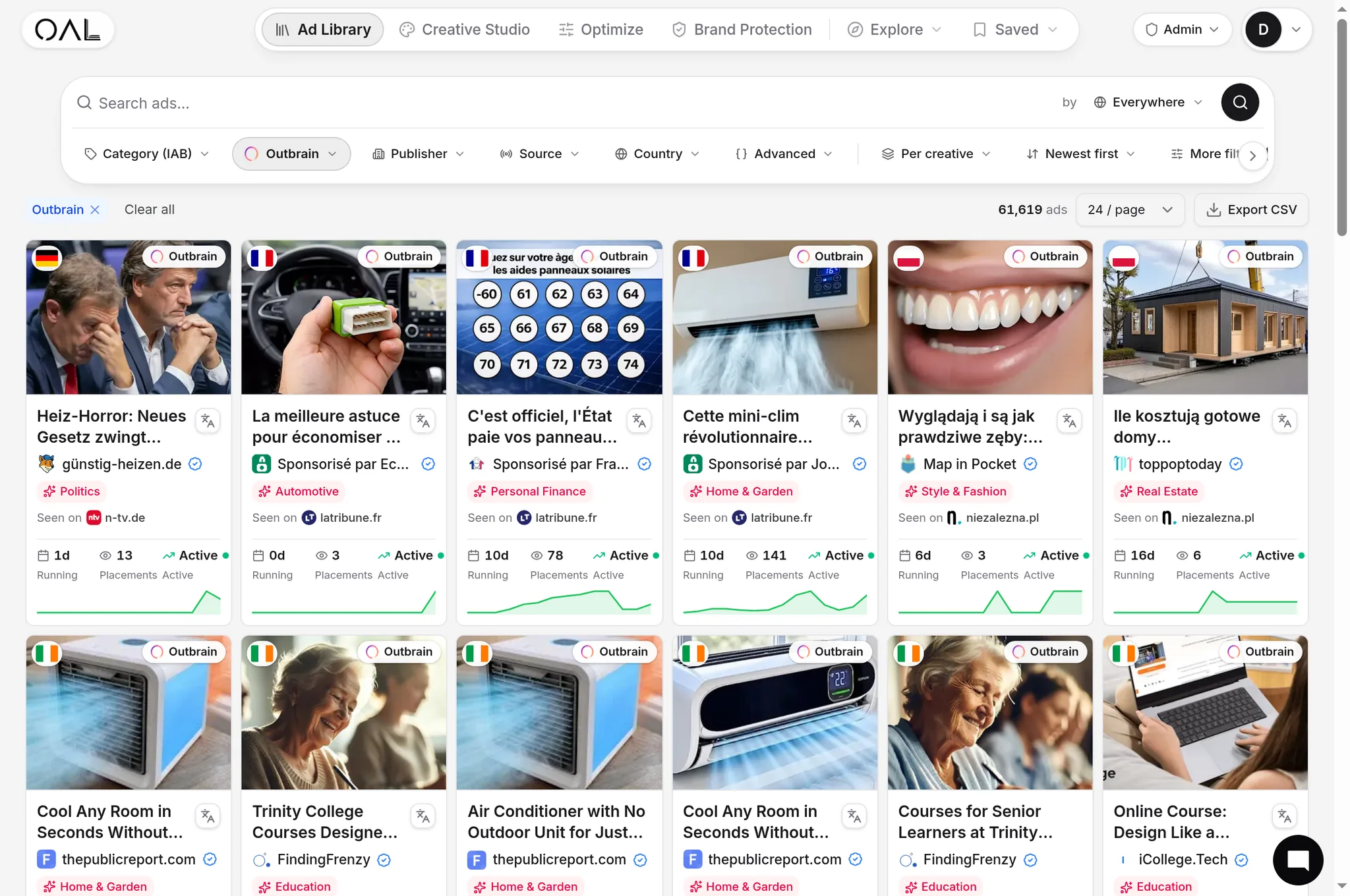
OpenAdLibrary records captured Outbrain creatives with first-seen and last-seen dates. A creative observed for weeks shows that it kept appearing, not that it paid for itself: it may reflect a brand budget, a slow test, optimization still under way or capture timing, and its spend, CTR and conversions are not observed. Filtering your vertical by observation span (a Founders-plan feature at $29.99/month; the free plan shows the 20 newest ads) gives you candidate angles and funnels to test, not a pre-validated map. Browse captured Outbrain ads at /spy/outbrain, and see the Outbrain ad library overview for what each record contains; the limits of longevity as evidence are discussed in what ad longevity can and cannot show.
A starter plan for a small Outbrain budget#
Before spending: review captured Outbrain ads in your vertical; shortlist 3 candidate angles; build one pre-lander if the offer needs one; wire conversion tracking end to end. Days 1–7: one campaign, one Tier-1 geo, one device class, 3 creatives at equal bids (Outbrain's help center suggests 5 to 10 pieces of content per campaign; fewer keeps a small budget readable). Daily budget = total test budget ÷ 14, but no less than Outbrain's $20 daily minimum, so a 14-day plan needs at least $280. Touch nothing for the first few days except pausing genuinely broken placements. Days 8–14: pause creatives that are clearly losing after ~100 clicks; check the section report, lower bids on weak sections and exclude only egregious spend-no-conversion placements; keep the best performer running. Verdict at 5–10× CPA spent: profitable or near-profitable → scale bids and placements gradually; nowhere close → change the funnel or the offer, not the daily budget.
Outbrain's minimum budget answers what the platform will accept. Your economics answer what the test requires. Fund the second number or wait until you can — an underfunded test does not cost less, it just pays for nothing.