 Español
 Português (Brasil)
 Français
 Deutsch
 Italiano
 Nederlands
 Polski
 Svenska
 Türkçe
 Русский
 日本語
日本語 한국어
한국어 简体中文
简体中文 Tiếng Việt
 Bahasa Indonesia
 繁體中文
繁體中文 Čeština
 Dansk
Dansk Norsk (bokmål)
 Suomi
Suomi Ελληνικά
 Română
 Magyar
 Українська
 ไทย
ไทย हिन्दी
 العربية
 עברית
עבריתOutbrain vs MGID: Premium Reach vs Affiliate Flexibility
Outbrain sells premium Tier-1 editorial reach under strict policies; MGID sells flexible, affiliate-friendly traffic across Tier-2/3 geos. What 171,000+ live creatives reveal about which network fits your offer.


Outbrain and MGID are both native feed networks, but they serve different buyers. Outbrain — part of the merged Teads company since February 2025 — offers premium Tier-1 editorial reach, stricter creative policies, and an advertiser book dominated by mainstream insurance, finance, and health lead-gen. MGID offers lower entry costs, more flexible compliance, deep Tier-2/Tier-3 geo coverage, and an advertiser base heavy with affiliates and ecommerce offers. In OpenAdLibrary's live index (June 2026), Outbrain accounts for 108,573 creatives and MGID for 62,765 — and the two books look nothing alike. If you run compliant lead-gen into Tier-1 geos, start with Outbrain. If you run aggressive offers, test internationally, or need cheap clicks to validate a funnel, start with MGID.
Two networks, two customer bases#
Outbrain was founded in 2006 and built its identity on premium publishers: the recommendation rows on major national and international news sites. That publisher DNA shaped everything else — stricter advertiser vetting, tighter creative policies, and a demand base that skews toward advertisers who can pass a compliance review. In 2025 Outbrain acquired Teads and took the Teads name for the combined company; the feed product this article compares continues inside that platform. The corporate details are in Did Outbrain Become Teads?, and the network's mechanics — formats, bidding, conversion optimization — are covered in How Outbrain Works.
MGID was founded in 2008 and grew up serving a different market: mid-tier content and entertainment publishers worldwide, with particular strength across Europe, Latin America, and Asia. Its sales motion leans on account managers, its policies accommodate more offer categories with regional nuance, and its buyer base skews affiliate and performance. The full guide is in How MGID Native Ads Work.
Neither origin story makes one network "better." They are adjacent markets: Outbrain sells scarcity (premium context, vetted demand), MGID sells flexibility (more geos, more categories, lower entry cost). The question is which market your offer belongs in.
Publisher quality: where your ads actually run#
Publisher mix is the most visible difference between the two networks, and it cuts both ways.
Outbrain placements concentrate on established news and editorial brands. For advertisers, that means cleaner adjacency, audiences with mainstream demographics and buying power, and — importantly for regulated verticals — a context that compliance teams will sign off on. The tradeoff is competition: premium inventory attracts well-funded advertisers, and click prices reflect it.
MGID's footprint is broader and rougher: entertainment sites, lifestyle content, regional news across dozens of countries. The audience quality varies more from site to site, which makes publisher-level optimization — reviewing placement reports and building blocklists — a bigger part of the job. The reward is reach that Tier-1-focused networks simply do not have, at click prices that let you test funnels without burning a Tier-1 budget.
A useful mental model: on Outbrain you mostly optimize creatives against a relatively consistent supply; on MGID you optimize supply itself — cutting weak publishers is where campaigns are won. Site-level whitelisting and blacklisting matters on both networks, but on MGID it is the core loop.
Advertiser mix: what 171,000+ live creatives show#
The live books are the most honest description of each network. As of June 2026, OpenAdLibrary's index of 725,000+ native creatives across 49 networks includes 108,573 Outbrain creatives and 62,765 MGID creatives, each classified by vertical.
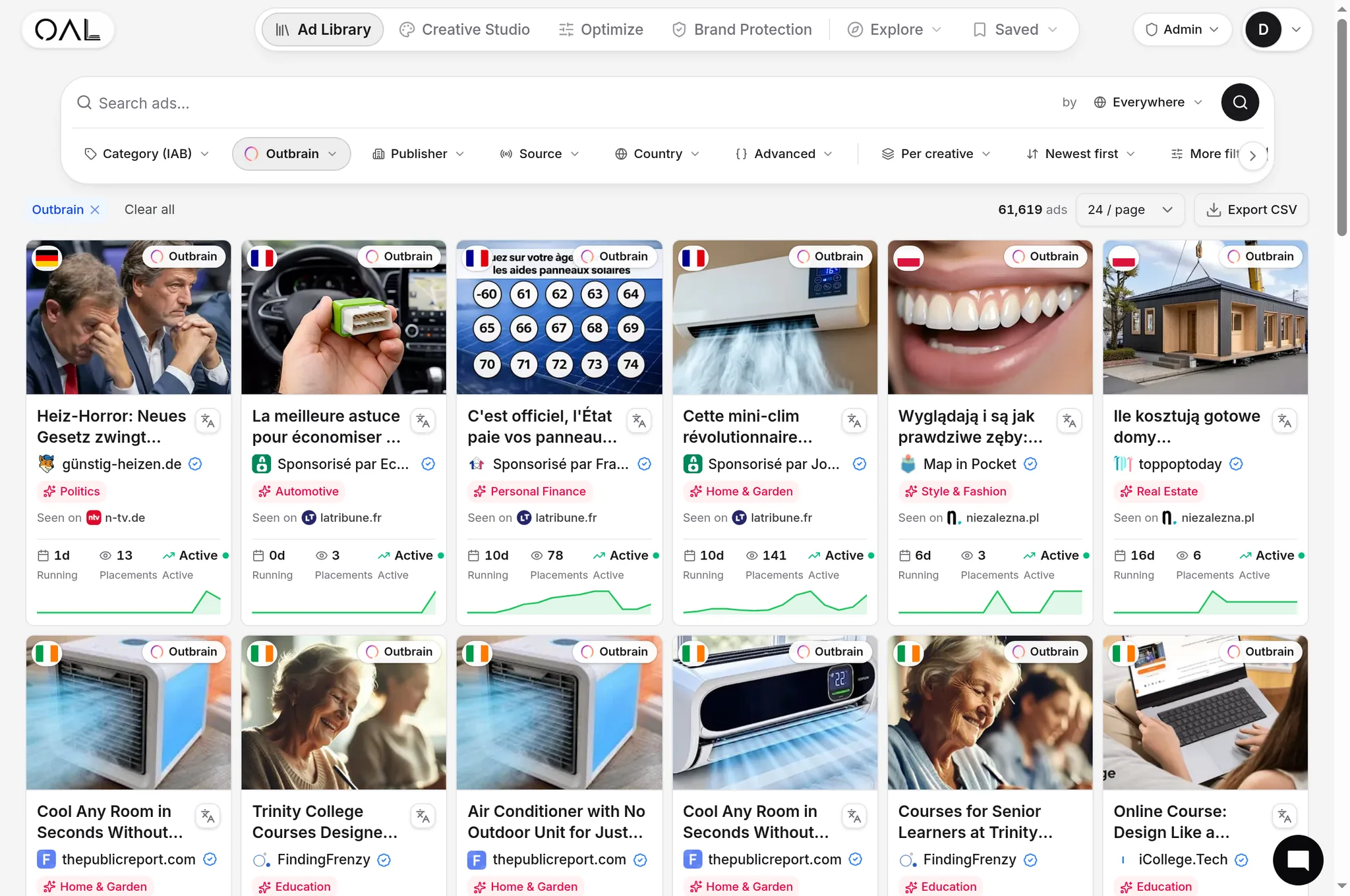
Outbrain's top verticals read like a mainstream lead-gen roster: insurance (4,345 classified creatives), finance (3,990), health (3,102), ecommerce (2,277), software (1,932), and home and garden (1,545). Alongside the performance demand sits genuine brand-content money — for example, an industrial group's sponsored-content series on energy topics that has been observed running for over a month. Advertorial-style health and consumer creatives are very much present, but they share the feed with corporate content programs.
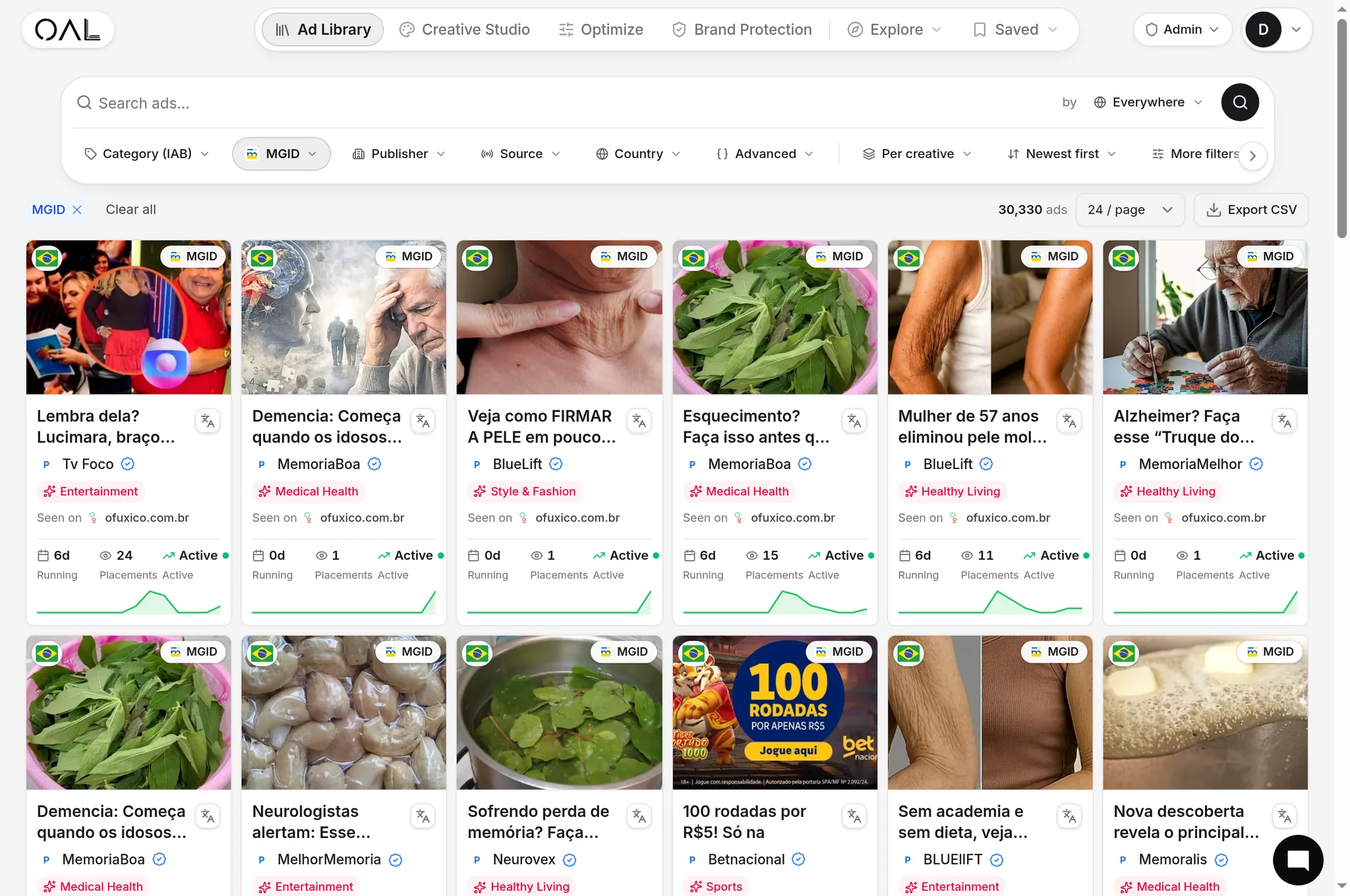
MGID's book is dominated by one category: entertainment, with 13,987 classified creatives — more than ten times its second vertical, health (1,220). That entertainment mass is largely content-arbitrage and engagement-bait demand — listicle and story traffic buyers — which tells you a lot about the network's supply and pricing. Below it: insurance (663), real estate (309), ecommerce (265), and food and beverage (219). The live creatives include classic affiliate and direct-ecommerce patterns: commemorative-coin offers, discount-urgency product ads ("Last Day 50% OFF"), and health advertorials.
What this means practically:
- If you run compliant finance, insurance, or health lead-gen, Outbrain's book proves that demand clears moderation and sustains spend there. You will be competing with sophisticated buyers.
- If you run aggressive ecom angles, sweeps-style offers, or content arbitrage, MGID's book shows those categories running openly. The competition is scrappier, and the moderation bar is more accommodating — within its published rules.
Two details from the live examples sharpen the picture. Outbrain's long-runners include both kinds of demand: a corporate sponsored-content piece observed at 34 days sits alongside a story-style advertorial at 35 days — premium context does not mean performance advertisers are absent, only that they run cleaner creative. MGID's book, meanwhile, is visibly multilingual: creatives in Greek, English, and other languages surface side by side, a direct reflection of its Tier-2/3 publisher spread. The network you choose is also choosing the languages and markets your competition researches in.
Both books are browsable live, with resolved advertisers, geos, and observed run lengths, at /spy/outbrain and /spy/mgid.
Compliance and creative policy#
Outbrain polices creatives noticeably harder. Health claims, before/after imagery, financial promises, and celebrity-adjacent hooks face stricter review, and repeat rejections can escalate to account review. That rigor is a feature if you sell something legitimate: it keeps the surrounding feed cleaner, which keeps premium publishers on the network, which keeps the audience worth buying.
MGID permits a wider set of offer categories, with rules that vary by geo and are applied with more case-by-case flexibility. More flexible does not mean absent — creatives still go through review, and prohibited categories still exist — but buyers moving from Outbrain to MGID consistently find that angles rejected on one clear on the other. If your vertical lives near the compliance line (nutra is the canonical example — see our nutra on native ads guide), MGID is usually the more workable home.
Policies on both networks change and are enforced unevenly across geos, so check current documentation before building creative strategy around any specific claim type.
Cost, minimums, and account model#
Neither network publishes universal pricing, so treat these as ranges practitioners commonly report rather than official figures.
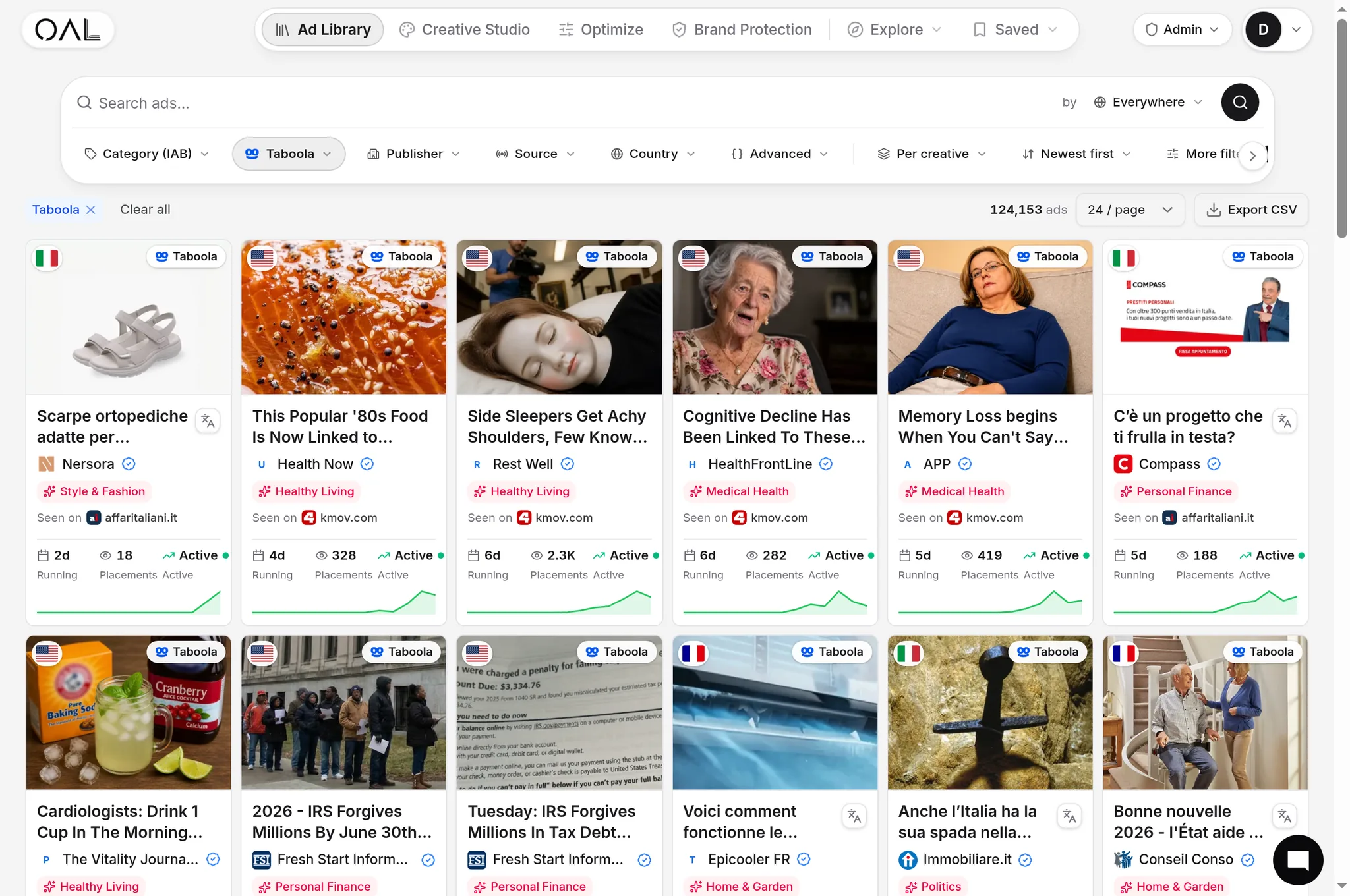
- CPCs. MGID clicks in Tier-2/Tier-3 geos are commonly reported from just a few cents, with Tier-1 traffic higher but still generally below premium-network pricing. Outbrain Tier-1 desktop CPCs are commonly reported in ranges similar to Taboola's — roughly $0.20 to $0.90 — with competitive verticals at the top. Vertical, geo, device, and creative CTR move all of these numbers substantially; the fuller picture is in our native CPC benchmarks.
- Entry cost. MGID's practical minimums are low — commonly reported in the low hundreds of dollars — and accounts typically come with an assigned manager who helps with launch and moderation. Outbrain's self-serve platform is open, but its economics reward larger structured tests; a meaningful Tier-1 validation budget is materially higher than an MGID Tier-2 test.
- Account model. MGID leans managed: expect a human touchpoint, creative feedback, and sometimes whitelist suggestions. Outbrain leans platform: better self-serve tooling, automated conversion bidding, and less hand-holding.
The strategic read: MGID is the cheaper laboratory, Outbrain the more expensive but more scalable Tier-1 machine. Many affiliate teams prove a funnel's mechanics on MGID traffic, then rebuild it with compliant creative for Outbrain's audience.
Geo coverage: Tier-1 depth vs Tier-2/3 breadth#
Outbrain's strength is depth in Tier-1 markets — the US, UK, Germany, France, and similar — where its premium publisher relationships concentrate. If your offer only converts in high-income English-speaking geos, Outbrain's footprint maps to your market almost exactly.
MGID's strength is breadth. Its publisher base spans European, Latin American, and Asian markets that premium-first networks reach thinly, making it a natural first stop for international expansion. Cheap clicks in Tier-2 and Tier-3 geos let you validate translated funnels at low stakes, and the network's regional account teams understand local offer norms. If that expansion path is your plan, our guide to scaling into new geos on native covers the workflow — including using ad libraries to check which advertisers already run in a target market before you spend.
Targeting and platform features#
Both networks offer the native-standard menu: geo, device, OS, and browser targeting; publisher-level reporting with blocking; retargeting; and automated bidding toward conversion goals (Outbrain's conversion-oriented bid strategies are among the more mature in native). Outbrain's platform tooling is generally more polished; MGID compensates with human account support and more granular manual control, including per-widget pricing adjustments.
Two feature areas deserve a closer look before you choose. Retargeting: both networks support pixel-based retargeting of your site visitors, but the audience you can build differs with the traffic quality — retargeting pools built from Outbrain's Tier-1 editorial audiences tend to be worth more per user, while MGID pools are bigger and cheaper to refill. Data transparency: Outbrain exposes cleaner conversion-path reporting through its platform; MGID gives more raw levers (per-placement bids, manual price adjustments) and expects you to build your own view, usually in your tracker. Teams that live in a tracker anyway lose nothing; teams that depend on platform dashboards will feel MGID's gaps.
Details shift often on both platforms — treat current network documentation as the source of truth, and treat any comparison article's feature matrix (including this one) as a snapshot.
What a first test looks like on each#
On MGID, a sensible first test is small, managed, and supply-focused. Fund the account at the minimum, take the account manager's onboarding call — their moderation guidance alone saves days of rejected-creative churn — and launch one geo with ten to fifteen creative variants against a proven funnel. Then spend your attention on placements: within the first few thousand clicks, the placement report will show a familiar pattern of a few strong sites and a long tail of junk. Cut ruthlessly, ask your manager for whitelist suggestions, and re-test. MGID campaigns are made or broken in that pruning loop; the buyers who treat it as a daily discipline get click costs the network's reputation says are impossible, and the ones who "set and forget" fund everyone else's education.
On Outbrain, a first test looks more like a structured performance launch. Creative goes through stricter review, so build variants that would survive an editor's read: no miracle claims, no bait-and-switch imagery. Set up conversion tracking properly before spending — Outbrain's automated conversion bidding is the platform's real strength, and it is blind without signal. Give the algorithm enough conversions to learn on before judging it, which in practice means budgeting the test around your funnel's conversion economics rather than a fixed dollar figure. Publisher hygiene still matters, but you will spend proportionally more time on creative iteration and bid strategy than on blocklists.
The common thread: both networks reward showing up with a funnel that already converts somewhere else. Neither is a good place to discover whether your offer works at all — that is what cheap validation traffic and your existing channels are for.
Which should you choose?#
| Your situation | Better fit |
|---|---|
| Compliant lead-gen (insurance, finance, home services) in Tier-1 | Outbrain |
| Aggressive ecom, sweeps, or arbitrage angles | MGID |
| First native test on a small budget | MGID |
| Scaling a proven funnel to premium Tier-1 audiences | Outbrain |
| International expansion into Tier-2/3 markets | MGID |
| Brand-safety-sensitive advertiser or agency mandate | Outbrain |
| Nutra or compliance-borderline verticals | MGID (check current policies) |
The honest answer for most performance teams is sequential: use MGID to find angles and validate funnel math cheaply, then bring the survivors to Outbrain — rebuilt to pass its moderation — for Tier-1 scale. The two networks punish different mistakes: Outbrain punishes weak unit economics with expensive clicks, MGID punishes lazy supply management with junk placements. Know which mistake you are more likely to make, and note that the sequence rarely works in reverse — creative tuned to Outbrain's polish tends to underperform on MGID's rougher supply without re-angling.
Research the books before you deposit#
Before funding either account, spend twenty minutes in the live data:
- Find your vertical on each network. If your category is thick on one and absent on the other, believe the data over the sales pitch.
- Sort by run length. Creatives observed running 30+ days are almost certainly profitable — the reasoning is in ad longevity as a winning signal. Study what the long-runners do: their hooks, their geos, their landing flows.
- Check geo overlap with your target market. An advertiser book heavy in your exact geo-vertical combination means proven demand — and tells you exactly whose creatives to learn from.
OpenAdLibrary indexes both networks continuously — 108,573 live Outbrain creatives and 62,765 live MGID creatives as of June 2026, each with resolved advertiser, geo, device, and landing-page data — so the comparison above is checkable, not anecdotal.