Español
 Português (Brasil)
 Français
 Deutsch
 Italiano
 Nederlands
 Polski
 Svenska
 Türkçe
 Русский
 日本語
日本語 한국어
한국어 简体中文
简体中文 Tiếng Việt
 Bahasa Indonesia
 繁體中文
繁體中文 Čeština
 Dansk
Dansk Norsk (bokmål)
 Suomi
Suomi Ελληνικά
 Română
 Magyar
 Українська
 ไทย
ไทย हिन्दी
 العربية
 עברית
עבריתHow to Advertise on NewsBreak: Ad Manager Setup Step by Step
NewsBreak's self-serve Ad Manager puts native ads inside the biggest US local-news feed. Here is the full setup — account review, structure, local targeting, bids, creatives and tracking — from a native buyer's perspective.


To advertise on NewsBreak, you create an advertiser account in NewsBreak Ad Manager — the self-serve platform at business.newsbreak.com — pass account review, then build a campaign: choose an objective, set a daily budget and cost-per-click bid, target by location and device, upload native image-and-headline creatives, and install NewsBreak's conversion pixel or a server-to-server postback so the platform has a signal to optimize toward. Ads serve as sponsored cards inside NewsBreak's US local-news feed, the audience skews older and is effectively US-only, and every ad passes review before it spends. The mechanics will feel familiar if you have run any native network; what changes the playbook is the single-app inventory, the local targeting, and the audience profile — and this guide works through each step with those differences in mind.
What NewsBreak is — and who you actually reach#
NewsBreak is a local-news aggregation app. It assembles local crime, weather, community, and human-interest stories into a personalized feed organized around where the reader lives, and it has spent years among the most-downloaded news apps in the United States. The audience profile is distinct from the open web: heavily American, skewing 45 and older, with unusually strong reach into suburban and smaller-market readers that coastal-metro campaigns routinely miss.
For an advertiser, the practical mental model is this: NewsBreak is a native ad network with a single, large owned-and-operated property. Your ad renders as a sponsored card between local news stories in the app feed and on newsbreak.com — the same in-feed pattern you know from content-recommendation widgets on the open web, except the platform controls the entire surface. There are no publisher lists to manage and no placement-level bids across thousands of sites. There is one feed, and your levers are geography, device, audience, bid, and creative.
That concentration cuts both ways. You lose the placement-level optimization that drives open-web native buying — no whitelisting the three publishers that convert, no blocking the hundred that don't. But you also skip the placement-quality lottery entirely: no mystery domains, no wondering whether your budget is draining into a widget nobody sees. Quality variance moves from "which site" to "which reader," which is why geo and creative carry almost all the optimization weight on this platform.
Who this reaches is the point. If your offer monetizes older, mainstream American consumers — insurance quotes, home services, legal claims, finance offers, health-adjacent products, senior-focused ecommerce — the audience fit is strong. If your offer needs international volume, urban twenty-somethings, or B2B decision-makers, spend elsewhere.
Before you build: is your offer a fit?#
Run this checklist before you open an account:
- US-only economics. NewsBreak inventory is American. An offer that only pays out internationally gains nothing here.
- Older-skewing angles. Creatives and offers aimed at readers 45 and up consistently fit this feed better than youth-oriented ones.
- Local hooks are an unfair advantage. The feed is organized around the reader's town. Offers that can be framed locally — home services, state-by-state insurance qualification, legal claims — get a relevance boost that generic national angles never see.
- Lead generation fits naturally. The platform suits cost-per-lead funnels: quote forms, claim checks, estimate requests, and calls all match the audience and the interruption context.
- You have a cold-traffic funnel. This is interruption traffic, not search intent. Plan a pre-lander or advertorial between the click and any form that asks for real commitment.
Also read the platform's current advertising policies before you spend. Restricted categories, claims rules, and creative standards evolve on every network; check NewsBreak's official documentation rather than assuming an angle that clears review on Taboola will clear review here.
Step 1: Create and verify your Ad Manager account#
Sign up at business.newsbreak.com with a working business email, real company details, and a payment method. Accounts go through review before they can spend, and a brand-new account is the most scrutinized object on any ad platform, so stack the deck in your favor:
- Use a real domain with a working website that matches the business you registered. Mismatches between account identity, domain, and landing page are the classic new-account rejection.
- Make your first funnel clean: visible disclosures, a working privacy policy, no aggressive claims, no misleading before/after imagery.
- Do not lead with your most aggressive advertorial on day one. Establish spend history and a clean review record with compliant creative first — the same account-warming logic experienced buyers apply everywhere.
Review timing varies from hours to days. Plan for it rather than around it, and use the waiting time to finish tracking setup (step 6) so you can launch the moment you are approved.
Step 2: Structure the campaign#
Ad Manager follows the familiar hierarchy — campaign at the top, an ad-group layer holding budget and targeting, and individual ads inside it. Exact labels may shift as the product evolves, but the structural decisions are yours, and they matter more than any single setting:
- One campaign per offer. Never mix an auto-insurance funnel and a home-services funnel under one budget; you will not be able to read the results.
- One ad group per meaningful targeting split. A state cluster, a device type, or an audience — change one variable at a time so differences mean something.
- Three to five creatives per ad group. Enough variety to find a working hook, few enough that each creative accumulates real impressions.
Resist over-splitting. NewsBreak is a single app, not the open web: slicing a modest budget across ten ad groups starves every one of them of the click volume needed to learn anything. Two or three deliberate splits beat a targeting matrix every time.
On objectives: if you can fire a conversion event with reasonable frequency — a submitted lead, not a funded insurance policy — run a conversion objective from the start so the platform optimizes toward the event you care about. If your conversion is rare or slow, start on a traffic objective and switch once the pixel has volume to learn from.
Step 3: Targeting — local is the point#
Location granularity is NewsBreak's structural differentiator. You can target down to state and city level — which actually means something on a platform whose entire feed is organized around where the reader lives, rather than being a bolt-on filter over national inventory.
How to use it by offer type:
- Statewide targeting for qualification-style offers — insurance, benefits eligibility, legal claims. Target only the states where your offer or your lead buyer actually operates and exclude the rest. For insurance in particular, licensing is state-by-state: a lead from a state your buyer cannot service is a click you paid for and revenue you will never see.
- Metro and city targeting for home services and anything fulfilled locally. This is where NewsBreak's local organization outperforms national native feeds.
- Broad US only for genuinely national ecommerce offers with no geographic constraint.
Beyond location: device and OS splits are worth testing early — iOS and Android audiences frequently produce different lead quality in lead-gen verticals, and you want to see that split while the campaign is small. Demographic and interest layers are best left broad at launch. In a native feed, the creative is the targeting: a headline that says who the ad is for qualifies readers more precisely than any interest checkbox. Narrow the settings from data, not assumption.
Step 4: Bids and budgets#
NewsBreak sells clicks — you set a CPC bid and a daily budget. There are no official rate cards, and any precise number you read is someone's campaign, not yours. What practitioners commonly report is that NewsBreak clicks come in below what the major open-web native networks charge for comparable US inventory — tens of cents rather than dollars in many verticals — with your vertical, state list, and creative CTR moving the real figure a lot. Treat any number you have heard as a starting bid to be corrected by data, and read our guide to how native ad pricing works for the auction mechanics that drive it.
Budget rules that hold on any CPC network:
- Set a daily budget that buys a meaningful number of clicks at your bid. Judging a campaign on thirty clicks is guessing with extra steps.
- If you need delivery data fast, open with a bid modestly above the platform's suggestion, then work it down as CTR earns you auction efficiency. High-CTR creative effectively buys you cheaper clicks on every native platform.
- Judge ad groups after a few hundred clicks each, not after day one.
Step 5: Creatives that fit the feed#
Your ad sits between local news stories, so editorial-style creative wins: real photography over polished studio shots, specific curiosity over brand slogans. The native creative fundamentals transfer directly — our breakdowns of native ad headline formulas and native creative best practices apply to NewsBreak without modification:
- Qualification hooks. "Homeowners in [state] could qualify for..." — the reader self-selects, which protects your CPC from curiosity clicks that never convert.
- Discovery framing. "Why [audience] are switching to..." reads like the surrounding stories instead of shouting over them.
- Specificity. Numbers, ages, places. Vague headlines die in news feeds; concrete ones get read.
- Images: single subject, human faces or concrete objects, minimal or no text overlay. Screenshots of walls of text underperform everywhere, and especially between news photos.
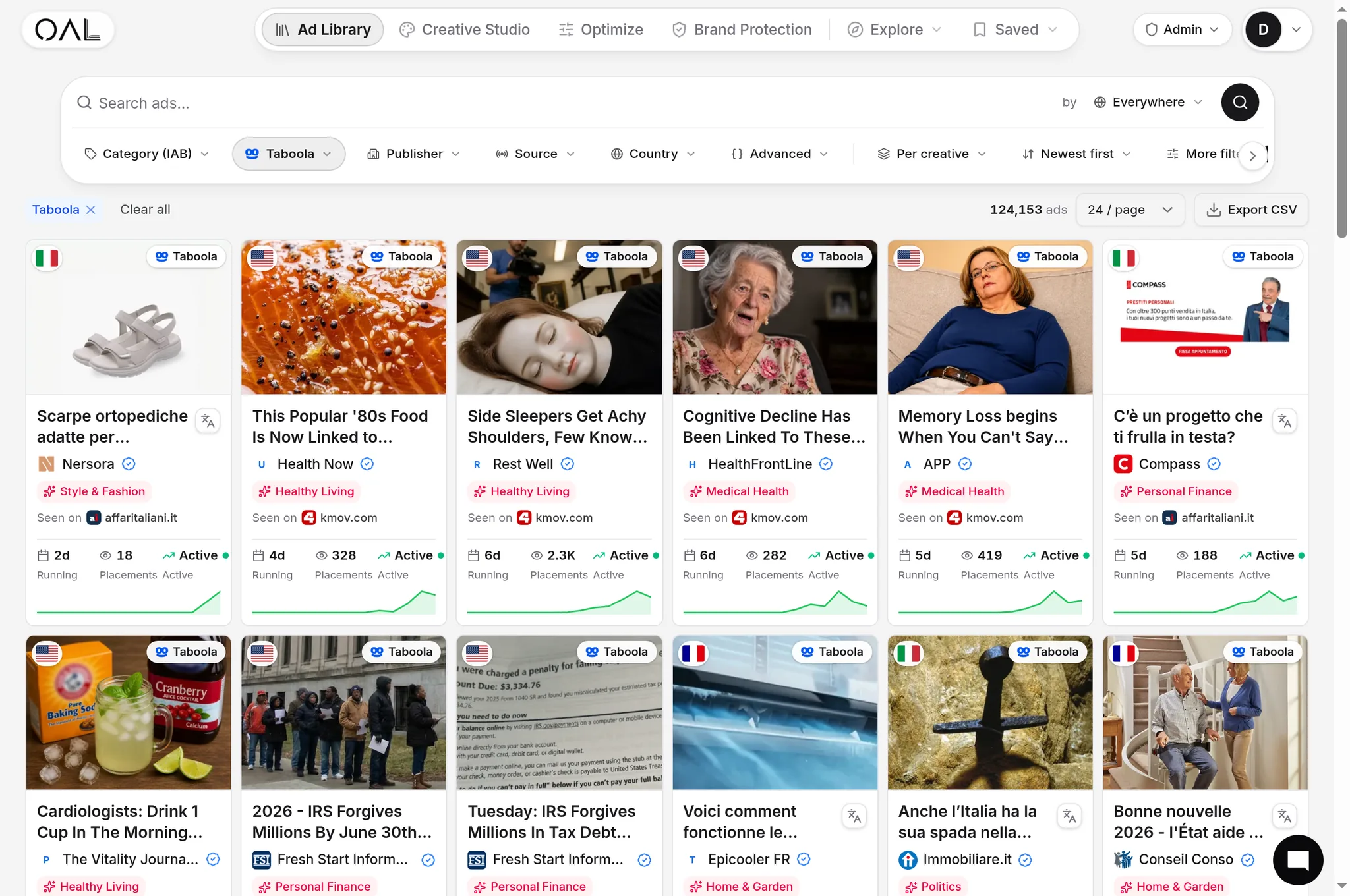
Because NewsBreak publishes no archive of the ads running on it, the practical way to research angles is to study what is provably working on the open-web native feeds, where the audience psychology is the same. A native ad spy tool lets you search hundreds of thousands of live native creatives by vertical, see which hooks have survived weeks of continuous spend, and adapt the pattern — not the copy — to NewsBreak's feed. OpenAdLibrary's index holds 725,000+ live native creatives across 49 networks as of June 2026, which is a far larger angle library than any swipe file.
One compliance note that new native buyers miss: if you run an advertorial between the ad and your offer, disclosure rules apply. The FTC's position is that content designed to look editorial must be identifiable as advertising — our summary of the FTC disclosure rules for advertorials covers what that means in practice.
Step 6: Install tracking before you launch#
Do not spend a dollar before the measurement chain works end to end:
- Platform pixel on your conversion page — lead submitted, call initiated — so NewsBreak's optimization has a real signal instead of optimizing toward clicks.
- Click ID passthrough if you run an affiliate tracker: append the click identifier to your landing URLs, and fire a server-to-server postback on conversion so your tracker and the platform agree about what happened and when.
- Test with a real click — from the app, through the pre-lander, to a test conversion — before scaling anything. A broken URL parameter discovered after $500 of spend is a self-inflicted wound, and it is the single most common one.
The first two weeks: an optimization cadence#
- Days 1–3: let it spend. Kill only what is actually broken — disapprovals, tracking gaps, creatives at effectively zero CTR. Early CPC and CTR numbers are noise; do not reallocate on them.
- Days 4–7: cut the bottom half of creatives. Judge on CTR and downstream conversion together. A high-CTR creative that produces junk leads is worse than a modest one that converts — clicks are a cost, not a result.
- Week 2: iterate on the winning hook. New images under the winning headline, new headlines over the winning image. Split by state or device only where the data shows a real difference, and trim geos producing leads your buyer rejects.
- Ongoing: plan creative refresh every two to three weeks. Fatigue arrives faster on a single-app network than on the open web, because the same readers see the same feed every day.
Common mistakes that burn NewsBreak budgets#
- Treating it like search traffic. These readers were not looking for you. Direct-to-form funnels that convert on search intent usually underperform here without a warm-up page in between.
- Ignoring state compliance. Insurance and legal offers carry state-level licensing constraints. On NewsBreak, geo-targeting is a compliance tool first and an optimization second.
- One creative per ad group. You learn nothing, and the one creative fatigues immediately.
- Judging too fast. CPC platforms need click volume before any metric stabilizes. Patience for the first three days is a position, not a weakness.
- Optimizing on clicks alone. A lead-gen campaign tuned to CTR selects for curiosity, not intent. The postback is what keeps you honest.
How NewsBreak compares to the big native networks#
| NewsBreak | Taboola / Outbrain | Microsoft Audience Network | |
|---|---|---|---|
| Inventory | Single app + site | Thousands of open-web publishers | MSN feed + Microsoft surfaces |
| Geography | US | Global | Global |
| Targeting edge | State/city local targeting | Publisher and placement control | Search and audience intent data |
| Scale ceiling | Moderate | Very high | High |
| Competition for attention | Lower | Highest | High |
The honest position: NewsBreak is a complement, not a replacement. Most buyers prove a funnel on the open-web networks first — see our guides to how Taboola ads work and MSN native ads — then add NewsBreak as a US-only second source with a distinct, older, local-minded audience and typically cheaper clicks. If you are building the broader channel stack, our media buying guide for native ads covers the sequencing logic.
The bottom line#
Advertising on NewsBreak is procedurally simple — self-serve account, CPC campaign, native cards in a news feed — and strategically specific: US-only, older-skewing, locally organized inventory that rewards qualification-style creative and punishes generic angles. Get tracking working before launch, structure a small number of deliberate splits instead of a matrix, borrow angle patterns that are already surviving on the open-web native networks, and treat state-level targeting as both your compliance rail and your primary optimization lever. Prove the funnel small, then scale it state by state.