Español
 Português (Brasil)
 Français
 Deutsch
 Italiano
 Nederlands
 Polski
 Svenska
 Türkçe
 Русский
 日本語
日本語 한국어
한국어 简体中文
简体中文 Tiếng Việt
 Bahasa Indonesia
 繁體中文
繁體中文 Čeština
 Dansk
Dansk Norsk (bokmål)
 Suomi
Suomi Ελληνικά
 Română
 Magyar
 Українська
 ไทย
ไทย हिन्दी
 العربية
 עברית
עבריתOutbrain Review 2026: Is It Worth It After Teads?
An evidence-backed verdict on who advertises with Outbrain, what it costs, where it shines, and where it can waste your budget after the Teads merger.


Outbrain is one of the two dominant premium native advertising networks — and since its merger with Teads, part of the largest combined platform in the category. Judged against the 108,573 live Outbrain creatives in OpenAdLibrary's index (July 2026), it earns a qualified recommendation: genuinely premium publisher supply, an advertiser base where insurance, finance and health brands sit alongside performance buyers, and dependable Tier-1 scale. The trade-offs are real too: CPCs that run higher than mid-tier networks, stricter creative approvals, and a platform still consolidating after a major merger. Outbrain rewards advertisers with content-driven funnels and a proper testing budget; it punishes anyone who arrives with one creative and a landing page that can't hold attention.
Outbrain in 2026: what you're actually buying#
Two structural facts frame any current Outbrain review. First, the merger: Outbrain acquired Teads in early 2025 and the combined company now operates under the Teads name, folding Outbrain's feed placements into a broader offering that includes outstream video and branding formats. The full history is in Did Outbrain become Teads? and What Is Teads?; the short version is that the demand platform media buyers know as Outbrain still exists, still runs feed-style native placements across premium publishers, and still bills primarily on CPC.
Second, the product: you buy clicks from content-recommendation placements on publisher pages, bid at the campaign level, and optimize toward conversions with the platform's bid strategies. The mechanics — formats, targeting, bidding — are covered step by step in How Outbrain works, so this review concentrates on the question that guide doesn't answer: what actually runs on the network, and is it worth your money?
What 108,573 live Outbrain ads reveal#
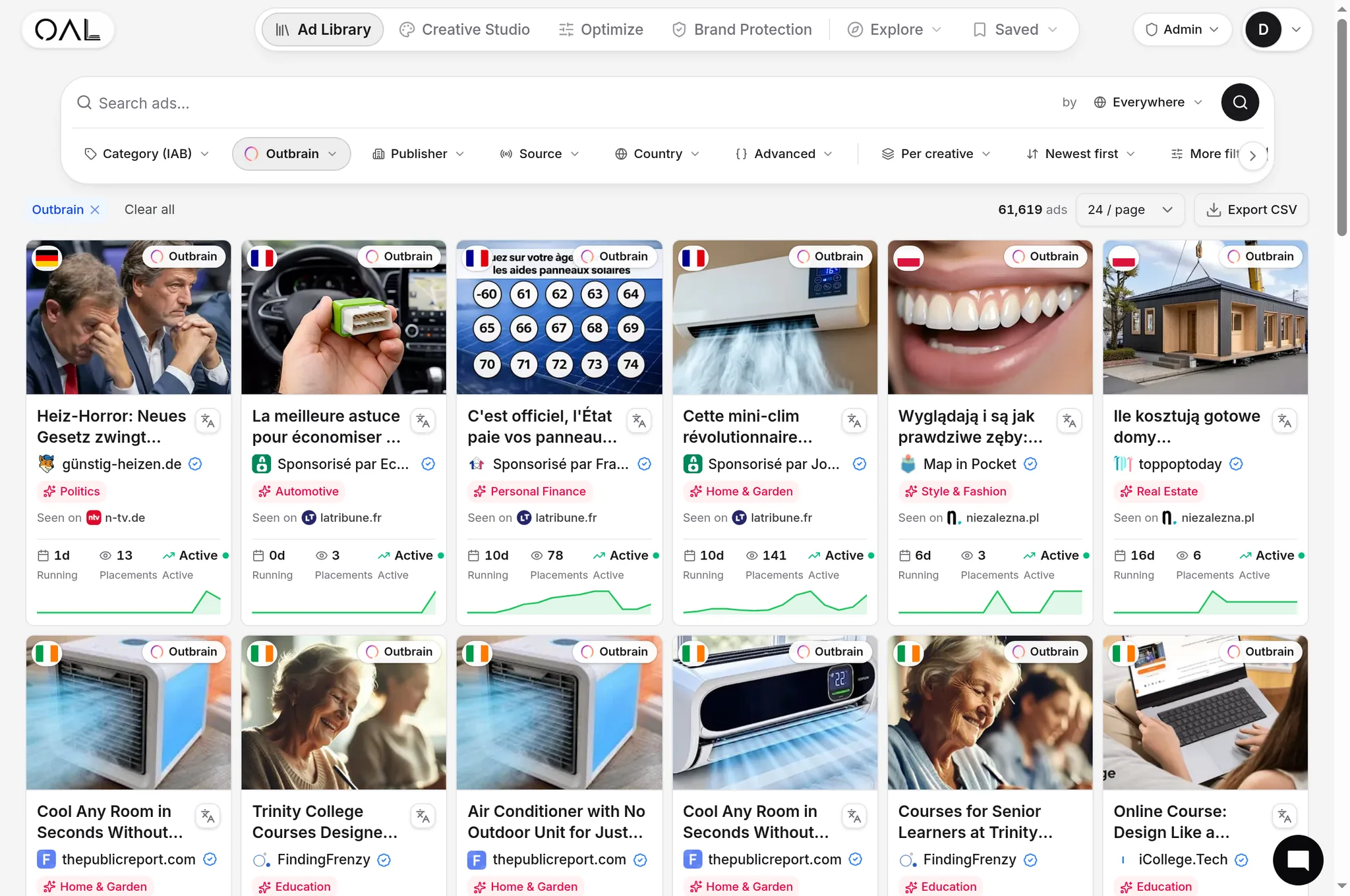
OpenAdLibrary continuously captures ads from live native placements — 725,000+ creatives across 49 networks in total — which makes it possible to review Outbrain against its observable output rather than its sales deck. Three findings stand out.
1. Considered-purchase verticals dominate. The classified portion of the live Outbrain corpus breaks down like this (July 2026):
| Vertical | Live classified creatives |
|---|---|
| Insurance | 4,345 |
| Finance | 3,990 |
| Health | 3,102 |
| Ecommerce | 2,277 |
| Software | 1,932 |
| Home & garden | 1,545 |
Insurance, finance and health together account for more classified Outbrain creatives than the next several verticals combined. That is a meaningful signal: these are advertisers with strict compliance teams and measurable CPA math, and they keep coming back. It also means those auctions are the most crowded — if you're entering insurance or finance lead generation, expect to bid against advertisers who have been optimizing on this network for years.
2. Brand and performance demand genuinely coexist. In the same feeds you'll find corporate content programs — a major industrial group running explainer-style sustainability content for over a month — next to classic direct-response beauty advertorials ("Moisturizer Won't Tighten Skin! Use This Household Item Instead", observed live for 30 days at capture). This mix is Outbrain's signature. It keeps the environment cleaner than mid-tier native networks, and it means advertorial-style performance creative is accepted — within limits the approval team enforces.
3. Winners run for weeks. Several Outbrain creatives in the index have been under continuous observation for 38 days — a pets advertorial, a home-and-garden story ad, a nonprofit content piece — with no sign of stopping. Advertisers don't keep paying for losing ads, which is why observed longevity is the most useful public profitability signal when you're deciding what to model your own campaigns on.
Where Outbrain is strong#
- Publisher quality. Outbrain built its business on premium editorial supply, and that remains the practical difference you feel versus mid-tier networks: fewer junk placements to blacklist, better brand adjacency, and audiences in a reading mindset rather than a skimming one.
- Conversion-focused buying. The platform's bidding can optimize toward your pixel- or postback-tracked conversions rather than raw clicks. Specifics evolve, especially post-merger — check Outbrain's current documentation rather than any third-party summary, including this one.
- Scale with cleanliness. Among the classic content-recommendation networks in our index, only Taboola's corpus is larger (206,145 live creatives to Outbrain's 108,573). You can deploy real budgets here without descending into remnant inventory.
- A compliance-friendly environment. The dominance of insurance and finance advertisers is itself evidence: regulated categories concentrate where approvals and placements are defensible to a legal team.
Where Outbrain falls short#
- Cost. Media buyers commonly report Tier-1 desktop CPCs from roughly $0.25 to $0.90 on premium native networks like this one, with competitive verticals pushing higher — a real premium over MGID- or Revcontent-class traffic. Those figures are practitioner-reported, not official; your vertical, geo and creative CTR will move them a lot. See the native ads CPC benchmarks for how the networks compare.
- Approval friction. Aggressive angles that sail through mid-tier networks get rejected or throttled here. Iteration is slower, so plan your creative pipeline accordingly.
- Managed-account thresholds. Self-serve exists, but the meaningful support tier — dedicated account management, early feature access — arrives with spend commitments. Small accounts largely run unassisted.
- Merger churn. Product surfaces, dashboards and packaging have been consolidating since the Teads merger. Nothing fatal, but expect occasional renames and moved furniture; verify current features against official docs before building a media plan around them.
Outbrain pricing: what buyers commonly report#
Outbrain publishes no rate card, so treat every number you read — here included — as directional. The pattern practitioners consistently report: Tier-1 English-language desktop clicks in the several-tens-of-cents range, mobile somewhat cheaper, Tier-2 geos meaningfully cheaper, and hot verticals (insurance, finance, legal) at the expensive end. Budget-wise, the sensible floor is whatever buys each creative angle a few hundred clicks before you judge it — at these CPCs, that usually means a four-figure total test budget for a serious verdict. How much do native ads cost? walks through the budgeting math across networks.
Who Outbrain fits — and who it doesn't#
Good fit:
- Insurance, finance and health lead generation with advertorial funnels and tracked CPA math
- DTC brands with considered price points and content-led funnels
- B2B and brand advertisers who want native reach on premium editorial supply
Poor fit:
- Buyers testing with a single creative and a minimal budget — the auction will eat it without teaching you anything
- Aggressive nutra or sweepstakes angles that depend on claims Outbrain won't approve
- Anyone whose unit economics require sub-$0.10 Tier-1 clicks; that traffic lives on mid-tier networks
If you're weighing the two premium networks against each other, Taboola vs Outbrain compares them dimension by dimension using the same index data.
Scout the network before you deposit#
The cheapest Outbrain research happens before you fund an account. Browse the Outbrain ad library to see the live creatives we've captured from the network; filter to your vertical and geo, and pay attention to what has survived 30+ days — that's the network telling you what converts. The Outbrain ad spy guide covers the full research workflow, and /spy/outbrain is the tool itself: advertiser search, longevity data and traced landing pages, with a free tier. An afternoon there answers the questions — which angles dominate my vertical? who am I actually bidding against? — that would otherwise cost you the first thousand dollars of a media test.
Verdict: is Outbrain worth it in 2026?#
| Criterion | Assessment |
|---|---|
| Publisher quality | Excellent — the network's core strength |
| Scale | Second only to Taboola among feed-native networks in our index |
| Cost | Premium; commonly reported Tier-1 CPCs well above mid-tier networks |
| Approvals | Strict; slows aggressive creative iteration |
| Best for | Insurance/finance/health lead gen, content-led DTC, brand-plus-performance |
| Skip if | You need very cheap clicks or run angles that won't pass review |
Outbrain in 2026 is a premium network that behaves like one. The 108,573 live creatives in our index show an advertiser-dense platform whose heaviest users are exactly the kind of compliance-bound, CPA-disciplined buyers who don't tolerate wasted spend — and who would have left by now if the traffic didn't perform. If your funnel and budget look like theirs, Outbrain belongs on your media plan. Just walk in having studied what already works there, not hoping to discover it at auction prices.