 Español
 Português (Brasil)
 Français
 Deutsch
 Italiano
 Nederlands
 Polski
 Svenska
 Türkçe
 Русский
 日本語
日本語 한국어
한국어 简体中文
简体中文 Tiếng Việt
 Bahasa Indonesia
 繁體中文
繁體中文 Čeština
 Dansk
Dansk Norsk (bokmål)
 Suomi
Suomi Ελληνικά
 Română
 Magyar
 Українська
 ไทย
ไทย हिन्दी
 العربية
 עברית
עבריתMedia Buying for Native Ads: A Beginner's Guide (2026)
Native media buying is a four-part loop (offer, creative, bid, scale), and this 2026 playbook walks each step with concrete settings, live cross-network examples, and the metrics that actually move money.

Native media buying is one tight loop run over and over: pick an offer, build a creative that earns the click, set a bid that lets the algorithm learn, then scale what works and cut what doesn't. Networks, pixels, dashboards: that's all plumbing around those four moves. This guide walks the full loop the way a working buyer runs it in 2026, with concrete settings and live cross-network examples you can verify yourself.
New to the channel? Read the 2026 native advertising playbook first for the strategic overview. This page is the hands-on companion: the actual sequence of decisions, in order.
What media buying for native ads actually means#
Media buying for native ads is the practice of purchasing in-feed, content-style placements (the "recommended for you" widgets and sponsored stories you see under articles) and optimizing them toward a profitable cost per acquisition. The difference from search and social is the audience temperature. Nobody on a news site was looking for your product. So the creative and the landing page carry the entire campaign, and your real job is to find one winning offer-angle-funnel combination, then feed the network's bid algorithm enough clean conversion data to scale it.
That inventory is sold through programmatic native advertising auctions on a handful of large supply networks. The biggest structural shift heading into 2026: the long-rumored Taboola-Outbrain merger collapsed, and instead Outbrain bought Teads in February 2025 for roughly $900M, then renamed the whole company Teads in June 2025. So the practical landscape is Taboola, the Outbrain-now-Teads platform, MGID, and Revcontent, plus a long tail like MediaGo, Yahoo and MSN. Knowing who controls each marketplace matters when you read competitor activity, because the same advertiser usually runs the same angle across several of them at once.
How big is "the same angle, everywhere"? Our index gives you a sense of scale. As of June 2026, OpenAdLibrary has captured 589,036 creatives from 25,933 advertisers across 42 networks, traced to 926,259 landing pages, with 5.4 million ad observations behind those numbers. Taboola alone accounts for 157,727 of those creatives, more than any other single network we track. That is the haystack you're competing in, and it's also where the winning needles are hiding in plain sight.
Step 1: Pick an offer that fits the channel#
Native traffic is cold, curiosity-driven, and skews older and mobile. That rules some offers in and others out before you spend a cent. The offers that print on native share three traits: mass-market appeal so the angle works on a general news audience, room for a story (supplements, financial products, insurance, home services, discovery e-commerce all support an advertorial), and a payout that survives a $0.30 to $0.90 click. Your average order value or commission has to absorb dozens of clicks per conversion.
The verticals carrying native in 2026 are not a mystery, because you can count them. Looking across our full index, finance leads with 17,232 active creatives, insurance is right behind at 15,629, health at 14,895, and e-commerce at 13,872 (OpenAdLibrary index, June 2026). Those four are the money lanes. They have the payouts, the regulatory-flavored urgency, and the demographic fit that native rewards. Entertainment (11,784), software (10,825) and travel (10,692) round out the next tier.
Here is what a live finance offer actually looks like in the feed. Tax-relief angles are everywhere right now, riding a real deadline:

Notice the moves: a year stamp, a hard date, a dollar magnitude, and a vague authority ("Fresh Start Information"). That is a textbook native finance hook, and it had been running 13 days when we captured it. Longevity like that is the cheapest signal you can buy. If an offer has been live across multiple networks for weeks, someone is profiting from it. A native ad spy tool lets you filter live ads by vertical and separate the advertisers sustaining spend from the ones that flamed out in days. For a data-backed shortlist of where the money is, see the best affiliate verticals for native ads in 2026.
The single biggest beginner mistake isn't a bad bid or a weak headline. It's running a low-ticket, impulse offer on cold native traffic that needs a pre-lander to convert. The channel punishes offers that expect a warm audience.
Step 2: Build the creative that earns the click#
In native advertising, the creative is a headline plus a thumbnail living inside a publisher feed. It has to read like editorial, not an ad. Two levers do almost all the work.
The thumbnail comes first. Curiosity-provoking, slightly imperfect, "real" imagery beats polished studio shots. Faces, before-and-after framing, and ordinary objects in everyday context outperform logos every time. The headline does the rest: specific, benefit- or curiosity-led, often with a number or a location token. "Why Texas Drivers Are Switching Insurers in 2026" beats "Save on Car Insurance" by a wide margin.
Health and supplement creatives are a masterclass in this. Look at the pattern across two live captures:


Same DNA: an authority cue ("MDs Identify"), an open loop ("See the List," "Do You Eat It?"), and a vague-but-alarming health claim aimed squarely at an older reader. Health is the third-largest vertical in our entire index for a reason. Both of these were freshly captured (running 3 days each), which is exactly the kind of signal you want to watch: new entrants testing into a proven angle.
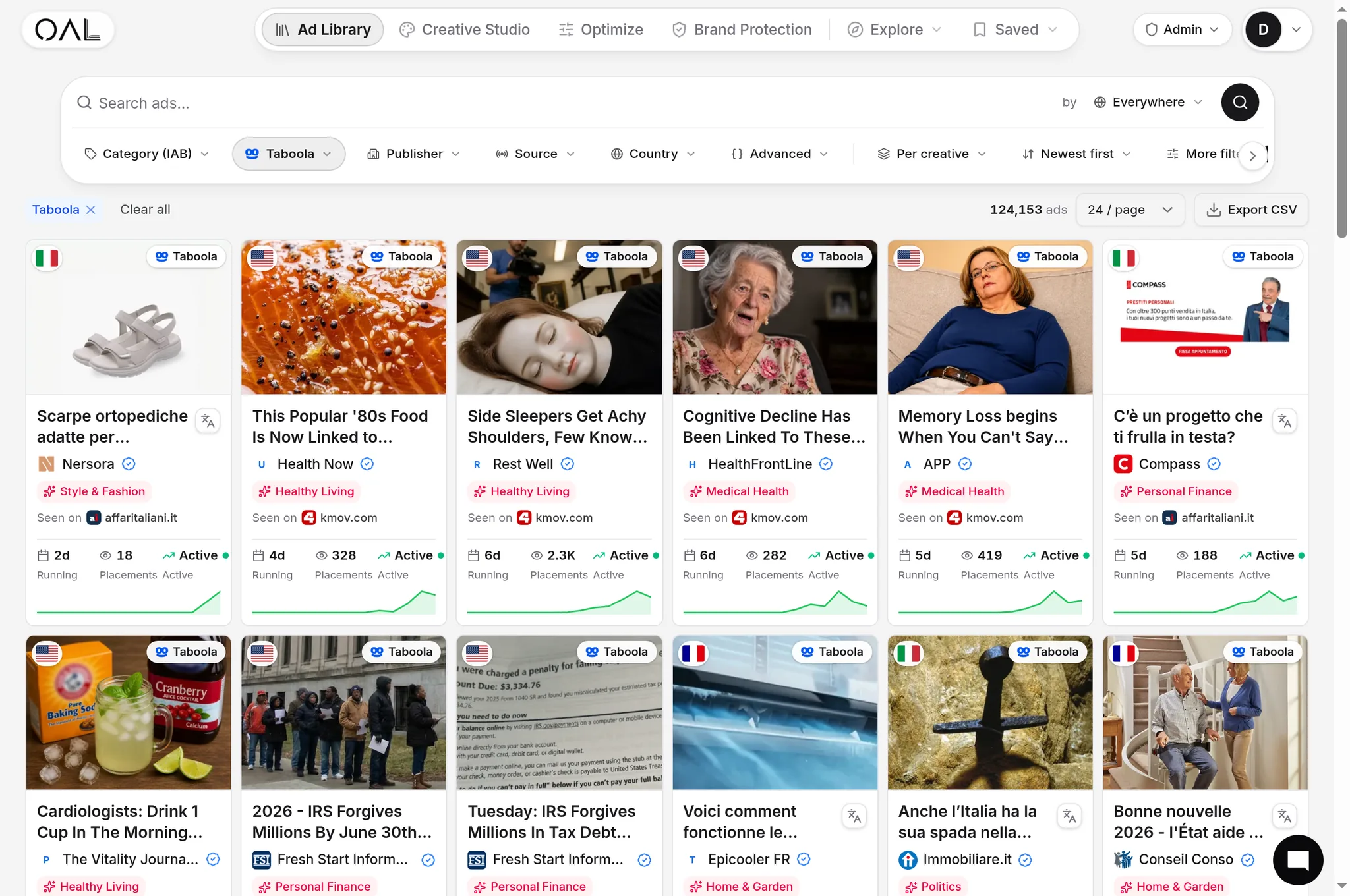
Don't guess at angles from a blank page. The fastest way to learn what a feed rewards is to study creatives that are already winning. Because OpenAdLibrary captures the real creative image at full quality and records how long each ad has run, you can separate genuine winners (long-running, multi-publisher) from noise (a one-day test that never scaled). Pull the top thumbnails in your vertical, find the recurring patterns (framing, color, headline structure), and build your own variations instead of copying. Copy DNA and Creative Studio inside the platform exist for exactly this: deconstruct the pattern, then generate fresh executions.
One launch rule: ship volume on the creative side. Five to ten image and headline combinations per ad set on day one. Native algorithms need options to optimize between, and creative is where most of your early wins come from.
Step 3: Set the bid and let the algorithm learn#
Bidding is where new buyers panic and break their own campaigns. The core idea is simple: native networks run a native ad auction for every impression, and your bid plus the predicted click and convert rate decides whether you win. You're not just buying clicks. You're teaching an algorithm what a conversion looks like.
A sane launch sequence on a conversion-optimized network like Taboola:
| Phase | Bid strategy | Goal | What to watch |
|---|---|---|---|
| Launch (week 1) | Maximize Conversions / Smart Bid | Gather data fast, feed the algorithm | Clicks, click-through rate, early conversions |
| Learning (weeks 1-2) | Same, leave it alone | Let it exit the learning phase | Cost per conversion stabilizing |
| Control (week 2+) | Switch to Target CPA | Defend profitability | CPA vs. break-even, scale headroom |
Taboola's own guidance treats Maximize Conversions and Target CPA as sequential, not competing. You launch broad to collect signal, then tighten to a CPA target once the engine has data. The same logic applies on MGID and Teads with different button names.
Two rules keep you out of trouble. First, don't touch bids during the learning phase. Every meaningful change resets it. Give a campaign 3 to 5 days and a few hundred clicks before you judge it. Second, bid for placements, not the whole network. Native supply quality varies wildly by publisher. Your reporting will show some sites converting at 3x the average and others quietly burning budget. Block the wasters, bid up the winners. That single habit is most of native optimization.
A note on 2026 targeting: Google deprecated most Privacy Sandbox advertising APIs in late 2025, but native networks never leaned on third-party cookies. They bid on contextual and publisher-side signals plus your conversion pixel. That makes a correctly installed pixel and clean conversion events the real foundation of optimization, more than any audience setting. This is the same media buying discipline you'd apply on any programmatic advertising channel. Native just wears it on its sleeve.
For the platform-specific walkthrough (account structure, conversion setup, the first campaign click by click) follow how to advertise on Taboola.
Step 4: Follow the click past the thumbnail#
Here is what most beginner guides skip. The ad is only the top of the funnel. After the click comes the pre-lander (an advertorial that builds the case) and then the offer page. A great creative pointed at a weak funnel loses money. A mediocre creative on a tuned funnel can win. Studying competitors at the creative level alone is half a picture.
You need to see the whole path. OpenAdLibrary traces each captured ad to its destination, the pre-lander and the landing page, without ever clicking the live ad, so you can study a competitor's complete funnel: the advertorial angle, the offer presentation, the call to action. That's how we've traced 926,259 landing captures so far. Pair the funnel with the longevity signal and you're not guessing whether something works. You can see it's been live and spreading for weeks.
About that longevity signal, and an honest caveat. Affiliate lore loves to talk about "90-day winners," and as a general industry heuristic that's fine. But that is not our measurement. Our continuous-observation window currently spans up to about 28 days per creative, and the ads pinning that ceiling tell a clear story. SmartAsset has been running "Ask a Pro: How Can I Avoid Paying Taxes on IRA Withdrawals?" on Outbrain for 28 straight days. Hidden Hearing has held two separate hearing-aid creatives at 28 days on the Microsoft Audience Network. "My IQ" is running half a dozen IQ-quiz variants, all pinned at our 28-day ceiling (OpenAdLibrary index, June 2026). When a single advertiser keeps the same hook alive that long and floods it with variants, that is the market telling you the funnel behind it converts.
The home and finance verticals show the same persistence. This solar-battery angle had been live 27 days when we logged it:

When you reverse-engineer a funnel, map it end to end. The ad creative is the hook that earns the click. The pre-lander is the story that reframes the reader's problem. The offer page is where the conversion mechanics live: price anchoring, scarcity, form length. Rebuild the structure, not the copy. Originality is an ethics and compliance requirement, and increasingly a performance one, since duplicate funnels get flagged and fatigue faster.
Step 5: Scale without killing ROI#
Once a campaign is profitable and out of the learning phase, scaling is a discipline, not a button. There are two distinct axes, and confusing them is how buyers blow up a winner.
Vertical scaling means pushing more budget through the same proven campaign. Do it in steps of roughly 20 to 30% every two to three days. Larger jumps re-trigger the learning phase and spike your CPA while the algorithm re-calibrates. You pay a tax for impatience.
Horizontal scaling means duplicating the winner into new surfaces: fresh placements, new devices, additional geos, or a sibling network. Because each duplicate starts its own learning, horizontal expansion grows volume without destabilizing the original campaign, which is why experienced buyers lean on it. The deep dive on choosing between them is horizontal vs. vertical scaling in native media buying, and the broader profit-protection framework is in how to scale affiliate campaigns without killing ROI.
A practical scaling order for a proven winner:
- Bump budget on the existing campaign by ~25%. Wait 72 hours. Repeat while CPA holds.
- Duplicate to new devices. A desktop winner is often untested on mobile, and vice versa.
- Duplicate the same offer onto a second network. If it won on MGID, the proven angle is a strong bet on Taboola's premium supply.
- Expand into adjacent geos. The cheapest growth often hides in Tier-2 and Tier-3 markets where competition (and CPCs) are lower. Scaling to new geos covers how to find them.
Geo expansion isn't theory. We see the same angle hop borders constantly: a "Real" life-insurance ad localized for Australia ("Australians looking for life insurance should read this"), a Honda City auto creative running in India, UK card-machine offers pinned at 28 days on the Microsoft Audience Network. The proven hook travels; the localization is the work.
Throughout, keep cutting. Scaling and pruning happen at the same time. Every few days, block underperforming placements, pause dead creatives, and reallocate to the survivors. A scaled campaign is a constantly weeded garden, not a set-and-forget machine.
Putting the loop together#
Run the four steps as a cycle, not a checklist.
- Offer: mass-market, story-friendly, payout that survives the click. Validate with longevity data before you spend.
- Creative: 5 to 10 native-feeling combos at launch, patterned on proven winners, executed originally.
- Bid: launch on Maximize Conversions, hold through learning, switch to Target CPA, optimize at the placement level.
- Scale: vertical in ~25% steps, horizontal across devices, networks and geos, prune relentlessly.
The buyers who win at native aren't guessing. They're reading the market. Live competitive data tells you which offers have legs, which creatives are sustaining spend, and what the full funnel behind a winning ad actually looks like. That is the entire premise of OpenAdLibrary: an open, affordable view of live native advertising across Taboola, Outbrain/Teads, MGID, Revcontent and more. The real advertiser behind each ad, the creative at full quality, and the click traced to the landing page, for $29.99/mo instead of the $80 to $400/mo the legacy spy tools charge. Start free and browse 200 ads with no card to see what's working in your vertical right now.